Cheniere Energy Ramps Up Lobbying on LNG Exports
Cheniere Energy intensifies Capitol Hill lobbying on LNG exports amid tariffs and tax changes. Discover the industry's key policy priorities.
Get the latest as our experts share their insights on global energy policy.
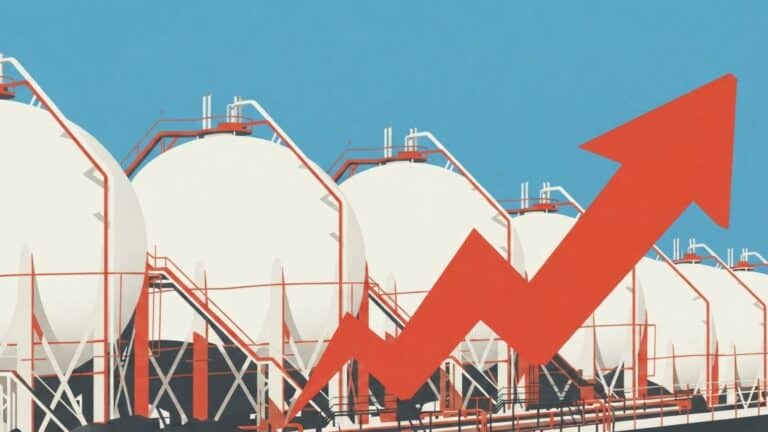
Amid the surge in US gas demand coming from LNG exporters, there is a lack of equivalent new working gas storage capacity in the US.
Hear in-depth conversations with the world’s top energy and climate leaders from government, business, academia, and civil society.
It started last year as a pressure campaign at sea, with the United States seizing tankers as part of what President Trump called a “total and complete blockade”...

Find out more about our upcoming and past events.
Join industry leaders, innovators, employers, and emerging talent for an evening exploring the technologies, trends, and career opportunities shaping the future of climate tech.

Insights from the Center on Global Energy Policy

This Energy Explained post represents the research and views of the author(s). It does not necessarily represent the views of the Center on Global Energy Policy. The piece may be subject to further revision. Contributions to SIPA for the benefit of CGEP are general use gifts, which gives the Center discretion in how it allocates these funds. More information is available here. Rare cases of sponsored projects are clearly indicated.
When the One Big Beautiful Bill Act (OBBBA) was enacted one year ago, a widespread reading was that US power-sector decarbonization advanced by the Inflation Reduction Act (IRA) had been derailed. Whether that verdict holds is an empirical question, not a rhetorical one. A year on, the effect of the OBBBA—and other climate policy rollbacks—deserves a measured accounting of how much of the climate benefits from the prior policy environment’s trajectory actually survive and what gap that leaves toward meeting clean electricity goals. For policymakers, investors, and analysts weighing what comes next, that is the core question.
The author recently published a report with MIT CEEPR providing such an accounting of power sector decarbonization, conducted with Energy Innovation’s Energy Policy Simulator. Measured against the IRA trajectory over 2025–35, the model shows the OBBBA scenario preserves 74% of new clean capacity and 67% of emissions reductions in the power sector (see Figure 1)—demonstrating that most of the prior path is sustained versus experiencing a total collapse. The author compares the prior and current policy environments to answer questions about what the rollback left intact and what would close the gap that remains.

The analysis compares two policy environments: the “IRA trajectory,” defined by the IRA and power plant regulations, and the “OBBBA scenario,” defined by the OBBBA without those regulations. It sets a bar—testing if at least 50% of the IRA trajectory’s clean electricity benefits are preserved in the OBBBA scenario and fossil outcomes no more than 50% higher—and finds they are met across all metrics and technologies except for onshore wind. Coal retires more slowly while existing gas supply stays level and generates more electricity to fill the clean shortfall.
Indeed, policy changes through the OBBBA will raise prices, cancel projects, cut jobs, limit the energy added to the grid, and more—losses that are real and already underway. But the report’s findings reduce the doom narrative that followed the OBBBA’s enactment, showing that the transition slows but is not kneecapped, while acknowledging the pressing priority to close the gaps. The result matters because it suggests that the next era of policy could seek to be additive to existing policy rather than try to fully restore what was lost.
Energy Innovation’s model ran two scenarios under its fixed assumptions on technology costs, demand, and supply-side restrictions. These assumptions translate to the economics of clean firm energy projects not becoming viable before 2035.
While three real-world observations, each bearing on a different part of the comparison, don’t all individually lead to the conclusion of a less dire OBBBA impact, on balance they strengthen that finding.
Two policy levers changed from the IRA trajectory to the OBBBA scenario: clean tax credits, which incentivize clean energy buildout, were pared back and power plant regulations, which shape the fossil fleet’s size and composition, were rescinded. The IRA trajectory’s deepest emissions cuts stemmed from regulations that would have induced an accelerated retirement of coal power plants. And a weaker set of clean energy tax credits translates to less clean energy added to the grid. Rather than constructing fossil capacity to compensate, though, the OBBBA scenario’s existing fossil supply flexibly generates more energy. The power sector thus becomes more fossil- and emissions-intensive in today’s policy environment.
Clean capacity additions can serve new load while existing fossil supply and thus total emissions remain the same. Whether a new clean megawatt-hour pushes a fossil one off the grid depends on the new capacity’s cost-effectiveness, local load growth, and if it can provide fossil’s reliability services. Variable wind and solar, even with four-hour batteries, cannot fully replace the on-demand capacity the grid relies on. Clean buildout that offsets emissions that could have been met by fossil supply is known as shallow decarbonization; while clean buildout that mitigates existing emissions is deep decarbonization. The latter is mainly achieved through deploying clean firm technologies such as geothermal, nuclear, and prospectively clean hydrogen and fusion.
First, permitting reform raises the ceiling on how much energy gets deployed overall. Renewables are more exposed to permitting processes than fossil fuels because they require more construction of new infrastructure (i.e., transmission lines) and they make up about 95% of the interconnection queue.
Second, shortening build timelines gets clean energy onto the grid faster, when it’s needed. When on-grid timelines are too slow, data centers instead pay a premium for faster and often more emission-intensive behind-the-meter gas. Accelerating on-grid connection makes that gas less attractive and lets clean energy compete for new demand.
The grid needs energy capacity available on demand to function and be reliable. Within the category of firm power, gas is the only new power that is cost-competitive at commercial scale today. Cheap gas aids decarbonization by supporting deeper penetration of variable renewables and lowering the cost of electrification. That supply can be managed rather than blocked.
Four measures Congress could pass, generally backed by the oil and gas industry, would help reduce the emissions intensity of the power sector: restoring the methane rule that limits methane emissions from oil and gas operations, expanding the carbon capture tax credit, reinstating the Greenhouse Gas Reporting Program that requires large emitters to report on greenhouse gas emissions, and establishing product-level carbon-intensity standards.
A single action: building. The clean gap closes by building more of the renewables and storage that compose the entire modeled shortfall. The emissions gap closes by building the clean firm capacity—such as geothermal and nuclear—that eventually sees fossil fuel plants retire. Because the fossil fleet’s size is sticky, out-building its utilization is the only path to decarbonization.
Doubling the grid is table stakes for that build—and for the economic growth, technological competitiveness, and national security that ride on it. Grid-enhancing technologies, demand response, and virtual power plants make the existing grid more efficient and could be pursued immediately. However, their impact would still be minuscule compared to the scale of buildout required to meet energy demand, decarbonize the grid, and fuel economic prosperity.
The IRA was not pressure-tested for today’s conditions: cost-of-living politics, massive demand growth from data centers and electrification, sharpened competition over supply chains and innovation, and a strained fiscal space. Against that backdrop, affordability, reliability, competitiveness, national security, and fiscal responsibility are not trade-offs against decarbonization but preconditions that climate policy must meet to survive. The surest route to decarbonization is the one that is politically viable and durable. Restoring the prior environment would not, on its own, meet the new priorities of today.
The US Secretary of Energy Chris Wright has directed the Federal Energy Regulatory Commission to make a rule that would help rapidly move electricity onto the US grid in large amounts.

AI’s growing power demand has received enormous attention in recent months. In many places, the lack of power supplies is an important constraint on the growth of data centers to train and run AI models.
Kenya and South Africa have recently started moving toward an open access regime in their electricity sectors, while the US and India have been on this path for over two decades.

The rapid expansion of AI has raised concerns about whether and how this new technology may impinge on the ability of the US to meet its zero-carbon electricity goals.