This website uses cookies as well as similar tools and technologies to understand visitors’ experiences. By continuing to use this website, you consent to Columbia University’s usage of cookies and similar technologies, in accordance with the Columbia University Website Cookie Notice.
The work of scientists and researchers deserves celebration, but solid climate, energy, and technology breakthroughs need costly infrastructure and sustained funding to scale. Relying on private philanthropy like the Bezos Fund for climate research says a lot about this country’s expressed values while laying a fragile foundation for our industry’s future.
Permitting reform—to allow for faster approvals on new projects—is one thing that both climate advocates and energy developers have wanted for a long time. With demand for power...
The Center on Global Energy Policy at Columbia University SIPA invites students to join us for an engaging roundtable discussion on sustainable finance with Jacqueline Ricciani, Managing Director,...
Event
• Columbia SIPA
About Us
We are the premier hub and policy institution for global energy thought leadership. Energy impacts every element of our lives, and our trusted fact-based research informs the decisions that affect all of us.
This white paper represents the research and views of the authors. It does not necessarily represent the views of the Center on Global Energy Policy. The piece may be subject to further revision.
Contributions to SIPA for the benefit of CGEP are general use gifts, which gives the Center discretion in how it allocates these funds. More information is available at our Partners page. Rare cases of sponsored projects are clearly indicated.
Key Takeaways
Power grid enhancement solutions—including grid-enhancing technologies (GETs) such as dynamic line ratings, advanced power flow control devices, and advanced conductors, along with modern control automation—can unlock substantial additional transmission capacity from existing infrastructure, often at a fraction of the cost of building new infrastructure and in months rather than years.
Deployment remains limited due to a misalignment between utility incentives and business models, data access barriers, and regulatory structures that financially reward capital-intensive investments over operational efficiency.
To address these obstacles, three near-term actions include advancing performance-based regulation, strengthening public power mandates for improved grid utilization, and modernizing planning processes.
Sustained leadership from C-suite executives, boards, regulators, and other key stakeholders, along with clear articulation of the value proposition of grid-enhancing solutions, can help expedite the changes needed to unlock near-term deployments that can play a critical role in meeting growing electricity demand.
Introduction
The US electricity grid faces considerable challenges. After decades without growth, electricity demand is surging, driven by energy-hungry data centers, new energy-intensive manufacturing facilities, and the increasing electrification of transportation and heating. At the same time, extreme weather is straining aging infrastructure, and the grid is tasked with integrating record levels of intermittent renewable energy that is often located far from population centers. These pressures are contributing to higher prices and increasing concerns across the country about energy affordability.
In the face of these challenges, the country’s transmission system is under increasing strain. Much of the US transmission network is decades old and beyond its intended useful life. Transmission congestion—where power lines lack sufficient capacity to deliver cheaper electricity from where it is produced to where it is needed—is a costly problem, raising customer bills through congestion charges and local price impacts while leaving needed new generation stuck in interconnection queues. New high-voltage lines are part of the solution, but building transmission lines is expensive and frequently delayed by siting and permitting challenges, community opposition, and disputes between jurisdictions over cost allocation.
One potential near-term strategy to boost capacity, improve reliability, and relieve bottlenecks is to better optimize existing grid infrastructure.[1] Available commercially viable solutions could unlock hundreds of gigawatts (GW) of additional transmission capacity within three to five years,[2] reducing operational costs and per-Megawatt-hour (MWhr) transmission costs while increasing energy delivery to meet rising demand.[3]
What Technology Solutions Exist
Many technologies that increase existing transmission capacity are commercially ready today and market uptake is growing, but significant barriers to widespread deployment remain.[4] While few independent evaluations of these technologies exist, pilot project reports suggest they can unlock substantial additional capacity and deliver measurable consumer savings by deferring or avoiding new infrastructure.
This white paper analyzes select solutions based on their demonstrated track record of field deployment. Implemented at scale, these solutions can effectively complement other sources of flexibility, including investments in generation, distributed energy resources, advanced management and control systems, and storage.
Solutions deployed at scale today
Dynamic Line Ratings (DLR): Transmission lines are typically operated using a static, single line rating, based on conservative extreme weather assumptions, to ensure safe and reliable operation under virtually all adverse conditions. DLRs, by contrast, rely on real-time weather data and line sensors to calculate how much electricity a transmission line can safely carry at any given moment. For example, on cold, windy days, DLRs may detect that lines can safely carry more power and adjust allowable capacity accordingly. In doing so, they harness existing but underutilized capacity constrained by static, conservative operating practices while providing cleaner energy.[5]
The UK’s transmission operator, National Grid, deployed DLR technology across 275 kilometers of transmission lines, reporting to regulators that the upgrade enabled the system to serve approximately 75,000 additional homes annually and deliver an estimated £20 million per year in consumer savings through reduced electricity costs.[6] Similarly, Belgium’s transmission operator, Elia, systematically deployed DLR technology across its network, and its DLR provider reported that the installations increased transmission capacity by an average of approximately 30 percent more than static line capacity over 90 percent of the time.[7]
In the United States, PPL Electric Utilities in Pennsylvania became the first major utility to integrate DLR into its grid operations. The company reports decreases in transmission line congestion of up to 65 percent on monitored lines and savings of over $50 million in transmission congestion costs.[8] Others have also deployed this solution with significant cost-benefit impacts.[9]
Advanced Power Flow Control: This solution uses smart switches to automatically redirect electricity away from congested transmission lines to less-used parallel routes, much like a GPS reroutes traffic around highway congestion. Utilizing the suite of Flexible AC Transmission System (FACTS)devices, advanced power flow control systems continuously adjust to real-time grid conditions, maximizing the amount of power the existing transmission network can carry.[10] By adjusting electrical conditions on a transmission line in real time, FACTS devices have been shown to increase the amount of power that can safely flow and direct electricity toward preferred paths.[11]
Phase shifting transformers (PSTs) provide a similar capability by using specialized equipment to control the direction and distribution of electricity across the grid. PSTs can prevent unwanted “loop flows” where power takes inefficient or congested routes, increase transfer capability, and relieve bottlenecks.[12] Both FACTS and PSTs are commercially mature with increasing market adoption, particularly in fast growing economies.[13]
National Grid has deployed advanced power flow control technologies in the United Kingdom to relieve transmission congestion, including on corridors affected by constraints between wind power generated in Scotland and demand centers in London. According to the utility, these solutions made available 2 GW of additional transmission capacity, enough to power roughly two million homes, and saved customers £390 million over seven years by reducing the need to curtail cheap renewable energy or build expensive new transmission lines.[14]
The integrated use of these solutions can enhance grid flexibility, allowing improved asset optimization at lower operation costs, increasing power throughput, and thereby increasing transmission-based revenues.[15]
Small scale pilots with growing momentum
Advanced Conductors: This solution replaces the steel core in traditional power lines with lightweight, high-strength carbon fiber composite materials.[16] These next-generation cables can carry up to twice the electricity of conventional lines while maintaining the same physical size and weight, allowing utilities to increase transmission capacity without building new towers or widening rights-of-way.[17]
Pilot projects suggest that this increased capacity can be achieved in a much shorter timeframe than new grid expansion—several months to a year vs 10–15 years. For example, Southern California Edison and American Electric Power have reconductored hundreds of miles of transmission lines in California and Texas, respectively. According to the conductor manufacturer, the California project increased line capacity by over 40 percent and the Texas project nearly doubled line capacity.[18] National analysis indicates potential savings of $180 billion by 2050 if advanced conductors were strategically deployed. These savings would come through transmission cost reductions, eased congestion, and access to low-cost generation.[19]
Topology Optimization: This solution uses software to identify the optimal configuration of transmission circuits, rerouting electricity around congested lines by strategically opening or closing circuit breakers. Whereas advanced power flow control devices actively regulate how much power flows across a given line, topology optimization avoids congestion by reconfiguring the grid to change which lines are connected. It requires no new infrastructure and typically can be implemented within months.
Case studies have shown that, as part of a portfolio of advanced grid solutions, topology optimization can help power systems manage the growing complexities of additional variable renewables, distributed resources, flexible loads, and transmission network configurations.[20]
The Midcontinent Independent System Operator (MISO) in the United States recently began allowing market participants to use topology optimization software to identify beneficial grid reconfigurations for its evaluation and approval. According to one developer of topology optimization tools, a single reconfiguration produced over $57 million in congestion-related cost savings.[21] Potomac Economics, MISO’s Independent Market Monitor, has recommended broader use of topology optimization to automatically identify opportunities to reroute power around congested lines, rather than relying solely on the utility’s manual proposals.[22]
Integrated Solutions
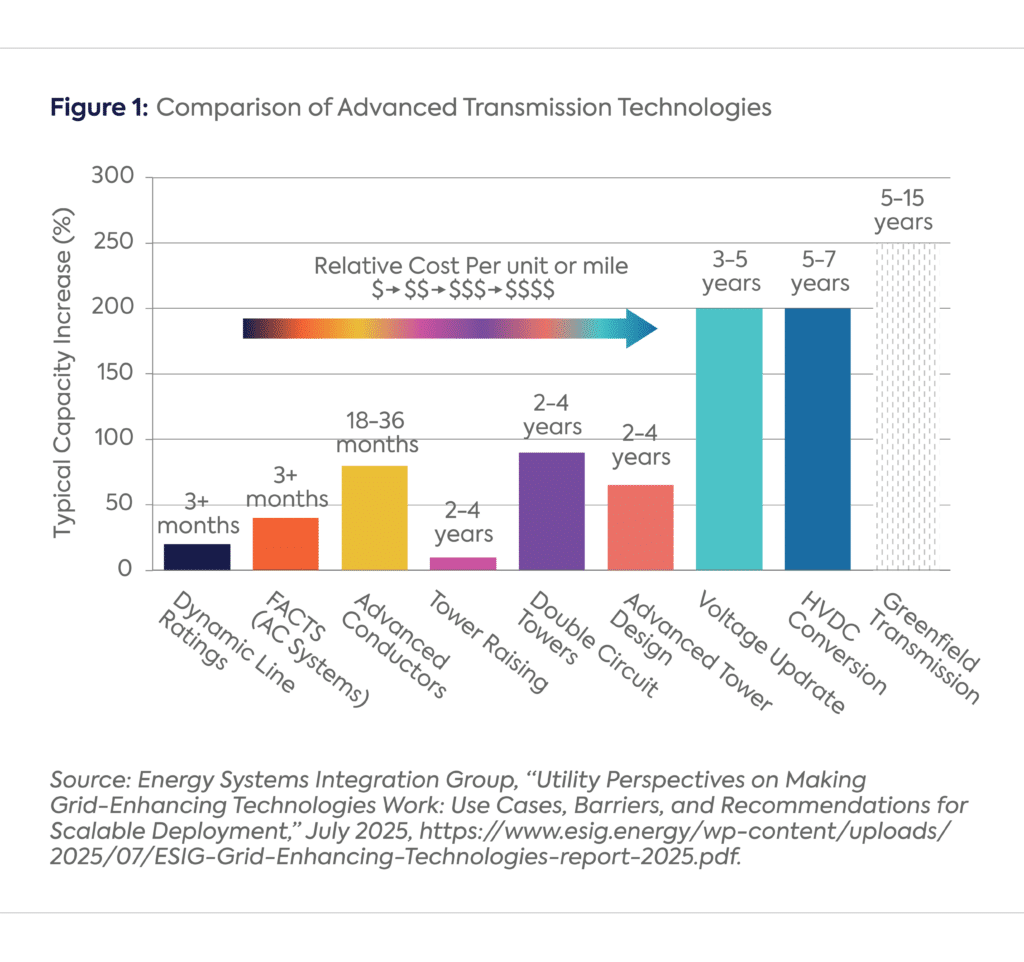
Integrated deployment of multiple advanced grid efficiency solutions simultaneously provide valuable capabilities that, together with others sources of flexibility, can address growing system complexity by increasing spatial and temporal flexibility within the transmission network.[23] As shown Figure 1, their potential as near-term solutions lies in their relative effective capacity increases and shorter deployment timelines, though a balanced portfolio of solutions also includes longer term, larger capital investments in transmission expansion. [24]
Why These Technologies Are Not Being Deployed at Scale
Given that most of these solutions are technologically mature with an increasing portfolio of often highly cost-effective use-cases, the natural question is why deployment remains limited. While any new technical solution will face multiple barriers to deployment,[25],[26] we focus on four factors that, if addressed, could significantly unlock grid-enhancement solutions in the near term.
Misaligned incentives: Utilities earn regulated returns from building new infrastructure, but not from operational efficiency improvements.
Data access restrictions: Limited access to transmission system data constrains third-party vendors and startups from identifying and proposing solutions.
Conservative risk postures: Grid operators often prioritize risk minimization and operational certainty over the adoption of new technologies.
Resource constraints: Utility engineering and planning staff are frequently stretched managing day-to-day operations, leaving them with limited capacity to evaluate and implement innovative tools.
Misaligned incentives: A fundamental barrier to adoption stems from how transmission-owning utilities earn returns under traditional cost-of-service regulation. Utilities maximize shareholder earnings by investing in capital assets, earning regulated returns of about 9–11 percent annually, rather than pursuing operational solutions that could lower costs for consumers but do not yield comparable returns.
This misalignment is especially pronounced because transmission owners do not bear the primary costs of grid congestion. [27] In recent years, congestion costs have ranged from $5 to $20 billion[28] per year nationwide. These costs flow through wholesale electricity markets to generators and ultimately to consumers. As a result, utilities often have limited financial incentive to deploy technologies that alleviate congestion, even when those technologies could deliver superior customer value and improve overall system efficiency.
Data access restrictions: Vertically integrated transmission-owning utilities control proprietary operational data—including historical congestion patterns by line segment, static and dynamic line ratings, power transfer distribution factors, and interconnection-driven upgrade costs—that are essential for modeling the effects of new technologies and, in turn, demonstrating their benefits. But the utilities have not made this data available to technology vendors, often creating an insurmountable barrier to market entry and informed procurement decisions. This information asymmetry reinforces incumbent utility control over technology deployment decisions.
Conservative risk postures: Transmission system operators tend to exercise caution when evaluating new technologies, based on legitimate concerns about grid reliability and the potentially severe consequences of blackouts to their careers, organizations, and society. Traditional transmission planning processes are designed around conservative assumptions and proven technologies with decades of operational history. Even mature technologies with extensive international deployment, such as dynamic line ratings deployed across National Grid’s UK system, face skepticism in conservative utility planning cultures that systematically prioritize avoiding failures over capturing efficiency gains.
Regulatory frameworks exacerbate this conservatism by requiring utilities to demonstrate technical and economic “need” for investments but not requiring systematic evaluation of lower-cost alternatives to meet identified needs. This regulatory gap has encouraged utilities to defer deploying advanced grid technologies in favor of proven approaches with clearer permitting and cost recovery pathways. FERC Order 1920, adopted in 2024, was the first federal mandate requiring transmission planners to consider new technologies as alternative solutions to traditional wires investments.[29] PJM and other independent system operators have begun to establish compliance mechanisms for FERC Order 1920, making improvements in long-term planning.[30]
Resource constraints: Utility engineering and planning staff are frequently stretched thin managing day-to-day operations, processing large interconnection queue backlogs, and executing capital projects.[31] Even when new technologies offer favorable economics, they compete for limited technical and managerial attention with projects that have established regulatory pathways, familiar solutions, and embedded organizational support.
At the same time, utilities face demands from federal and state policies, including clean energy integration, grid resilience, extreme weather hardening, and interconnection backlog relief. These pressures are particularly acute for smaller utilities that lack dedicated innovation teams or in-house capacity to pilot and scale emerging technologies.
What Can Be Done to Relieve These Constraints:
Expanding the use of advanced grid technologies requires more than proving they work. It will take clear rules and new incentive structures for utilities.
The following three solutions could promote faster and wider deployment.
Performance-based incentives for utilities: Although utilities are typically incentivized to invest in large, capital-intensive infrastructure, electricity policy experts have long argued[32] for shifting toward performance-based regulation where utility earnings are linked to outcomes such as lower system costs, improved reliability, and cleaner generation. The United Kingdom and Australia have moved in this direction,[33] but adoption in the United States has been limited.[34]
At least one proposed federal law–H.R. 2073, the Advancing Grid Enhancing Technologies Act of 2025[35]–would direct FERC to establish incentive-based rules to accelerate deployment. Because federal authority over utilities is limited, however, sustained, large-scale deployment will require complementary actions by regional and state regulators.
“Price-cap regulation” has been proposed as an alternative approach. Under this strategy, regulators would set a multi-year cap on the prices a utility can charge for transmission—rather than guaranteeing a return on invested capital—thereby strengthening incentives for the utility to improve operational efficiency and reduce costs, because it retains any savings achieved below the cap.[36]
Public power mandates: Although federal and state regulators have emphasized that advanced grid technologies can reduce costs and increase grid capacity, adoption has often lagged in the absence of explicit direction.[37] For publicly owned utilities (federal, state, and municipal), which are not motivated by shareholder returns like their private counterparts, mandating systematic evaluation of grid-enhancing technologies alongside conventional upgrades, and requiring deployment when they are the least-cost solution, can help overcome institutional inertia. Then, well-documented successes within public systems can serve as proof points for broader reform, particularly as regulatory incentives for investor-owned utilities evolve. Pairing such requirements with targeted technical assistance and federal funding would ensure that smaller public utilities also have the capacity and confidence to implement these technologies effectively.
Planning requirements: Advanced grid technologies can be systematically incorporated into formal grid planning processes, requiring regional planners and utilities to evaluate them as part of transmission expansion plans and interconnection studies and to publicly report where deployment could reduce congestion costs or defer capital investments.[38] If planners and regulators could quantify how much congestion relief, cost savings, or capability expansion is foregone under conventional approaches compared to integrating grid enhancing technologies, it would become more difficult to justify business-as-usual planning. Over time, this visibility can help build political and public support for incentive reforms and targeted mandates.
Sustained Leadership: Advancing these solutions will require sustained leadership and structured dialogue across power sector stakeholders—including corporate executives, utility managers, regulators, policymakers, academics, financiers, and technology providers—to rigorously assess the technical potential, economic costs and benefits, and institutional barriers, and to develop creative and practical approaches to overcome constraints. Given the wide range of affected constituencies—from residential, commercial, and industrial customers to independent power producers, virtual power plant providers, grid operators, and regulators—well-structured, multiparty processes will be essential to building consensus and accelerating implementation at scale.
About the Authors
Dr. Douglas J. Arent is a Global Fellow at the Columbia University Center on Global Energy Policy and a Distinguished Fellow of the World Economic Forum. Dr. Arent brings more than three decades of experience and expertise in energy systems, electric power, and international energy policy.
Dr. Arent is Emeritus Executive Director at the NREL Foundation and holds emeritus status at the National Laboratory of the Rockies (previously the National Renewable Energy Laboratory), where he served for nearly thirty years. During his term, he was a member of the laboratory’s senior leadership team and helped guide its growth to an annual budget exceeding $1 billion.
He has served on numerous national and international advisory and study bodies, including committees of the National Academy of Sciences, the National Petroleum Council, and the Intergovernmental Panel on Climate Change.
He has authored more than 150 peer reviewed articles and is the author of Our Renewable Energy Future: The Remarkable Story of How Renewable Energy Will Become the Basis for Our Lives (World Scientific, 2024), which examines the technological, economic, and policy forces driving the global transition to renewable energy. His work has been published in Science, Nature Energy, Joule, and Energy Policy, among others.
He holds a BA from Harvey Mudd College, an MBA from Regis University, and a PhD from Princeton University.
Dr. Noah Kaufman is an economist who has worked on energy and climate change policy in both the public and private sectors. Noah is Senior Research Scholar at the Center on Global Energy Policy at Columbia University SIPA.
Under President Biden, Noah served as a Senior Economist at the Council of Economic Advisers. Under President Obama, he served as the Deputy Associate Director of Energy & Climate Change at the White House Council on Environmental Quality. At World Resource Institute, he led projects on carbon pricing, the economic impacts of climate policies, and long-term decarbonization strategies. Previously, he was a Senior Consultant in the Environment Practice of NERA Economic Consulting.
Noah received his BS in economics from Duke University, and his PhD and MS in economics from the University of Texas at Austin, where his dissertation examined optimal policy responses to climate change.
Lawrence Heath is a Non-Resident Fellow at the Columbia University Center on Global Energy Policy. In this capacity he focuses on the intersection of AI, energy, and geopolitics. Beyond the Center, Lawrence previously worked with former UK Prime Minister Tony Blair on energy policy and is currently an Associate Partner at McKinsey & Company. He began his career building geopolitical wargames for oil majors. Together, this experience provides him with distinctive knowledge across the full energy sector, spanning hydrocarbons to electrons, grounded in both business and political acumen. Lawrence holds degrees in Economics and International Relations, with concentrations in political economy and Chinese. He is a member of the Chicago Council on Global Affairs energy roundtable.
[3] Omid Mirzapour, Xinyang Rui, and Mostafa Sahraei-Ardakani, “Grid-Enhancing Technologies: Progress, Challenges, and Future Research Directions,” Electric Power Systems Research 230 (2024): 110304; Ali Q. Al-Shetwi et al., “Latest Advancements in Smart Grid Technologies and Their Transformative Role in Shaping the Power Systems of Tomorrow,” Progress in Energy 7 (2025): 012004.
[5] Nurul Husniyah Abas et al., “Optimizing Grid with Dynamic Line Rating of Conductors: A Comprehensive Review,” IEEE Access 12 (2024): 9738–9756, https://doi.org/10.1109/ACCESS.2024.3352595.
[10] Mengxia Wang, Ming Yang, and Xueshan Han, “Optimal Power Flow Considering Transient Thermal Behavior of Overhead Transmission Lines,” International Journal of Electrical Power & Energy Systems 114 (2020): 105396, https://doi.org/10.1016/j.ijepes.2019.105396.
[11] Mohammad Tarafdar Hagh et al., “A Comprehensive Review of Flexible Alternating Current Transmission System (FACTS): Topologies, Applications, Optimal Placement, and Innovative Models,” Heliyon 11, no. 1 (2025): e41001, https://doi.org/10.1016/j.heliyon.2024.e41001.
[12] Ming Yu et al., “Power Flow Optimization and Economic Analysis Based on High Voltage Phase Shifting Transformer,” Energies 15, no. 7 (2022): 2363, https://doi.org/10.3390/en15072363.
[19] Emilia Chojkiewicz et al., “Accelerating Transmission Capacity Expansion by Using Advanced Conductors in Existing Right-of-Way,” Proceedings of the National Academy of Sciences 121, no. 40 (2024): e2411207121, https://doi.org/10.1073/pnas.2411207121.
[23] Jia Li et al., “Grid-Side Flexibility of Power Systems in Integrating Large-Scale Renewable Generations,” Renewable and Sustainable Energy Reviews 93 (2018): 272–284, https://doi.org/10.1016/j.rser.2018.04.109.
[26] Bipartisan Policy Center, Unlocking the Potential of Grid-Enhancing Technologies.
[27] Dasom Ham, Oliver Kay, and Catherine Hausman, “Transmission Lowers U.S. Generation Costs, but Generator Incentives Are Not Aligned,” Proceedings of the National Academy of Sciences 123, no. 9 (2026): e2524463123, https://doi.org/10.1073/pnas.2524463123.
[28] Grid Strategies, Transmission Congestion in the U.S.
[32] Paul L. Joskow, “The Expansion of Incentive (Performance-Based) Regulation of Electricity Distribution and Transmission in the United States,” Review of Industrial Organization 65 (2024): 455–503, https://doi.org/10.1007/s11151-024-09973-x.
After decades without growth, electricity demand is surging, driven by energy-hungry data centers, new energy-intensive manufacturing facilities, and the increasing electrification of transportation and heating.
Data centers face growing local opposition as states impose moratoriums on hyperscale projects and grid connections. Communities can negotiate deals for tax revenue and jobs.