Bipartisan Senate group urges Trump to abandon plan to buy Russian diesel amid Ukraine war
A bipartisan group of six senators is urging President Donald Trump’s administration to abandon a plan to purchase diesel from Russia.
Get the latest as our experts share their insights on global energy policy.
Mandatory application review by the Advisory Committee on Reactor Safeguards (ACRS) reflects an earlier era, when the nuclear regulator lacked today’s permanent technical staff and nuclear promotion was...

Hear in-depth conversations with the world’s top energy and climate leaders from government, business, academia, and civil society.
Carbon credit markets have become one of the most hotly debated tools in the fight against climate change. Supporters call them essential to closing the gap between corporate...

Find out more about our upcoming and past events.
The Center on Global Energy Policy at Columbia University SIPA’s Women in Energy initiative invites Columbia University students to a roundtable discussion with Pam Brown, Managing Director at...

When Joey Harris first started covering energy in 2023 for the The Bismarck Tribune, his beat was North Dakota’s oil fields and the struggling carbon capture projects that never quite got off the ground there. Today he’s based in Indianapolis, covering state government and utilities. The places may have changed, he says, but the story hasn’t.
You’re still telling the same stories. Energy and climate are inseparable issues. You’re still going to touch on those. It’s unavoidable.

Harris was one of 20 journalists who gathered at the Center on Global Energy Policy (CGEP) at Columbia University SIPA this June for the 2026 Energy Journalism Fellows seminar. Marking the 10th anniversary, the fellowship has enrolled 200 journalists from around the world since launching in 2017. What brought him here was something specific: not more content to consume, but a room where you could engage with energy scholars and push back.
You can hear from experts on many different platforms, but here you can ask questions directly.
That distinction—access, not information—is what CGEP had in mind when it originally designed the program. Jason Bordoff, CGEP’s founding director, announced it in February 2017 with a simple premise: as the energy landscape grows more complex, the journalism covering it needs to keep pace. “High-quality energy journalism is key to ensure policymakers, business leaders, and the general public have the best information possible,” he said when announcing the 2026 cohort.
A decade later, the complexity has only deepened. Bill Loveless, who directs the program, put it plainly in his welcome remarks to this year’s cohort. “The questions you cover—about oil and gas, electricity, mining, climate, technology, affordability, geopolitics, and security—are also questions about economics, politics, public trust, and human well-being,” he said. “And these stories are becoming harder to cover.”
That tension is something fellows feel acutely. Stuti Mishra, Asia Climate Correspondent at The Independent, came to the program after noticing a shift in how her reporting was landing. She covers climate and energy from Delhi, India, and in recent years she’s watched the conversation around her work undergo fundamental changes.

“It’s more practical,” she said. “Readership-wise, energy stories do better. The news cycle has shifted to geopolitics, war, money, affordability. You can frame it more about economics and geopolitics. It helps broaden your scope.” She wasn’t suggesting the climate had lost its urgency. Rather, that energy had become the more navigable entry point for readers who might otherwise tune out.
What drew Mishra to EJF was the community. She had previously been part of a network of climate reporters through Reuters and found those peer relationships rewarding. The EJF program offered the same for energy. “Community keeps you going,” she said. “You’re connected to other people.”
Meghan Potkins, Alberta correspondent for The Logic, came for a different version of the same thing: the generalist view. Reporters can cover a lot of ground, she said, but there are niche technical points where a gap in knowledge—or a gap in contacts—can leave a story flat. The week at CGEP, away from filing pressure, was what she called “indulgent” in the best sense. Time to actually learn.
Catherine Cartier, a visual verification producer at Reuters based in Beirut, framed her work in starker terms. She uses satellite imagery and video documentation to cover conflict and energy simultaneously, and the two, she’s found, are rarely separable. “The war in the Middle East underscores just how much energy is the fundamental issue right now,” she said. “People care about it because they have to and they don’t have a choice.”
For the scholars who share their expertise with fellows over the four-day seminar, the program offers something too: a chance to understand how their work is used as source material and tell a story. Ira Joseph, a Global Fellow at CGEP who covers oil and gas markets, said the central challenge for journalists on this beat is holding complexity without losing the reader.
More accessible without making it shallow. A more sophisticated piece of analysis: contextualizing the facts, telling a story with numbers. It requires nuance.

But he also pointed to something more structural: the way certainty gets manufactured in energy coverage, often by sources with something to sell. Before 2005, he noted, conventional wisdom held that the US market was headed for a natural gas shortage. Then shale happened, and the entire projection collapsed. “Most people in industry are trying to sell an idea,” he said, “and they’re very often withholding on what could go wrong.” The questions he wishes reporters would ask more often are the ones that go against conventional thinking..
Loveless, for his part, is candid about what has and hasn’t changed over the past ten years. The curriculum’s fundamentals — markets, policy, finance, geopolitics — have held steady. What shifts year to year is the context: how conflicts are shaping supply chains, how elections are rewriting policy, what role AI is beginning to play in how energy systems are managed and reported on. “Ten years ago, many energy stories could be understood through a single lens,” he said. “Today, nearly every energy story seems to involve economics, politics, technology, security, and equity all at once.”
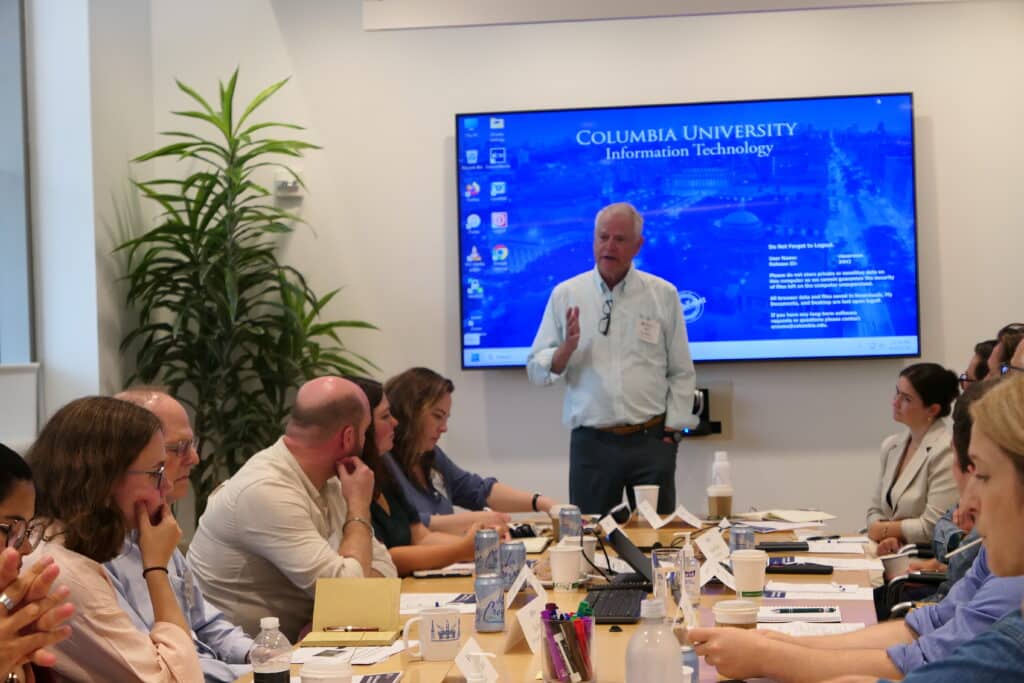
Dan Murphy of CNBC was covering the energy transition when he attended EJF in 2023. Three years later, he’s an anchor from the Middle East, and the issues have transformed around him. “In 2026, I’ve spent nearly five months covering energy as a weapon,” he said. The program, he said, gave him credibility in rooms where it matters. ” EJF helped me to get a real answer more often than a prepared one.”
When the Iran conflict began, Bordoff and Karen Young, a senior scholar at CGEP, both appeared on Murphy’s CNBC program, Beyond on-air expertise, the program built lasting connections: a group of EJF fellows still message one another when major stories break. “The fellowship gave me an instant network of people to share problems and ideas with, and it enhanced my reporting when I needed it,” said Murphy.

The 2026 cohort brought together reporters from outlets spanning Bloomberg, Reuters, the Associated Press, CNBC International, the Los Angeles Times, and a range of regional and independent outlets across the US, Canada, Latin America, and Asia. Applications for the 2027 cohort will open early next year. The program is free to journalists, including transportation and lodging for those who need it.
Harris, asked what drew him here after three years on the beat, returned to the same idea he’d started with: the ability to question out loud, in a room, with people who know more than he does about one part of a story he’s still learning to see whole.
There is a shift in thinking about systems. People are much more interested in learning about macro factors. Everything is energy.
Find more information on the Energy Journalism Fellows program here.
A bipartisan group of six senators is urging President Donald Trump’s administration to abandon a plan to purchase diesel from Russia.
President Donald Trump announced Friday that he had struck a deal with Russian President Vladimir Putin to immediately supply the U.S. more than 300,000 tons of diesel.
Donald Trump announced a deal with Vladimir Putin to supply additional Russian diesel amid global fuel shortages. The agreement outlines the potential supply of millions of tonnes of diesel in the coming months. However, concerns exist about Russia's ability to meet the promised volumes due to domestic limitations. Analysts suggest that any significant price relief in the U.S. may be unlikely in the current market.
The White House has just announced over $2 billion in new critical minerals, magnets, and battery investments.

Think tank indipendente per la transizione energetica e industriale dell'Italia