This website uses cookies as well as similar tools and technologies to understand visitors’ experiences. By continuing to use this website, you consent to Columbia University’s usage of cookies and similar technologies, in accordance with the Columbia University Website Cookie Notice.
The global order that shaped the past several decades is giving way to a more fragmented and uncertain world. Long-standing alliances are under strain, economic integration is giving...
We are the premier hub and policy institution for global energy thought leadership. Energy impacts every element of our lives, and our trusted fact-based research informs the decisions that affect all of us.
Please join the Center on Global Energy Policy (CGEP) and the Institute of Global Politics at Columbia University’s School of International and Public Affairs (SIPA) to mark the fiftieth anniversary of the 1973 Oil Embargo.
SIPA Dean Keren Yahri-Milo will provide welcome remarks, followed by a keynote address by Pulitzer Prize-winning author Dr. Daniel Yergin that will examine the historical significance of the Embargo.
We will then move to a panel discussion focusing on the details of the 1973 Oil Embargo—what happened, and how did it shake up geopolitics and the global economy? The panel will then examine the lasting effects—how it has guided policymakers in the decades since, and what lessons does it hold for the current precarious geopolitical situation? This event will provide an excellent opportunity to re-examine a pivotal moment in energy history, and one that continues to shape policymaking, in manners both subtle and obvious.
4:30-5:00 p.m. EDT – Check-in
5:00-6:30 p.m. EDT – Panel Discussion
Welcome Remarks:
Keren Yarhi-Milo, Dean, School of International and Public Affairs (SIPA), Adlai E. Stevenson Professor of International Relations, Columbia University
Keynote Remarks:
Daniel Yergin, Vice Chairman, S&P Global
Moderator:
Vijay V. Vaitheeswaran, Global Energy & Climate Innovation Editor, The Economist
Speakers:
Jason Bordoff, Founding Director, Center on Global Energy Policy; Professor of Professional Practice, Columbia SIPA; Professor and Co-Founding Dean Emeritus, Columbia Climate School
Ed Morse, Global Head, Commodities Research, Citibank
Meghan O’Sullivan, Director of the Belfer Center for Science and International Affairs, Harvard Kennedy School
Adnan Shihab-Eldin, Senior Visiting Research Fellow, Oxford Institute for Energy Studies
—
This event will be hosted in person in New York City and live-streamed via Zoom.
Advance registration is required. Upon registration, you will receive a confirmation email. The event will be recorded and the video recording will be added to our website following the event.
This event is open to the press, and registration is required to attend. For media inquiries or requests for interviews, please contact Natalie Volk ([email protected]). For more information about the event, please contact [email protected].
On February 28, the United States and Israel launched an attack on Iran, resulting in the deaths of Iranian Supreme Leader Ali Hosseini Khamenei and senior Iranian leaders...
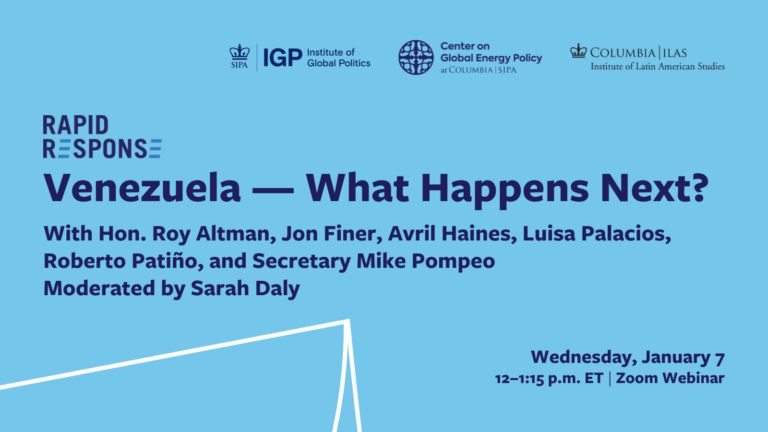
The recent military operation to remove Venezuelan President Nicolás Maduro and First Lady Cilia Flores raises several implications for the future of Venezuela and Latin America, geopolitics, and energy markets. Cosponsored by SIPA’s Institute of Global Politics (IGP) and Center for Global Energy Policy (CGEP), along with Columbia’s Institute of Latin American Studies (ILAS), this webinar will analyze the circumstances and impact of their capture and extradition to New York to face narcoterrorism and drug trafficking charges.
On October 22, the United States Department of the Treasury announced the imposition of sanctions on Russia’s two largest oil companies, Rosneft and Lukoil, as a penalty for what it characterized as a lack of Russian commitment to ending the war in Ukraine.
*Registration is closed for this event. The Center on Global Energy Policy at Columbia University SIPA's Women in Energy initiative, in collaboration with the Columbia Policy Institute, invites...
Event
• International Affairs Building,
Columbia SIPA
The oil shock triggered by the crisis in the Persian Gulf has pushed crude above $100 per barrel, reviving familiar fears of economic turmoil in the United States driven by surging gasoline and diesel prices.