Energy Markets Series: Half-Time Talk Weekly Feature Interview
Dr. Tatiana Mitrova, Research Fellow, Center on Global Energy Policy, Columbia UniversityTells Half-Time Talk GI Exclusive Interview: âEnergy Markets Pass th...
Get the latest as our experts share their insights on global energy policy.
Midterm voters gave Democrats control of both chambers of Congress and flipped governorships in states central to data center development.

Hear in-depth conversations with the world’s top energy and climate leaders from government, business, academia, and civil society.
Earlier this month, US voters handed Democrats control of both chambers of Congress and flipped several governorships across the country. The dramatic shift in power raises big questions...

Find out more about our upcoming and past events.
CGEP invites students to join a roundtable discussion with Cassady Walters, Vice President, Power, The Rockefeller Foundation.

Insights from the Center on Global Energy Policy
This post was originally published in the Montel October Geopolitical Report.
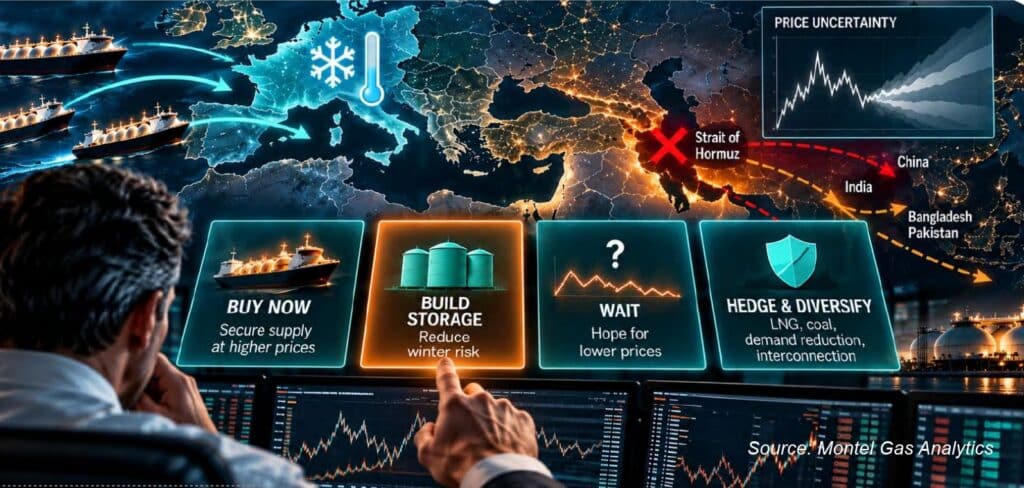
In early 2026, everyone was expecting a huge wave of LNG supply to begin having a significant impact on the global gas market, depressing prices and improving buyers’ options for gas supply. Instead, the world is facing a second energy crisis in five years. Unlike in 2022, this shock combines natural gas and oil/refined products, while the impact of the new Middle East conflict has merged with that of the ongoing war between Russia and Ukraine.
While most of the Gulf oil and LNG supplies traditionally went to Asia, Europe is also heavily impacted due to its high dependency on oil and gas imports. Having imported less LNG than in 2025, the EU is starting winter with low storage levels.
After seven months of the conflict, we are now used to looking at the Strait of Hormuz in binary terms – it is either closed or open. There is a Schrödinger-like twist in this binary approach though: as a few cargoes manage to go through with their transponders off, we only know whether they have crossed once they reappear somewhere between the Gulf of Oman and Indonesia. Since the conflict began, fewer than 50 LNG cargoes (totalling over 4 bcm) from Qatar and the UAE have crossed the Strait of Hormuz and reached Asian countries, while Qatar delivered most of its LNG exports (~6 bcm) inside the Gulf.
Consequently, the world has already lost around 54 bcm LNG passing through the Strait. While this has been partially compensated for by higher LNG exports from other producers, lower gas demand (achieved either through demand destruction or gas-to-coal switching) has also played a role, as well as a slower refill of EU gas storage induced by lower LNG imports.
As time has gone by, the potential reopening date has been progressively pushed back. For the upcoming winter, it’s probably still appropriate to continue looking at the Strait in such binary terms despite a small number of Qatari LNG cargoes dashing through the Strait in the last two weeks of September. Despite hopes that peace discussions during the UN General Assembly in New York could result in a phased path out of the conflict and Tehran reopening the Strait of Hormuz, no such breakthrough occurred, even though negotiations continue. President Trump himself mentioned that a peace deal might be concluded only after the midterms. After so many false starts and dashed hopes, it now seems unlikely that Gulf LNG exports will fully recover before the end of 2026, implying that the total disruption of Qatari and Emirati LNG supplies could reach up to 75 to 80 bcm. Global LNG trade will contract in 2026, for the first time since 1981. Furthermore, many analysts have started to push the reopening back to 2027 as their base case, while at the Gastech conference in September, many were quietly wondering whether Qatari LNG would ever come back.
Looking forward, only two to three LNG trains are expected to start up before the end of the coming winter, including Golden Pass LNG Train 2 (6 mtpa), Pluto LNG Train 2 (5 mtpa, Q4 2026), and possibly Rio Grande LNG Train 1 (5.8 mtpa, Q1-Q2 2027). Meanwhile, LNG exports from recently commissioned plants (such as Corpus Christi Stage 3 Trains 5 to 7, Energia Costa Azul, and Golden Pass Train 1) will increase. However, the timing of their initial startup and the speed of their ramp-up will be critical in determining incremental LNG supplies. Meanwhile, there remains a persistent risk of unplanned maintenance or accidents at operational LNG facilities (such as the Freeport LNG accident in 2022).
Most importantly for Europe, southeast Asian and Indian LNG demand has proven resilient, increasing slightly over the period March to September compared to the same period a year earlier. Countries such as Bangladesh, Pakistan and India have launched tenders to secure alternative LNG cargoes and have paid prices two to three times higher than what they were paying before the conflict. Some expensive LNG cargoes have been rejected, but there are few alternatives for these countries (besides coal) as refined products are often even more expensive. Trends in China deserve close attention given the decline in Chinese LNG imports in 2026 so far. Chinese companies resell contracted LNG cargoes – notably from the US – to other countries amid sluggish domestic gas demand, strong domestic production and tariffs on US LNG imports. However, China’s National Energy Administration has recently urged Chinese NOCs to stop LNG resales through the coming winter to secure sufficient supply for the domestic market.
Source: Montel Gas Analytics
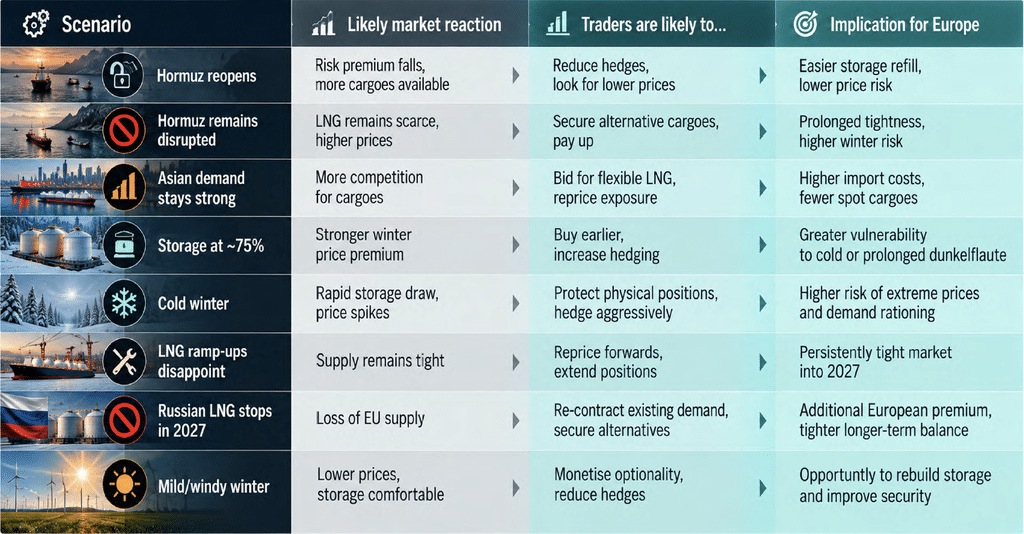
EU storage levels were at around 72% as of the beginning of October, and are likely to reach only around 75% at the start of winter. This compares unfavorably to the 90% target in the 2022 storage regulation, or even the lower 80% target mentioned by the Energy Commissioner in March 2026 “in case of difficult market conditions”. Storage levels are particularly low in the Netherlands and Germany. On 29 September, German Minister Katherina Reiche ordered state-owned Sefe to buy 8 TWh by 15 December – better late than never. Still, the German attitude appears difficult to understand. Even after the trauma of the cavalcade in August 2022 to refill storage at any price. And the price increases in late 2024/early 2025 as some players bet that Europe would pay any price to refill storage last summer.
Many argue that a lower storage level of 75% or 80% is adequate given that EU gas demand in 2025 was 17% lower than in 2021. However, this fails to consider three key factors. First, residential gas demand accounts for a high share of total consumption and cannot be so easily reduced if the winter is really cold, even if high gas bills will incentivise many to lower the thermostat. Second, gas is often the fuel of last resort in the power sector, meaning that gas-fired generation increases when problems arise with other fuels. And let’s be honest, hydro reservoirs in EU countries are critically low wherever one looks. Finally, stable Russian pipeline gas supplies (before Putin decided to use them as a weapon) have been replaced by LNG supplies: that may be fine in an oversupplied market, but this winter, Europe will have to compete directly with Asia.
Over the past 10 years, storage levels have dropped by between 40 and 71 percentage points during the winter period. The drop was lowest over the two winters following the 2022 crisis (40 and 41 percentage points) due to mild weather and energy conservation measures, but it reached 62 and 55 percentage points over the following two winters. Do the math if we start with 75%.
In the view of many gas industry stakeholders, Europe is sometimes shooting itself in the foot when it comes to regulation, even well-intended regulation. Two regulations are due to kick in on 1 January 2027, both of which have been sometimes described as representing an increased energy security risk.
The first one is the Methane Emissions Regulation (MER), which was passed in August 2024. Fossil fuel importers must show that imported fossil fuels were produced in a jurisdiction with monitoring, reporting and verification requirements equivalent to those applied in the EU. Over the past 18 months or so, the oil and gas industry and the European Commission (EC) have been locked in a game of “who blinks first”, with the oil and gas industry asking for a delayed implementation and the EC expected to provide more guidance on implementation.
Since March 2026, this standoff has been exacerbated by energy security concerns, with the gas industry arguing that importer requirements (Article 28) could impact energy supplies and pricing starting next year under strict MER enforcement assumptions, under which up to 43% of EU natural gas could become non-compliant and could no longer be imported. Another study concluded that global gas volumes meeting the OGMP Level 5 reporting standard exceeded current EU imports by more than three times. Pressed by several Member States, the EC seems to have lost the match: as announced in late September, it is now planning to delay the regulation by one year (ie, from January 2027 to January 2028). We won’t know whether 43% of our gas supplies would have stopped coming in three months. See you in late summer 2027 for another round.
The second regulation is the ban on Russian LNG which will also take effect on January 1, 2027. The EU imported more than 20 bcm of Russian LNG in 2025 and is on track to import pretty much the same volume in 2026. But on 1 January 1, the music stops, and the EU will lose about one-sixth of its LNG supply. This regulation is not new. The countries where this LNG is going are known: Belgium, France, the Netherlands and Spain. The holders of the LNG contracts are also well known. So if the governments of these countries have not had a serious discussion with these importers about what they are planning to do to replace those Russian LNG supplies, there are still about three months to act.
Maybe there will be an increase in LNG cargoes crossing the Strait. Maybe LNG supply will nicely increase over the next six months. Maybe we will have a mild, windy and very rainy winter in Europe (and in northeast Asia too). Maybe Russia will not extend its hybrid war to some of our gas supply infrastructure.
But surely, it does not hurt to be prepared in case things do not go as planned. In 2022, mild weather from late December onward helped us avoid testing energy solidarity. ENTSOG is expected to publish its Winter Outlook on October 8. Still, late September, Energy Commissioner Dan Jørgensen asked EU Member States to reduce demand for gas and electricity. It’s a telling sign when politicians start to talk about demand reduction, this usually shows they have run out of easy options.
As explained at various speaking engagements in Berlin and Paris, be prepared and pinch your nose because none of the solutions will be easy:
Winter is coming.
This Energy Explained post represents the research and views of the author(s). It does not necessarily represent the views of the Center on Global Energy Policy. The piece...

Reporting in the New York Times suggests a key element in the Trump administration's Russia-Ukraine peace plan involves Europe resuming Russian gas imports.
Last week's summit between US President Trump and Chinese President Xi was the second meeting between the two leaders since the US and Israel attacked Iran.
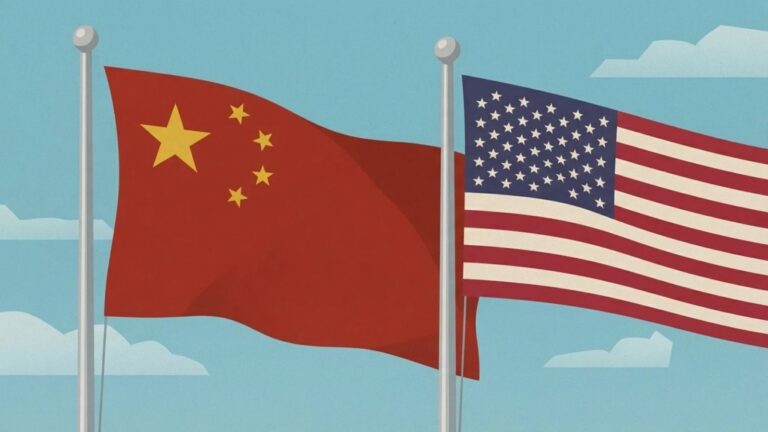
The Center on Global Energy Policy is providing live updates on key developments related to the Iran crisis. Check back here for the latest.
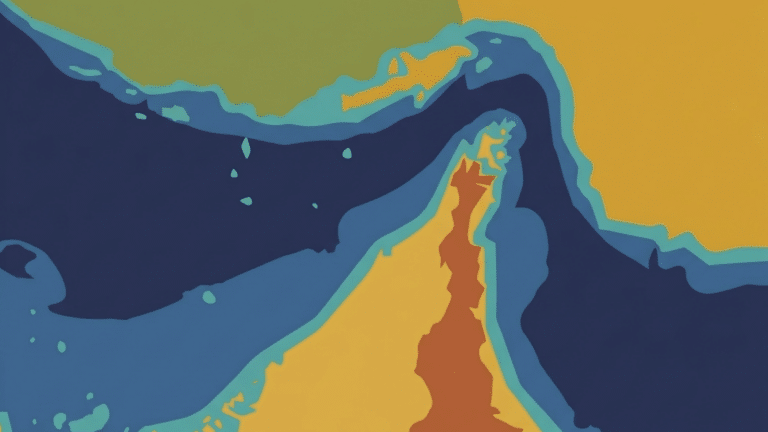

Disruption in the Strait of Hormuz has reduced the supply of oil, refined fuels and liquefied natural gas (LNG), reviving fears that Europe could face its second severe energy crisis in five years.