Congress Looks to Charge Data Centers Billions in Sweeping Energy Plan
The permitting bill could make it easier to build data centers for A.I. but a novel provision would also force data centers to pay much more for power.
Get the latest as our experts share their insights on global energy policy.
The shift in the balance of political power will help determine which US policies can be funded and sustained over the next two years.
Hear in-depth conversations with the world’s top energy and climate leaders from government, business, academia, and civil society.
Affordability was one of the key issues that drove US voters to the polls last week, and the resulting message for the newly elected Congress is clear: driving...

Find out more about our upcoming and past events.
Putting data centers in space once seemed fanciful. Today, a growing number of companies have started doing so.
Insights from the Center on Global Energy Policy
This Energy Explained post represents the research and views of the author(s). It does not necessarily represent the views of the Center on Global Energy Policy. The piece may be subject to further revision. Contributions to SIPA for the benefit of CGEP are general use gifts, which gives the Center discretion in how it allocates these funds. More information is available here. Rare cases of sponsored projects are clearly indicated.
The shift in the balance of political power in Washington following the Democratic Party midterm victories on November 3, 2026, will help determine which US policies can be funded and sustained over the next two years. Since US President Donald Trump took office in January 2025, energy and international development have seen sharp policy pivots, including the curtailment of clean energy incentives, withdrawal from multilateral climate initiatives, and expanded support for legacy energy technologies.
With the Democratic Party taking control of both chambers of Congress in January, there are questions as to how US energy and development cooperation policies may evolve. This could matter for US partners, especially those in emerging markets and developing economies (EMDEs), because changes to these policies may affect access to energy supplies and technology, financing for infrastructure and minerals projects, and even the terms on which firms can access the US market.
Three possible policy trajectories could shape the direction of US global energy and development cooperation: continuity, change, and stasis. Which trajectory emerges in each policy area will depend on where authority lies between the executive and Congress, the extent of bipartisan support or political polarization, and the incoming Congress’s willingness to influence policy through oversight, appropriations, or legislation. The presidential veto could, however, limit the scope for legislative reversal. The following questions examine how these scenarios could unfold across different policy areas.
Some policies are likely to follow their current course because the White House can continue to pursue them through executive action and/or because their objectives have bipartisan support. These include bilateral energy partnerships, international development finance, multilateral energy and climate initiatives, and foreign assistance.
The Trump administration is likely to continue promoting its “energy dominance” agenda in ways that shape US energy technology exports associated with fossil fuel production, nuclear power, and geothermal energy. The Department of Energy’s Energy Dominance Financing Program is likely to continue supporting the expansion of domestic energy infrastructure and critical minerals projects, while deprioritizing renewable energy. Nevertheless, solar energy’s share of US electricity generation continued to rise and is expected to reach nearly 10 percent in 2027, from 7 percent in 2025.
For US partners, this means that Washington will likely continue promoting American liquefied natural gas (LNG) exports, along with nuclear and geothermal technologies through bilateral agreements and commercial diplomacy. These priorities were reflected in the March 2026 Indo-Pacific Energy Security Ministerial and Business Forum, which highlighted LNG exports and advanced nuclear energy cooperation, and in a September 2026 agreement between the US Trade and Development Agency and Thailand to support a feasibility study of US small modular reactor technologies.
It is likely that US development and export finance will remain available for select projects because the agencies responsible have underlying bipartisan support for their activities. Congress reauthorized the US International Development Finance Corporation (DFC) in December 2025 through 2031. Financing for the Lobito Corridor Railway Project in Angola, backed by a $553 million DFC loan, reached financial close in December 2025, for example.
The US Export-Import Bank’s (EXIM) authority for new business is scheduled to expire on December 31, 2026. Congress has demonstrated bipartisan support for EXIM, although proposals differ in their approaches to reauthorization, financing capacity, and priorities. A bipartisan Senate bill introduced in February 2026 proposes a 10-year reauthorization of EXIM, compared with five years under a March House discussion draft. Another bipartisan bill introduced in August seeks to expand civil nuclear export financing under EXIM’s China and Transformational Exports Program. Separately, Senate Democrats’ June proposal would raise EXIM’s exposure ceiling, the maximum amount that the bank can lend, from $135 billion to $205 billion and expand financing for export-oriented domestic manufacturing, including critical minerals, batteries, and advanced energy technologies. The incoming Congress’s ability to influence these proposals will depend on the outcome of reauthorization and White House support for subsequent changes.
Several energy initiatives at multilateral development banks (MDBs) where the United States is a major shareholder have a basis for continuity because borrower countries support them. At the October IMF-World Bank Annual Meetings, Treasury Secretary Scott Bessent applauded electrification expansion efforts by Mission 300, launched by the World Bank and African Development Bank in 2024, and endorsed a technology-neutral approach to energy financing. The World Bank has since approved financing for a regional gas project in West Africa and is advancing nuclear energy cooperation in partnership with the International Atomic Energy Agency, and expansion of engagement in critical minerals (the lender announced $19 billion in planned minerals financing and private capital mobilization for fiscal years 2026–30). Washington will likely continue encouraging similar shifts at other MDBs. The Asian Development Bank has already revised its energy policy to allow support for nuclear power.
US financial contributions to MDBs could continue, although funding levels remain contested. The current administration reduced its proposed contribution to the World Bank’s International Development Association’s 21st replenishment (IDA21) from $4 billion to $3.2 billion, requesting $866.7 million for FY2027, while a House-passed bill proposes just $504 million, well below the annual amount needed to fulfill the commitment. The administration also did not pledge funding for the African Development Fund’s latest replenishment (AfDF-17) and proposed canceling $197 million in previously appropriated funds. Given congressional Democrats’ previous support for IDA21 and earlier AfDF contributions, the incoming Congress could seek higher funding if FY2027 appropriations remain unresolved. However, competing domestic spending priorities and negotiations with the White House could constrain any increases.
US disengagements from major multilateral climate initiatives are unlikely to be reversed because they were done through executive orders. These include the Trump administration’s departure from the Paris Agreement, the Green Climate Fund, the Just Energy Transition Partnerships, and international organizations such as the International Renewable Energy Agency. The separate withdrawal from the UN Framework Convention on Climate Change is due to take effect on February 27, 2027, although Congress could hold hearings to question and examine the implications of this withdrawal.
Congress may examine the role of the US DOGE Service in cutting foreign assistance and closing associated agencies that implemented projects in international energy- and climate-related areas. These include the US African Development Foundation and the Inter-American Foundation, policy institutes such as the United States Institute for Peace, and most notably, the US Agency for International Development (USAID), which, according to the Government Accountability Office, terminated about 6,780 of 7,510 awards between January 2025 and March 2026. However, reconstituting USAID’s operating capacity during the next Congress appears unlikely.
There are also areas where partisan disagreement or the economic issues that figured in the election give the incoming Congress reason to act. Congressional tools such as oversight, appropriations, or legislation could materially alter policy or its implementation. The main cases are federal support for critical minerals projects, US military operations against Iran, and broad tariffs and the trade negotiations they underpin.
Government equity stakes and other critical minerals incentives taken by the Trump administration could face greater scrutiny over the selection of beneficiary firms and deal terms. Even before the election, Democratic lawmakers signaled interest in investigating these transactions, which amounted to at least $10 billion according to CFR. Pending financing proposals could face additional scrutiny over project selection and financing terms. In Tanzania, Lifezone Metals is negotiating an investment in the Kabanga nickel project with the DFC-backed Orion Critical Mineral Consortium, with a final investment decision expected in early 2027. Congressional examination of US overseas minerals financing could introduce further disclosure requirements and uncertainty over the timing of support.
Furthermore, the role of US-government-backed individuals in mining projects could be investigated. Vulcan Elements, a US rare-earth magnet manufacturer backed by 1789 Capital, where Donald Trump Jr. is a partner, has already faced congressional inquiries over a $620 million conditional Pentagon loan commitment, and scrutiny that could intensify under the incoming Congress. However, the underlying bipartisan support for securing critical minerals supply chains makes a broad reversal less likely.
The Iran war’s inflationary impacts on energy prices for US consumers contributed to voters’ cost-of-living concerns in the midterm elections. The incoming majorities in Congress could renew efforts to constrain military action through war powers legislation or seek conditions on future fiscal appropriation, following the Senate’s narrow rejection of an Iran war powers resolution in September 2026. Some Democratic lawmakers are already pushing to restrict funding for military operations against Iran ahead of the December 11 government funding deadline. However, the party remains divided over how to pursue these restrictions. Countries around the world will be tracking the role of Congress in these military and diplomatic developments associated with the Strait of Hormuz due to the inflationary impacts, especially in fuel-importing EMDEs across Asia and Africa.
The tariffs on US trade partners could face greater scrutiny, in part, because of their implications for consumer prices. After the Supreme Court ruled that the International Emergency Economic Powers Act did not authorize the original reciprocal tariffs, the administration relied on other statutory authorities. In July, the US Trade Representative imposed Section 301 duties of 10 percent or 12.5 percent on imports from 60 economies, subject to exemptions. While the House Ways and Means and Senate Finance committees could scrutinize executive-led negotiations, specific legislation narrowing executive tariff authority could face a veto by the White House.
Other areas face competing priorities and/or political polarization making further progress unlikely even where congressional action could materially change the course. This applies to federal support for US renewable energy technology exports and the bilateral agreements on reciprocal trade (ARTs), whose implementation also depends on decisions by US trading partners.
The outlook for US clean technology exports is likely to remain subdued due to the stalling of domestic developments. The 2025 tax law shortened eligibility for certain wind and solar deployment credits and ended federal EV consumer credits for vehicles acquired after September 30, 2025, although manufacturing credits for eligible solar and battery components continue. But progress in renewable energy deployment around the world continues. Africa installed about 4.5 GW of solar capacity in 2025, up 54 percent year-on-year, and Asia added 513.3 GW of renewable energy capacity, up 21.6 percent from the previous year. Disruptions in the Strait of Hormuz have incentivized fuel-importing countries – from Ethiopia and Kenya to Bangladesh and Pakistan– to diversify their energy sources. For US exporters, however, expanding global demand may not translate into greater market share amid strong competition from lower-cost Chinese manufacturers.
Some of the signed bilateral ARTs and advanced negotiations could stall in two ways. The incoming Congress could challenge the administration’s bilateral approach in favor of regional strategies in places such as Southeast Asia, building on bipartisan legislation introduced in 2025 and the previous administration’s Indo-Pacific Economic Framework. However, advancing regional negotiations would require White House support. Delays could also abound within partner countries for various reasons. Restrictive provisions on mineral exports and inward-bound investments, uncertainty around US tariff policy, and pending USTR Section 301 investigations into excess industrial capacity in the Indonesia and Malaysia ARTs, have complicated the ratification processes in both countries. Uncertainty over US tariff terms may lead partner governments to defer sensitive commitments on LNG purchases and critical minerals partnerships until the next presidential administration.
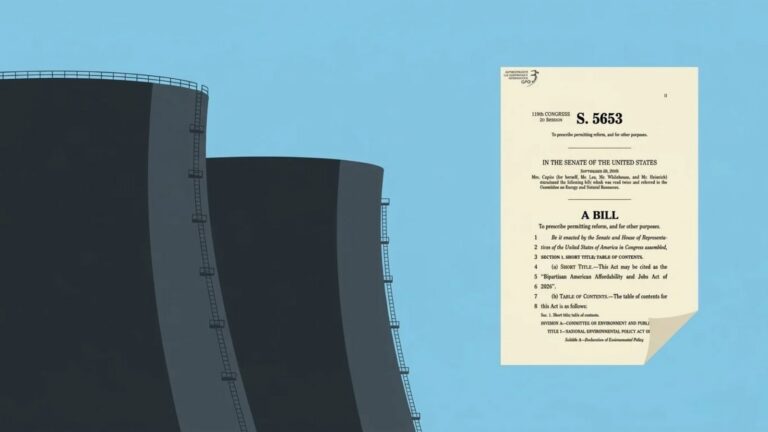
The BAAJA bill could facilitate nuclear development by streamlining federal environmental reviews and providing greater certainty for permitted projects.
This Energy Explained post represents the research and views of the author(s). It does not necessarily represent the views of the Center on Global Energy Policy. The piece...

The White House has just announced over $2 billion in new critical minerals, magnets, and battery investments.

The economic and humanitarian consequences of the June 24 twin earthquakes in Venezuela continue to emerge.

The interactive tool estimates how the Bipartisan American Affordability and Jobs Act could impact the permitting and construction timelines of different types of energy projects.