This website uses cookies as well as similar tools and technologies to understand visitors’ experiences. By continuing to use this website, you consent to Columbia University’s usage of cookies and similar technologies, in accordance with the Columbia University Website Cookie Notice.
Last week's summit between US President Trump and Chinese President Xi was the second meeting between the two leaders since the US and Israel attacked Iran.
Global gas markets, especially in Europe, are approaching winter under serious pressure. With storage inventories lagging behind historical averages and shipping disruptions from the Middle East threatening key...
Apply to Register The Center on Global Energy Policy at Columbia University SIPA’s Women in Energy initiative invites Columbia University students to a roundtable discussion with Pam Brown,...
Event
• Center on Global Energy Policy
Large Conference Room
About Us
We are the premier hub and policy institution for global energy thought leadership. Energy impacts every element of our lives, and our trusted fact-based research informs the decisions that affect all of us.
This Energy Explained post represents the research and views of the author(s). It does not necessarily represent the views of the Center on Global Energy Policy. The piece may be subject to further revision.Contributions to SIPA for the benefit of CGEP are general use gifts, which gives the Center discretion in how it allocates these funds. More information is available here. Rare cases of sponsored projects are clearly indicated.
Energy discussions at the summit focused on trade in refined petroleum and coal, with Trump pressing China to increase its refined-product exports amid record-high US diesel prices less than two months before the US midterm elections, and Beijing including coal on its list of US products under consideration for reduced tariffs.
While Trump’s request for China to export more refined products fell on deaf ears, with China restricting its refined-product exports for October, the summit set the stage for increased US coal exports to China, which could be meaningful for US coal producers but would represent only a small fraction of China’s total coal imports.
Although electric vehicles (EVs) were not discussed, discussions continue in the United States over whether, how, and when to engage with Chinese EV companies on domestic manufacturing.
Last week’s summit between US President Donald Trump and Chinese President Xi Jinping was the second meeting between the two leaders since the United States and Israel attacked Iran, triggering the world’s largest oil supply disruption. Both leaders prioritized pageantry and extending the trade truce. While energy was not the focus of the meeting, the energy discussions that did take place focused largely on the future of fossil-fuel trade between the two countries. Specifically, Washington sought China’s help to mitigate the fallout in energy prices from the war by increasing its output of refined products, while Beijing indicated that coal is one of the US products it is considering for tariff relief.
In this Q&A, CGEP scholars Erica Downs and Calli Obern examine the implications of these developments, as well as one energy issue that was notably absent from the summit—electric vehicles (EVs). They suggest that China is unlikely to increase its diesel exports in response to Trump’s request, that increased US coal exports to China could be more significant for US producers than for China, and that the Iran war is likely to boost the appeal of EVs among Americans.
Why did Trump ask China to increase refined product output, and how is China likely to respond?
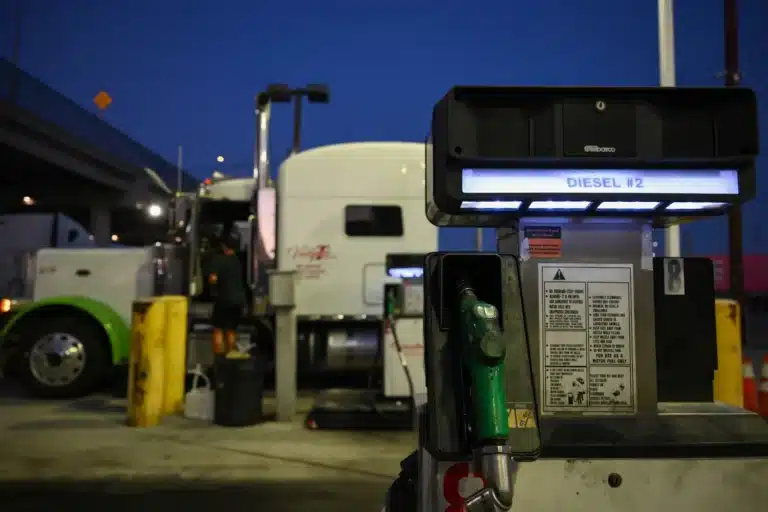
The backdrop to Trump’s request is record-high diesel prices in the United States, coming less than two months before the midterm elections. The high prices reflect disruptions to exports from the Middle East and Russia associated with the wars in Iran and Ukraine, respectively. Kpler estimates that diesel exports from these two countries fell from 1.5 million barrels per day (bpd) in February to 300,000 bpd in August. Average US diesel prices jumped from $3.72 to $5.46 per gallon over the same period before reaching $6.53 in late September.
This price surge has prompted Trump to contemplate a ban on US diesel exports, which reached a record high of 1.6 million bpd in August. The administration is also looking to China for additional supply, as China is the only country with material spare refining capacity to support an increase in refined-product exports.
However, Beijing is not obliging. Whie China exported about 320,000 bpd in August, the most since March 2024, its diesel inventories are at a decade low, and it has suspended refined product exports for October. The main factor shaping China’s product export decisions is the need to ensure domestic supplies—hence its use of export quotas. This point is exemplified by the refined-product export restrictions implemented days after the US-Israeli attack on Iran. Since then, Beijing has balanced domestic supply concerns against the interest of China’s refiners in capitalizing on high export margins while maintaining supplies to customers in Asia.
How did coal figure into the discussions?
The summit set the stage for increased US coal exports to China. Coal is among the US products China will consider as part of the “30-for-30” framework, under which the two countries would each import $30 billion of goods from the other at lower tariff rates. The White House’s account of the discussions indicates China will import at least 10 million tons of US coal in both 2027 and 2028. While the Chinese readout does not mention this, an official with China’s Ministry of Commerce (MOFCOM) stated that the inclusion of coal in the framework will help China increase US coal imports over the next two years.
Purchasing a minimum of 10 million tons of US coal per year would be a small commitment for the world’s largest importer and consumer of coal, representing just 2 percent of China’s total coal imports in 2025 (492 million tons). However, it could be a more significant development for US coal producers. More than 75 percent of the decline in total US coal exports in 2025 was due to China reducing its purchases following the imposition of retaliatory tariffs on US coal amid the US-China trade war. China’s purchases of US coal, and its share of total US coal exports, can vary widely from year to year. In 2025, China accounted for1 percent of US coal exports, down from 12 percent in 2024. The 10-million-ton commitment would bring purchases close to their 2024 level.
China’s coal purchases from the United States—and elsewhere—are largely shaped by prices. China seeks supplies from abroad when domestic prices are higher than international ones. If a reduction in China’s tariff on US coal increases imports, Beijing could build goodwill by supporting an industry Trump is eager to reinvigorate. But Beijing is unlikely to be concerned if China’s imports fail to meet US expectations; the fact that China did not meet the energy purchase targets in the US-China Phase One Trade Agreement is a case in point.
What about EVs?
EVs would be a logical topic for discussion given the importance of China’s EV industry to the global automotive market and the growing interest in EVs in the United States amid high gas prices. Pre-summitspeculation that the founders of the Chinese clean-energy giants BYD, Xiaomi, and CATL would attend the state dinner raised expectations that EVs would indeed feature in the summit. None of the founders ultimately attended, however, and EVs were not discussed. For now, China’s EVs remain subject to US tariffs of over 100 percent and software restrictions.
Consumers around the world have been buying more Chinese EVs as higher gas prices resulting from the Iran war have increased the appeal of EVs. As a result, China’s EV exports increased 71 percent year-over-year in January–August 2026. Simultaneously, American automakers have retracted investments in EVs and focused on combustion engines, creating opportunities for Chinese competitors to further expand their global market share.
There is also a growing sense among some automakers that cooperating with Chinese companies—whether in the form of joint ventures or partnerships—may be necessary for US automakers to compete. Earlier this year, the CEO of Ford met with the Trump administration to discuss an initial framework for Chinese companies to establish production in the United States without disrupting the domestic auto sector. Last Tuesday, he said, “We’re going to partner with the Chinese where we don’t have IP, where we can be more capital efficient in places like Europe or Southeast Asia.”
Trump has on several occasions expressed openness to Chinese automakers manufacturing EVs in the US. For example, he recently stated on Fox News that “If China wanted to come in and open a plant to build their cars here, I’d be okay with that.” Trump’s comments prompted members of Congress to urge him not to end the complete ban before the summit. While Trump’s rhetoric does not constitute a change in US policy, it suggests that discussions may be underway over how to keep US automakers from falling behind as gas prices rise, transportation electrifies, and Chinese alternatives become more and more affordable.
The White House announced last week an oil deal for more than 65 billion barrels of oil reserves in Venezuela and a 35% equity stake in North American Blue Energy Partners (NABEP).
The Trump administration and Saudi leadership have reportedly agreed to a nuclear agreement that could enable US nuclear technology transfers to Saudi Arabia.
In this edition of Global Institute Dialogues Jason Bordoff discusses how the Iran crisis, China’s electrification strategy, and the US shale revolution have changed energy geopolitics.
As inventories run dry and the Iran war continues to disrupt transit routes, oil has surged back to more than $100 per barrel. Diesel fuel—the workhorse of the agricultural and trucking sectors—has now soared to historic highs, pushing U.S. exports to record levels.