Congress Looks to Charge Data Centers Billions in Sweeping Energy Plan
The permitting bill could make it easier to build data centers for A.I. but a novel provision would also force data centers to pay much more for power.
Get the latest as our experts share their insights on global energy policy.
The shift in the balance of political power will help determine which US policies can be funded and sustained over the next two years.
Hear in-depth conversations with the world’s top energy and climate leaders from government, business, academia, and civil society.
Earlier this month, US voters handed Democrats control of both chambers of Congress and flipped several governorships across the country. The dramatic shift in power raises big questions...

Find out more about our upcoming and past events.
Putting data centers in space once seemed fanciful. Today, a growing number of companies have started doing so.


Ethan Zindler:
We at Bloomberg NEF see about 530 gigawatts of solar build through 2036, about 100 gigawatts of wind, and maybe most importantly, about 400 gigawatts of battery storage. We also see a lot of growth in gas, and that is also very much related to the data center phenomenon.
Lily Bermel:
I think my core reflection in all of this work is rooted in that the Trump administration is creating near-term headwinds. The laws on the books have changed, and that does make a material impact, but it ultimately can’t repeal the structural tailwinds that do drive deployment to record levels. And it doesn’t change the fact that the economy for the first time in decades is experiencing a demand growth not seen since last century. And that demand growth, not the tax code, is becoming the strongest deployment incentive.
Jason Bordoff:
Earlier this month, voters handed Democrats control of both chambers of Congress and flipped several governorships across the country. The dramatic shift in power raises big questions about where US energy policy is now headed. Following the passage of the One Big Beautiful Bill Act, which ended or cut back many of the Inflation Reduction Act’s clean energy tax credits, analysts warned that new clean power additions could fall by more than half over the next decade. But the build out has held up better than many expected. Last year, the US added more new power capacity than it had in over two decades, most of it coming from clean energy sources. Rising electricity demand, much of it from data centers, keeps pushing developers to build. Recent analyses suggest the clean energy build out will keep growing even without the full set of tax incentives. So what does the incoming Congress mean for clean energy policy?
Should Democrats spend their political capital on restoring the tax credits or on clearing bottlenecks like permitting? And with hyperscalers heavily relying on new natural gas capacity, how can policymakers make the case for clean energy heading into 2028?
This is Columbia Energy Exchange, a weekly podcast from the Center on Global Energy Policy at Columbia University. I’m Jason Bordoff.
Today on the show, Ethan Zindler and Lily Bermel. Ethan Zindler is a non-resident fellow here at the Center on Global Energy Policy, and he leads country and policy research at BNEF. Before this, he served as climate counselor to the US Treasury Secretary, Janet Yellen, and led the treasury’s efforts to facilitate and unlock financing needed to achieve a low carbon economy. Lily Bermel is a visiting fellow here at the center and also consults with Climate Philanthropies on clean industrial strategy. Previously, she was a research advisor to MIT innovation fellow Brian Deese. Before that, Lily was a policy advisor for the climate team at the US State Department. We spoke about how Trump’s actions to roll back many of Biden’s climate policies has and has not impacted clean energy deployment to date.
Jason Bordoff:
And we looked ahead to where government support for clean energy would have the biggest impact. I hope you enjoy our conversation. Ethan Zindler, Lily Bermel welcome to Columbia Energy Exchange. Great to see you both.
Ethan Zindler (03:20):
Hello.
Lily Bermel (03:21):
Thanks for having us, Jason.
Jason Bordoff (03:22):
All right, so there’s a lot to talk about, and basically what I wanted to do with this discussion was sort of help listeners understand where the energy system is today given multiple changes, shocks that are hitting it right now, and help listeners understand what big trends we are seeing. I think you see headlines sort of every day about renewables growing faster than maybe some expected despite Trump’s rollback of some climate policies. There’s also a lot of concern about gas build out, particularly with the surge in power demand for AI and data centers. BNEF of course always does really good work on all of this stuff and you’ve released some new reports recently. So Ethan, maybe let me start with you. You can tell us some of your latest findings at BNF about where we are in the US energy system. I think there’s a big focus now on electricity more than in the past.
Jason Bordoff (04:16):
Electricity demand is growing, electricity prices are rising faster than inflation. Just give us a quantitative sense of what that looks like to you and where you see the investment coming from that’s going to meet rising power demand.
Ethan Zindler (04:30):
So you’re exactly right. I mean, the US power system, we’ve had a couple decades here of basically pretty much no growth at the top line in terms of electricity demand, and that is now very rapidly changing and changing so quickly that it’s hard to keep up with. And really the main driver of that has been all these announcements about data centers and the amount of electricity that they’re going to require. So you’ve had a market that frankly was a market where it was kind of a swap and replace, and mostly you had coal that was retiring over the last 10, 20 years and mostly being replaced by natural gas fire generation and renewables. And now suddenly you have a top line demand coming in as well, and it is creating a lot of activity in the marketplace above and beyond, frankly, I think where many people would’ve thought we would’ve been three or four years ago.
Jason Bordoff (05:30):
Can I just ask you, so many pieces I want to get to in this, but you just mentioned something, coal being replaced by gas and renewables and people often lump those things together, but you often hear some people say actually the cheap shale gas revolution has been the primary driver of pushing coal out of the system and the reason US greenhouse gas emissions have declined or at least had been declining. That may have been true in the early years. I think something may have changed over time. Maybe that was more true five years ago than today, but I want to know from you as between those two things, do you have a sense of what the causes of emission decline and coal displacement has been quantitatively?
Ethan Zindler (06:10):
Let’s say that they have both played a very important role and I think it sort of depends on which advocates you talk to and they’ll sort of tout the role that they’ve played. You could argue that renewables play a disproportionately large role because when they come into competitive power markets, they essentially are priced at a zero marginal cost and that brings the whole stack of electricity pricing downward and puts real pressure on coal. Gas is typically been cheaper than coal for some time now, so it also reduces it, but not quite always quite so dramatically overall. So it’s a little hard to parse it out. It has definitely been done very much in partnership up to this point and the net effect has been substantially lower CO2 emissions from the power sector over the last 10 years or so. I think the real question though is what happens now and where do we go from here?
Jason Bordoff (07:01):
Lily, I’ll come to you in a second, but just tell everyone BNF’s view say for the next decade on how we’re going to meet rising power demand in this country, what the growth looks like for solar, for wind, for energy storage and for natural gas.
Ethan Zindler (07:14):
So we at Bloomberg NEF see about 530 gigawatts of solar build through 2036, about 100 gigawatts of wind, and maybe most importantly, about 400 gigawatts of battery storage. So this is a tremendously large amount of new build getting added to the grid. To give you some context, there’s about 1400 gigawatts of total installed capacity in the United States today. So we’re really talking about a net additive of about a thousand gigawatts of storage plus generation. Now there’s a lot of apples and oranges and pears in that. Obviously storage is not the same as generation overall. And also renewables generated a lower capacity factor than a gas or coal or nuclear power plant. So it’s not kind of like for like in terms of swapping in, but it is still an enormous amount of build that we do anticipate over the next 10 years. And in terms of the build pattern, we are expecting a record year for build this year and then another record next year with somewhere around 90 gigawatts of new capacity for wind, solar and storage added.
Ethan Zindler (08:25):
Although we then expect a dip over the next several years, we get down to something close to 75 gigawatts per year and then eventually into the next decade, it does really stage quite a comeback and we eventually get to a market that’s somewhere about 100 to 110 gigawatts per year into the mid 2030s. And that’s really the era where we think the market has moved decidedly past tax credits and is standing pretty much entirely on its own.
Jason Bordoff (08:53):
Just help people put that in context.
Ethan Zindler (08:55):
Yeah, so we have about 1400 gigawatts or so roughly online in the entire US system at the moment. I think talking capacity terms is always not entirely correct because we have something like, I don’t know, 4,100 terawatt hours of actual generation and clean power, renewable power capacity generates at lower capacity factors than gas does. So it’s not like if you have 1400 gigawatts now, you have 400 gigawatts that you’re adding a third more generation. It’s considerably lower than that. It’s probably about half of that. But nonetheless, it’s poised for a lot of growth. We also see a lot of growth in gas, and that is also very much related to the data center phenomenon. In fact, probably we think there’ll be about a tripling, more than a tripling even of demand from data centers, at least based on the last forecast that we did. And we think about two thirds of that is going to be met by gas fired generation.
Ethan Zindler (09:56):
I say all that with the giant caveat of the fact that we just had an election and the pace at which data center rollout continues will be very much affected by the policies that get made, I think most notably at the state level going forward, though there might be some efforts at the federal level as well.
Jason Bordoff (10:16):
I want to come back to a couple of things you said there, but Lily, talk a little bit about the impact of policy. Ethan mentioned the rollback of the tax credits when those expire and that might change what BNAF though the outlook was for renewables. You obviously have done some analysis on this. How big an impact are those policy changes having?
Lily Bermel (10:36):
Sure. Thanks Jason. So this summer I released a report called Glass Half Full that tried to answer a version of that question, essentially looking at the Biden era clean energy build out from the Inflation Reduction Act and all of the power plant regulations under the EPA and looked at the new policy and environment under the Trump administration where those regulations are rolled back and some of those tax credits are removed to look at what percent of clean energy capacity will still get added in the coming decade. And that answer is about three quarters. Now this is just an estimate focusing on clean energy in particular, but to me what it really speaks to is that we now operate in a market economy where clean energy, wind, batteries and solar are mainstream, are mature, have high market penetration, and there is such strong demand pull for them whereby last year they were about 90% of what got added to the grid.
Lily Bermel (11:34):
And so even in the absence or the slow removal of that policy support, those technologies are still deploying most of what we would’ve expected them to with the policy present.
Jason Bordoff (11:49):
So just to repeat the finding, if I understand it right, when you compare the amount of clean energy growth, renewables growth by 2035, when you compare what the projection was when the Biden policies were put in place, like the Clean Power Plan and the Inflation Reduction Act from 2021 forward at the start of the Biden administration, and then you look at that same growth today, you find about three quarters of the growth still happening.
Lily Bermel (12:19):
Yes, that’s exactly right.
Jason Bordoff (12:20):
And is that in total, not percentage terms, meaning the landscape looks different today, so we’re growing the denominator a lot more, power demand is growing. I’m wondering if what you found is inconsistent or consistent with what Ethan said, because what Ethan just told me was two thirds of the growth in at least electricity demand from data centers, other sources of electricity demand growth too, is going to come from natural gas. So that three quarter sounds really good. You titled your paper glass half full, but is that a total amount of electricity? And you say, well, actually if the glass were really full, it would be a lot more than that now because electricity demand’s growing so fast. So we’re getting three quarters of the renewables we though we were going to get. We’re getting much, much more natural gas than we though we were going to get.
Lily Bermel (13:03):
Yeah, great question. I think it’s always good to clarify what exactly is this glass that we’re talking about. And the glass again is that Biden era projections and expectations of what would’ve happened under that era of policy. Of course, we know that that was not a net zero glass that was not going to have us accomplish all of our clean energy goals at that time. And so really it’s a look at relativity of renewables today compared to renewables that would have happened before. What Ethan just spoke to was renewables compared to total. And I think what we’re going to see going forward are record levels of clean energy deployment that Trump will again oversee as president. And we’re also seeing a big boom in gas as well, and those are happening at the same time.
Ethan Zindler (13:47):
Jason, can I jump in for one second on this just because I think it’s interesting. I mean, I’ve been following from afar some of the discussion around this and I slightly don’t understand. And so far there’s been a little bit of a, I forget what we say, controversy about it. I don’t really get it in the sense that when the One Big Beautiful Bill Act passed, we and others said we thought that about three quarters to 80% of everything that was going to get built in the renewable sector would get built. And actually we’ve now raised our forecast and we think that if you compare our pre One Big Beautiful Bill Act forecast to where we are now, it’s actually only off by about 7%.
Ethan Zindler (14:36):
We’ve reduced the haircut substantially overall. Now there are a lot of things going on that we’ve been talking about. The data center build thing has been really strong. It’s been frankly stronger than we were expecting. It’s a big tide that’s lifting a lot of boats in renewables and gas. And so yeah, I think to Lily’s point, I think it kind of depends on which glass we are talking about on a renewable basis. I’m not going to characterize it as good or bad, but it’s the amount below what we were tracking is not that far below. There have been other effects on gas for sure, and on electric vehicles ironically, which we can talk about as well. But within the renewable sector, the forecast has not been that dramatically different so far.
Jason Bordoff (15:24):
So just to be clear, BNEF’s finding is consistent with maybe even more optimistic or glass more full.
Ethan Zindler (15:31):
We were saying basically get 20 to 25% haircut right around when the bill passed. Now we’re saying probably only about a 6 or 7% bill as the haircut compared to what we were thinking over a year ago. We’ve raised our forecast frankly a couple times since the legislation passed. And the main reason is because overall top line electricity demand is really providing a lot of sort of ballast for everybody. Anyway, sorry to jump in.
Jason Bordoff (15:58):
No, no, it’s helpful.
Ethan Zindler (15:59):
I think it’s worth contextualizing.
Jason Bordoff (16:01):
I was going to ask you if your understanding was similar to what Lily wrote in the paper she did with her seat here published through MIT or different. It sounds pretty consistent. And as you said, there were some lots of, for people in the super deep weeds of climate Twitter and stuff, discussion about it and questions about it, maybe even some criticism of parts of it. So I did want to tease that out, and there were questions about the baseline year and things like that. But the broader question I was getting at is just, look, if you’re trying to understand how bad is it, how much damage did it do that the Trump administration and Republicans in Congress passed the One Big Bautiful Bill Act and also rolled back clean power plant regs? But Lily, we should come back to that because I do think the regulatory issues played a quite significant role as well as I understand the work you did.
Jason Bordoff (16:56):
My question was whether all of this new growth in power demand people had not been expecting in 2021 result in an outlook that but for Trump’s policies, we should be seeing, I’m making up a number, like 150% of what we though, 200% of what we though. The actual impact, it’s not right to say we’re getting 75% or 90% of what we though we were going to get, which sounds pretty good. It’s absent these policy changes, we’d be getting much, much more than that. Is that the right way to think about the impact of these Trump policies? Ethan, maybe I’ll start with you and then Lily.
Ethan Zindler (17:29):
I think that’s fair. I mean the question is look, even had there not been a One Big Beautiful Bill Act, we were not tracking towards cutting emissions at the pace that we needed to. So anything that subtracts from that from an emissions perspective is not great news. And as I said a moment ago, there’s also been an indirect effect, which I feel like doesn’t get talked about quite as much, and you got to bear with me here for one second on this, which is that on electric vehicles, we had a $7,500 per customer tax credit for new EV purchases that disappeared at the start of the fourth quarter of 2025. And we have seen a notable decline in EV sales, which were somewhere around 180 or 190,000 a month to about 100,000 a month. Why does this matter? What matters is that the EV sector has been hurt and the clean power sector has benefited.
Ethan Zindler (18:31):
And the reason is because there were a number of EV battery makers that were anticipating a big EV market. They got halfway through building their manufacturing plants in anticipation of claiming a generous 45X tax credit. And then when this law passed, they were faced with a decision, which is do they complete those plants to make batteries for vehicles or do they complete the plants for batteries for stationary storage purposes? And they chose to do that. And why that matters is because the tax credits related to batteries, which are on the books into the next decade, are contingent on people buying batteries that are not made in China. And so building a domestic availability of batteries was very important and is part of what has bolstered our forecast as well, in addition to the fact that there’s been this rising top line demand. So anyway, that’s a long story, but there’s a long way of saying that EVs’ loss has been the renewable power sector’s gain.
Ethan Zindler (19:36):
And so that has been a little bit of a zero-sum game. And it is from an emissions perspective, we’re not moving as quickly as other countries around the world to adopt EVs. Since Iran began, we’ve seen real surges in electric vehicle purchases in other markets. Only in the used EV market have we seen a real growth so far. There’s more room for real growth to go for sure. And so there has been some sort of zero-sum aspects of this.
Jason Bordoff (20:06):
Quick clarification point, and then I’ll come to you, Lily. You said according to BNEF, two-thirds of the growth in data center power demand will come from natural gas. Is that basically the same as saying two-thirds of the projected growth in US power demand? Is it nearly all data centers or are those two things different?
Ethan Zindler (20:21):
They’re different because there’s other sources of demand that we do think will grow, but it’s the biggest source. It’s the majority of the growth. I couldn’t tell you exactly off the top of my head what the rest of it is.
Jason Bordoff (20:31):
And just remind people, how much of US power demand today is data centers when you say it’s going to roughly triple?
Ethan Zindler (20:35):
I think it’s, I’m going to guess about 5%. It’s pretty relatively small, but it’s growing quickly.
Jason Bordoff (20:42):
Okay. So two-thirds of the growth in data center electricity demand is gas. And for the country as a whole, again, there are other sources, it’s more than half, let’s say.
Ethan Zindler (20:52):
Yeah.
Jason Bordoff (20:53):
Okay. Lily, I’d love your reflection on all of that and also the question I talked about, which is the right way to measure how damaging all these Trump rollbacks have been. Part of the question is the counterfactual in this new world of rising power demand.
Lily Bermel (21:07):
To add on to what Ethan was just saying, I think my core reflection in all of this work is rooted in that the Trump administration is creating near-term headwinds. The laws on the books have changed, and that does make a material impact, but it ultimately can’t repeal the structural tailwinds that do drive deployment record levels. And it doesn’t change the fact that the economy for the first time in decades is experiencing a demand growth not seen since last century. And that demand growth, not the tax code, is becoming the strongest deployment incentive. So clean energy is being contracted in quantities and on timelines that were simply not happening before, and that is buoying the clean energy industry forward. I think in terms of the right way to measure it, it certainly is a narrow view to just simply compare current expectations compared to Biden expectations.
Lily Bermel (21:59):
But in the aftermath of the One Big Beautiful Bill Act, for me at least, that was the major question on hand. And so that’s why I use that 2021 baseline to ask and answer that specific question. Of course, if you were trying to do a specific policy attribution analysis, you would look at a 2025 baseline to look at when the law on the books changed. And you could also even look at a 2031 baseline to look at the environment when wind and solar tax credits are not present. And when Ethan gave me a glimpse of his data, I personally found it really interesting to see wind and solar and storage deployment continue to rise year on year in that post 2031 era when those tax credits aren’t present. And Ethan can speak to this better than I can, but to me again, that doubles down on the thesis that demand growth is a really strong deployment incentive that we have.
Ethan Zindler (22:49):
It’s also worth noting that in the solar market, Jason, the majority of stuff we’re seeing built now is solar plus batteries, and solar equipment is pretty inexpensive these days, and you can still take the tax credit on the battery. So if you merge the two together, you have an incentive to build a giant battery attached to a reasonably sized solar system and then take the credit, 30% of the CapEx on the credit on the battery. So tax credits are still affecting the market into the 2030s as we’re set up at the moment.
Jason Bordoff (23:23):
Can you just remind people the rough timeframe by which the important tax credits expire so people understand how this might unfold and when things will see more of an impact versus less?
Ethan Zindler (23:34):
I’m happy to, Lily, correct me if I get the exact schedule wrong, but basically the wind and solar tax credits have effectively expired except for if you have safe harbored projects, meaning you’ve essentially gotten under construction or demonstrated that you’ve made some meaningful progress on your project. And there is a considerable volume of projects that fall into that category and will come online over the next couple of years. But then after that wind and solar essentially are gone, the storage credit, again, Lily, correct me if I’m wrong, I think it goes all the way to 2032 and starts to phase out then. And in the case of solar and storage, the way the credits work is it’s 30% of your capital expenditure. So you spend a hundred million dollars on a battery, you get a tax credit for 30 million bucks. The wind tax credit is more on a production basis and it depends on how much actual electricity you generate.
Ethan Zindler (24:31):
You get tax credits as you do so.
Jason Bordoff (24:33):
And Lily, to Ethan’s point, and I’m impressed you got even a peek at his data, those BNEF paywalls are tough, but the data is very high quality analysis, so I encourage people to look at it. That’s your commercial and plug, Ethan. Your analysis, to his point about transportation and EVs, you were looking just at the power sector. So that is an important point. As you were saying, there’s dynamic interactions between sectors like transportation, batteries for transportation and batteries for grid storage. Can you say something, Lily, about this often comes back to the tax credits and the rollback of the big beautiful bill, but the impact of rolling back regulations on stationary and mobile sources under the Clean Power Plan. And your analysis also talked about the importance of those regulatory things, particularly say in the coal outlook. Is that right?
Lily Bermel (25:30):
Yeah. So while my paper didn’t do any specific policy attribution analysis, I did reflect on how the power plant regulations are targeting fossil fuels and the clean energy tax credits are targeting clean energy. And so essentially the regulations on the books are really incentivizing the rapid or accelerating the rapid retirement of coal plants such that it’s near zero by 2035 and in other rules on the books to help decarbonize gas and capture methane as well, while the clean energy tax credits are really focusing on making clean energy cheap and supporting a boom in that space. And so when you think about the bigger picture emissions, both levers have a role to play. And so when coal is not getting phased out as fast, the existing fossil fleet is dirtier with more coal online. And the question of renewables, they are both meeting new demand and maybe offsetting fossil, but the role that they play in decarbonizing depends on if they’re just simply meeting new demand or actually supplanting existing emissions that fossil currently emits.
Jason Bordoff (26:41):
So Democrats just had a historic sweep, wave, tsunami, pick what metaphor you want to use, making people optimistic about the presidential election too from that side of the aisle. And imagine that scenario, it would raise the question of what do you do? What’s your climate policy? And you could imagine some people saying, “Well, we had this historic thing called the Inflation Reduction Act that had a huge amount of government spending on tax credits for solar and wind. Let’s put those back in place.” Lily, does your analysis suggest that is not the best use of taxpayer dollars?
Lily Bermel (27:16):
That is a normative takeaway that I have from my analysis, yes. I think after decades of bipartisan support for these clean energy tax credits where they are an important driver in the IRA and they have been the main policy on the books for supporting wind, solar and batteries, the fact that these technologies are quite resilient in their absence to me shed light on the fact that maybe these technologies don’t depend on that supportive policy like they used to, like they needed to. In fact, that this policy was so successful that now they can kind of survive on their own. And so for me, when I think about future policymaking efforts, which will be inherently constrained by our fiscal space, by political capital, now by a bigger democratic tent that has to manage a lot of different interests, I think a future policymaking efforts won’t see climate winning the day and getting a lot of money like we did before.
Lily Bermel (28:14):
There will be another meeting between the four corners and the most moderate senators in the caucus deciding explicitly how much to spend where. And I think in the climate challenge when we need to be deploying renewables as fast as we can, we also need to be commercializing clean, firm energy like geothermal and advanced nuclear and carbon capture. And those technologies have a long way to go until they can reach mass scale and deployment. And so while nothing is mutually exclusive, of course multiple things can be done at once. Of course, there might be a future candidate Ossoff who wants these tax credits to support his offtake of solar manufacturing in Georgia. Maybe there’s a way to revise these credits. I think it’s important to prioritize climate policy by what is actually the most effective, what is the most cost effective, and what is the most value add rather than continuing the status quo or trying to replace what we once had.
Jason Bordoff (29:12):
Ethan, you know a little about this. You worked at the US Treasury Department. Imagine a hypothetical world where fiscal space is more constrained and people are more concerned with the debt and the bond market is more concerned with the debt. That’s just a hypothetical. You have to be pretty careful with where you choose to deploy government resources. Is that how you see the implications from a policy standpoint of what BNEF has done, Lily’s work, others?
Ethan Zindler (29:35):
I mean, I’m going to keep my analyst hat firmly on here as an out of government, but I would say that look, there –
Jason Bordoff (29:45):
The analytic question is the return on the government dollar. How much, to use an economist term, how much of that spending is inframarginal and going to subsidize stuff that would’ve happened anyway?
Ethan Zindler (29:56):
Look, if you look at the results, let’s maybe take this question from a political… Angle for a second, which is if you look at the results of the election, consumers were clearly unhappy about $4 a gallon gasoline. And the US federal government is now not providing supports for people to buy electric vehicles. There is a record volume of used EVs coming onto the market now as a lot of leases expire, which are already priced at a fairly affordable level. There used to be a used electric vehicle tax credit. Perhaps that’s a better way to spend money in terms of a climate impact return on investment. I haven’t done the analysis, but I’m just saying there are a number of different ways that you could potentially spend money. The importance of the tax credits in particular, I would say for solar are probably not what they were because first the tax credits are based against CapEx, and the CapEx’s of solar projects have been coming down because solar equipment prices have come down quite a lot.
Ethan Zindler (30:59):
And the second reason is because solar projects, as I said before, are most often these days paired with batteries and you can put the tax credit onto the battery as well. So I have not done the full analysis, and so whoever wants to come at me, fine. But the reality of it is there are other issues related to deploying clean energy in this country, and I assume we’ll come out to talking about permitting, which is important. There’s also tariffs that have been put in place that are not helpful necessarily. There’s questions about what a prohibited foreign entity is in so far as using a battery and where it comes from. There’s been an executive order issued by the White House related to bulk power system equipment that’s raised a lot of questions. There are a lot of other obstacles that potentially could get addressed, and a number of which are not financially oriented.
Ethan Zindler (31:57):
I think the challenge with that whole list that I just gave you is that just generally speaking, they lie in the hands of the Trump administration. And so whether or not they plan to do anything different remains to be seen.
Lily Bermel (32:08):
To add onto what Ethan said, I do think we are seeing a lot of, and will see a lot of renewables deployment in the absence of those credits, which suggests that the credits are not creating deployment in action that would not otherwise occur. Another way of saying that is that the majority of a tax credit is going to those big developers and companies who don’t need that incentive to build. It’s essentially free money to them. A lot of lawyers and accountants are very happy with that. I think the question of any tax credit extension, it’s important to remember that it’s not the original IRA tax credit that is up for being extended. It is a much smaller version. It is the fiat version, what Ethan referenced, it’s the very limited version of it. And I think these companies are starting to not plan around tax credits in part because you can only tell your EPC contractor to hurry up so much.
Lily Bermel (33:03):
People are not putting forward projects that depend on a tax credit to pencil out. I think they can help projects pencil out when the price of gas changes and the relative economics changes, but thus far they actually don’t radically change the economics of these projects. They don’t necessarily improve their odds of survival. They’re just kind of a discount to companies who manage to survive the gauntlet of permitting reform and whatnot. So I think in terms of policy design, it’s useful to think about if they’re achieving what we want them to achieve and what that first order impact really is.
Jason Bordoff (33:37):
So what I hear you both saying from the analysis you’ve done, and I think this is consistent with some others I’ve seen, is renewables are… The market’s doing a lot of the work. They’re cost competitive. We need to move quickly. A lot of that can be deployed quickly. And so making it easier to get permits, doing permitting reform, not blocking the development of offshore wind, et cetera, thinking quite carefully about energy security concerns and the use of tariffs that could actually raise the cost of some parts of renewable supply chains, you would focus there more than just subsidizing it. And in a world of scarce resources, it would be a better return on every dollar to think maybe about things we also know we’re going to need like nuclear on the grid or carbon capture or geothermal or green molecules and try to overcome some of the financing challenges there and drive the cost curves for those technologies down as we saw with solar and wind in years past.
Lily Bermel (34:41):
Yes. Yes, I think that’s totally right. And I think it’s important to put this adjacent to… It’s not just saying, “Hey, we don’t need to spend money on climate or wind and solar are perfectly fine.” It’s in the context that there are so many other opportunities to craft climate policy and to spend scarce fiscal resources. So you just talked about commercializing clean firm. I think a next big wave of obstacles that we’ll face is the grid equipment and supply chain and workforce development. There’s a lot that we can do to build out transformers and inverters and the poles and wires to build out really double the size of our grid and add as much clean energy as possible. We need to train workers and also in the coming years there’ll be an opportunity to do another Bipartisan Energy Act. The first one was during the second half of Trump’s first term when there was a Democratic Congress and Trump signed off and many of either that funding or those authorizations are expiring.
Lily Bermel (35:38):
So there’s a really fresh opportunity to enact a DOE innovation agenda going forward.
Jason Bordoff (35:43):
Ethan, do you agree with what I said?
Ethan Zindler (35:45):
Yeah. Well, I would just say, look, would the industry like it to get those tax credits? Yes. Could it be somewhat helpful to them? Yes. Is it in the priority of needs the thing that would come top of the list compared to return on investment of other government spending? I haven’t candidly done the analysis, but I would say there do seem to be other things that could require support and investment overall. I’ll say one last thing, which I’m sure will not endear me to the industry, which is that we have been doing this at BNEF for some time now. We have seen subsidies removed in other markets, namely most often things like feed-in tariffs removed and pretty consistently, particularly with the solar market. When those do get removed, the market finds a way to reduce its costs pretty dramatically thereafter. It has happened sort of time and again in different markets around the world.
Ethan Zindler (36:38):
So there are strong reasons to believe that in a post-tax credit or less tax credited world that there can be reductions in costs. Although it is predicated on no massive tariffs on imported goods, which is something that the US has made challenging for the solar industry.
Jason Bordoff (37:00):
Well, let’s talk about that for just a quick moment because it makes it more costly to deploy clean technology when you put tariffs on it, and maybe there are legitimate reasons why we are concerned about import dependent. So how big an impact do you see, Ethan, those policies having? I mean, to the extent you want to share your normative thoughts about their justification, that’s helpful. I mean, I’ll start it just by sort of saying I have a sense that you tell me this is unfair, you worked in the administration and it’s not just Biden. I think generally the conversation in DC runs a risk of oversimplifying energy security risks and lumping lots of different types of risks into a single bucket. The dependence on China for heavy rare earths or gallium and germanium and things with defense applications is, it seems to me, different than a solar module or something else.
Jason Bordoff (37:53):
And then there’s often, I worry more optimism than is warranted that with some tariffs and some industrial policy and some tax credits, we can make a huge dent in China’s dominant position and make all of this stuff here in the US. It turns out it’s really, really hard to make a dent in China’s dominant position. Maybe you can erode it a little bit, but the scale of manufacturing is just massive. So look, if you really wanted to reduce oil dependence for climate or energy security reasons, you’d open the door to BYD. There are reasons we might not want to do that. So I’m just kind of curious if you could talk a little bit about how much impact you see those policies having and what the smart way to think about them from a policy standpoint is.
Ethan Zindler (38:33):
Yeah, I mean look, as you rightly point out, this was definitely something that we discussed during the Biden years and something I think it’s still a current conversation and a live conversation about whether or not the US should be playing an active role or trying to be a world leader in the production of conventional photovoltaic modules and cells. I think to your point, Jason, the market, again, strictly speaking, talking about conventional polysilicon equipment has gotten enormous. China is a dominant player. There are other countries as well, India, that are major suppliers at an enormous scale and very low cost.
Ethan Zindler (39:18):
I do think it’s worth at least asking the question about whether that horse has now long since left the gate and whether or not at this point it might be wiser for the US to enjoy the very low cost equipment that is available on the global market so that we can speed as much solar deployment as we possibly can with conventional modules. Now, there is a question around next generation of solar equipment, next generation of battery equipment. There’s a lot still to be sort of played for, but I think your point’s well taken, which is look, this thing has reached an unbelievable scale. Currently, the US pays often twice as much for a solar module as other markets do around the world because of the various tariffs that we have in place and the difficulty we make it for equipment to get into this country.
Ethan Zindler (40:05):
So we are artificially inflating the cost of solar already, and part of it is because of a push to try to support a domestic manufacturing industry, which let’s be honest at the moment is very small and quite fledgling to date. So again, I think there are real opportunities and it’s important for the US from a competitive perspective to support industries, but we also sometimes need to make tough calls and say, “Okay, well this one, maybe the time has passed to try and be a global competitor on the conventional side so far.”
Jason Bordoff (40:36):
Lily, anything you’d add to that before I want to come to permitting reform next?
Lily Bermel (40:41):
Sure. I think we’re seeing tariffs increase the prices of things, and it’s not just on solar, it’s on all the grid components as well. And so to me, that feels like a easy opportunity, a low hanging fruit to help reduce costs and to accelerate deployment of things by alleviating those tariffs.
Jason Bordoff (41:00):
So you mentioned permitting reform, both of you, a few times. I will note we are recording very shortly before the motion to proceed vote in the Senate, and so a lot of things will have happened by the time this podcast comes out. But let’s assume everyone’s listening to this at a moment when this is still a live debate and question whether we’re moving forward with this big piece of bipartisan legislation or not. Ethan, let me maybe just start with you. How big a difference would it make to the outlook for clean energy based on the work you guys have done?
Ethan Zindler (41:33):
So we haven’t modeled it, and in part because I think there’s so many aspects of it that are based on the assumptions of follow through on the implementation of some of the aspects of it and the assumption that the implementation will be done in a relatively even-handed way. Also, frankly, we kind of want to see what actually comes out of the legislative process so we have a little bit clearer sense as to what we want to try to model. So I do think there’s some real open questions. I’ve read the work from the Rodium Group, which is really interesting in terms of what they say the potential implications are. I think it seems pretty clear that the transmission aspects of the bill could have some real net positive effects in terms of making it easier to build transmission across state lines, to have the United States finally build at some scale high voltage direct current transmission, which is something that, for instance, China has sped ahead with and could really enable the ability to move more clean power resources from one part of the country to the other.
Ethan Zindler (42:36):
However, I also understand and hear some of the concerns the environmental groups have about the implications for gas pipeline permitting in all of this. And one thing I just would note, Jason, is that going back for a second on data centers and the tremendous amount of new gas demand that we see coming from data centers, if you add that demand from data centers to the demand coming from LNG, we’re seeing a market where in the next couple of years the US gas market could in theory actually start to get kind of tight. And look, it’s a big market nationally, so looking at on across the country basis doesn’t tell the whole story, but it does raise the potential that for some of these data centers, the price for gas could go up, especially if they don’t have sufficient pipeline capacity. And so I guess I can understand some of the environmental group’s concerns about making gas pipelines too easy to permit because it could facilitate the use of more gas generation for data centers specifically, including behind the meter gas center generation.
Ethan Zindler (43:42):
So there’s two sides to this for sure.
Jason Bordoff (43:45):
Yeah, I guess if we want to prevent behind the meter building, permitting reform on the flip side helps quite a bit to get more onto the grid and prevent some of what you just said people would be concerned about, which is a big push for gas behind the meter. That’s more likely to happen, I think, if you can’t build the grid infrastructure.
Ethan Zindler (44:02):
Well, it’s provided that you’re also careful about making sure that the EPA has authorities to limit behind the meter gas bill and that it does not go through without thorough review. I think that’s another concern that some folks have here about this legislation.
Jason Bordoff (44:20):
Lily, your thoughts on what this permitting reform bill would do and the concerns even before the permitting reform bill, but especially now about how we’re entering another age of gas build out in the country from a climate standpoint.
Lily Bermel (44:33):
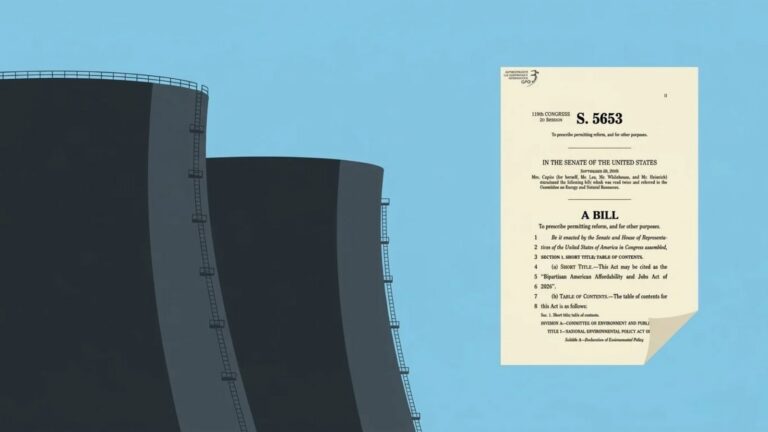
So to pick up on what Ethan was just saying, the reason why we are seeing a trend towards behind the meter gas is because it is too slow and too cumbersome to connect directly to the grid for these hyperscalers that are placing a very large premium on speed to build. I think that is where the permitting reform bill called BAAJA comes into play. While we’re recording this before the motion to proceed vote on Monday, regardless of what happens in the vote, it puts together a very remarkable bipartisan package to address many of these issues and to bring certainty to the permitting process, reduce times to build, and really to unleash clean energy and transmission build out. So I think it is worth giving a huge kudos to everyone who worked on that in good faith and over the years because it is really impressive to have a bill that both lowers costs for Americans, accelerates clean energy build out, holds data centers accountable, and it reduces emissions.
Lily Bermel (45:32):
It somehow does all in one and has some really massive support from API to Evergreen Action. On the permitting process in particular, when we have more transition built out, that will increase the size of the grid, increase that surface area for projects to connect, it will increase the pace of building, and it will decrease the cost of connecting as well when it takes a fraction of the time. And with colleagues at the center, we put out a pretty detailed white paper explaining all the BAAJA provisions and its various implications. And so of course implementation matters, of course, the actual quantities of demand of energy matter as well, but it looks like it will be a net positive impact across the board on many topics. In my own work over the summer on my paper, something that really struck me that relates to this is that ultimately the binding constraint on building clean energy is not the cost anymore, it’s on the supply side barriers.
Lily Bermel (46:32):
And so what we’re seeing is that there is a literal limit and a ceiling on how much clean energy can get added every year and how fast it does. And so by increasing that speed, it does a lot. It will materially impact the amount of clean energy on the grid and how fast the grid can get built out. That’s one point. I think it is important though to recognize that there is more gas coming as Ethan’s numbers show. And so to me, the main question is then, well, what do you do about it? And to me, at least six things come to mind. Again, those provisions to get connected to the grid as soon as possible so that the gas can compete with clean energy. There’s a lot that can be done to capture the methane emissions from the gas build out. I think there’s a series of policy that can get enacted or passed to reduce the carbon intensity of that gas, like expanding support for carbon capture in the form of the 45Q tax credit, bringing back that greenhouse gas reporting program, introducing carbon intensity standards.
Lily Bermel (47:38):
I think fourth, there’s a lot to take advantage of building out the grid, and that’s what BAAJA also does, is really capture hyperscaler investment in the grid so that they take accountability for all of the costs of new energy and transmission build out that these data centers incur. And then as we were talking about earlier, to really invest a lot in clean firm energy that can power these data centers as well. So there’s a lot to do, and I think regardless of how big the data center specific energy growth is, we will see demand come from electric cars, from heat pumps, from electrification, re-industrialization, and so all of these investments will really pay off.
Jason Bordoff (48:23):
I’m kind of curious what each of you thinks the midterm elections might end up meaning for this clean energy outlook. Maybe Lily, I’ll start with you and then come to Ethan.
Lily Bermel (48:32):
Sure. I think one of my takeaways from the election was that we saw both liberals and moderates ascendant and that the Democratic Party is on its way to becoming a big tent again, really representing a heterodoxy of views, as Adam Jenelson says. And so we’re now having to govern or Democrats in the future will have to govern with Democrats in red and purple oil and gas states like Texas and Pennsylvania and still prioritize and care about energy and climate change. And so for me, what I’m thinking about is that this moment, both in terms of that mix of a governing coalition, but then also set against the backdrop of energy demand growth and many pressing priorities, is that it really demands a politics and a policy of energy addition in that you can’t block your way to affordability or to net zero. You can’t just block the old system.
Lily Bermel (49:28):
You have to build it and meet demand growth and supply energy with however it can come as cheap as possible. I think any successful climate policy will be one that expands supply, ensures reliability, ensures security, and helps the affordability project. When I think about what comes next, for me, ambition is less so measured in terms of how big a bill is and how fast it gets us to net zero, but how realistic is it in being able to last and be effective over time? I think the country has an opportunity to execute on that going forward.
Jason Bordoff (50:05):
Thanks. Ethan.
Jason Bordoff (50:07):
I’d quickly add that I’m really quite pessimistic about a whole lot coming out of Washington over the next two years, given the setup between the administration and the Congress, but I do think a lot of very interesting things could come out of the states and you look at some of the trifectas that Democrats won in some of these important states, I think it’d be very interesting. Then the last thing I’ll say I think it’s just fascinating how much Texas is now very much at the center of the entire political discussion, both in terms of the electoral college and thinking about energy going forward. And to Lily’s point, that will probably mean that you have a pull towards a more moderate discussion around energy policy overall.
Jason Bordoff (50:53):
Yeah, states are important, as you say. A Democrat got elected to the Texas Railroad Commission. That does not happen every day, so it’ll be interesting to see how this all plays out and what it means. So final topic and then we’ll wrap up. I’ve taken too much of your time, but we’ve talked about some of the big changes people have seen in the last year or two, data centers, the potential for permitting reform. The other, of course, is a historic level energy shock. Ethan, in BNEF’s analysis, did that meaningfully change the outlook either in the US or the rest of the world for the deployment of clean energy?
Ethan Zindler (51:27):
The short answer is I can give you short-term effects so far, and I think we’re going to revise for our long-term views, frankly, depending on what happens over the next couple months in the Gulf. It’s kind of hard to see a world where things just go right back to where we were beforehand. It does seem like there’ll be at least some additional premium of moving oil and gas out of that region given what’s transpired there at the very least. But look, in the short run, the things that we can count are things like Chinese exports of clean tech goods, and that’s very important because China is by far the largest producer of this equipment. We saw a market that was at about $15 billion per month in the 12 months leading up to the war, jumped to $21 billion of exports in those six or seven months that we can track since then.
Ethan Zindler (52:21):
If you look at countries like Brazil and a number of countries in Europe, we’ve seen electric vehicle sales surge, and this is because consumers are simply trying to avoid higher gasoline prices. We have seen an uptick a little bit in the used EV sales market, as I mentioned earlier, and a little bit of progress on new EVs, but nothing like we’re seeing in other parts of the world.
Ethan Zindler (52:48):
It’s hard to say we’ve seen a meaningful trajectory change in the US so far. But look, if we keep leaving consumers with $4 gasoline and six or whatever it is, dollar diesel, there will be more moves, I think, towards alternatives overall.
Jason Bordoff (53:07):
Really interesting. Lilly, I guess that didn’t really factor in energy shock into the analysis and the modeling you did, but I’m curious in the models you were working with, which I know come from other groups, if you have a sense for how that might change anything.
Lily Bermel (53:22):
Sure. I mean, I think my takeaway from this moment is that we’re experiencing more so oil and gas shocks rather than electricity shocks, and the security argument for clean energy runs through electrifying what burns that oil, so the cars and the truck side of things rather than the decarbonization of the power sector. I think we see China really understand that, and as Ethan has been talking about, that really raises the importance of doing what we can to electrify the transportation industry. And in a moment where we feel kind of bereft of the industrial policy toolkit that the Biden administration had, where we lack the regulations, we lack the consumer tax credits, I think that suggests that it requires out of the box creative thinking, including conditioning Chinese FDI into this sector to spur innovation and support that domestic industry here at home.
Ethan Zindler (54:26):
Can I make one last quick qualitative point, and pardon me for sort of editorializing on this, which is just I do think that, look, these technologies are energy secure and energy independence promoting technologies, and yet that is not often how they frankly are perceived and not always the first way that they communicate about themselves. And so as we think about this new democratic majority, I guess the one thing I would hope is that the policymakers not be defensive about wanting to be pushing these technologies because I do think they’re consistent with addressing affordability, they are consistent with addressing energy security, and there’s no reason to feel defensive about this. I say that in the context of maybe some who feel that they don’t want to be viewed as sort of being paternalistic by promoting electric vehicles or promoting solar adoption or things like that that consumers can do.
Ethan Zindler (55:25):
But those types of moves are smart moves to reduce your energy costs and improve overall US energy security.
Jason Bordoff (55:33):
I mean, we did just have a whole conversation about tariffs and industrial policy and energy security risks. So I hear what you’re saying, and there’s a lot of reasons why dependence on… We are also seeing at the same time that even though we are supposedly dominant and the largest oil producer in the world, diesel prices are still what they are because of a shock halfway around the world. So that is true, but it’s also the true that the technologies you’re talking about may raise some of their own risks so that it may not be a… There’s nuance to the answer even if it may net out the way you described. Is that fair?
Ethan Zindler (56:06):
Yeah, although I think there’s been a lot made of the fact that China, for instance, has cut its imports of oil products so dramatically since the start of the war. There are also two and three cars sold every month in China now has a plug in it, and one in three trucks that’s being sold in China has a plug in it. So it’s not just that they are making steps to permanently reduce their demand for road fuels, and we’re doing kind of nothing on that right now.
Jason Bordoff (56:32):
No, I think that’s a fair critique, and their imports have rebounded to some extent, but the reason they built up a huge strategic reserve and electrified a lot more of their economy than we and others have is more for energy security reasons than anything else. I think that’s probably a fair and accurate statement. Can I ask you one last question, and then I know I keep saying that and then letting you guys go. Because you talked about energy security, and then you also said doing all this clean stuff makes everything cheaper. That’s often not the perception. It’s not the perception in, say, some parts of Europe as well. And if that is true, explain if it is true and what the data shows, and if it is true, why do we still need to subsidize it and mandate it and require it?
Ethan Zindler (57:21):
So it’s true with batteries, and batteries I think are really the critical thing now because look, the story is we’ve seen the tail of the duck curve, which is what prices can look like and how much they can dramatically fluctuate up and down through the course of the day when you throw a lot of renewables onto the grid, particularly solar, which generates a ton of electricity, let’s say at two o’clock, but is not so great at six o’clock when demand really peaks. And so as a result, you have some real price craziness that that can create. But we are in a new era now where batteries are now much less expensive and much more available, particularly if you’re willing to buy them from any country, and that can really mitigate that and address it on a more complete basis. So solar plus storage is a much more comprehensive solution now that is truly low cost.
Ethan Zindler (58:14):
But again, with some caveats here, which is you can’t do all of that and put a giant tariff on bringing the equipment into your country and raising the cost for consumers. If you want to play by the international rules and you just… That’s probably the wrong way to put it because who knows what the international rules are on trade these days, but if you want to just bring in whatever you can get from wherever at the lowest cost price, then renewables these days in many markets, and let’s be clear, not everywhere, it depends on what your natural resource is, is the low cost option.
Jason Bordoff (58:44):
Ethan Zindler, Lily Bermel, thank you so much for making so much time to be with us. Super interesting discussion, particularly at this moment of so many changes with data centers and permitting reform and energy crisis in different parts of the world. So thanks for helping us think it through. Great to be with you.
Ethan Zindler (59:00):
Thank you.
Lily Bermel (59:01):
Thanks, Jason.
Jason Bordoff (59:06):
Thank you again, Ethan Zindler and Lily Bermel, and thanks to all of you for listening to this week’s episode of Columbia Energy Exchange. The show is brought to you by the Center on Global Energy Policy at Columbia University. The show’s hosted by me, Jason Bordoff, and by Bill Loveless. Mary Catherine O’Connor, Dara Diamond, and Kyu Lee produced the show. Gregory Vilfranc engineered the show. For more information about the podcast or the Center on Global Energy Policy, please visit us online at energypolicy.columbia.edu or follow us on social media @columbiauenergy. And please, if you feel inclined, give us a rating on Apple or Spotify or wherever you get your podcasts. It really helps us out. Thanks again for listening. We’ll see you next week.
Earlier this month, US voters handed Democrats control of both chambers of Congress and flipped several governorships across the country. The dramatic shift in power raises big questions about where US energy policy is headed.
Following the passage of the One Big Beautiful Bill Act—which ended or cut back many of the Inflation Reduction Act’s clean energy tax credits—analysts warned that new clean power additions could fall by more than half over the next decade. But the buildout has held up better than many expected. Last year, the US added more new power capacity than it had in over two decades, most of it coming from clean energy sources. Rising electricity demand, much of it from data centers, keeps pushing developers to build. Recent analyses suggest the clean energy buildout will keep growing, even without the full set of tax incentives.
So what does the incoming Congress mean for clean energy policy? Should Democrats spend their political capital on restoring the tax credits or on clearing bottlenecks like permitting? With hyperscalers heavily relying on new natural gas capacity, how can policymakers make the case for clean energy heading into 2028?
Today on the show, Jason Bordoff talks to Ethan Zindler and Lily Bermel about how Trump administration policies have impacted the state of clean energy in the US.
Ethan Zindler is a non-resident fellow at the Center on Global Energy Policy (CGEP) and leads country and policy research at BloombergNEF (BNEF). Lily Bermel is a visiting fellow at CGEP and also consults with climate philanthropies on clean industrial strategy.
Affordability was one of the key issues that drove US voters to the polls last week, and the resulting message for the newly elected Congress is clear: driving...

Energy costs are a big consideration for voters in much of the US today as they head to the polls. But the decisions that shape those costs will...

Every permitting bill promises the same thing: build faster. The harder question is what the trade-offs are, and who bears them. That question is at the heart of...

After years of trying, the US may be on the cusp of a nuclear renaissance. Commercial nuclear generation began in this country in 1958. Today, the US has...

The shift in the balance of political power will help determine which US policies can be funded and sustained over the next two years.
The BAAJA bill could facilitate nuclear development by streamlining federal environmental reviews and providing greater certainty for permitted projects.
This Energy Explained post represents the research and views of the author(s). It does not necessarily represent the views of the Center on Global Energy Policy. The piece...