This website uses cookies as well as similar tools and technologies to understand visitors’ experiences. By continuing to use this website, you consent to Columbia University’s usage of cookies and similar technologies, in accordance with the Columbia University Website Cookie Notice.
Last week's summit between US President Trump and Chinese President Xi was the second meeting between the two leaders since the US and Israel attacked Iran.
Carbon credit markets have become one of the most hotly debated tools in the fight against climate change. Supporters call them essential to closing the gap between corporate...
Apply to Register The Center on Global Energy Policy at Columbia University SIPA’s Women in Energy initiative invites Columbia University students to a roundtable discussion with Pam Brown,...
Event
• Center on Global Energy Policy
Large Conference Room
About Us
We are the premier hub and policy institution for global energy thought leadership. Energy impacts every element of our lives, and our trusted fact-based research informs the decisions that affect all of us.
This white paper represents the research and views of the authors. It does not necessarily represent the views of the Center on Global Energy Policy. The piece may be subject to further revision. Contributions to SIPA for the benefit of CGEP are general use gifts, which gives the Center discretion in how it allocates these funds. More information is available at Our Partners. Rare cases of sponsored projects are clearly indicated.
Key Takeaways
Power grid enhancement solutions—including grid-enhancing technologies (GETs) such as dynamic line ratings, advanced power flow control devices, and advanced conductors, along with modern control automation—can unlock substantial additional transmission capacity from existing infrastructure, often at a fraction of the cost of building new infrastructure and in months rather than years.
Deployment remains limited due to a misalignment between utility incentives and business models, data access barriers, and regulatory structures that financially reward capital-intensive investments over operational efficiency.
To address these obstacles, three near-term actions include advancing performance-based regulation, strengthening public power mandates for improved grid utilization, and modernizing planning processes.
Sustained leadership from C-suite executives, boards, regulators, and other key stakeholders, along with clear articulation of the value proposition of grid-enhancing solutions, can help expedite the changes needed to unlock near-term deployments that can play a critical role in meeting growing electricity demand.
Key Takeaways from the Addendum
A growing gap has emerged in the United States between rising electricity demand forecasts and investment in new transmission infrastructure. Grid-enhancing technologies (GETs)—particularly dynamic line rating (DLR), which enables greater power flow—could help address this gap by unlocking additional transmission capacity.
More than 20 states and the federal government have increasingly recognized this potential and taken steps to support the evaluation and deployment of GETs through legislation, executive action, and regulatory changes.
However, persistent data restrictions and analytical limitations mean that existing estimates of GETs’ contributions are largely limited to select use cases and extrapolated to broader applications, making it difficult to assess their potential at system-wide and national levels and limiting decision-makers’ confidence in applying them more broadly.
Fully evaluating the benefits and risks of GETs will require improved data access; more advanced analytical capabilities; and broader, system-wide, and national assessments. At the same time, regulators can introduce incentives for utilities to evaluate and deploy GETs rather than rely solely on cost-of-capital and return-on-investment-based economic evaluations.
Introduction
The US electricity grid faces considerable challenges. After decades without growth, electricity demand is surging, driven by energy-hungry data centers, new energy-intensive manufacturing facilities, and the increasing electrification of transportation and heating. At the same time, extreme weather is straining aging infrastructure, and the grid is tasked with integrating record levels of intermittent renewable energy that is often located far from population centers. These pressures are contributing to higher prices and increasing concerns across the country about energy affordability.
In the face of these challenges, the country’s transmission system is under increasing strain. Much of the US transmission network is decades old and beyond its intended useful life. Transmission congestion—where power lines lack sufficient capacity to deliver cheaper electricity from where it is produced to where it is needed—is a costly problem, raising customer bills through congestion charges and local price impacts while leaving needed new generation stuck in interconnection queues. New high-voltage lines are part of the solution, but building transmission lines is expensive and frequently delayed by siting and permitting challenges, community opposition, and disputes between jurisdictions over cost allocation.
One potential near-term strategy to boost capacity, improve reliability, and relieve bottlenecks is to better optimize existing grid infrastructure.[i] Available commercially viable solutions could unlock hundreds of gigawatts (GW) of additional transmission capacity within three to five years,[ii] reducing operational costs and per-Megawatt-hour (MWhr) transmission costs while increasing energy delivery to meet rising demand.[iii]
What Technology Solutions Exist
Many technologies that increase existing transmission capacity are commercially ready today and market uptake is growing, but significant barriers to widespread deployment remain.[iv] While few independent evaluations of these technologies exist, pilot project reports suggest they can unlock substantial additional capacity and deliver measurable consumer savings by deferring or avoiding new infrastructure.
This white paper analyzes select solutions based on their demonstrated track record of field deployment. Implemented at scale, these solutions can effectively complement other sources of flexibility, including investments in generation, distributed energy resources, advanced management and control systems, and storage.
Solutions deployed at scale today
Dynamic Line Ratings (DLR): Transmission lines are typically operated using a static, single line rating, based on conservative extreme weather assumptions, to ensure safe and reliable operation under virtually all adverse conditions. DLRs, by contrast, rely on real-time weather data and line sensors to calculate how much electricity a transmission line can safely carry at any given moment. For example, on cold, windy days, DLRs may detect that lines can safely carry more power and adjust allowable capacity accordingly. In doing so, they harness existing but underutilized capacity constrained by static, conservative operating practices while providing cleaner energy.[v]
The UK’s transmission operator, National Grid, deployed DLR technology across 275 kilometers of transmission lines, reporting to regulators that the upgrade enabled the system to serve approximately 75,000 additional homes annually and deliver an estimated £20 million per year in consumer savings through reduced electricity costs.[vi] Similarly, Belgium’s transmission operator, Elia, systematically deployed DLR technology across its network, and its DLR provider reported that the installations increased transmission capacity by an average of approximately 30 percent more than static line capacity over 90 percent of the time.[vii]
In the United States, PPL Electric Utilities in Pennsylvania became the first major utility to integrate DLR into its grid operations. The company reports decreases in transmission line congestion of up to 65 percent on monitored lines and savings of over $50 million in transmission congestion costs.[viii] Others have also deployed this solution with significant cost-benefit impacts.[ix]
Advanced Power Flow Control: This solution uses smart switches to automatically redirect electricity away from congested transmission lines to less-used parallel routes, much like a GPS reroutes traffic around highway congestion. Utilizing the suite of Flexible AC Transmission System (FACTS)devices, advanced power flow control systems continuously adjust to real-time grid conditions, maximizing the amount of power the existing transmission network can carry.[x] By adjusting electrical conditions on a transmission line in real time, FACTS devices have been shown to increase the amount of power that can safely flow and direct electricity toward preferred paths.[xi]
Phase shifting transformers (PSTs) provide a similar capability by using specialized equipment to control the direction and distribution of electricity across the grid. PSTs can prevent unwanted “loop flows” where power takes inefficient or congested routes, increase transfer capability, and relieve bottlenecks.[xii] Both FACTS and PSTs are commercially mature with increasing market adoption, particularly in fast growing economies.[xiii]
National Grid has deployed advanced power flow control technologies in the United Kingdom to relieve transmission congestion, including on corridors affected by constraints between wind power generated in Scotland and demand centers in London. According to the utility, these solutions made available 2 GW of additional transmission capacity, enough to power roughly two million homes, and saved customers £390 million over seven years by reducing the need to curtail cheap renewable energy or build expensive new transmission lines.[xiv]
The integrated use of these solutions can enhance grid flexibility, allowing improved asset optimization at lower operation costs, increasing power throughput, and thereby increasing transmission-based revenues.[xv]
Small scale pilots with growing momentum
Advanced Conductors: This solution replaces the steel core in traditional power lines with lightweight, high-strength carbon fiber composite materials.[xvi] These next-generation cables can carry up to twice the electricity of conventional lines while maintaining the same physical size and weight, allowing utilities to increase transmission capacity without building new towers or widening rights-of-way.[xvii]
Pilot projects suggest that this increased capacity can be achieved in a much shorter timeframe than new grid expansion—several months to a year vs 10–15 years. For example, Southern California Edison and American Electric Power have reconductored hundreds of miles of transmission lines in California and Texas, respectively. According to the conductor manufacturer, the California project increased line capacity by over 40 percent and the Texas project nearly doubled line capacity.[xviii] National analysis indicates potential savings of $180 billion by 2050 if advanced conductors were strategically deployed. These savings would come through transmission cost reductions, eased congestion, and access to low-cost generation.[xix]
Topology Optimization: This solution uses software to identify the optimal configuration of transmission circuits, rerouting electricity around congested lines by strategically opening or closing circuit breakers. Whereas advanced power flow control devices actively regulate how much power flows across a given line, topology optimization avoids congestion by reconfiguring the grid to change which lines are connected. It requires no new infrastructure and typically can be implemented within months.
Case studies have shown that, as part of a portfolio of advanced grid solutions, topology optimization can help power systems manage the growing complexities of additional variable renewables, distributed resources, flexible loads, and transmission network configurations.[xx]
The Midcontinent Independent System Operator (MISO) in the United States recently began allowing market participants to use topology optimization software to identify beneficial grid reconfigurations for its evaluation and approval. According to one developer of topology optimization tools, a single reconfiguration produced over $57 million in congestion-related cost savings.[xxi] Potomac Economics, MISO’s Independent Market Monitor, has recommended broader use of topology optimization to automatically identify opportunities to reroute power around congested lines, rather than relying solely on the utility’s manual proposals.[xxii]
Integrated Solutions
Integrated deployment of multiple advanced grid efficiency solutions simultaneously provide valuable capabilities that, together with others sources of flexibility, can address growing system complexity by increasing spatial and temporal flexibility within the transmission network.[xxiii] As shown Figure 1, their potential as near-term solutions lies in their relative effective capacity increases and shorter deployment timelines, though a balanced portfolio of solutions also includes longer term, larger capital investments in transmission expansion. [xxiv]
Why These Technologies Are Not Being Deployed at Scale
Given that most of these solutions are technologically mature with an increasing portfolio of often highly cost-effective use-cases, the natural question is why deployment remains limited. While any new technical solution will face multiple barriers to deployment,[xxv],[xxvi] we focus on four factors that, if addressed, could significantly unlock grid-enhancement solutions in the near term.
Misaligned incentives: Utilities earn regulated returns from building new infrastructure, but not from operational efficiency improvements.
Data access restrictions: Limited access to transmission system data constrains third-party vendors and startups from identifying and proposing solutions.
Conservative risk postures: Grid operators often prioritize risk minimization and operational certainty over the adoption of new technologies.
Resource constraints: Utility engineering and planning staff are frequently stretched managing day-to-day operations, leaving them with limited capacity to evaluate and implement innovative tools.
Misaligned incentives: A fundamental barrier to adoption stems from how transmission-owning utilities earn returns under traditional cost-of-service regulation. Utilities maximize shareholder earnings by investing in capital assets, earning regulated returns of about 9–11 percent annually, rather than pursuing operational solutions that could lower costs for consumers but do not yield comparable returns.
This misalignment is especially pronounced because transmission owners do not bear the primary costs of grid congestion. [xxvii] In recent years, congestion costs have ranged from $5 to $20 billion[xxviii] per year nationwide. These costs flow through wholesale electricity markets to generators and ultimately to consumers. As a result, utilities often have limited financial incentive to deploy technologies that alleviate congestion, even when those technologies could deliver superior customer value and improve overall system efficiency.
Data access restrictions: Vertically integrated transmission-owning utilities control proprietary operational data—including historical congestion patterns by line segment, static and dynamic line ratings, power transfer distribution factors, and interconnection-driven upgrade costs—that are essential for modeling the effects of new technologies and, in turn, demonstrating their benefits. But the utilities have not made this data available to technology vendors, often creating an insurmountable barrier to market entry and informed procurement decisions. This information asymmetry reinforces incumbent utility control over technology deployment decisions.
Conservative risk postures: Transmission system operators tend to exercise caution when evaluating new technologies, based on legitimate concerns about grid reliability and the potentially severe consequences of blackouts to their careers, organizations, and society. Traditional transmission planning processes are designed around conservative assumptions and proven technologies with decades of operational history. Even mature technologies with extensive international deployment, such as dynamic line ratings deployed across National Grid’s UK system, face skepticism in conservative utility planning cultures that systematically prioritize avoiding failures over capturing efficiency gains.
Regulatory frameworks exacerbate this conservatism by requiring utilities to demonstrate technical and economic “need” for investments but not requiring systematic evaluation of lower-cost alternatives to meet identified needs. This regulatory gap has encouraged utilities to defer deploying advanced grid technologies in favor of proven approaches with clearer permitting and cost recovery pathways. FERC Order 1920, adopted in 2024, was the first federal mandate requiring transmission planners to consider new technologies as alternative solutions to traditional wires investments.[xxix] PJM and other independent system operators have begun to establish compliance mechanisms for FERC Order 1920, making improvements in long-term planning.[xxx]
Resource constraints: Utility engineering and planning staff are frequently stretched thin managing day-to-day operations, processing large interconnection queue backlogs, and executing capital projects.[xxxi] Even when new technologies offer favorable economics, they compete for limited technical and managerial attention with projects that have established regulatory pathways, familiar solutions, and embedded organizational support.
At the same time, utilities face demands from federal and state policies, including clean energy integration, grid resilience, extreme weather hardening, and interconnection backlog relief. These pressures are particularly acute for smaller utilities that lack dedicated innovation teams or in-house capacity to pilot and scale emerging technologies.
What Can Be Done to Relieve These Constraints:
Expanding the use of advanced grid technologies requires more than proving they work. It will take clear rules and new incentive structures for utilities.
The following three solutions could promote faster and wider deployment.
Performance-based incentives for utilities: Although utilities are typically incentivized to invest in large, capital-intensive infrastructure, electricity policy experts have long argued[xxxii] for shifting toward performance-based regulation where utility earnings are linked to outcomes such as lower system costs, improved reliability, and cleaner generation. The United Kingdom and Australia have moved in this direction,[xxxiii] but adoption in the United States has been limited.[xxxiv]
At least one proposed federal law–H.R. 2073, the Advancing Grid Enhancing Technologies Act of 2025[xxxv]–would direct FERC to establish incentive-based rules to accelerate deployment. Because federal authority over utilities is limited, however, sustained, large-scale deployment will require complementary actions by regional and state regulators.
“Price-cap regulation” has been proposed as an alternative approach. Under this strategy, regulators would set a multi-year cap on the prices a utility can charge for transmission—rather than guaranteeing a return on invested capital—thereby strengthening incentives for the utility to improve operational efficiency and reduce costs, because it retains any savings achieved below the cap.[xxxvi]
Public power mandates: Although federal and state regulators have emphasized that advanced grid technologies can reduce costs and increase grid capacity, adoption has often lagged in the absence of explicit direction.[xxxvii] For publicly owned utilities (federal, state, and municipal), which are not motivated by shareholder returns like their private counterparts, mandating systematic evaluation of grid-enhancing technologies alongside conventional upgrades, and requiring deployment when they are the least-cost solution, can help overcome institutional inertia. Then, well-documented successes within public systems can serve as proof points for broader reform, particularly as regulatory incentives for investor-owned utilities evolve. Pairing such requirements with targeted technical assistance and federal funding would ensure that smaller public utilities also have the capacity and confidence to implement these technologies effectively.
Planning requirements: Advanced grid technologies can be systematically incorporated into formal grid planning processes, requiring regional planners and utilities to evaluate them as part of transmission expansion plans and interconnection studies and to publicly report where deployment could reduce congestion costs or defer capital investments.[xxxviii] If planners and regulators could quantify how much congestion relief, cost savings, or capability expansion is foregone under conventional approaches compared to integrating grid enhancing technologies, it would become more difficult to justify business-as-usual planning. Over time, this visibility can help build political and public support for incentive reforms and targeted mandates.
Sustained Leadership: Advancing these solutions will require sustained leadership and structured dialogue across power sector stakeholders—including corporate executives, utility managers, regulators, policymakers, academics, financiers, and technology providers—to rigorously assess the technical potential, economic costs and benefits, and institutional barriers, and to develop creative and practical approaches to overcome constraints. Given the wide range of affected constituencies—from residential, commercial, and industrial customers to independent power producers, virtual power plant providers, grid operators, and regulators—well-structured, multiparty processes will be essential to building consensus and accelerating implementation at scale.
Addendum: The State of GETs Technical Assessment and Deployment in the United States
By Douglas J. Arent, PhD, September 2026
Building on the preceding white paper on the potential for grid-enhancing technologies (GETs) to address near-term demand-related cost increases while continuing to advance grid expansion where warranted, this addendum analyzes the technical potential for scaling GETs deployment across the United States, as well as the extent of state and federal action, utility interest and uptake, and regulatory support—areas that have received greater attention since the white paper was published but remain insufficiently understood.
The addendum first explains the forecasted electricity demand–transmission construction gap, the potential demand growth from data centers, and the opportunities for GETs to provide near-term transmission capacity enhancements. It then compiles and analyzes recent state and federal action in support of GETs. Finally, it analyzes the latest research across the range of GETs that assesses their technical potential, deployment experience, and broader applicability and identifies priorities for future research.
The Evolving Landscape for GETs Deployments
Over the past two decades, transmission planning was calibrated to flat or slowly growing US electricity demand. Given the incremental pace of system change, planning cycles could safely be measured in years. That premise no longer holds. Aggregate utility load forecasts filed with the Federal Energy Regulatory Commission (FERC) now project peak demand growth on the order of 166 gigawatts by 2030, a roughly sixfold increase over the forecast for 2022 and equivalent to an approximately 20 percent increase over estimated 2025 peak load.[xxxix]
Planned or proposed high-voltage transmission was not developed in anticipation of this rapid rise in demand. Meanwhile, high-voltage transmission construction has declined from an average of about 1,700 miles per year during 2010–2014 to approximately 350 miles per year during 2020–2023.[xl] The resulting mismatch between demand growth and transmission development is not merely quantitative but also temporal. Whereas large loads can come online quickly, generation and transmission capacity typically require up to a decade to plan, permit, and construct. As a result, many large load developers have opted to pursue behind-the-meter solutions rather than connect to the grid[xli]—an approach that can energize a hyperscale data center, for example, in a matter of months rather than many years.[xlii] For developers that do pursue grid connection, the temporal mismatch has facilitated innovations across the country, including payment requirements for entering the queue, penalties for early exits, controllable load requirements, community benefit agreements, and potential partnerships with local utilities to provide grid-enhancing services.[xliii]
Given the time required to develop new transmission, making more effective use of existing infrastructure has become a priority among federal and state policymakers, system operators, utilities, nongovernmental organizations, and companies seeking new supply. Grid utilization—the amount of transmission capacity that is used on average or at any given time—is generally low, in part because utilities tend to be conservative in how they plan for peak loads and contingencies, including planned or anticipated outages. However, the selected use cases analyzed in the preceding white paper, along with additional examples,[xliv] provide evidence that GETs, particularly dynamic line rating (DLR), can improve grid utilization. The full potential of other announced capacity enhancements, such as topology optimization—most of which come from software-enabled startups that are currently working on early implementations—is not yet supported by rigorous assessments and power flow analysis.[xlv]
While estimates vary, the United States needs to build or expand high-voltage transmission lines by roughly 47,000 gigawatt-miles (total capacity-distance) or 5,000 to 7,000 circuit miles per year through 2035 to meet growing demand.[xlvi] Against the approximately 350 miles of new construction per year today, the gap is an order of magnitude that cannot be closed within the timeframe of projected load growth. Reconductoring is expected to take approximately two years, while new transmission takes anywhere from five to 15 years.[xlvii] Thus, broader and more expeditious evaluation of GETs, more real-world deployment and experience, expanded peer-to-peer learning, and regulatory reform to incentivize investments in these options are needed.
The Role of Data Centers in Load Growth
Although data centers are widely considered among the largest potential sources of new load growth in the United States, their contribution to future demand remains uncertain—a reflection of the significant uncertainty about the pace and scale of their development. As mentioned previously, load is anticipated to grow roughly 20 percent above estimated 2025 peak demand. Data centers are expected to account for approximately 55 percent of that growth.[xlviii] The Electric Power Research Institute (EPRI) 2026 assessment estimates that data centers consumed approximately 177 to 192 terawatt-hours of US electricity in 2024, approximately 5 percent of total consumption, and projects they will account for 9 to 17 percent of national consumption by 2030, approximately 60 percent higher than EPRI’s 2024 projection.[xlix] Concentration is as important as magnitude: Several states, including Louisiana, Mississippi, New Mexico, Ohio, and Pennsylvania, are projected to see data centers account for more than 10 percent of state electricity demand by 2030.[l]
However, opposition to data center development is growing.[li] According to recent polling, 7 in 10 Americans oppose data center development in their community.[lii] As of September 2026, more than 15 states have established or are considering moratoria, while 24 others are advancing or discussing such legislation. Still, four states—Alabama, South Dakota, Utah, and West Virginia—have incentives in place for new data center development.
If data center growth can proceed in ways that address local and state concerns, as well as power sector issues such as impacts on electricity rates, reliability requirements, and air and water quality, the additional large, geographically concentrated loads—ranging from hundreds of megawatts to gigawatts—will require substantial grid upgrades. Meanwhile, transmission infrastructure development has not occurred at nearly the pace that would be needed to meet that growth. Annual transmission spending was about $28 billion in 2023, less than 10 percent of total power system investment, and much of this spending was directed to local reliability upgrades and replacement of aging equipment rather than new regional capacity or GETs.[liii]
Growing State and Federal Support for GETs
Despite these uncertainties, policymakers, regulators, and other stakeholders are increasingly taking steps to promote GETs. This section reviews these developments at the state and federal levels.
Federal Action
Federal regulators, primarily FERC, have taken incremental steps in advancing GETs within regional transmission organization (RTO) and independent system operator (ISO) markets and transmission planning processes. FERC Order No. 881 (2021) revised the pro forma Open Access Transmission Tariff to require transmission providers to adopt line ratings that reflect ambient air temperature—known as ambient-adjusted ratings (AARs)—rather than relying on static, conservative seasonal ratings.[liv] AARs provide only modest capacity gains compared with other approaches, including irradiance-adjusted, wind-adjusted, or fully DLRs.
FERC Order No. 1920 (2024, accompanied by related Order No. 1920-A) established new long-term regional transmission planning requirements that oblige transmission providers to consider advanced transmission technologies (ATTs)—including DLRs, advanced power flow control, and transmission switching—and evaluate whether deploying them could increase transmission capacity or reduce costs relative to options such as reconductoring or new builds.[lv] This marked a shift away from treating GETs as optional add-ons toward requiring their formal consideration alongside traditional (typically higher-cost) transmission solutions in long-term regional planning.
Finally, FERC’s Advance Notice of Proposed Rulemaking (ANOPR) on the Implementation of Dynamic Line Ratings (2024) preliminarily found that transmission line ratings that fail to account for solar heating and wind conditions may result in unjust, unreasonable, or unduly discriminatory rates. Based on this finding, the ANOPR proposed requiring transmission providers to adopt DLR, which accounts for both conditions.[lvi] As of now, this rulemaking remains pending—FERC has not yet issued a final rule mandating DLR—but the ANOPR represents a potential major next step in the federal push toward more dynamic, technology-enabled transmission capacity management.
State-Level Action
State actions in support of GETs span a wide range of approaches, including permitting reform, requirements to study GETs, advance planning mandates, and consideration of GETs for congestion relief. Each approach reflects a growing recognition of the potential for GETs to enhance efficiency while maintaining reliability and lowering costs, as well as the specific challenges and priorities of each state’s electricity system and broader political and economic context. The states that impose stricter reporting and inclusion requirements are more likely to achieve greater increases in GETs deployment. However, as discussed below, wider deployment will likely depend on greater data access, more rigorous analysis of additional use cases, and system-wide evaluation of GETs.
California provides an illustrative example. Recent bills have directed utilities to evaluate reconductoring and cost-effective utilization of GETs. Among these, SB1006 (2024) requires utilities to submit reports detailing these assessments for independent evaluation as part of the state’s transmission planning process. The evaluations of reports that have been submitted to date clearly indicate that the utilities are finding value in deploying GETs and savings for customers. [lvii]
Beyond California, more than 20 states have introduced or enacted legislation addressing GETS.[lviii] In most cases, the legislation requires studies and reports assessing the viability of various GETs options. In a few cases, the legislation goes further by requiring GETs to be considered as an alternative to transmission expansion and providing direction on cost recovery to state regulators.[lix]
Table 1 provides a summary of this state legislation.
From Use Case to System-Wide, Regional, or National Potential
The growing interest in GETs among federal and state policymakers increasingly faces a bottleneck in the limited availability of high-quality data and analytical capabilities needed to evaluate their broader potential. Detailed models of US transmission topology, line impedance, and operating parameters are subject to restrictions imposed by FERC’s Critical Energy Infrastructure Information and the North American Electric Reliability Corporation (NERC) Critical Infrastructure Protection standards.[lx] Access requires formal application, and redistribution is impermissible. The models are therefore structurally incompatible with reproducible research.
As an alternative, researchers have typically turned to standardized test cases, including the Institute of Electrical and Electronics Engineers (IEEE) 14-, 30-, 118-, and 300-bus systems, and, more recently, the curated benchmark collection of the IEEE PES Power Grid Library.[lxi] However, these cases are designed to test solver algorithms rather than represent real systems. Moreover, they predate large-scale renewable integration and generally omit high-voltage direct current links. Standard test cases have also not been able to adequately reproduce structural characteristics of real networks, including degree distribution, electrical diameter, and the spatial relationship between generation and load.[lxii]
While synthetic datasets are now available,[lxiii] and analyses based on them can provide useful insights into advanced grid technologies, key stakeholders lack sufficient confidence that the findings are broadly representative. These limitations explain why relatively few efforts have been made to evaluate the full technical potential of GETs at the national level. One notable effort that has been made is an initial detailed assessment of DLR by the National Laboratory of the Rockies (NLR).[lxiv] This section analyzes the findings of this study and explores the state of technical analysis for other GETs options.
DLR
The thermal rating of an overhead conductor is determined by the balance between resistive heating and solar heating on one side and convective and radiative cooling on the other. Static line ratings (SLR) fix weather conditions at conservative values. Because those conditions rarely co-occur, static ratings are systematically conservative for most hours, and occasionally, when wind is genuinely absent, systematically optimistic.[lxv]
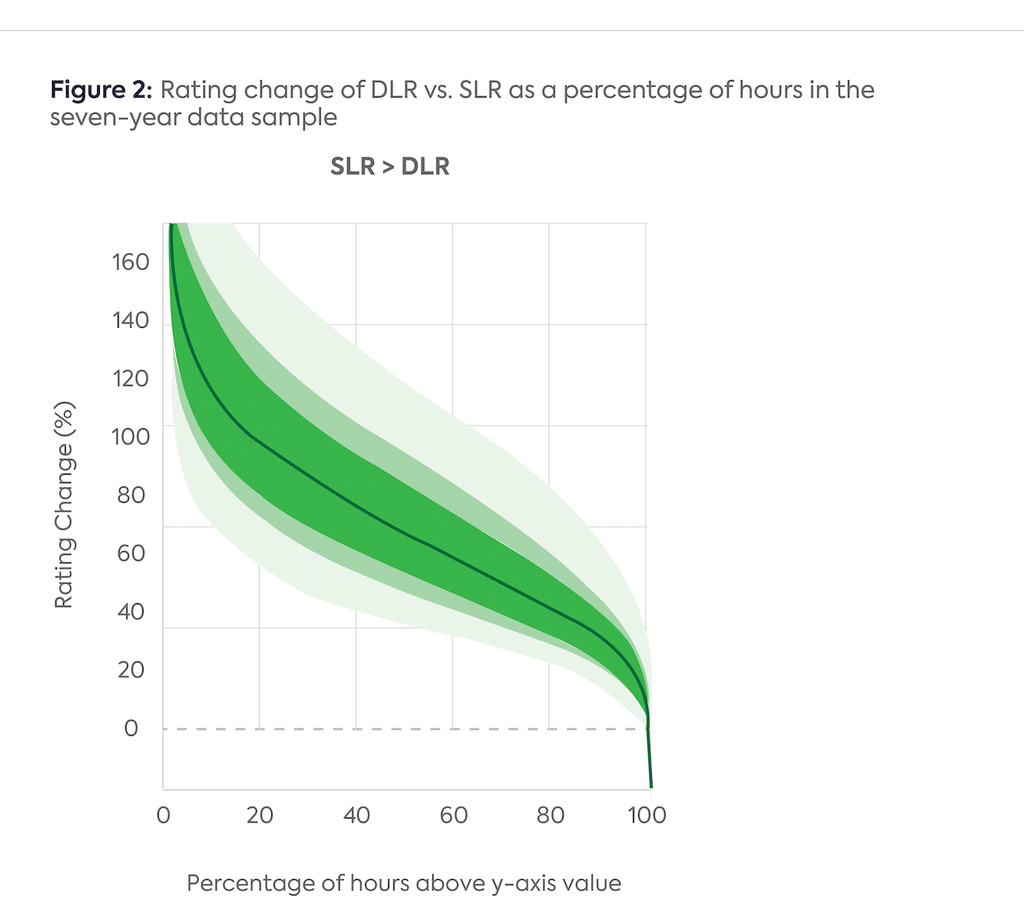
However, understanding of DLR’s potential benefit at a national level remains limited. Until recently, existing literature on DLR has tended to analyze small line sets under limited weather samples, leaving open the extent to which the findings are representative for the country. The NLR study instead uses a national dataset and high-resolution historical weather data covering seven years and combines public line routes from Homeland Infrastructure Foundation-Level Data with reanalysis hourly weather. The weather data include wind speed, wind direction, air temperature at 10 meters, and air pressure at approximately two-kilometer resolution from the Wind Integration National Dataset Toolkit,[lxvi] as well as global horizontal irradiance at approximately four-kilometer resolution from the National Solar Radiation Database.[lxvii] The study models each linear segment of a route independently to capture the angle between wind direction and conductor heading and defines the hourly rating of a line as the minimum among its constituent segments. The analysis subset comprises 51,957 lines at 115 kilovolts and above and no longer than 50 miles, evaluated over 61,368 hours spanning 2007 to 2013, yielding approximately 3.2 billion hourly rating values. Approximately 84,000 lines are represented in the released dataset.[lxviii] As shown in Figure 1, the study reports the range of potential gain from DLR relative to SLR across all evaluated lines as a function of the number of hours in a year. On average (the middle line within the dark green band), DLR could increase line ratings by 50–100 percent for 20–80 percent of the operating hours in a year.
Source: National Renewable Energy Laboratory (NREL) 2023, “DynamicLine Ratings” repository,github.com.
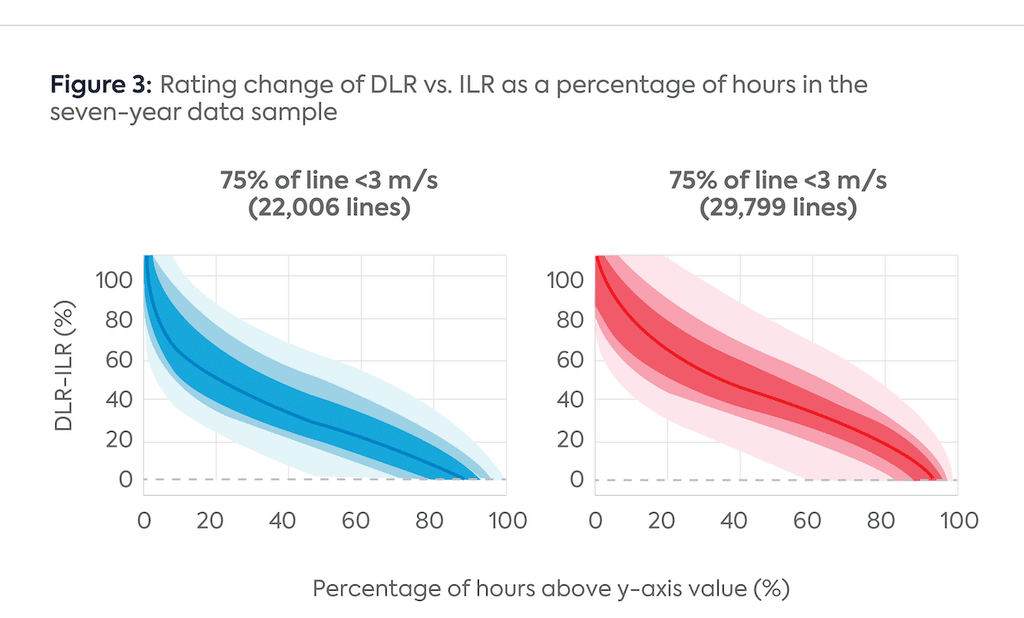
The study also indicates that wind and wind-driven convection are critical to thermal management. In particular, it finds that “Lines with >75% of their length above 3m/s tend to demonstrate larger increases in ratings with DLR than lines below the threshold, but there is significant variability across lines, and many lines below the threshold still show large benefits from DLR; full calculations including hourly wind speed and direction provide more information than heuristics based on average wind speed.” Figure 2 compares increases in rating from DLR with irradiance-adjusted line ratings (ILR), indicating how wind cooling affects the thermal capacity of the lines.
Source: National Renewable Energy Laboratory (NREL) 2023, “DynamicLineRatings” repository,github.com.
As the authors of the NLR study acknowledge, its use of historical wind and solar data means that it does not account for climate change effects, span-level sag and clearance, wildfire or ice loading, emergency ratings, actual installed conductor types, or ratings of non-conductor equipment such as transformers and breakers. The study also does not assess implementation costs or economic and emissions benefits, including congestion reduction and production cost savings. Perhaps most importantly, ratings derived from modeled weather are indicative only and must be verified by direct sensor measurement. Nevertheless, the NLR study represents the first detailed national-level assessment of GETs, providing promising evidence of capacity benefits at national levels.
Advanced Conductors
As noted in the preceding white paper, advanced conductors have been studied and deployed on select line segments over many years. They are also more straightforward to include in planning studies and economic evaluations than other GETs. Evolved Energy Research’s recent report on advanced conductor options for the Electric Reliability Council of Texas (ERCOT) is worth mentioning as an example of area-wide analysis to inform planning and decision-making. The study is based on modeling advancements that fuse capacity expansion with nodal power-flow physics, keeping ERCOT’s full approximately 5,000-bus and 7,000-line network intact so the model can choose upgrade type—reconductor, parallel greenfield, or voltage upgrade—endogenously and screen each choice against N-1 reliability. The model is built entirely from public data, with no Critical Energy Infrastructure Information (CEII), and should therefore be viewed with caution,[lxix] but it represents a step forward in assessment capabilities and, if supplemented by CEII data, could enable more accurate assessment. The study concludes that reconductoring can be an economically and technically attractive option for relieving thermal limits by using higher-ampacity conductors, while also observing that reconductoring alone cannot solve network problems such as switching limits or topology reconfiguration.
Topology Optimization
Topology optimization is highly dependent on network structure and configuration. For example, it offers little upside in networks with parallel pathways but can have a more significant impact in meshed networks. Technical evaluations of topology optimization and its use cases have been maturing for more than a decade.[lxx] Software-enabled solutions have also been deployed in select use cases and have demonstrated congestion relief and economic savings. Many of these use cases are presented in RTO or FERC proceedings or technical conferences rather than in published research, although the software approaches have been studied in academic literature.[lxxi] Advanced computing and software solutions offer significant opportunities to enhance these capabilities and enable increased deployment in real-time operations with associated cost savings.[lxxii]
Flexible AC Transmission Systems (FACTS)
FACTS use cases and deployment continue to expand worldwide. Evaluations of these technologies have largely been conducted on a use-case basis. EPRI and Idaho National Laboratory (INL), for instance, identified 10 use cases using power flow controllers that demonstrated positive technical and economic benefit.[lxxiii] However, FACTS devices and capabilities have only recently been incorporated into transmission planning tools, requiring sophisticated software upgrades and extensive computing capabilities.[lxxiv] As a result, system operator-, RTO-, regional-, or national-level evaluations have not been conducted, although increased computing capabilities and artificial intelligence (AI) may help facilitate this integration and are beginning to be deployed in commercial software packages such as Power System Simulator for Engineering.[lxxv] Interest in the potential of FACTS to help resolve transmission congestion and facilitate topology rerouting and optimization is likely to grow.
Economic Evidence and the Valuation Gap
As the preceding white paper showed, existing research has indicated the economic value of deploying GETs in specific use cases and at the national level. Additional technical analyses provide evidence that GETs offer not only increased utilization benefits (e.g., greater throughput capacity and energy), but also enhanced capabilities to manage the technical complexities through power electronics–enabled control of current, voltage, and phase angles.[lxxvi] Those use cases have continued to evolve. For example, the Energy Systems Integration Group (ESIG)[lxxvii] and Quanta[lxxviii] recently conducted numerous new case studies demonstrating positive economic value. However, similar to the previous analyses, these studies provide only coarse estimates of potential national impacts. Aside from the NLR DLR analysis, none is supported by detailed quantitative analytics.
Conclusion
This addendum suggests, based on the latest research, that GETs can help meet growing electricity demand by increasing utilization of existing transmission infrastructure. Recognizing this potential, many states and the federal government have introduced legislation and regulatory requirements to support the evaluation and deployment of GETs. DLR offers the strongest near-term opportunity due to growing awareness among utilities and regulators, an expanding range of use cases, and economic evaluations demonstrating benefits associated with their deployment in select contexts. Advanced conductors, topology optimization, and FACTS likewise show promise, but compared with DLR, they have been evaluated in fewer use cases and have less system-level or national-level analysis.
However, the prospect of deploying GETs at the system or national scale faces significant bottlenecks, including limited high-quality data, analytical capabilities, and real-world applications. High-quality transmission data remain inaccessible, and existing literature and utility reports typically focus on individual technologies in limited use cases rather than analyzing combinations of GETs at the regional or national level. More rigorous analysis is needed to evaluate GETs across service territories and regional transmission grids as well as to assess the impacts of combining these technologies in different ways tailored to a system’s specific energy, political, and economic circumstances.
Expanding the use of GETs will therefore require expanding access to high-quality data and advancing modeling methods and tools that take advantage of exascale computing, AI, and advanced mathematical formulations. These methods and tools can give utilities, regulators, and policymakers greater confidence that, in the right settings, GETs can deliver significant value. Reliability standards must also continue to evolve through NERC, IEEE, the International Council on Large Electric Systems (CIGRE), and related organizations around the world. Finally, investment decisions and regulatory reforms that support the deployment of GETs must continue to advance in parallel with the continued evolution of regulatory frameworks to recognize performance enhancements and performance-based results.
About the Authors
Dr. Douglas J. Arent is a Global Fellow at the Columbia University Center on Global Energy Policy and a Distinguished Fellow of the World Economic Forum. Dr. Arent brings more than three decades of experience and expertise in energy systems, electric power, and international energy policy.
Dr. Arent is Emeritus Executive Director at the NREL Foundation and holds emeritus status at the National Laboratory of the Rockies (previously the National Renewable Energy Laboratory), where he served for nearly thirty years. During his term, he was a member of the laboratory’s senior leadership team and helped guide its growth to an annual budget exceeding $1 billion.
He has served on numerous national and international advisory and study bodies, including committees of the National Academy of Sciences, the National Petroleum Council, and the Intergovernmental Panel on Climate Change.
He has authored more than 150 peer reviewed articles and is the author of Our Renewable Energy Future: The Remarkable Story of How Renewable Energy Will Become the Basis for Our Lives (World Scientific, 2024), which examines the technological, economic, and policy forces driving the global transition to renewable energy. His work has been published in Science, Nature Energy, Joule, and Energy Policy, among others.
He holds a BA from Harvey Mudd College, an MBA from Regis University, and a PhD from Princeton University.
Dr. Noah Kaufman is an economist who has worked on energy and climate change policy in both the public and private sectors. Noah is Senior Research Scholar at the Center on Global Energy Policy at Columbia University SIPA.
Under President Biden, Noah served as a Senior Economist at the Council of Economic Advisers. Under President Obama, he served as the Deputy Associate Director of Energy & Climate Change at the White House Council on Environmental Quality. At World Resource Institute, he led projects on carbon pricing, the economic impacts of climate policies, and long-term decarbonization strategies. Previously, he was a Senior Consultant in the Environment Practice of NERA Economic Consulting.
Noah received his BS in economics from Duke University, and his PhD and MS in economics from the University of Texas at Austin, where his dissertation examined optimal policy responses to climate change.
Lawrence Heath is a Non-Resident Fellow at the Columbia University Center on Global Energy Policy. In this capacity he focuses on the intersection of AI, energy, and geopolitics. Beyond the Center, Lawrence previously worked with former UK Prime Minister Tony Blair on energy policy and is currently an Associate Partner at McKinsey & Company. He began his career building geopolitical wargames for oil majors. Together, this experience provides him with distinctive knowledge across the full energy sector, spanning hydrocarbons to electrons, grounded in both business and political acumen. Lawrence holds degrees in Economics and International Relations, with concentrations in political economy and Chinese. He is a member of the Chicago Council on Global Affairs energy roundtable.
[iii] Omid Mirzapour, Xinyang Rui, and Mostafa Sahraei-Ardakani, “Grid-Enhancing Technologies: Progress, Challenges, and Future Research Directions,” Electric Power Systems Research 230 (2024): 110304; Ali Q. Al-Shetwi et al., “Latest Advancements in Smart Grid Technologies and Their Transformative Role in Shaping the Power Systems of Tomorrow,” Progress in Energy 7 (2025): 012004.
[v] Nurul Husniyah Abas et al., “Optimizing Grid with Dynamic Line Rating of Conductors: A Comprehensive Review,” IEEE Access 12 (2024): 9738–9756, https://doi.org/10.1109/ACCESS.2024.3352595.
[x] Mengxia Wang, Ming Yang, and Xueshan Han, “Optimal Power Flow Considering Transient Thermal Behavior of Overhead Transmission Lines,” International Journal of Electrical Power & Energy Systems 114 (2020): 105396, https://doi.org/10.1016/j.ijepes.2019.105396.
[xi] Mohammad Tarafdar Hagh et al., “A Comprehensive Review of Flexible Alternating Current Transmission System (FACTS): Topologies, Applications, Optimal Placement, and Innovative Models,” Heliyon 11, no. 1 (2025): e41001, https://doi.org/10.1016/j.heliyon.2024.e41001.
[xii] Ming Yu et al., “Power Flow Optimization and Economic Analysis Based on High Voltage Phase Shifting Transformer,” Energies 15, no. 7 (2022): 2363, https://doi.org/10.3390/en15072363.
[xix] Emilia Chojkiewicz et al., “Accelerating Transmission Capacity Expansion by Using Advanced Conductors in Existing Right-of-Way,” Proceedings of the National Academy of Sciences 121, no. 40 (2024): e2411207121, https://doi.org/10.1073/pnas.2411207121.
[xxiii] Jia Li et al., “Grid-Side Flexibility of Power Systems in Integrating Large-Scale Renewable Generations,” Renewable and Sustainable Energy Reviews 93 (2018): 272–284, https://doi.org/10.1016/j.rser.2018.04.109.
[xxvi] Bipartisan Policy Center, Unlocking the Potential of Grid-Enhancing Technologies.
[xxvii] DasomHam, Oliver Kay, and Catherine Hausman, “Transmission Lowers U.S. Generation Costs, but Generator Incentives Are Not Aligned,” Proceedings of the National Academy of Sciences 123, no. 9 (2026): e2524463123, https://doi.org/10.1073/pnas.2524463123.
[xxviii] Grid Strategies, Transmission Congestion in the U.S.
[xxxii] Paul L. Joskow, “The Expansion of Incentive (Performance-Based) Regulation of Electricity Distribution and Transmission in the United States,” Review of Industrial Organization 65 (2024): 455–503, https://doi.org/10.1007/s11151-024-09973-x.
[xlii] EPRI, Powering Intelligence 2026: Updated Scenarios of U.S. Data Center Electricity Use and Power Strategies, Electric Power Research Institute, 2026, https://powering-intelligence.epri.com/.
[xlvi] Amy Rose, Becca Fuchs, Lina Ramirez, and Ram Mohan Pandian, Informing Transmission Supply Chain Needs from National Transmission Studies, NLR/TP-6A40-97167, National Laboratory of the Rockies, 2026, https://www.nlr.gov/docs/fy26osti/97167.pdf.
[lvii] Julia Selker, Zach Zimmerman, Kelt Wilska, and Nathan Shreve, “Building on SB 1006: Scaling Advanced Transmission Technologies in California to Unlock Affordable Energy,” Grid Strategies LLC, July 16, 2026, https://gridstrategiesllc.com/building-on-sb-1006/.
[lviii] These include Colorado, Connecticut, Delaware, Illinois, Indiana, Louisiana, Maine, Maryland, Massachusetts, Minnesota, Montana, New Jersey, New Mexico, New York, North Carolina, Ohio, Oregon, Pennsylvania, South Carolina, Texas, Utah, Virginia, Washington, and Wyoming.
[lix] These include Connecticut, Delaware, Indiana, Massachusetts, New Mexico, Ohio, Oregon, Pennsylvania, South Carolina, Utah, and Virginia.
[lxi] Sogol Babaeinejadsarookolaee, Adam Birchfield, Richard D. Christie, Carleton Coffrin et al., “The Power Grid Library for Benchmarking AC Optimal Power Flow Algorithms,” arXiv:1908.02788, 2019, https://arxiv.org/abs/1908.02788.
[lxii] Adam B. Birchfield, Ti Xu, Kathleen M. Gegner, Komal S. Shetye et al., “Grid Structural Characteristics as Validation Criteria for Synthetic Networks,” IEEE Transactions on Power Systems 32, no. 4, 2017,, 3258–65, https://doi.org/10.1109/TPWRS.2016.2616385.
[lxiii] Andrea Britto, Thiago Spina, Weiwei Yang, Spencer Fowers et al., “Building Power Grid Models from Open Data: A Complete Pipeline from OpenStreetMap to Optimal Power Flow,” arXiv:2605.04289, 2026, https://arxiv.org/abs/2605.04289.
[lxvi] Caroline Draxl, Andrew Clifton, Bri-Mathias Hodge, and Jim McCaa, “The Wind Integration National Dataset (WIND) Toolkit,” Applied Energy 151, 2015,, 355–66, https://doi.org/10.1016/j.apenergy.2015.03.121.
[lxvii] Manajit Sengupta, Yu Xie, Anthony Lopez, Aron Habte et al., “The National Solar Radiation Database (NSRDB),” Renewable and Sustainable Energy Reviews 89, 2018,: 51–60.
[lxxii] Nico Westerbeck, Leonard Hilfrich, and Dirk Willhaut, “Transmission Topology Optimization Using Accelerated MAP-Elites,” arXiv, May 2026, https://arxiv.org/pdf/2605.10128.
[lxxiv] Kevin Wu, Mathieu Tanneau, and Pascal Van Hentenryck, “Strong Mixed-Integer Formulations for Transmission Expansion Planning with FACTS Devices,” Electric Power Systems Research 235, 2024 110695, https://doi.org/10.1016/j.epsr.2024.110695.
[lxxv] J. Gentle, S. M. S. Alam, M. Sun, Z. Priest et al., Implementation and Operation of Power Flow Control Solutions for Transmission Systems, INL/RPT-24-78148, rev. 0, INL and EPRI, 2024.
[lxxvi] Tong Su, Junbo Zhao, Antonio Gomez-Exposito, Yousu Chen, et al., “Grid-Enhancing Technologies for Clean Energy Systems,” Nature Reviews Clean Technology 1, no. 1 (2025): 16–31, https://doi.org/10.1038/s44359-024-00001-5.
Data centers face growing local opposition as states impose moratoriums on hyperscale projects and grid connections. Communities can negotiate deals for tax revenue and jobs.