This website uses cookies as well as similar tools and technologies to understand visitors’ experiences. By continuing to use this website, you consent to Columbia University’s usage of cookies and similar technologies, in accordance with the Columbia University Website Cookie Notice.
This Energy Explained post represents the research and views of the author(s). It does not necessarily represent the views of the Center on Global Energy Policy. The piece...
Global gas markets, especially in Europe, are approaching winter under serious pressure. With storage inventories lagging behind historical averages and shipping disruptions from the Middle East threatening key...
Apply to Register The Center on Global Energy Policy at Columbia University SIPA’s Women in Energy initiative invites Columbia University students to a roundtable discussion with Pam Brown,...
Event
• Center on Global Energy Policy
Large Conference Room
About Us
We are the premier hub and policy institution for global energy thought leadership. Energy impacts every element of our lives, and our trusted fact-based research informs the decisions that affect all of us.
This Energy Explained post represents the research and views of the author(s). It does not necessarily represent the views of the Center on Global Energy Policy. The piece may be subject to further revision.Contributions to SIPA for the benefit of CGEP are general use gifts, which gives the Center discretion in how it allocates these funds. More information is available here. Rare cases of sponsored projects are clearly indicated.
Disruptions in the Strait of Hormuz have increased China’s clean-tech exports as countries seek to become less dependent on fossil fuels but have also exposed upstream vulnerabilities in China’s clean-tech supply chains.
Reduced supplies of petrochemical feedstocks and sulfur for mineral processing have raised costs and reduced output at some upstream suppliers, while downstream manufacturing has so far remained broadly resilient.
China’s domestic production, processing, and natural supplies of key materials as well as its coal-based power system provide important buffers to curtailed supplies but may not fully insulate the country if the Middle East crisis persists. These buffers could also create long-term risks from overcapacity, higher emissions, and carbon-related trade pressure.
The Middle East crisis has increased demand for China’s clean technologies as disruptions to oil and gas supplies in the Strait of Hormuz (SoH) make alternatives to fossil fuels more attractive. But meeting this demand could become more difficult if upstream constraints persist—Chinese clean-tech production depends on imported petrochemical feedstocks and processing chemicals disrupted by events in the Persian Gulf. While downstream output has remained broadly resilient so far, higher input costs and tighter overseas supplies are encouraging adjustments to the upstream that carry risks.
The author finds that while the country has real advantages to weathering the crisis—such as the ability to substitute some feedstocks, a domestic supply of other key materials, and a power system not heavily dependent on imported energy—China is less insulated from petrochemical and industrial chemical chokepoints than is often assumed. These vulnerabilities could become more consequential in a prolonged crisis.
Two Main Supply Hurdles
Petrochemical Feedstocks
Petrochemical feedstocks such as naphtha, liquefied petroleum gas (LPG), and ethane are used to manufacture components for solar photovoltaics, batteries, and electric vehicles. Before the conflict, the Middle East supplied about 40% of China’s naphtha imports and 45% of its LPG imports, mostly via the SoH. In April 2026, Chinese imports of Middle Eastern naphtha and LPG fell more than 70% year-over-year.
Refiners in China cut petrochemical output while seeking alternative feedstocks. US ethane helped offset part of the loss, with China’s imports rising 72% month-over-month in April 2026. But ethane is an imperfect substitute because naphtha and LPG produce a broader range of olefins and co-products. With China’s petrochemical production falling, polymer prices rose to around four-year highs earlier this year and have remained elevated and volatile through September, increasing input costs for clean-tech manufacturers even as downstream output has held up.
Methanol is another important feedstock that is used to make lithium-ion battery electrolyte solvents and can be converted into ethylene and propylene for plastics used in solar panels, batteries, and EV components. Around one-third of global seaborne methanol trade passed through the SoH pre-conflict. About 70% of China’s methanol imports came from the Middle East in 2025.
Industrial Chemicals
The second supply hurdle involves industrial chemicals. The most important is sulfur, which is used to produce sulfuric acid for mineral processing in battery and EV supply chains. About half of global seaborne sulfur passed through the SoH pre-conflict. Volumes fell by 98% in April 2026, and delivered prices in Asia rose about 50%.
Although China is the world’s largest sulfuric acid producer, it imports over half of its sulfur supply. About 56% of China’s sulfur imports came from the Middle East in 2025, but volumes more than halved in the first half of 2026.
China’s nickel-based battery supply chain relies heavily on nickel intermediates processed in Indonesia, where sulfuric acid is essential for high-pressure acid leaching (HPAL) of nickel ores. Indonesia relies on the Middle East for about 75% of its sulfur imports, and sulfur shortages forced some HPAL operators to reduce output and raised nickel-processing costs by roughly one-third, tightening supplies to Chinese cathode, battery, and EV manufacturers.
Sulfuric acid is also important for China’s lithium-processing industry. China dominates global lithium-processing capacity but relies heavily on concentrate imported mostly from Australia. Chinese processors use sulfuric acid to convert this concentrate into lithium carbonate and lithium hydroxide for battery manufacturing. Sulfuric acid shortages have raised hard-rock lithium-conversion costs, with sulfuric acid’s share of production costs reportedly more than tripling in some cases.
China has sharply restricted sulfuric acid exports in the near term to prioritize domestic supply, which limits its ability to relieve shortages in overseas nodes such as Indonesia. So far, upstream disruptions have raised input costs and tightened battery-material supplies, but downstream clean-tech manufacturing has largely absorbed the shock.
China’s Manufacturing Is Advantaged but Not Insulated
China has several advantages in its clean-tech industry, including its ability to substitute some petrochemical feedstocks, domestic supplies of selected materials, and a power system less exposed to natural gas. But each comes with limits.
China can reduce imported petrochemical feedstock exposure through coal-to-chemicals projects that can replace some oil-derived naphtha,integrated refining-petrochemical complexes that increase chemical yields, and deep-conversion technologies that can turn heavier, non-Middle Eastern crude into olefins. It can also impose export restrictions to protect domestic supply. But petrochemical feedstocks remain heavily dependent on imported crude oil. China imports about 70% of its crude, roughly half from the Middle East pre-conflict, and that share fell to 32% in Q2 2026.
But over time, a rushed expansion of substitute capacity could increase domestic and global petrochemical oversupply, squeeze margins, and discourage investment in cleaner, more efficient production. Coal-to-chemical production emits significantly more greenhouse gases than oil- or gas-based production, increasing risks to China’s net-zero trajectory and exposure to carbon-related trade policies.
A second advantage is that China is well positioned in key materials such as graphite and aluminum, with dominant graphite mining and processing capacity as well as a large aluminum refining, smelting, and processing base. Graphite is essential for battery anodes and aluminum is used in solar-module frames, grid infrastructure, and EV lightweighting. In 2024, China produced about 78% of global natural graphite and about 60% of the world’s newly smelted aluminum. Although China imports bauxite for aluminum production, most of it comes from Guinea and has been unaffected by the SoH closure.
Producing these materials depends heavily on China’s abundant, low-cost, coal-based power, as both graphite processing and aluminum smelting are electricity-intensive. China’s power system, with coal providing about half of generation, helps shield clean-tech manufacturing from wider fuel supply and price shocks that power systems more dependent on imported natural gas face. The IEA estimates that coal supplies over 60% of the electricity used in global solar PV manufacturing, largely because production is concentrated in China’s Xinjiang and Jiangsu provinces, where coal accounts for over 75% of annual power generation and benefits from favorable tariffs.
But this power system resilience creates longer-term risks for China, as carbon-footprint requirements, procurement standards, and carbon-related trade measures could penalize such carbon-intensive production.
While the Hormuz disruptions have reinforced China’s clean-tech export strength, they have also exposed upstream dependence on imported crude and sulfur. Higher petrochemical feedstock and mineral-processing costs have reduced some upstream output, but China has been able to balance this somewhat with its ability to substitute feedstocks, a domestic supply of key materials, and a power system that relies on domestic coal. As noted, though, these advantages also carry risks of overcapacity, higher emissions, and carbon-related trade pressure.
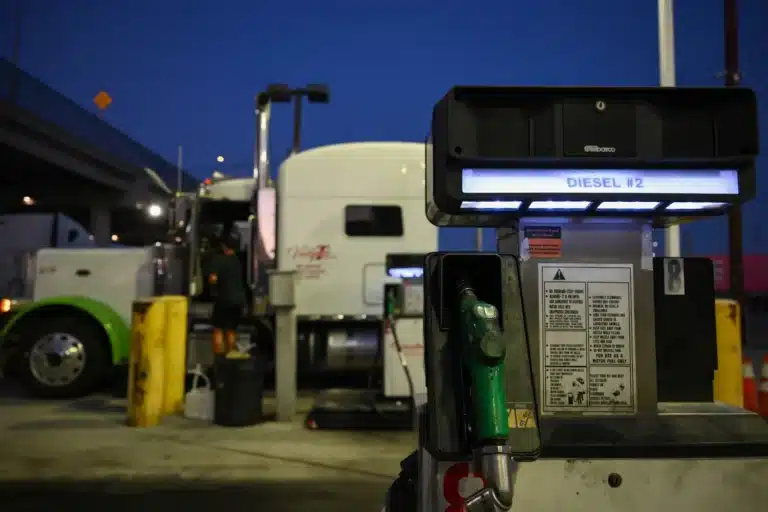
As inventories run dry and the Iran war continues to disrupt transit routes, oil has surged back to more than $100 per barrel. Diesel fuel—the workhorse of the agricultural and trucking sectors—has now soared to historic highs, pushing U.S. exports to record levels.