This website uses cookies as well as similar tools and technologies to understand visitors’ experiences. By continuing to use this website, you consent to Columbia University’s usage of cookies and similar technologies, in accordance with the Columbia University Website Cookie Notice.
Last week's summit between US President Trump and Chinese President Xi was the second meeting between the two leaders since the US and Israel attacked Iran.
Carbon credit markets have become one of the most hotly debated tools in the fight against climate change. Supporters call them essential to closing the gap between corporate...
Apply to Register The Center on Global Energy Policy at Columbia University SIPA’s Women in Energy initiative invites Columbia University students to a roundtable discussion with Pam Brown,...
Event
• Center on Global Energy Policy
Large Conference Room
About Us
We are the premier hub and policy institution for global energy thought leadership. Energy impacts every element of our lives, and our trusted fact-based research informs the decisions that affect all of us.
This commentary represents the research and views of the authors. It does not necessarily represent the views of the Center on Global Energy Policy. The piece may be subject to further revision. Contributions to SIPA for the benefit of CGEP are general use gifts, which gives the Center discretion in how it allocates these funds. More information is available at Our Partners. Rare cases of sponsored projects are clearly indicated.
Six months into the Strait of Hormuz crisis, crude oil prices have stabilized well below wartime peaks, but a worsening refined fuel crunch shows the 1970s-era strategic oil reserve system built around crude oil in advanced economies cannot address the refined product shortfall.
With U.S. refiners running near operational limits heading into U.S. winter and hurricane season, Middle Eastern capacity damaged or stranded, Russian refineries repeatedly disrupted by drone strikes, and China’s substantial spare capacity restricted by export quotas, geopolitical and logistical constraints in refining are now critical energy and economic security variables.
Policymakers should consider measures to sustain a floor in strategic refining capacity during the energy transition, preserving critical conversion functions and optionality rather than defending all aging OECD capacity. Installed refining capacity is not effective spare capacity without the ability to mobilize, supply, and connect it to deficit markets.
The most pressing problem in oil markets today is not a shortage of crude, but a shortage of the capacity to turn crude into the fuels consumers need. Six months into the Strait of Hormuz crisis, benchmark Brent crude oil prices are sitting around $90/barrel, well below April’s wartime peaks over $125/barrel,[1] despite ongoing disruptions to maritime transit since the US-Iran Memorandum of Understanding collapsed in July. The more intense oil shock is playing out in fuel markets like diesel, jet fuel and gasoline, with diesel facing the largest crunch.
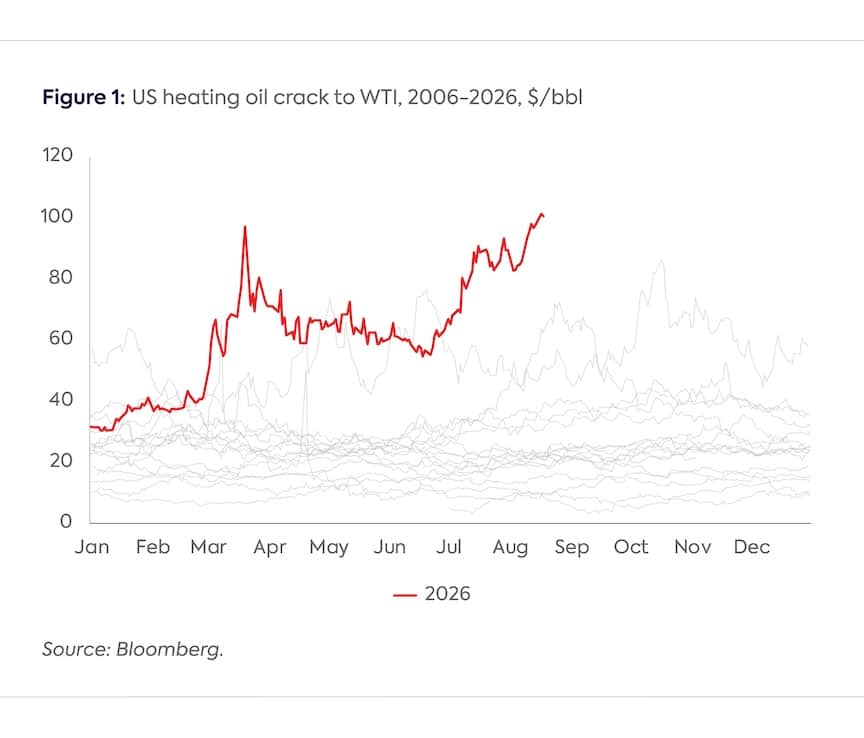
Crack spreads, the difference between crude oil and transportation fuel prices, have spiked to record levels. U.S. diesel cracks jumped over $100/barrel in mid-August (see Figure 1), an unprecedented extreme on top of an $85/barrel WTI price. Globally, finished transportation fuels are trading in the $150-$190/barrel range, levels that reflect severe supply disruptions.
Behind record refining margins are the simultaneous shocks of disruptions to maritime transit through the Hormuz and Bab al-Mandab (Red Sea) chokepoints, damage to Middle East Gulf and Red Sea refineries, and Ukraine’s intensifying attacks on Russia’s refining assets, all of which are significantly disrupting trade in refined products. These shocks have disrupted 20 percent of global seaborne shipments of diesel while jet fuel trade is down by roughly one-third compared with last year.
This commentary examines why there is not a shortage of crude, but too little effective refining capacity in the right locations, with feedstock access and the conversion capacity to produce and distribute the right fuels where and when needed. It also highlights geopolitical distinctions between where refining capacity is installed and can be mobilized as the industry’s center of gravity shifts from OECD countries toward Asia and the Middle East. U.S. refiners have exported record volumes to capture enormous margins (depleting U.S. oil product inventories) but are now near their operational limits. Middle Eastern capacity is partly impaired or stranded, while some Asian refiners are constrained by a lack of crude oil feedstock. China, meanwhile, holds the largest pool of spare capacity but resorted to export controls during the crisis. The refined product crisis creates short-term market risks and highlights other long-term risks. The Northern Hemisphere is heading into winter, exposing regions dependent on heating oil, such as the U.S. Northeast, to potential shortages and price spikes. In the longer term, the decline in spare refining capacity risks leaving the global system ill-equipped to respond to future disruptions.
Second, this commentary argues that these crises are playing out against a 1970s energy security playbook built largely around crude oil buffers concentrated in advanced economies that are no longer the dominant drivers of oil consumption growth. The crisis rippling through fuel markets suggests refining capacity and petroleum product trade flows need to be treated as an energy security variable, not a downstream afterthought to crude oil availability.
The piece concludes with considerations and recommendations for policymakers and industry leaders, highlighting the need for a policy framework to strengthen energy security in refined products. Specifically, the piece suggests reassessing the composition and location of strategic stocks with a greater role for refined products where appropriate, managing the decline in refining capacity while preserving a strategic floor of critical refining conversion and delivery capabilities, and assessing usable refining capacity by specific products and route. Capacity that cannot be activated or connected to a deficit market is not effective spare capacity.
Four drivers of a refined fuel crunch
The relative stability of crude oil prices as refined fuel prices blow out shows that the world’s oil system can have adequate buffers of crude but still be functionally short of fuel when specialized processing units, product stocks, or transport links fail for specific fuels. The following is a discussion about the four challenges behind the crunch in transportation fuels, concentrated in middle distillates – especially diesel and jet fuel. Diesel is particularly exposed, as the winter heating season begins with inventories well below five-year minimum levels.
1. Middle East refining capacity has been bottled up and damaged
The Middle East accounted for 11 percent of the world’s refining capacity in 2025.[2] The closure of the Strait of Hormuz and attacks on Gulf refineries lowered regional refinery runs by 27 percent to around 6.5 million barrels per day (mb/d) in Q2 2026, sharply cutting regional product exports, which exceeded 5 mb/d before the war.[3] While so-called dark transits—shipments by vessels with tracking signals disabled or obscured—have helped seaborne crude flows through Hormuz recover to an estimated 40-50 percent of pre-war volumes,[4] refined products have failed to show any meaningful recovery given far more complex logistics and prohibitive costs under current security conditions.[5] According to the IEA, global seaborne trade in refined products was down 3.8 mb/d year on year (y/y) in July—over half of that is diesel and jet fuel.[6] According to OPEC, in 2025, the Middle East represented more than 15 percent of global diesel exports and roughly a fifth of the world’s trade in jet fuel.[7] The region is a less important global gasoline supplier, exporting roughly 450,000 b/d in 2025, compared with a combined 1.7 mb/d of diesel and aviation fuel and over 2 mb/d of petrochemical feedstocks such as LPG and naphtha.[8]
Strait of Hormuz closures had compounding effects in Asia, not only by disrupting product supply but by knocking down Asia’s own refining sector (40 percent of world capacity) via disruptions to crude and related feedstocks.[9] For example, India’s export-oriented refining system, which had been a source of flexibility during Russia’s invasion of Ukraine, had to confront its own crude supply disruptions.[10]
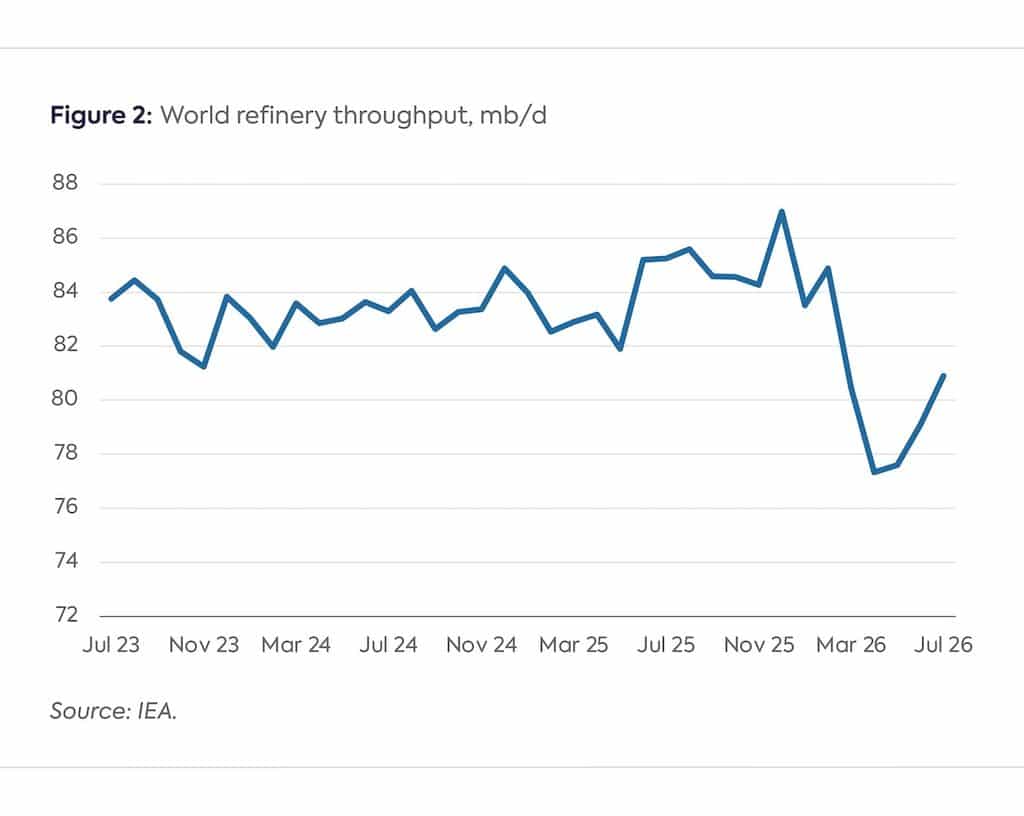
At the peak of the Hormuz crisis in April/May 2026, combined refinery runs in the Middle East and Asia fell more than 7.5 mb/d versus pre-war levels, according to IEA data (see Figure 2). Refinery throughput has since improved on more reliable feedstock availability (from strategic reserve releases, Middle East dark transits, flows from the Americas, reduced Chinese crude oil purchases and higher Russian crude supply as a result of lower refining runs). But East of Suez refinery runs are still nearly 5 mb/d below pre-war levels.[11]
2. Russian refining disruptions are tightening global middle-distillate markets
By July 2026, the IEA had recorded at least 100 Ukrainian strikes on refineries since August 2025,[12] with many of them struck repeatedly. The broader campaign also targeted pipelines, ports, maritime infrastructure and tankers. Before the last wave of attacks, Russian refineries were processing about 5.0-5.5 million b/d of crude oil.[13] Kpler estimated that about 1.5-2.0 mb/d of Russian capacity was effectively offline, but refineries in downtime or affected by attacks represented about 4.3 million b/d, or 58 percent, of Russian capacity.[14] The impact has been especially severe for middle distillates, as strikes have damaged secondary processing units and logistics.
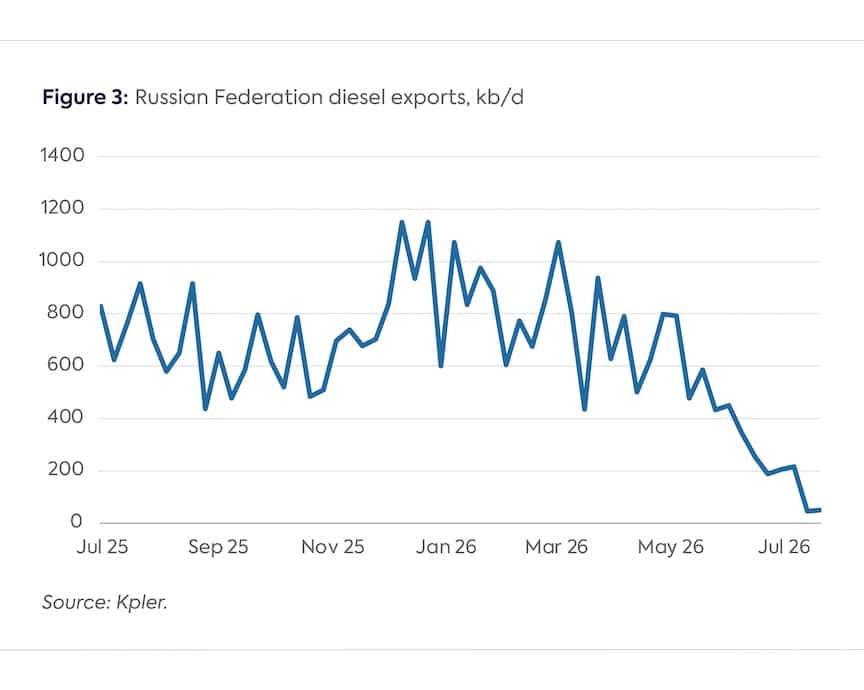
At the time that Russia banned diesel exports in July to prioritize domestic supply,[15] Russia’s more than 800,000 b/d of middle-distillate exports reported by Kpler in 2025 had fallen to around 350,000 b/d in June, a 60 percent y/y decline. By the end of July, these exports were down to 50,000 b/d, an 82% y/y decline (see Figure 3).
Russia, the second-largest exporter of diesel after the United States, had redirected its exports mainly to Turkey, Brazil and West Africa since the EU embargo. But as these barrels disappeared because of Ukraine drone attacks, these buyers are competing with Europe and other importers for U.S. and other replacement cargoes. The loss of Russian export availability therefore removes a major source of Atlantic Basin flexibility just as Middle Eastern product exports are also impaired.[16]
The strategic effect of Ukraine’s drone strikes is therefore larger than the barrels physically disrupted: the attacks are changing the behavior of the system, forcing shifts in refinery scheduling, crude and product trade, fuel standards and domestic allocation.
3. Global spare refining capacity has shifted to emerging markets, creating new risks for global refined fuel markets
The United States did exactly what a market-based refining system is supposed to do in a global shortage: record margins pushed refiners to maximize throughput and product exports. Refinery utilization reached 97.2 percent in mid-August, and U.S. product exports surged to meet global demand. [17] But this responsiveness should not be confused with global resilience. U.S. distillate stocks remain about 13 percent below their five-year average, and U.S. refiners are operating close to practical limits as hurricane season and autumn maintenance approach.[18] With virtually all capacity mobilized, there is little redundancy to absorb another major unit going offline.
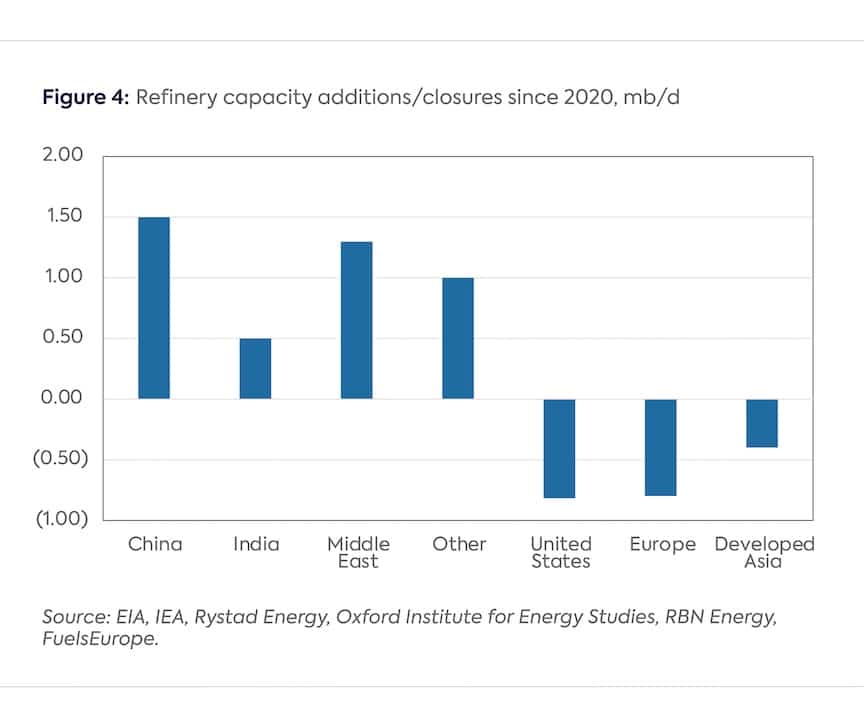
Record cracks offer refiners every incentive to maximize throughput, but there is hardly any slack left in the OECD system. Refinery capacity in the United States, Europe and developed Asia has dropped by nearly 2 million b/d over the past decade due to structural demand erosion (vehicle efficiency standards, EV adoption), carbon and environmental compliance costs, and the challenged economics of aging assets (see Figure 4).
As Figure 4 shows, the United States has shed close to a net 800,000 b/d of refining capacity since a 2020 peak. Europe has lost a comparable amount, with declines in Developed Asia concentrated in Japan, which closed 240,000 b/d of capacity in 2023-24, [19] and Australia[20], which since 2021 has shut two of its last four refineries.[21] Meanwhile, as Figure 4 shows, essentially most of the world’s net new refining capacity has been built in China (a net 1.5 mb/d, after consolidating some teapot refineries), India and the Middle East (1.3 mb/d). In this crisis, Middle East refineries have been at the epicenter of the conflict zone, and one of China’s first moves was restricting refined product exports in Q2 2026 as refiners slashed throughput.[22] China has the world’s largest repository of spare refining capacity, but state-owned refiners are utilizing only 73-74 percent of available capacity, and independent teapot utilization stands at 50 percent.[23] Because China manages product exports through a quota system to balance the domestic market, Chinese refiners have not been able to capitalize on attractive export margins. [24] China’s export restrictions have since eased as feedstock became more available, but China’s refining capacity remains only partially available to the world market. How much reaches global buyers depends on feedstock availability, domestic priorities and export approvals, making China’s response to price signals policy-mediated rather than market-driven.
The IEA estimates an additional 1.6 million b/d of refinery capacity closures in the 2025-2030 period in OECD countries, with most taking place in Europe and to a lesser extent in the Americas.[25] The current supply disruptions in fuels markets could lead policymakers to consider whether measures to slow down the speed of refinery closures for energy security considerations are appropriate and/or which hard-to-replace conversion capabilities and delivery options should be preserved.
4. Emergency stocks cushioned crude markets more effectively than product markets
On March 11, IEA members agreed to release 400 million barrels from emergency reserves, the largest coordinated stock release in the agency’s history.[26] According to the IEA, 72 percent of this release was crude oil (largely from the U.S. and Japan), and only 28 percent was finished products (mostly from the EU, which requires member states to hold a meaningful share of national stocks as finished products).[27] By July, roughly 290 million barrels, about 73 percent of that pledge, had physically reached the market.[28] The SPR releases did what they were designed to do: increase crude feedstock availability, buy time, and dampen the price shock. But crude-heavy inventories could not recreate damaged conversion units, solve product-specification mismatches, or move fuel through closed routes. Oil product buffers provided relief, but they were smaller and fragmented by grade and location.
Geopolitical and energy security conclusions from refining disruptions
The global refining industry entered this crisis under structural pressure from declining road-fuel demand in some advanced economies, aging assets, and decarbonization policy. But the shock exposes a deeper problem. A modern oil system can be materially abundant and functionally scarce: crude may be available but the capability to turn it into the right fuel, specification, and location is not. Chokepoints are not only a geographical distinction, but also a value-chain issue, and this crisis is revealing refining as a chokepoint in the system. The relevant unit of oil security is therefore not the barrel of crude—or even the refinery in isolation—but the conversion-and-delivery network linking feedstocks, processing units, storage, ports, pipelines, shipping, trade rules and end users. Here are some considerations for policymakers and industry decision-makers internalizing the lessons of the current oil market disruptions:
The 1970s strategic reserve model should be updated. The IEA system is built around crude oil in advanced economies that dominated consumption half a century ago. This year’s release stabilized crude markets, but inventories cannot recreate a disabled hydrocracker, solve a specification mismatch, or move fuel through a closed route. Energy security planning has to treat refined products as their own variable, not a downstream afterthought to crude. That means policymakers need to reassess the strategic value of product storage and the associated questions and challenges of storing different fuels, including their cost, degradation issues, and location.
Energy security should preserve critical functions and options, not every refinery. Structural refinery closures in advanced economies, and a steady demand shift toward petrochemicals, aviation and other non-road fuels, require a more intentional policy framework to maintain a floor of strategic capacity. An uneven distribution of global refining slack, now centered in China, has security implications akin to those of supply chains for critical minerals, semiconductors, and clean energy technologies. National energy ministries and regulators, working with industry, should identify a strategic floor of critical refining and delivery capabilities. This does not mean maintaining all aging OECD nameplate capacity. It means identifying which conversion capabilities, product grades and transport links are hard to replace, and preserving a portfolio of options: including restartable units, product stocks, import terminals, blending and specification flexibility, pipeline and rail links, pre-arranged trade channels, emergency regulatory waivers. The objective is managed decline with preserved optionality.
One of the lessons from the crisis for policymakers, international organizations and industry decision makers should be that the security value of refining capacity depends on access to feedstock, the ability to produce the required fuels, and connections to deficit markets. The current crisis exposed different constraints: U.S. refiners responded to margins but are near operational limits; Middle Eastern capacity is damaged or stranded; Russian refining output has been disrupted by repeated refinery attacks; and China’s substantial installed capacity is limited to global markets by policy. Policymakers should therefore assess usable conversion capability by product and route, rather than gross nameplate capacity. Capacity that cannot be activated, supplied and connected to deficit markets is not spare capacity for the system; the same is true of capacity sitting in geopolitical hotspots.
Decarbonization and oil security are not a simple trade-off. Falling average demand does not remove seasonal, peak, or crisis requirements for particular products. Electrification reduces exposure to oil shocks, but leaving the shutdown of conversion and logistics capability to the market, without government coordination, can increase vulnerability during the transition. The question is not whether to preserve the 20th-century refining system, but which critical assets to retain, where a slowdown of announced refinery closures is appropriate or which refineries can be retrofitted or even brought back online, and how to strengthen product storage and import infrastructure in key regions, particularly where refineries have already closed. [29]
[4] Emmanuel Balestrino, “60 days of a broken US-Iran MoU: the market stopped waiting for Hormuz” Kpler, August 19, 2026, https://www.kpler.com/blog/60-days-of-a-broken-us-iran-mou-the-market-stopped-waiting-for-hormuz.
[5] Mitchell Ferman, “Oil CEOs See Market Split With Bearish Crude, Bullish Fuels” Bloomberg
August 24, 2026, https://www.bloomberg.com/news/articles/2026-08-24/total-ceo-says-market-is-bearish-for-crude-bullish-for-products-mt75hra8.
[6] This means that about 20 percent of diesel exports and 38 percent of jet fuel exports are offline. See IEA (2026), “Oil Market Report,” August 2026, IEA, Paris https://www.iea.org/reports/oil-market-report-august-2026.
[9] Energy Institute, Statistical Review of World Energy 2026, https://www.energyinst.org/statistical-review
[10] Luisa Palacios and Shayak Sengupta, “Tensions with the United States and the EU Could Threaten India’s Role as Refinery Hub”, Center of Global Energy Policy, September 9, 2025, https://www.energypolicy.columbia.edu/tensions-with-the-united-states-and-the-eu-could-threaten-indias-role-as-refinery-hub/
[14] Sumit Ritolia, “Ukraine’s drone campaign pushes Russian refinery runs to 21-year lows,” Kpler, August 2026, https://www.kpler.com/blog/ukraines-drone-campaign-pushes-russian-refinery-runs-to-21-year-lows.
[15] “Russia to extend diesel export ban through September, sources say,” Reuters, August 25, 2026, https://www.reuters.com/business/energy/russia-extend-diesel-export-ban-through-september-sources-say-2026-08-25/.
[16] “Falling Russian diesel exports tighten global distillate markets,” Oil and Gas Journal, July 17, 2026, https://www.ogj.com/general-interest/economics-markets/news/55391756/falling-russian-diesel-exports-tighten-global-distillate-markets.
[17] Utilization rate numbers are from the EIA’s Weekly Inputs & Utilization data,https://www.eia.gov/dnav/pet/pet_pnp_wiup_dcu_nus_w.htm. Also, according to the EIA, U.S. exports of petroleum products are now at 8.3 million b/d, a 20 percent increase y/y.
[18] EIA, Weekly Petroleum Status Report, August 19, 2026, https://www.eia.gov/petroleum/supply/weekly/pdf/wpsrall.pdf.
[19] EIA, “Japanese refineries close as the country’s petroleum consumption falls,” Today in Energy, December, 13, 2023, https://www.eia.gov/todayinenergy/detail.php?id=61063.
[20]Tina Soliman-Hunter, “Australia hasn’t built an oil refinery in decades. But that could change” The Conversation, July 29, 2026, https://theconversation.com/australia-hasnt-built-an-oil-refinery-in-decades-but-that-could-change-288497.
[22] Luisa Palacios and Erica Downs, “Disruptions in the Middle East Reinforce China’s Aim for Greater Self-Sufficiency in Refining and Petrochemicals,” Center on Global Energy Policy, May 18, 2026, https://www.energypolicy.columbia.edu/disruptions-in-the-middle-east-reinforce-chinas-aim-for-greater-self-sufficiency-in-refining-and-petrochemicals/.
[23]Tsvetana Paraskova,“China’s Teapot Refineries Cut Operations to Their Lowest Level Since 2017,” OilPrice.com, Jun 24, 2026, https://oilprice.com/Latest-Energy-News/World-News/Chinas-Teapot-Refineries-Cut-Operations-to-Their-Lowest-Level-Since-2017.html.
[26] IEA, “IEA Member countries to carry out largest ever oil stock release amid market disruptions from Middle East conflict,” Press release, March 11, 2026, https://www.iea.org/news/iea-member-countries-to-carry-out-largest-ever-oil-stock-release-amid-market-disruptions-from-middle-east-conflict.
[27] IEA, “IEA confirms Member country contributions to collective action to release oil stocks in response to Middle East disruptions” Press Release, March 19, 2026, https://www.iea.org/news/iea-confirms-member-country-contributions-to-collective-action-to-release-oil-stocks-in-response-to-middle-east-disruptions
[29] For a discussion on a specific product storage for heating oil in the U.S. North East see Marianne Kah & Luisa Palacios “US Diesel Supply Risks in the Era of Energy Security and Transition”, Center on Global Energy Policy, January 31, 2023, https://www.energypolicy.columbia.edu/us-diesel-supply-risks-in-the-era-of-energy-security-and-transition/.
As inventories run dry and the Iran war continues to disrupt transit routes, oil has surged back to more than $100 per barrel. Diesel fuel—the workhorse of the agricultural and trucking sectors—has now soared to historic highs, pushing U.S. exports to record levels.