This website uses cookies as well as similar tools and technologies to understand visitors’ experiences. By continuing to use this website, you consent to Columbia University’s usage of cookies and similar technologies, in accordance with the Columbia University Website Cookie Notice.
The work of scientists and researchers deserves celebration, but solid climate, energy, and technology breakthroughs need costly infrastructure and sustained funding to scale. Relying on private philanthropy like the Bezos Fund for climate research says a lot about this country’s expressed values while laying a fragile foundation for our industry’s future.
Permitting reform—to allow for faster approvals on new projects—is one thing that both climate advocates and energy developers have wanted for a long time. With demand for power...
The Center on Global Energy Policy at Columbia University SIPA’s Women in Energy initiative invites Columbia University students to a roundtable discussion with Pam Brown, Managing Director at...
Event
• Center on Global Energy Policy
Large Conference Room
About Us
We are the premier hub and policy institution for global energy thought leadership. Energy impacts every element of our lives, and our trusted fact-based research informs the decisions that affect all of us.
This Energy Explained post represents the research and views of the author(s). It does not necessarily represent the views of the Center on Global Energy Policy. The piece may be subject to further revision.
Contributions to SIPA for the benefit of CGEP are general use gifts, which gives the Center discretion in how it allocates these funds. More information is available here. Rare cases of sponsored projects are clearly indicated.
New York’s 2030 emissions target appears out of reach based on the current law.
The costs of meeting the current 2030 target should not be confused with the costs of well-designed climate regulations.
The economic case for the state’s cap-and-invest program remains strong, even in an environment of high energy costs.
New York’s greenhouse gas accounting method weights methane much more heavily than carbon dioxide, significantly affecting the state’s measured emissions.
On March 20, Governor Kathy Hochul proposed significant changes to New York’s Climate Leadership and Community Protection Act (CLCPA), the landmark climate law passed in 2019. These proposed amendments include extending the deadline to issue regulations from 2024 to 2030 and changing the greenhouse gas (GHG) accounting rules to align with the standard used by most other states.
Hochul frames the change as necessary to protect vulnerable New Yorkers from the costs of climate regulations. Environmental groups view it as a retreat from climate action at precisely the moment states need to step up. Both sides are largely talking past each other, and a showdown is looming in budget negotiations.
This blog post provides a common set of facts to enable a more constructive conversation about New York’s next steps.
Limited Progress Toward the 2030 Goal
Emissions targets can serve a practical purpose in climate policy strategies by forcing jurisdictions to chart credible pathways toward long-run goals and providing a benchmark to measure progress against.
When the CLCPA passed in 2019, its goal of 40 percent emissions reductions by 2030 relative to 1990 levels seemed ambitious but achievable with sustained progress on clean-tech innovations, implementation of regulations, and federal support. Several of these factors have not been sustained, however. The post-pandemic supply-chain disruptions and inflationary spike hampered progress on key technologies, including offshore wind―just a small fraction of the 9 gigawatts envisioned by CLCPA by 2035 is likely to be deployed. The state itself missed the statutory deadline to issue implementing regulations, squandering years of potential early progress. Exacerbating these problems, the federal government has turned actively hostile toward low-emission technologies: the Trump administration’s repeal of clean energy tax credits and wave of executive actions targeting renewables have made New York’s transition both harder and more expensive.
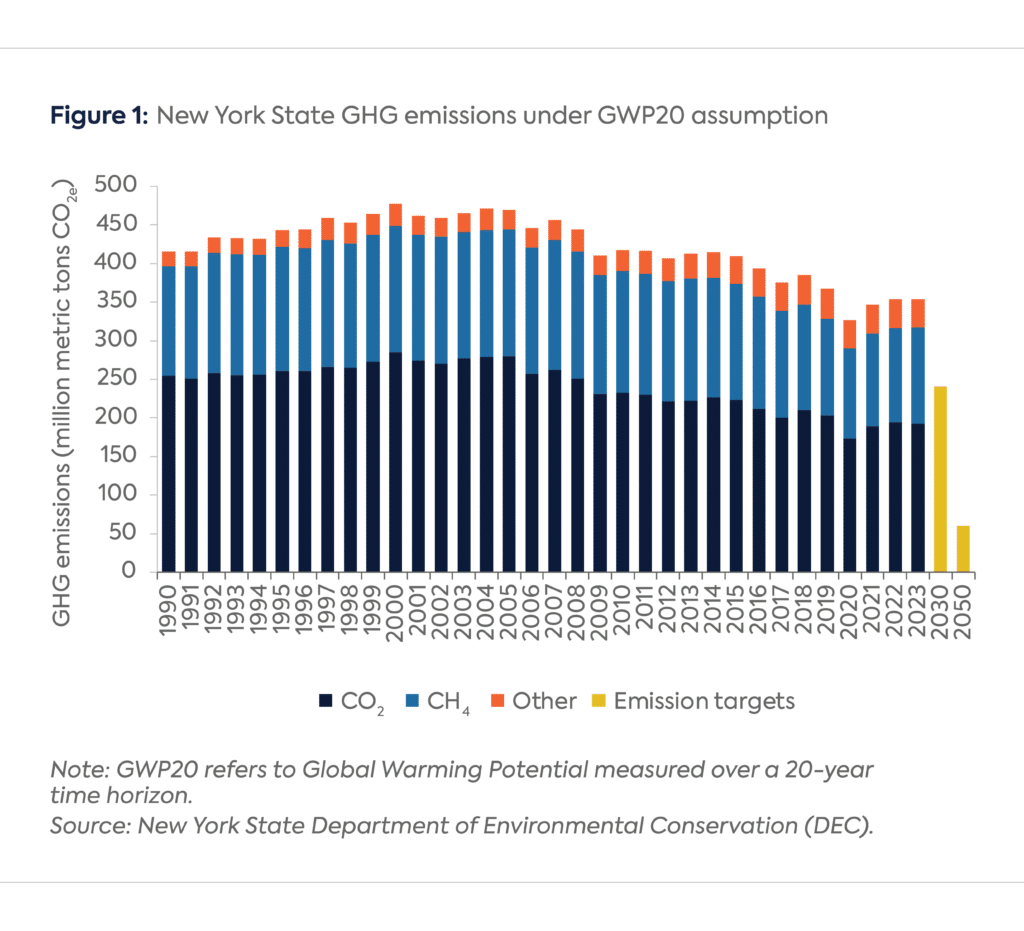
As Figure 1 shows, achieving the 2030 target would require roughly 30 percent emission reductions in just a few years. (There is little evidence to suggest that emissions have fallen significantly since 2023, when official data ends.) Much of the emissions cuts New York achieved during the prior decade came from eliminating coal-fired power plants from the state’s power mix, a phaseout that has now been completed.
A Carbon Price Could Drive Up New York’s Energy Prices
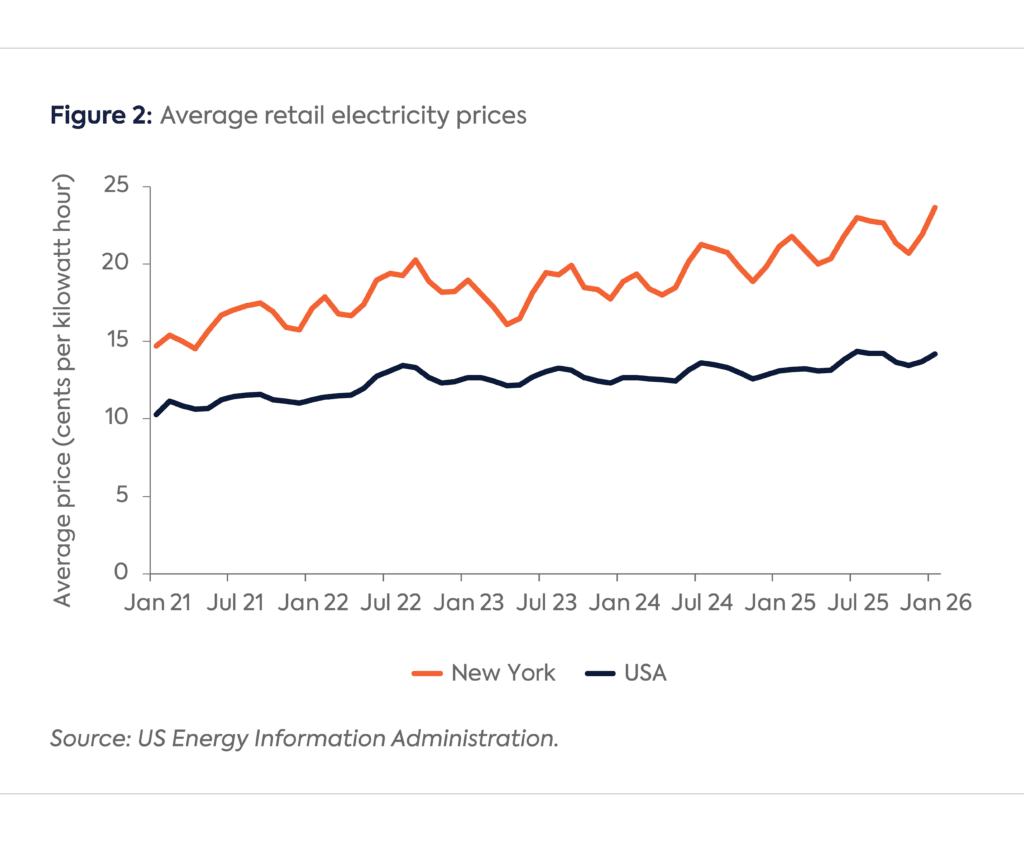
The persistence of inflationary pressures has also brought affordability concerns to the fore, precipitating a backlash against rising electricity prices that has become a central issue in statewide elections. New Yorkers already pay among the highest rates in the nation—roughly 50 percent above the national average (see Figure 2). The ongoing conflict in the Middle East has driven oil and gasoline prices sharply higher. With many New York households struggling to pay for these higher energy costs, public support for the CLCPA could erode quickly if the law is seen as driving them even higher.
Policies that restrict energy sources tend to raise energy prices because they force greater reliance on alternatives that would not be chosen on cost grounds alone. A carbon price works this way by design, raising the costs of carbon-intensive products to make lower-carbon alternatives more attractive. The more stringent the policy, the larger the price increases.
As a core element of its strategy to meet the CPLCA’s emissions targets, in early 2023, New York proposed a carbon pricing policy in the form of a “cap-and invest” program. Governor Hochul has highlighted a February 2026 analysis by the New York State Energy Research and Development Authority (a state energy agency) showing that New Yorkers will bear a high cost—roughly one to three thousand dollars per year for typical households—if the carbon price is used to fully close the large gap between the current emissions trajectory and the 2030 target.
Carbon Pricing Policies are Cost-Effective Tools that Include Compensation for Higher Energy Costs
This NYSERDA analysis may provide a useful indicator of the costs of achieving the current 2030 emissions target, but it does not provide a useful estimate of the costs of a well-designed cap-and-invest program.
A large body of economic research supports carbon pricing as a cost-effective strategy for achieving emissions reductions. Unlike policies that promote specific technologies or regulate specific sectors, a carbon price creates incentives to reduce emissions by switching to lower-carbon alternatives in the cheapest ways possible.
Under New York’s proposed program, regulated entities would purchase tradable emission permits at auction. Roughly two-thirds of the resulting revenues would be directed to investments in clean energy and other priorities, and one-third would be returned to households and small businesses, particularly low-income families, as rebates to offset higher energy costs.
In short, the economic case for carbon pricing does not weaken when energy prices are high. If anything, the importance of minimizing the cost of decarbonization is greater when household budgets are already under strain.
New York’s GHG Accounting Method’s High Value on Methane over Carbon Dioxide
Annual GHG emissions targets require combining gases with very different characteristics into a single measure. A common, albeit oversimplified and controversial, approach is to express all gases in “CO2-equivalent units” using the Global Warming Potential (GWP) framework, which measures how much heat a pulse emission traps over a chosen time horizon relative to carbon dioxide (CO2).
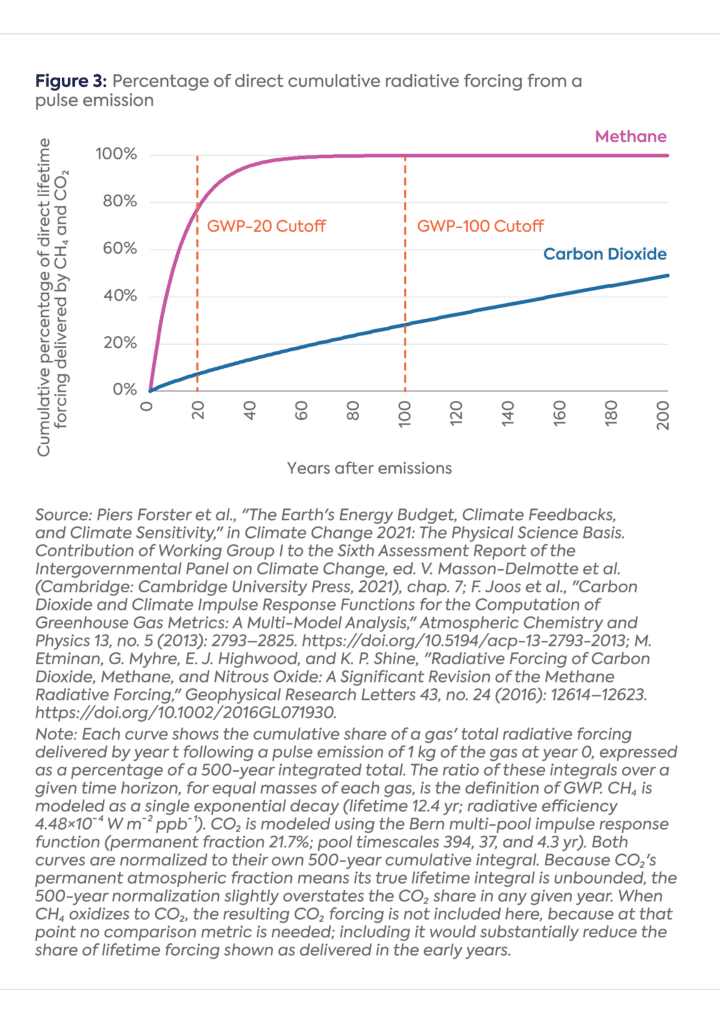
The choice of time horizon matters enormously for methane, which has strong short-term warming effects but decays within decades, whereas CO2 has long-term warming effects as it persists in the atmosphere for centuries. Any economic analysis will place more value on near-term than long-term effects, but New York’s current approach goes further, comparing methane and CO2 based on effects over the first 20 years (called GWP20) and ignoring effects beyond 20 years. As Figure 3 shows, GWP20 captures about 80 percent of methane’s lifetime impacts but under 10 percent of CO2’s.
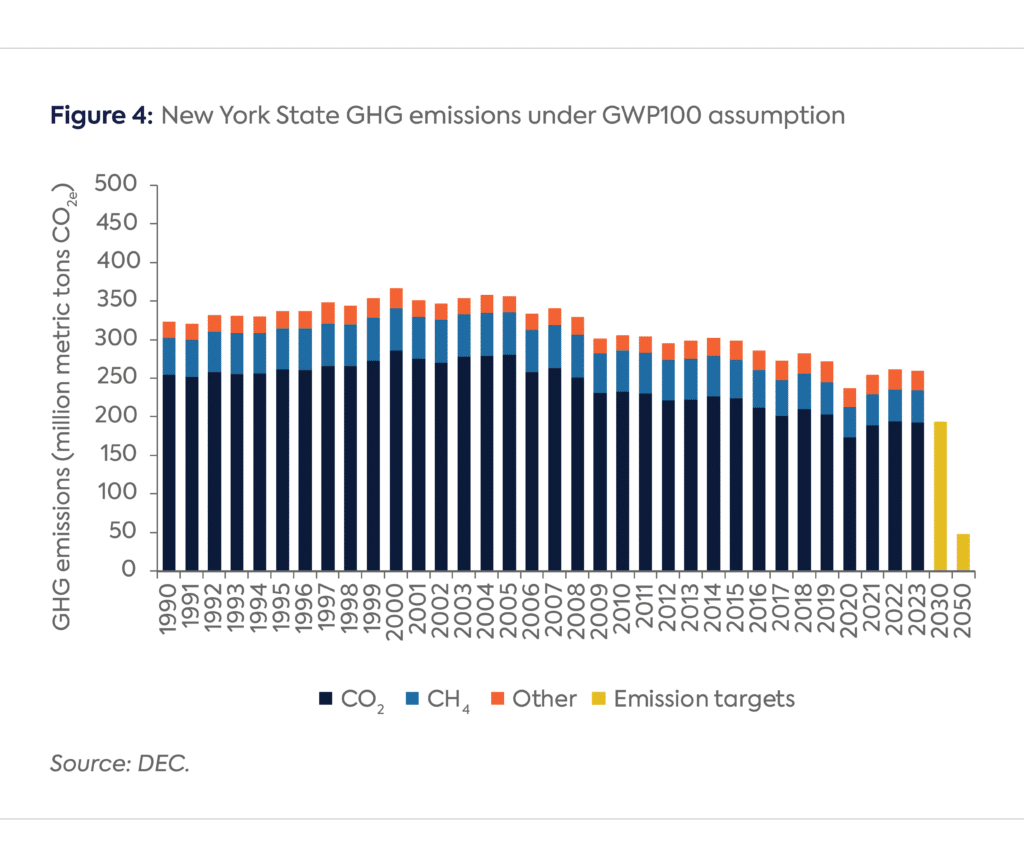
Governor Hochul wants the state to switch the GHG accounting from a 20-year to a 100-year horizon, arguing that this is the standard in academic analyses and other jurisdictions. Given that New York’s emissions goals account for methane leaks from the natural gas that it imports, this change would dramatically lower New York’s measured emissions, thus reducing the gap between those emissions and the state’s targets (compare Figures 1 and 4).
The risk is that both sides in this debate are focused on the impact of this accounting choice on the emissions scorecard rather than on any principled assessment of how methane and CO2 damages should actually be compared.
None of these facts resolves the question of what New York should do. Reasonable people will disagree on the appropriate emissions targets, accounting rules, and policy instruments.
Notably, Governor Hochul and her critics both remain committed to the state’s 2050 target of 85 percent emissions reduction from 1990 levels. If they can build on this shared commitment and find common ground on a near-term pathway, New York can remain the climate leader the CLCPA was designed to make it. Such collaboration will require engaging honestly with the real trade-offs involved in decarbonizing one of the largest and most complex economies in the country.
The Nepal flood that has left 1,000 people dead and close to 4,000 people missing, as of September 1, has also damaged hydropower plants that the country relies on.
Critical minerals were once again near the top of the agenda for G7 leaders as they met in Évian, France, this week, a year after the G7 launched the Critical Minerals Action Plan.
In March 2026, the Office of the US Trade Representative (USTR) announced it was investigating "structural excess capacity and production in manufacturing sectors" in 16 economies.
Why U.S. economic models must account for climate change and the clean energy transition to improve policymaking, forecasting, and public investment decisions.