Trump says ongoing talks are Iran’s ‘last chance’
Karen Young, senior research scholar at the Centre on Global Energy Policy at Columbia University, joins BNN Bloomberg to discuss the energy sector.
Get the latest as our experts share their insights on global energy policy.
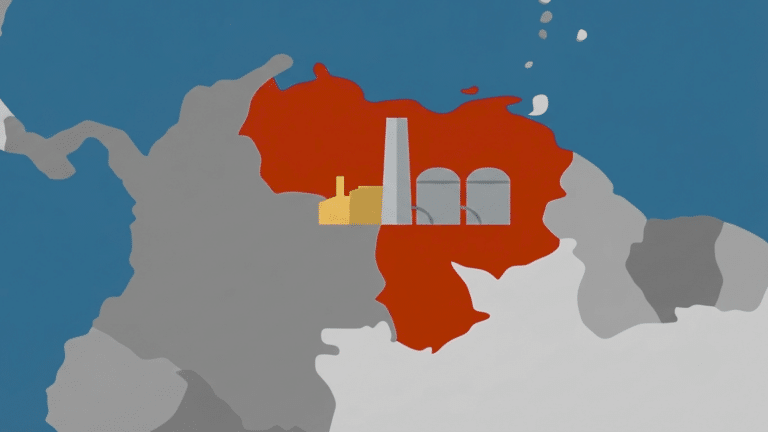
The economic and humanitarian consequences of the June 24 twin earthquakes in Venezuela continue to emerge.
Hear in-depth conversations with the world’s top energy and climate leaders from government, business, academia, and civil society.
Over the past five months, the Strait of Hormuz has been closed for extended stretches of time, disrupting roughly 10 to 15 million barrels of oil supply each...
Find out more about our upcoming and past events.
Join industry leaders, innovators, employers, and emerging talent for an evening exploring the technologies, trends, and career opportunities shaping the future of climate tech.

Past Event
November 17, 2021
1:00 pm - 2:00 pm
Please note: This is a hybrid event. Registration for in-person attendance has reached capacity. Should additional space open, this message will be updated. Virtual attendance is still open and we invite you to join us remotely.
Background:
Foreign direct investment can contribute significantly to sustainable development through tax revenues, the transfer of capital and technology, job creation, linkages with local industries, infrastructure development, and capacity building. However, the extent to which these benefits actually accrue to host countries depends heavily on the policies of the host country and the investor, the regulatory and legal framework governing their relationship, and the institutions available to find mutually satisfactory outcomes for both parties. Nowhere are the stakes higher than with extractive industries, where oil, gas and mining have sometimes been a springboard to development and at other times a source of corruption, social degradation, and environmental catastrophe. As the resources are non-renewable, countries have a one-shot opportunity to transform the resource wealth into development.
Objective:
This event, co-hosted by the Center on Global Energy Policy and Columbia Global Centers | Rio de Janeiro, will provide a basic knowledge of the transformative potential, benefits and risks of the extractive-industry and the role of industry, governments and civil society. Participants will have the opportunity to learn and interact with experts from Columbia University and Fundação Getúlio Vargas to discuss the interlinkages of oil, gas and mining in Brazil and the U.S.
Speakers:
Director of the Columbia Center on Sustainable Investment. Since joining CCSI in 2008, she established and now oversees CCSI’s robust research portfolio in its cross-cutting areas of expertise, and has overseen advisory work in Chile, Guinea, Malawi, Mozambique, Namibia, Paraguay, Tanzania and Timor-Leste, among other countries. She teaches a masters seminar at Columbia Law School and Columbia’s School of International and Public Affairs on Extractive Industries and Sustainable Development, and lectures at Externado University in Colombia on International Investment Law. She received a Bachelor of Arts in Economics from Harvard University, and earned her Juris Doctor and a Masters degree in International Affairs from Columbia University, where she was a James Kent Scholar and recipient of the Parker School Certificate in International and Comparative Law.
PHD trained in Energetic Planning (engineering), with petroleum geopolitics emphasis, Master degrees in Management Engineering and in International Finance. Two published books on Petropolitics, and an affiliated professor of Oil Geopolitics in Brazilian Navy Officers University. Professional experience in relevant companies, in Brazil and abroad, as Deloitte, Vale S.A., Gama Filho University, Royal Shipping Services and Dickinson Maritime Agency. Skilled on business plans design and construction, project financial viability studies and business valuation. Long experience in strategic planning, merger and acquisition, business analysis, economic and financial evaluation and competitive intelligence.
—
Please note: This is a hybrid event. Registration for in-person attendance has reached capacity. Should additional space open, this message will be updated. Virtual attendance is still open and we invite you to join us remotely.
Advance registration is required. Upon registration, you will receive a confirmation email with access details.
For more information about the event, please contact [email protected].
On February 28, the United States and Israel launched an attack on Iran, resulting in the deaths of Iranian Supreme Leader Ali Hosseini Khamenei and senior Iranian leaders...


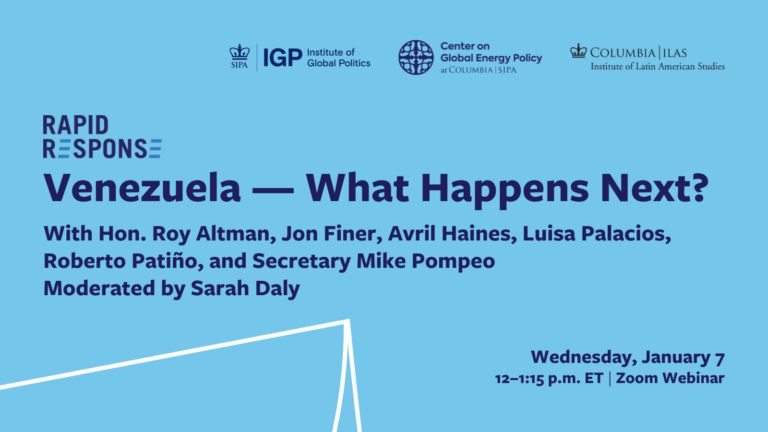
The recent military operation to remove Venezuelan President Nicolás Maduro and First Lady Cilia Flores raises several implications for the future of Venezuela and Latin America, geopolitics, and energy markets. Cosponsored by SIPA’s Institute of Global Politics (IGP) and Center for Global Energy Policy (CGEP), along with Columbia’s Institute of Latin American Studies (ILAS), this webinar will analyze the circumstances and impact of their capture and extradition to New York to face narcoterrorism and drug trafficking charges.
https://www.youtube.com/watch?v=vWh5WQVVMLc Global gas markets are set to undergo major changes by the end of the decade, with the coming wave of liquefied natural gas (LNG) production capacity poised...
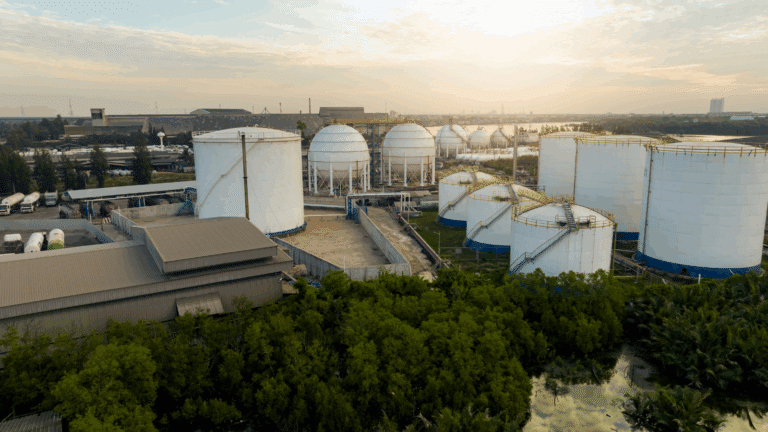
On October 22, the United States Department of the Treasury announced the imposition of sanctions on Russia’s two largest oil companies, Rosneft and Lukoil, as a penalty for what it characterized as a lack of Russian commitment to ending the war in Ukraine.

CHRONIQUE. Les Etats-Unis vont bientôt contrôler environ un tiers des capacités mondiales de GNL, bien plus que le Qatar. Sous l’administration Trump, le GNL est devenu un outil de politique étrangère, écrit Anne-Sophie Corbeau, chercheuse au Center on Global Energy Policy de l’Université Columbia

The Iran crisis, whenever it ends, will materially change how the LNG market operates.