This website uses cookies as well as similar tools and technologies to understand visitors’ experiences. By continuing to use this website, you consent to Columbia University’s usage of cookies and similar technologies, in accordance with the Columbia University Website Cookie Notice.
The work of scientists and researchers deserves celebration, but solid climate, energy, and technology breakthroughs need costly infrastructure and sustained funding to scale. Relying on private philanthropy like the Bezos Fund for climate research says a lot about this country’s expressed values while laying a fragile foundation for our industry’s future.
Permitting reform—to allow for faster approvals on new projects—is one thing that both climate advocates and energy developers have wanted for a long time. With demand for power...
The Center on Global Energy Policy at Columbia University SIPA invites students to join us for an engaging roundtable discussion on sustainable finance with Jacqueline Ricciani, Managing Director,...
Event
• Columbia SIPA
About Us
We are the premier hub and policy institution for global energy thought leadership. Energy impacts every element of our lives, and our trusted fact-based research informs the decisions that affect all of us.
This Energy Explained post represents the research and views of the author(s). It does not necessarily represent the views of the Center on Global Energy Policy. The Center on Global Energy Policy would like to thank Blue Horizon Foundation for its grant in support of CGEP.
US rare earth dependency is broader than the current policy discussion suggests—extending beyond the permanent magnet supply chain to include significant exposure to yttrium and lanthanum.
Beijing’s export licensing apparatus has already demonstrated significant reach, and the November US–China truce defers rather than resolves the threat, leaving US industry vulnerable if full implementation resumes this fall.
Because finished goods from key trading partners carry deeply embedded Chinese magnet content, coordinated multilateral action is the only credible path to US resilience.
One of the central objectives of the second Trump administration has been to pursue a maximalist trade policy toward China. However, that ambition has been blunted by China’s ability to leverage its dominance of the rare earth supply chain, including 91 percent of global rare earth refining production and, together with Myanmar, 83 percent of heavy rare earth mined production. In April 2025, Beijing subjected seven heavy rare earth elements—samarium, gadolinium, terbium, dysprosium, lutetium, scandium, and yttrium—to export licensing controls requiring exporters to declare end-users before shipment, including for permanent magnets containing dysprosium and terbium. The Chinese government subsequently added holmium, erbium, thulium, europium, and ytterbium to the export control regime and introduced a Foreign Direct Product Rule-equivalent measure, extending Beijing’s influence over downstream supply chains worldwide. Although China and the United States reached a temporary truce in November that deferred full implementation of the controls, the licensing apparatus remains intact, and Beijing has already demonstrated its willingness to employ it by blacklisting twenty Japanese companies for dual-use concerns in February 2026.
One year after the initial restrictions were announced, China’s General Administration of Customs (GACC) has released the latest export data, offering a glimpse of US dependence on Chinese rare earths. This piece draws on the data from January 2023 through April 2026 to map that dependence and identify segments of the supply chain where US exposure is pronounced. The analysis reinforces the established picture in current US policy debates of heavy reliance on permanent magnets, but suggests that the full extent of US exposure has been understated. The dataset captures only magnets shipped as discrete components, excluding those embedded in finished goods. It also indicates that the current debate obscures US reliance on yttrium and lanthanum. More broadly, the piece shows that US dependence extends well beyond the “mine-to-magnet” supply chain, raising questions for policymakers about how far diversification efforts should reach.
Permanent Magnets
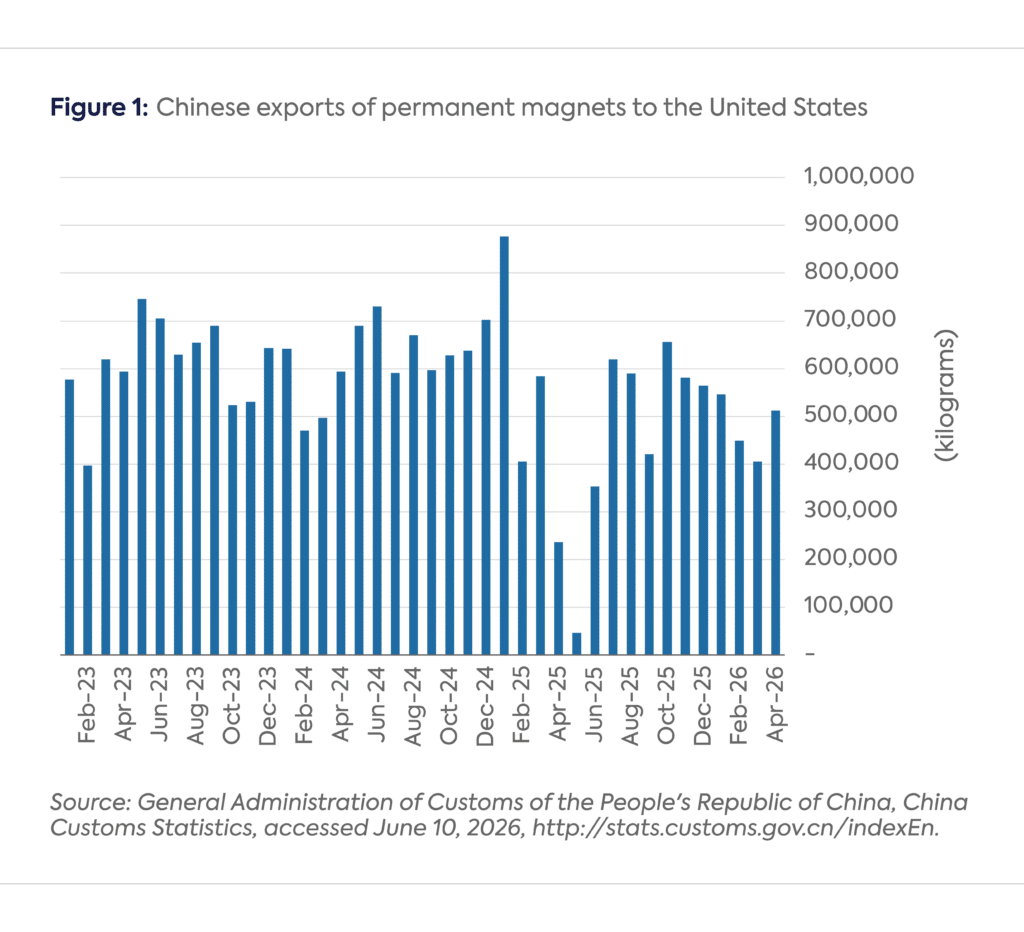
The rare earths policy discussion has concentrated on the permanent magnet supply chain, and for good reason—magnetic rare earths represent 96 percent of consumption by value. Neodymium-iron-boron (NdFeB) magnets account for over 90 percent of the permanent magnet market, and China accounts for 94 percent of global sintered NdFeB production. Between January 2023 and April 2026, the United States was the second-largest destination for Chinese permanent magnet exports by volume, after Germany, receiving 22,600,310 kilograms.
However, before the recent restrictions, the United States imported only trace amounts of dysprosium and terbium, the heavy rare earth elements that are used in NdFeB magnets, reflecting limited domestic processing and manufacturing capacity. Instead, US imports are concentrated in finished products containing these materials.
Figure 1 shows that Chinese exports continued to flow following the restrictions as the supply chain adjusted to the new licensing requirements. Nevertheless, shipments to the United States fell by 22 percent in the twelve months ending in April 2026 compared with the prior twelve months. Despite the truce, total magnets exports from December 2025 through April 2026 were still down compared to the same time period over the previous two years.
Yet the export data underestimates US exposure. The permanent magnet Harmonized System (HS) code captures only magnets shipped as discrete products; it does not capture the magnets embedded in finished goods that enter the United States inside vehicles, appliances, and electronics. For example, the Department of Energy estimates that each electric vehicle motor requires approximately 1–2 kg of NdFeB magnet material. The United States imported 451,575 EVs in 2025—251,371 from Mexico, 93,388 from Germany, 56,490 from Japan, 14,552 from South Korea, and 9,833 from Sweden. Outside Japan, none of these countries produces NdFeB magnets at scale and all are leading recipients of Chinese magnets.
Japan is a partial exception as the world’s second-largest NdFeB producer. However, it still relies on China for approximately 70 percent of its rare earth supply chain. The United States and Japan therefore have an interest in working together to diversify upstream production and reduce exposure to further demand shocks arising from their position in the supply chain.
Yttrium
The White House fact sheet published after President Trump’s recent visit to China in May states that “China will address U.S. concerns regarding supply chain shortages related to rare earths and other critical minerals, including yttrium, scandium, neodymium, and indium.” The export data shows why yttrium was included on this list.
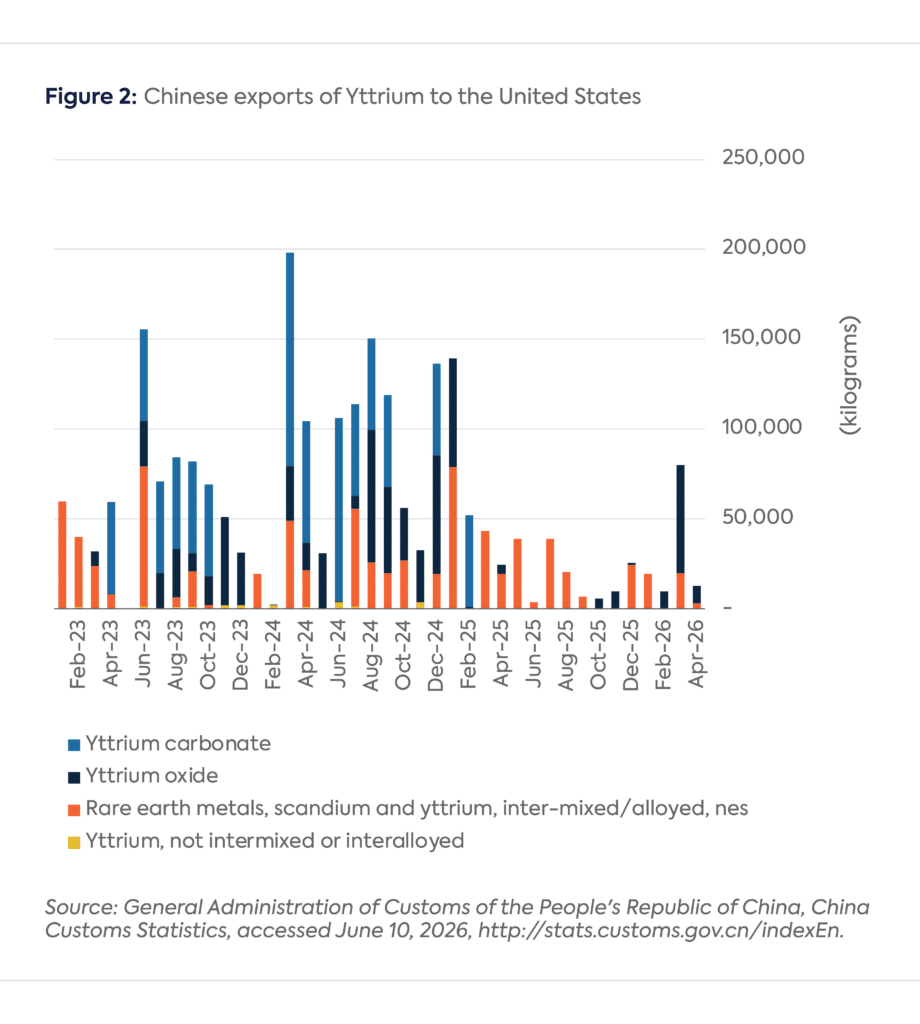
The United States is 100 percent import-reliant for yttrium. The bulk of civilian demand for it derives from ceramics and phosphors for LED lighting and display screens, but the more strategically sensitive applications are in aerospace and defense. Yttrium is used in thermal barrier coatings that protect jet engines from extreme heat and in the production of high-performance lasers. Chinese Yttrium oxide exports to the United States fell by approximately 75 percent in 2025 relative to 2024. Despite the October US–China truce, aerospace organizations warned of industrial shortages as recently as February. Exports only began to recover in March. Yttrium carbonate, a precursor to yttrium oxide, has not recovered (Figure 2).
The most credible near-term source of non-Chinese yttrium is Serra Verde’s Pela Ema deposit in Brazil, which is ramping up production. Yttrium is expected to account for 42 percent of full output. However, Pela Ema produces concentrate rather than separated oxide, and Serra Verde has not yet made a final investment decision on a separation facility. While Serra Verde agreed to a fifteen-year offtake with a US government–backed special purpose vehicle for 100 percent of its production of four magnetic rare earths, yttrium was not included.
Lanthanum
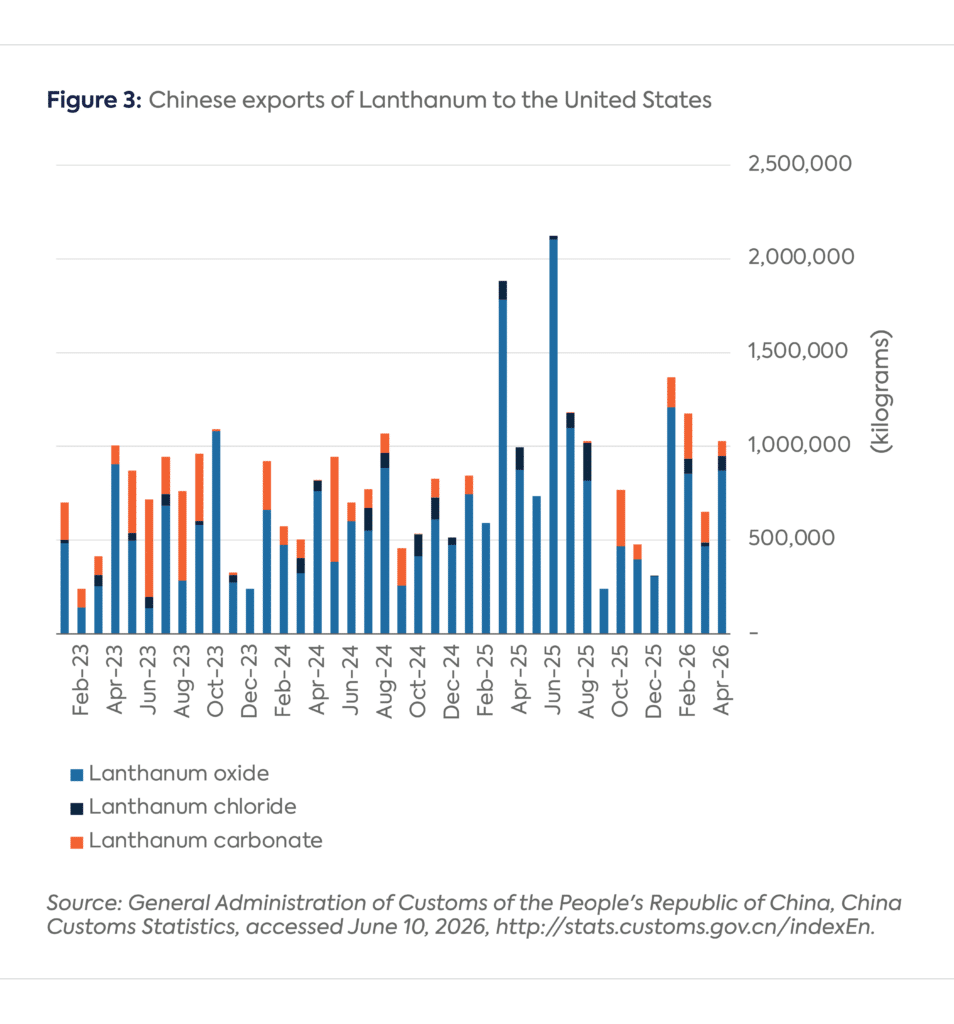
The most traded rare earth oxide between China and the United States is lanthanum—a light rare earth outside the scope of Beijing’s export controls. Lanthanum-based catalysts are the backbone of fluid catalytic cracking, the refinery process that converts crude oil into gasoline, diesel, and military jet fuel.
Since January 2023, the United States has absorbed approximately 64 percent of China’s total global lanthanum oxide exports (Figure 3).
Economics, not geology, accounts for this dependency. Lanthanum oxide averaged just $1 per kilogram in 2025, compared with $69 per kilogram for NdPr oxides. At that price, separation and processing costs are unrecoverable for most producers outside China. China also exports significant quantities of lanthanum carbonate, a precursor to lanthanum oxide, to the United States, extending the dependency further upstream.
Policy Implications
There is bipartisan consensus in Washington on the need to support rare earth supply chain projects. However, the export data highlight two important considerations for US policymakers.
US Dependence extends beyond the permanent magnet supply chain: The permanent magnet supply chain remains the highest US policy priority, but it does not define the scope of US exposure. China has demonstrated the ability to threaten key supply chains by restricting yttrium, a rare earth that has received relatively little attention until recently. Lanthanum poses a different challenge: China’s dominance stems not from geology but from economics. At roughly $1 per kilogram, non-Chinese processing is uneconomical. Policymakers will need to assess whether this form of dependence can be managed or requires active diversification.
Partnerships are crucial: Chinese magnet content is deeply embedded in finished goods arriving in the United States, such as vehicles, appliances, and electronics, from Germany, Japan, Korea, Mexico, and other countries. This exposure cannot be addressed bilaterally. Instead, it requires coordinated action with partners whose own industrial bases are equally integrated into Chinese magnet supply chains.
Critical minerals were once again near the top of the agenda for G7 leaders as they met in Évian, France, this week, a year after the G7 launched the Critical Minerals Action Plan.
The US Export-Import Bank is preparing to close the first funding tranche of Project Vault, a public-private partnership establishing the US Strategic Critical Minerals Reserve.