This website uses cookies as well as similar tools and technologies to understand visitors’ experiences. By continuing to use this website, you consent to Columbia University’s usage of cookies and similar technologies, in accordance with the Columbia University Website Cookie Notice.
Permitting reform—to allow for faster approvals on new projects—is one thing that both climate advocates and energy developers have wanted for a long time. With demand for power...
The Center on Global Energy Policy at Columbia University SIPA invites students to join us for an engaging roundtable discussion on sustainable finance with Jacqueline Ricciani, Managing Director,...
Event
• Columbia SIPA
About Us
We are the premier hub and policy institution for global energy thought leadership. Energy impacts every element of our lives, and our trusted fact-based research informs the decisions that affect all of us.
This Energy Explained post represents the research and views of the author. It does not necessarily represent the views of the Center on Global Energy Policy. The piece may be subject to further revision. Contributions to SIPA for the benefit of CGEP are general use gifts, which gives the Center discretion in how it allocates these funds. Rare cases of sponsored projects are clearly indicated.
For a full list of financial supporters of the Center on Global Energy Policy at Columbia University SIPA, please visit our website at Our Partners. See below a list of members that are currently in CGEP’s Visionary Circle. This list is updated periodically.
Saudi Arabia is experiencing a significant economic transformation under its Vision 2030 plan to reduce the country’s dependence on oil revenues by diversifying its economy. The Saudi government’s introduction of a value-added tax (VAT) and successful debt issuances have already diversified revenue sources, lowering oil’s share of total revenue to below 70 percent, even during periods of high oil prices.[1] But challenges remain. Saudi Arabia’s fiscal break-even oil price—the price per barrel needed to balance the budget—has risen, indicating continued sensitivity to oil price fluctuations. Its external break-even oil price has also increased, reflecting ongoing reliance on oil exports to finance imports. These challenges underscore the need for policies that enhance fiscal resilience, particularly in the face of potential future oil shocks.[2]
One approach Saudi Arabia has adopted is investing heavily in renewable energy, particularly through partnerships with China. This has had the effect of accelerating the country’s progress in renewable energy, with far-reaching implications for global geopolitics and energy markets. Specifically, Saudi Arabia is increasingly becoming aligned with China while China is gaining greater access to Middle Eastern markets and greater regional influence.
Saudi Arabia’s Renewable Energy Ambitions
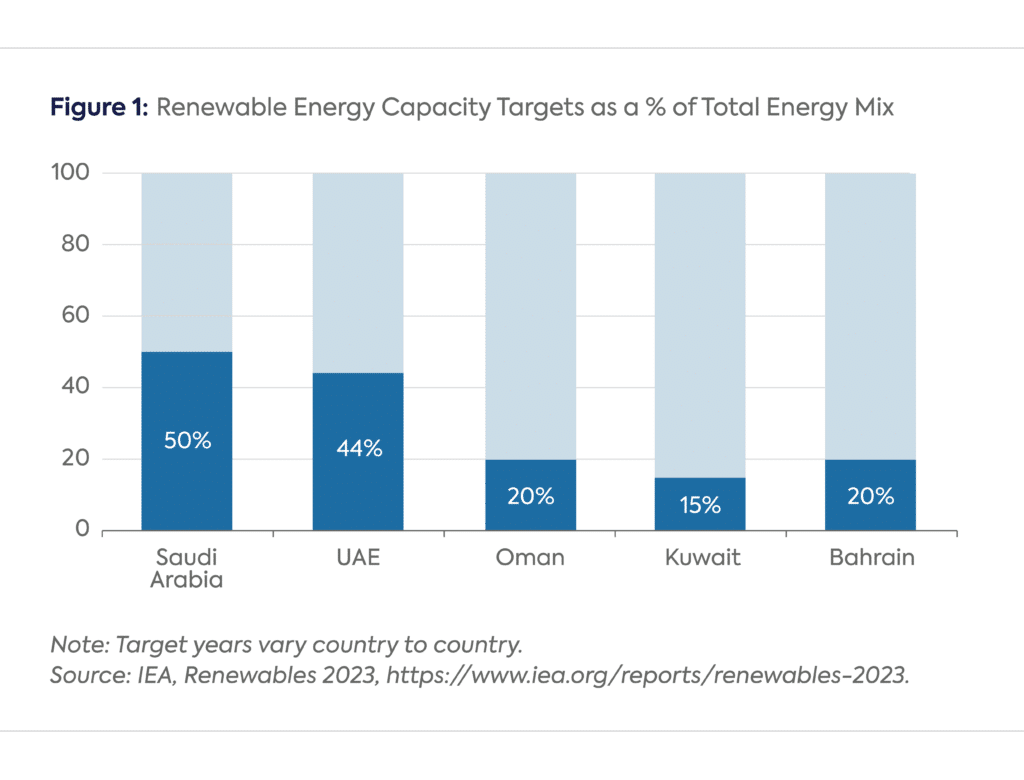
Saudi Arabia has established a goal to source at least 50 percent of its power from renewable energy by 2030, expanding its capacity to 130 gigawatts (GW), 58.7 GW of which is expected to come from solar and 40 GW from wind.[3] This target is the most ambitious of its kind among Gulf Cooperation Council (GCC) countries (Figure 1).
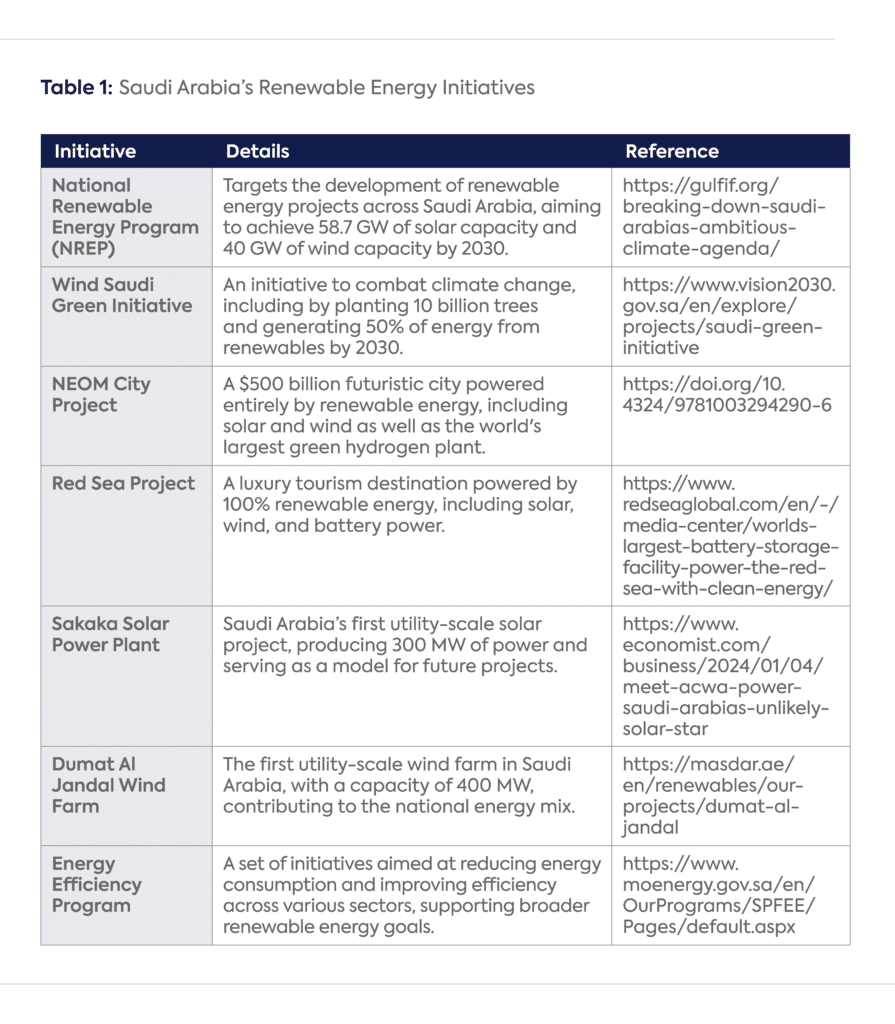
To achieve it, Saudi Arabia is prioritizing a range of renewable energy production and infrastructure initiatives (Table 1).
Saudi Arabia intends to use the renewable capacity it develops from these initiatives not only to power the country but also to export renewable energy to the world.[4]
New Strategic Partnerships and Their Geopolitical Implications
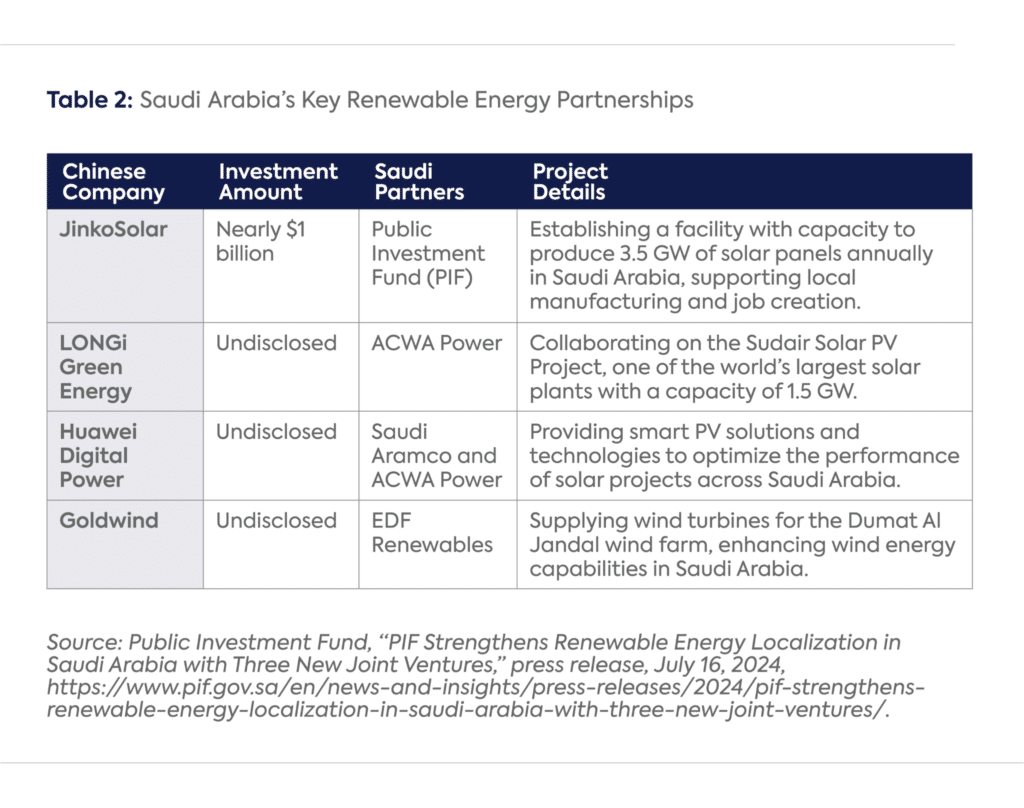
Saudi Arabia has also been forming significant partnerships with leading Chinese renewable energy companies undergirded by substantial investments (Table 2).
These partnerships provide Saudi Arabia with advanced technology and financing options while allowing China to secure vital energy resources, strengthen its Belt and Road Initiative, and gain greater access to Middle Eastern energy markets.
Saudi Arabia’s new alignment with China on renewable energy could have powerful and lasting geopolitical implications. Through this relationship, China is expanding its influence in Saudi Arabia and the broader Middle East region. This poses a major strategic challenge to the United States, which has long been a key strategic partner and ally to Saudi Arabia and the dominant external player in the region. If the US intends to maintain its regional foothold going forward, US policymakers may want to consider how they can enhance economic engagement with and/or offer competitive partnerships to Saudia Arabia and other nearby countries.
Moreover, Saudi Arabia’s localization efforts, supported by Chinese partnerships, could significantly alter global supply chains in the clean energy sector. The country aims to transition from a renewable technology importer to a renewable technology exporter, potentially making the Gulf region a central hub for renewable energy components.[5]
Conclusion
Saudi Arabia’s aggressive investment in renewable energy and strategic partnerships, particularly with China, represent a significant development with global implications. The move aligns with the country’s goal of economic diversification and positions it as a potential leader in the global energy transition. By challenging traditional geopolitical alliances, it may also lead to a more multipolar balance of power in the Middle East, which in turn could prompt global powers, especially the United States, to reconsider their strategic approach to the region.
Foundations and Individual Donors Anonymous Anonymous the bedari collective Jay Bernstein Breakthrough Energy LLC Children’s Investment Fund Foundation (CIFF) Arjun Murti Ray Rothrock Kimberly and Scott Sheffield
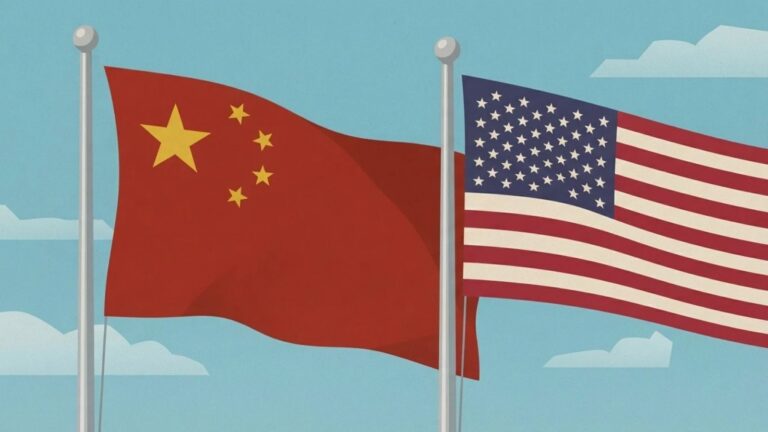
Last week's summit between US President Trump and Chinese President Xi was the second meeting between the two leaders since the US and Israel attacked Iran.
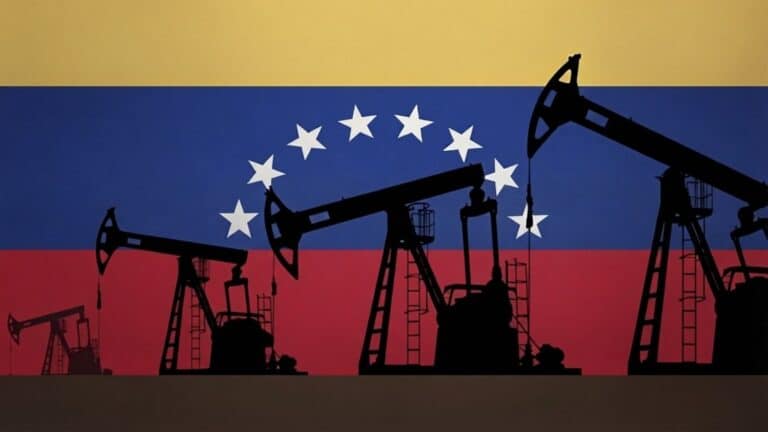
The White House announced last week an oil deal for more than 65 billion barrels of oil reserves in Venezuela and a 35% equity stake in North American Blue Energy Partners (NABEP).
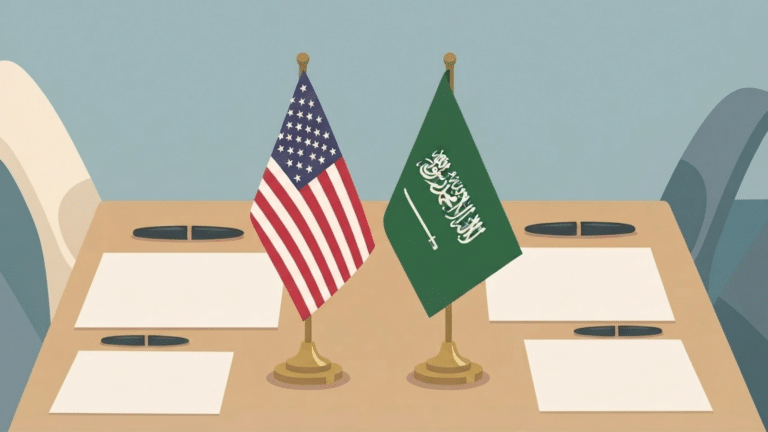
The Trump administration and Saudi leadership have reportedly agreed to a nuclear agreement that could enable US nuclear technology transfers to Saudi Arabia.
In this edition of Global Institute Dialogues Jason Bordoff discusses how the Iran crisis, China’s electrification strategy, and the US shale revolution have changed energy geopolitics.
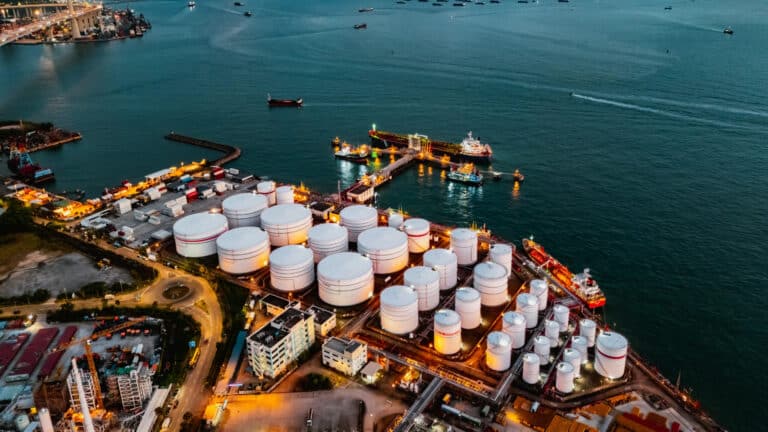
As inventories run dry and the Iran war continues to disrupt transit routes, oil has surged back to more than $100 per barrel. Diesel fuel—the workhorse of the agricultural and trucking sectors—has now soared to historic highs, pushing U.S. exports to record levels.