This website uses cookies as well as similar tools and technologies to understand visitors’ experiences. By continuing to use this website, you consent to Columbia University’s usage of cookies and similar technologies, in accordance with the Columbia University Website Cookie Notice.
Two economic planning documents released at the March meeting of China's National People’s Congress include the term "energy powerhouse" for the first time.
Much of the world’s attention today is understandably focused on conflict in the Middle East, and the immediate implications for energy markets and global security. But other regions...
We are the premier hub and policy institution for global energy thought leadership. Energy impacts every element of our lives, and our trusted fact-based research informs the decisions that affect all of us.
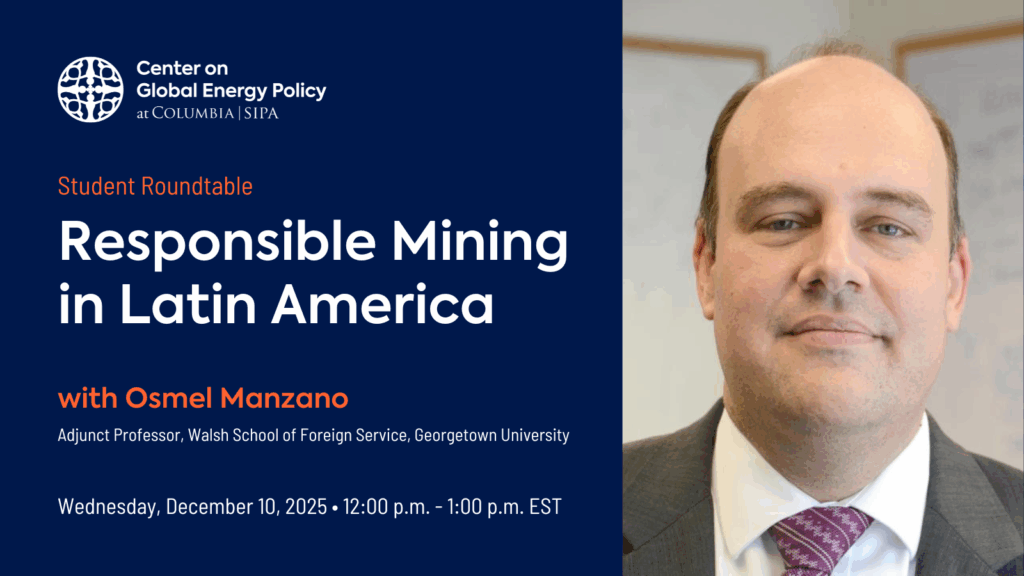
Responsible Mining in Latin America: The Extractive Transition and Social License, a Crossroad for the Andean Region
Past Event
December 10, 2025
12:00 pm - 1:00 pm est
Share
The event is for CUID holders only. Please note: space is limited.
The Center on Global Energy Policy at Columbia University SIPA invites Columbia University students to a roundtable discussion with Osmel Manzano, Adjunct Professor at the Walsh School of Foreign Service (Georgetown University), Professorial Lecturer at the Elliott School of International Affairs (George Washington University) and Nonresident Fellow for Latin American Energy Studies at the Center for Energy Studies (CES) at Rice University’s Baker Institute for Public Policy.
This seminar will examine the pivotal role of extractive industries in the Andean region within the broader context of the global energy transition. Historically, natural resources have shaped the economic trajectory of Bolivia, Colombia, Ecuador, Peru, and Venezuela, contributing significantly to GDP and exports. Yet, reliance on resource rents has also created vulnerabilities, exemplified by recurrent boom-and-bust cycles and persistent social conflicts. The current shift toward decarbonization introduces new risks for hydrocarbon-dependent economies, while simultaneously opening opportunities for countries endowed with critical minerals such as lithium and copper.
Dr. Manzano will make a presentation on“The Extractive Transition and Social License: The Crossroad for the Andean Region” based on a paper that explores the social, economic, and environmental impacts of extractive projects, the institutional mechanisms governing revenue distribution, and the conditions under which communities grant or withhold a Social License to Operate (SLO).
For more information about the event, please contact [email protected].
The Columbia Global Energy Summit 2026 is an annual event dedicated to thought-provoking discussions around the critical energy and climate challenges facing the global community.
*Registration is closed for this event. The Center on Global Energy Policy at Columbia University SIPA's Women in Energy initiative, in collaboration with the Columbia Policy Institute, invites...
Event
• International Affairs Building,
Columbia SIPA
The Columbia Global Energy Summit 2024 is an annual event dedicated to thought-provoking discussions around the critical energy and climate challenges facing the global community.
The Columbia Global Energy Summit 2024 is an annual event dedicated to thought-provoking discussions around the critical energy and climate challenges facing the global community.
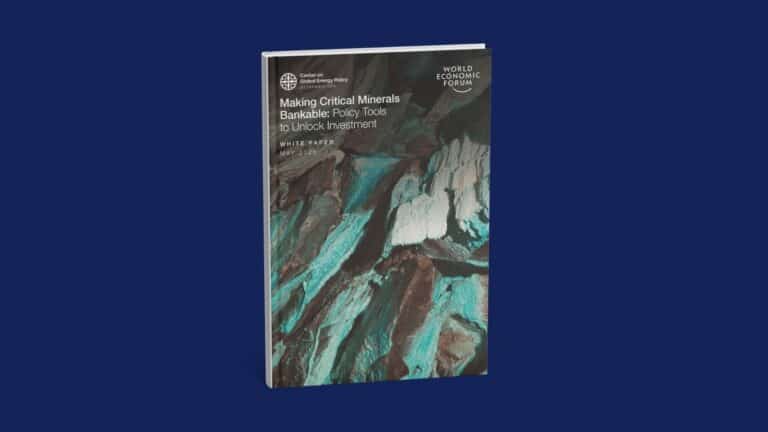
This paper proposes a de-risking framework of policy interventions to provide the risk allocation, revenue certainty and delivery confidence required by mainstream private finance.
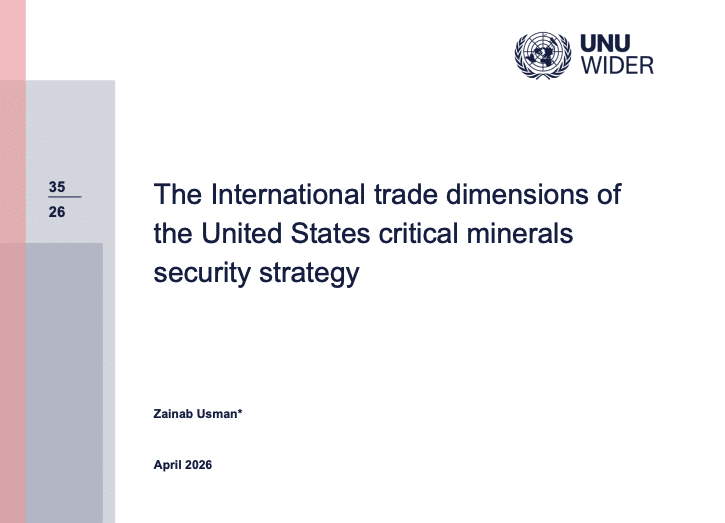
This paper examines the trade dimensions of the policy instruments employed by the United States to secure critical minerals supply chains. Drawing on policy statements, executive orders, tariff schedules, and six bilateral critical minerals agreements announced in 2025, it assesses how US trade policy has been repurposed to advance supply-chain security objectives. The paper finds that recent US initiatives reflect bipartisan trends in reconfiguring trade policy that predate the Trump administration, even as they introduce new and consequential trade coordination mechanisms that operate outside the World Trade Organization and beyond conventional free trade agreements. Specifically, US critical minerals security strategy now relies on a differentiated set of sector-specific arrangements that combine familiar elements of US international economic engagement with more novel features that increasingly utilize trade policy instruments. What distinguishes these six minerals deals is their systematic coupling with parallel reciprocal trade negotiations, their incorporation of an explicitly ‘America First’ approach to reciprocity, the absence of a clear ideological hierarchy among partner countries, an emphasis on domestic processing and industrialization, and the growing use of exclusion mechanisms targeting third-party actors. The recurrence of these novel elements across diverse minerals deals suggests deliberate design rather than ad hoc experimentation that may have durable restructuring effects across global mineral supply chains. The paper concludes by outlining implications for US policy makers, for partner countries—particularly mineral-producing low- and middle-income economies—and for the architecture of the global trading system.