Trump delayed a global carbon tax. Now he wants to finish the fight.
American officials are drafting a diplomatic cable that warns dozens of countries against adopting a climate fee on the shipping industry.
Current Access Level “I” – ID Only: CUID holders, alumni, and approved guests only
Past Event
February 25, 2014 - February 27, 2026
6:00 am
On February 25, 2014, Columbia University’s Center on Global Energy Policy (CGEP) and the Baker Institute’s Center for Energy Studies hosted a roundtable on the implications of the U.S. crude oil export ban and the prospects for reform. The roundtable is part of a CGEP study on U.S. oil export policy, a collaboration with Trevor Houser of the Rhodium Group and Ken Medlock of the Baker Institute, which will be a comprehensive analysis of the economic and geopolitical implications of a shift in policy relative to the status quo. Energy leaders from government, industry, banking, and academia participated in a discussion of light tight oil production, refining economics, regulations, U.S. and international oil markets, and major avenues for industry and policymakers to respond to increasing domestic supply.
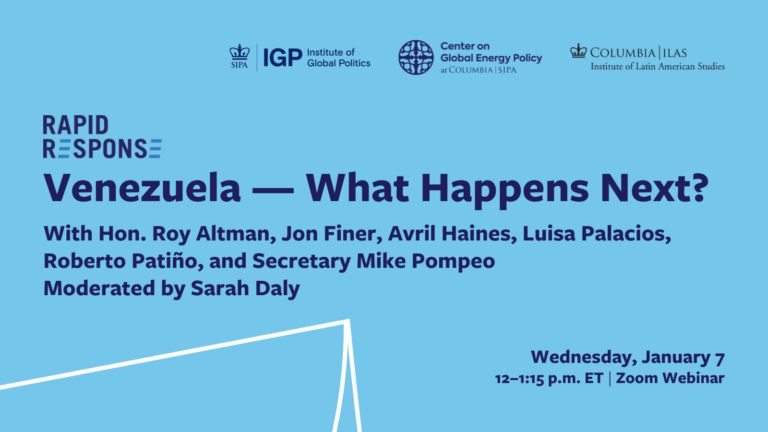
The recent military operation to remove Venezuelan President Nicolás Maduro and First Lady Cilia Flores raises several implications for the future of Venezuela and Latin America, geopolitics, and energy markets. Cosponsored by SIPA’s Institute of Global Politics (IGP) and Center for Global Energy Policy (CGEP), along with Columbia’s Institute of Latin American Studies (ILAS), this webinar will analyze the circumstances and impact of their capture and extradition to New York to face narcoterrorism and drug trafficking charges.
The Columbia Global Energy Summit 2026 is an annual event dedicated to thought-provoking discussions around the critical energy and climate challenges facing the global community.
On October 22, the United States Department of the Treasury announced the imposition of sanctions on Russia’s two largest oil companies, Rosneft and Lukoil, as a penalty for what it characterized as a lack of Russian commitment to ending the war in Ukraine.
*Registration is closed for this event. The Center on Global Energy Policy at Columbia University SIPA's Women in Energy initiative, in collaboration with the Columbia Policy Institute, invites...
Iran has among the world's largest natural gas resource bases, but its ability to supply regional and global markets is constrained by sanctions, underinvestment, and limited export infrastructure.
Multiple US–Iran conflict scenarios carry materially different risks for global oil infrastructure, transit routes, and prices.
China’s crude oil imports hit a record-high 11.6 million barrels per day in 2025, as geopolitical tensions, low oil prices, and global oversupply spurred China to increase its oil stockpiles, a trend likely to continue in 2026.