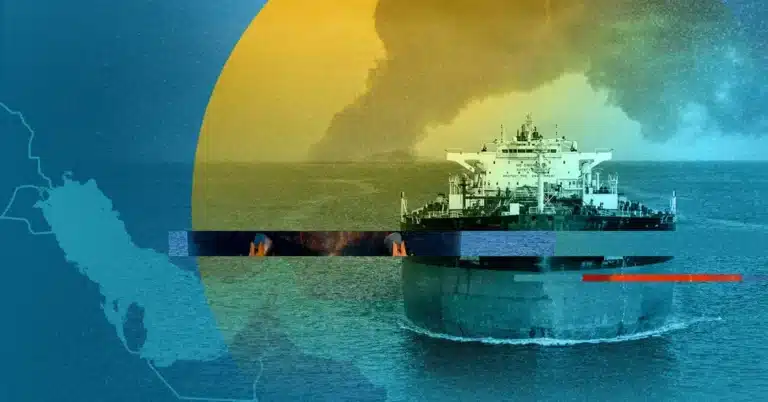
Prix des carburants : pourquoi les raffineries sont au cœur de la tempête
Plus que d'un problème pétrolier, la flambée des prix du carburant résulte de tensions sur les capacités mondiales de raffinage.
Get the latest as our experts share their insights on global energy policy.
Last week's summit between US President Trump and Chinese President Xi was the second meeting between the two leaders since the US and Israel attacked Iran.
Hear in-depth conversations with the world’s top energy and climate leaders from government, business, academia, and civil society.
Carbon credit markets have become one of the most hotly debated tools in the fight against climate change. Supporters call them essential to closing the gap between corporate...

Find out more about our upcoming and past events.
Apply to Register The Center on Global Energy Policy at Columbia University SIPA’s Women in Energy initiative invites Columbia University students to a roundtable discussion with Pam Brown,...

Insights from the Center on Global Energy Policy
This Energy Explained post represents the research and views of the author(s). It does not necessarily represent the views of the Center on Global Energy Policy. The piece may be subject to further revision. Contributions to SIPA for the benefit of CGEP are general use gifts, which gives the Center discretion in how it allocates these funds. More information is available here. Rare cases of sponsored projects are clearly indicated.
The Center on Global Energy Policy at Columbia University SIPA is closely following the escalating conflict in Iran and its implications for US national security, Middle East geopolitics, and global energy markets. See all of our coverage here.
Many analyses of what the conflict in the Middle East means for China’s energy security have rightly focused on China’s oil and natural gas imports from the region. Afterall, about 40–50% of China’s crude oil imports and 30% of its LNG imports transited the Strait of Hormuz (SoH) last year. Less attention has been paid to the impact of these disruptions on China’s refining sector and petrochemical industry, the main source of China’s oil demand growth.
This blog discusses three ways the conflict is affecting China’s refining and petrochemical industries: the interruption in energy flows through the SoH has prompted China to restrict refined product exports—compounding the global jet fuel supply crunch, to import more petrochemical feedstocks from the United States, and to reinforce China’s commitment to self-sufficiency in petrochemical feedstocks to enhance energy security and economic resilience.
The Iran war has highlighted the strategic importance of the refining industry and China’s role as a regional exporter of petroleum products, particularly jet fuel. China uses export quotas for refined products to balance domestic supply and demand, and its export restrictions, in effect since early March, are contributing to shortages in Asia.
About 20% of global refining output transits the SoH. While the Middle East supplies about 8% of the world’s gasoline exports, it accounts for about 15% and 21% of diesel and jet fuel exports, respectively. The disruption of diesel and jet fuel exports in particular is creating supply shortages.
China’s export restrictions are magnifying the impact of the Middle East conflict on refined products. For example, China accounts for 20% of the global trade in jet fuel, and its largest customers are in Asia, including Australia, Japan, Malaysia, and the Philippines.[1]
Restricting, not banning product exports reflects Beijing’s efforts to balance supplying China’s market with boosting the profits of state-owned refiners and engaging in good neighbor diplomacy. State-owned refiners had lobbied for permission to sell more refined products overseas to capture higher export margins. Beijing also pledged to cooperate with Southeast Asia on energy security.
The SoH closure has affected about 5 million barrels per day (b/d) of refining output, with knock-on effects on the global petrochemical market. While the Middle East is a key producer of petrochemical products itself, refining outages are compounding shortages of naphtha and liquified petroleum gas (LPG)—key petrochemical feedstocks—for other producers, particularly in Asia, which buys over 50% of its naphtha from the region.
The Middle East supplies about 40% of China’s naphtha imports and 45% of its LPG imports. To compensate for lost supplies, China has increased imports from the United States of ethane, a natural gas liquid that can substitute for the lost naptha and LPG for ethylene production. US ethane exports to China reached a record high in April.
Washington attempted to use ethane exports as a source of leverage over China in 2025; the US is the only country capable of exporting waterborne ethane, supplying all of China’s imports. However, while China accounted for almost half of US exports, US ethane only accounted for 7.8% of China’s ethylene production in 2024.[2] But with China’s imports of naptha and LPG from the Middle East compromised, US ethane becomes more critical.
As China’s build-up of integrated refinery-petrochemical units continues, so will its strategy to reduce dependence on imported petrochemical feedstocks, including through a coal-to-chemicals push, which bypasses oil feedstock altogether. The Middle East conflict may strengthen China’s commitment to coal-to-chemical projects—mentioned in China’s 15th five-year plan for 2026–2030—to enhance energy security.
China’s refining capacity has almost tripled over the last 20 years to become the world’s largest, at 18.5 million b/d, having surpassed the United States in 2024. This lead is set to expand with an additional 1.3 million b/d of capacity by 2030.
This buildup is occurring despite China’s transformation into an electrostate. While the country’s gasoline consumption has peaked, its demand for non-transportation refining products, including those needed for energy transition technologies, has increased. Three characteristics of this transformation are noteworthy.
First, refinery additions prioritize petrochemical output over transport fuels, with most recent capacity additions coming from integrated refining and petrochemical hubs to maximize petrochemical feedstock. Hengli Petrochemical, sanctioned by the US on April 24 for receiving Iranian crude, was characterized by the US Treasury as a teapot refinery. Instead, the 400,000-b/d refinery exemplifies the type of world-class refining-petrochemical complexes in which Beijing wants to consolidate its refining capacity.
Second, China’s national oil companies are shutting down old units and adding petrochemical facilities in anticipation of a further shift in oil demand away from gasoline and into jet fuel and non-transportation refined products, in line with energy transition technologies.
Third, these adjustments have occurred alongside refinery closures. Beijing has capped its refining capacity at 20 million b/d, targeting closures of smaller refineries to make room for larger petrochemical complexes. The SoH closure might make China reassess the strategic value of maintaining oversupply in diesel and gasoline, and even to postpone some shutdowns as a form of energy security insurance, but that could weigh on refinery utilization and profitability.
The SoH disruptions have impacted China’s refining and petrochemical output, further encouraging the country’s energy self-sufficiency drive that has transformed it into a powerhouse in these sectors. Policymakers in advanced economies might take note of the ramifications of these circumstances for global refining and petrochemical markets given their implications for energy security and supply chains in these strategic sectors.
[1] China is not the only Asian country that has resorted to export restrictions to ensure domestic supplies. South Korea, the world’s largest exporter of jet fuel, moved to cap its own exports to 2025 levels to avoid diversion to higher-paying markets and banned naptha exports.
[2] Ethylene can be produced from other petrochemical feedstocks such as naphtha and LPGs. But ethane, a natural gas liquid, is the preferred feedstock for ethylene production given its higher yield and, unlike naphtha or LPGs, its price not being linked to crude oil prices.
Last week's summit between US President Trump and Chinese President Xi was the second meeting between the two leaders since the US and Israel attacked Iran.
The Middle East crisis has increased demand for China's clean technologies.
The Center on Global Energy Policy is providing live updates on key developments related to the Iran crisis. Check back here for the latest.

The White House announced last week an oil deal for more than 65 billion barrels of oil reserves in Venezuela and a 35% equity stake in North American Blue Energy Partners (NABEP).
In this edition of Global Institute Dialogues Jason Bordoff discusses how the Iran crisis, China’s electrification strategy, and the US shale revolution have changed energy geopolitics.
The United States has struggled for decades to make progress on managing spent nuclear fuel (SNF) from its commercial power reactors.
For almost seven months, energy markets have looked at LNG flows through the Strait of Hormuz in binary terms: either LNG cargoes go through, or they do not.