Trump promoted fossil fuels. His war is pushing the world away from them.
As oil prices spike, governments are slashing fuel use and eyeing renewables — threatening to erode global demand for fossil energy.
Get the latest as our experts share their insights on global energy policy.
On February 28, the US and Israel launched new attacks on Iran targeting primarily the country's leadership, security forces, and missile program.

Hear in-depth conversations with the world’s top energy and climate leaders from government, business, academia, and civil society.
While US and Israeli forces have significantly degraded Iran’s military and nuclear capability, the global energy landscape remains in a precarious position. For weeks, the Strait of Hormuz...
Find out more about our upcoming and past events.
This roundtable is open only to currently enrolled Columbia University students. To register, you must sign in with your UNI. Join the Center on Global Energy Policy’s Women...

Vice Chair and Chief Global Economist, PGIM
Daleep Singh:
I think good industrial policy builds markets, not monopolies. Now, I don’t think the goal of any of these interventions should be permanent dependence on public support. The government’s role, I think, should shrink as private capital scales up in markets mature. The most successful examples of industrial policy like the Reconstruction Finance Corporation or DARPA, or to be fair, Operation Warp Speed. They were all mission driven. They were all time bound. And they were all grounded in the theory of market failure.
Jason Bordoff:
The global economy is shifting toward increased fragmentation and competition. And since President Donald Trump began his second term, the state has taken unprecedented action in the US private sector. The federal government’s investments in critical minerals mining and in Intel are two examples. And the Trump administration has also embraced tariffs framing them as tools for economic security and a domestic industrial revival. And there’s actually some bipartisan support for state intervention into private markets in the name of national security and economic security. But these shifts have major implications for energy security and for the clean energy transition. How can this new form of American state capitalism be conceptualized? Are the Trump administration’s use of these tools different from prior US government programs to support critical industries like the Biden Administration’s investments under the CHIPS Act? And what are the best strategies for aligning industrial policy with goals around energy security, supply chain, resilience and innovation?
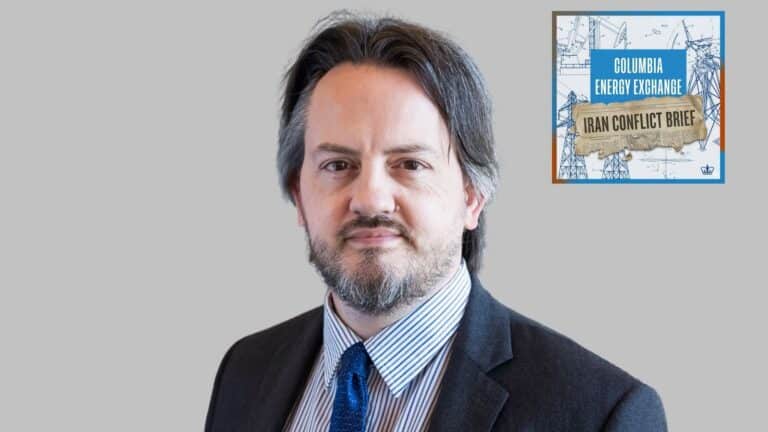
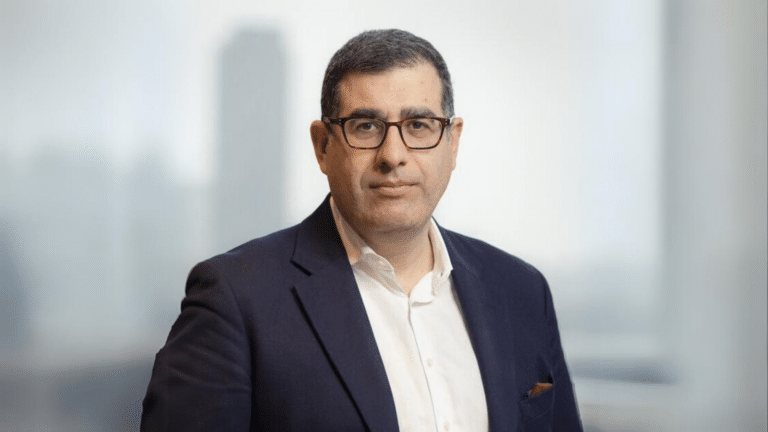
This is Columbia Energy Exchange, a weekly podcast from the Center on Global Energy Policy at Columbia University. I’m Jason Bordoff. Today on the show. Daleep Singh. Daleep is vice chair and chief global economist at PGM and a thought leader on global policy and macroeconomic trends. He first joined PGM in 2022 before serving the Biden administration as deputy national security advisor for international economics and deputy director of the National Economic Council. He also served as the US Sherpa to the G-7 G-20 and APEC. Earlier in his career, he held roles at the New York Federal Reserve and the US Treasury Department.
Daleep joined me to discuss how the US deploys economic state craft and the need for a framework to guide its use. We talk about industrial policy and how it can be used to boost supply chain resilience, safeguard energy security, and maintain our technological edge. Daleep also shares why he thinks we need new economic tools and institutional mechanisms like sovereign wealth funds to improve our economic competitiveness. I hope you enjoy our conversation.
Daleep Singh, good to see you again, my friend. Thanks for making time to be with us on Columbia Energy Exchange. Great to talk to you. I’m excited.
Daleep Singh (00:02:55):
My pleasure, Jason, good to be with you.
Jason Bordoff (00:02:57):
There’s a lot of things I want to talk to you about, but to give all of our listeners on an energy podcast sort of an understanding of why I’m so excited to talk to you and why what you have spent your career doing is so important for the energy sector energy, geopolitical risk, energy transition. Can you just explain your role in government and what the intersection is between national security and international economics?
Daleep Singh (00:03:21):
Yeah, so I’ve had three different stints in government. One at the Treasury Department, which is where you and I met, and then I was at the Fed running the markets group that implements monetary policy. And I was there during the most acute phase of the COVID pandemic. And then after Joe Biden was elected, Jake Sullivan asked if I would come to the White House and be a deputy national security advisor for international economics. And that’s a mouthful, so I have trouble saying it. But basically the job was to take on issues at the intersection of economics and national security. So if you think about how do we boost supply chain resilience, how do we safeguard energy security, how do we maintain our technological edge? What’s the right way to use the punitive toolkit of statecraft? How should we think about a positive affirmative agenda? Those are the types of issues I got into.
Jason Bordoff (00:04:11):
And like you said, we met when I first joined the Obama administration and you were at the Treasury Department, I think before the very senior political appointee roles you’ve had in a civil servant position is how you, I think, initially got into treasury and we were working, it’s funny, I hadn’t actually thought of this bring you out of the podcast, but I suspect we will talk a fair amount about the role of government, of the state in private enterprise in today’s new world of fragmentation and competition. And we were working together on things like could we take oil off the market to apply pressure to Iran and what would the oil market impacts be or should we release oil from the strategic petroleum reserve after the loss of oil supply from Libya? Those are all the sort of market crafter type policies that seem antiquated now relative to the scale of what both sides of the aisle have in mind when they talk about government policy intervening in a market. In that case, it was oil. Yeah,
Daleep Singh (00:05:09):
Those were the early days and it felt kind of naughty, discussing how the government could intervene in private markets. I had just spent, before I joined treasuries, a civil servant in 2011, I had just spent nearly a decade on the trading floor at Goldman Sachs, sort of at the vanguard of private sector, open economy on markets. And so it was a head fake getting asked the questions that you did. And then that began an entire new chapter of my life.
Jason Bordoff (00:05:37):
And I had been before joining the Obama administration, working with people like Peter Orszag and Bob Rubin at a think tank based on market, market-based economic principles at Brookings and earlier working at Treasury and the Clinton administration — an administration where I feel like if you had talked about industrial policy, you might have been shown the door. So that’s how I want to start. I mean, it does seem like one of the few things both sides of the aisle can agree on now is that the state needs to intervene much more, not less in private enterprise, in the name of national security and economic security, and that has enormous implications for energy and climate and clean energy and supply chains in China. But just at a macro level, talk about how you see that moment we’re in now and how you approached it when you were in government and how we should approach it moving forward.
Daleep Singh (00:06:26):
Well, I mean I’m 49 years old. I came of age, professional age in the nineties. That was the unipolar moment. And it felt at that point that ideological convergence was inevitable, irreversible. Many were saying democracy was in almost permanent ascendance and all of the notorious ism of the 20th century communism, nationalism, authoritarianism, they were out for good. And it wasn’t pure fantasy. I mean, during the ’90s, Russia joined the G seven to make it the G eight. Russia was fast trapping its way to the WTO. The EU created the euro and BRICS were like the Beatles of the emerging world, and they were lifting hundreds of millions of people out of poverty. So that was the backdrop. But then Putin and Xi came to power, and then we had a series of American failures from within, I would argue. The Iraq war, the 2008 financial crisis.
(00:07:17):
And I think it collectively shattered the notion that convergence was both likely and desirable from the perspective of revisionist powers. So that was one kind of flawed assumption in terms of the ’90s going on for an extended period into the new century. And then there was a second flawed assumption that I’ve come to realize, which is that markets have all the answers. It’s not correct. The private sector left entirely to itself, does not have the incentives to distribute resources and gains in ways that are sustainable and aligned with our national interests for our national security first and foremost, but also our economic security and I would argue for our democracy. And we’ve learned that the hard way. It turns out our supply chains were brittle. It turns out our industrial base was hollowing out. Our technological edge on some measures was fading. The climate crisis near and dear to you that was compounding and then inequality, social cleavages, they were all rising.
(00:08:13):
So too many people felt left behind by the kind of post Cold War unipolar construct of our economy. And the American dream has felt like it’s slipping further and further away. So I think the premise of industrial policy, by the time I came back into government at the White House, I had already come to the conclusion that look, market failures absolutely exist. I’d seen them firsthand in the private sector and the public sector. We can identify them and they can be corrected with targeted government interventions. And those interventions come in many different forms. And I’m glad that we’re finally having a conversation collectively out there about how to think about instrument choice. When do you use tax policy, regulatory shifts, investment subsidies, equity injections, government procurement, or even the basic foundations of building industrial capacity, immigration policy, infrastructure, spending, education. All of these interventions alter the structure of economic activity. And the goal is to align that activity in ways that better accord with the national interest. So that’s the regime we’re now in is how do we get that right?
Jason Bordoff (00:09:30):
I mentioned the kind of back to the ’90s, Clinton administration, Rubin, Summers, the sort of icons of what’s often called neoliberal economics. I don’t think any of them would disagree that there are market failures or argue that markets have all the answers and the idea that there are negative externalities like pollution and carbon emissions and markets need to account for them, or that there are public goods like national defense or roads and highways and government needs to provide them. Or education. I think the question is how broad that definition of market failures gets. And to pick energy as one example, if we are importing our solar panels from China, that is often classified — rightly or wrongly — as a national security threat or electric vehicles or that kind of coming back to that hollowing out in of industrial base. Manufacturing is declining, maybe services are growing, GDP is growing, and that sort of was the idea behind increased globalization. So I’m curious if you agree that we’re not often precise enough in figuring out how we define those market failures. And the consequence of that is trying to figure out where government should be intervening and how far to take state capitalism and maybe we’re not.
Daleep Singh (00:10:46):
I think I agree with the premise, the record of industrial policy or state capitalism, call it what you want. There are more cautionary tales than success stories. And I think right now the way industrial policy is being practiced, it’s from my taste far too improvised. And we do need an institutional framework to get at when —
Jason Bordoff (00:11:07):
Is that a criticism or a characterization you’d apply on both sides right now?
Daleep Singh (00:11:12):
Absolutely. It’s a self-critique of the way I thought about things and the administration more broadly that I was part of. But also, certainly now, and I would say more so now to be honest, and we can get into why, but I think we need to have a framework that first asks what is the strategic objective of the intervention? Okay, is the policy designed to advance supply chain resilience, safeguard energy security? Is it technological preeminence? Second, what is the market failure we’re trying to fix? Is there a demand shortfall? Is there a capital constraint? Do we face a cost disadvantage? Is there some kind of coordination failure that the private sector is not going to solve on its own? I would say third is then match the tool, the intervention to the fix, right? So the instruments should match the problem. Sometimes it’s going to be a tax credit or a loan guarantee.
(00:12:05):
Other times it should be an offtake agreement or a price floor or some type of procurement commitment. And then I think even when you match the tool to the problem, you’ve got to make sure that the intervention preserves competition. I think good industrial policy builds markets not monopolies, and it avoids single point dependencies. And you do that by having milestones and clawbacks and sunset clauses, so you protect taxpayers. And then the last question that I think we have to ask every time, and I don’t just mean privately within government, I mean publicly with democratic accountability and transparency, what’s the exit strategy? I don’t think the goal of any of these interventions should be permanent dependence on public support. There may be certain examples of where that’s necessary, but in general, the government’s role I think should shrink as private capital scales up and markets mature. And the common thread for all those questions is discipline. That’s the most successful examples of industrial policy like the Reconstruction Finance Corporation or DARPA, or, to be fair, Operation Warp Speed. They were all mission-driven. They were all time-bound and they were all grounded in a theory of market failure.
Jason Bordoff (00:13:16):
The second thing you mentioned the instrument, sort of a price floor, an offtake agreement. I think the examples you gave were all sort of focused on the idea of increasing domestic production and manufacturing. And I’m wondering how you think about the toolkit, which includes de-risking dependence on other countries. We might try to do more mining and refining and processing in the US, but in all honesty, to catch up to China is a pretty tall order. So you might want to maybe do things like the administration just did, which are strategic stockpiles or having responsive mutually assured destruction. We have capabilities and with cyber, that’s what discourages other actors. I’m curious how you think about the toolkit of reducing the risk of dependence, not just reducing dependence.
Daleep Singh (00:14:00):
Yeah, I mean this is the art of industrial policy. I mean, I think actually I’ll applaud the structure of the MP Materials deal because it addressed both the supply side of the problem, especially the financing challenges. It provided concessionary loans, it provided an equity injection on the financing side, but it also addressed the demand side by providing a 10-year offtake agreement with a price floor to ensure that this was going to be money good if you’re a private investor and you want to make a follow on investment. My only critique is that, and actually the administration has kind of heard this critique, not for me necessarily, but empty materials can’t be the only example of this type of structure. We don’t want to create a national champion. We should create a market. And so we should make these types of interventions with as many companies as possible to create a market ecosystem in which competition decides how resources are allocated. So I mean, look, there’s no formula. There’s no formula for exactly what instrument to use in each circumstance. I mean that depends on the market structure, the microeconomics of the particular supply chain that’s deemed to be brittle or lacking in resilience.
Jason Bordoff (00:15:21):
Your boss famously had a speech at Brookings talking about a small yard with a high fence. We want global economic integration and trade and it helps lower costs and there are efficiencies to trade or Ricardian basic principles of comparative advantage. But for a small subset of things that have very acute national security implications, risks, threats, we want to make sure we have domestic capacity there. And I’m wondering if you still think about that concept in the right way. Is that the right way to think about it? And I think what I hear you saying is one of the challenges is really defining how small that yard is. And when you talk about clean energy from a solar panel to a battery to an EV, to critical minerals, all of these things where there’s concern about supply chains, it sometimes feels to me like these all get lumped together and we’re not often precise enough about what the actual risks are that we’re worried about.
Daleep Singh (00:16:15):
Yeah, I think we do need a strategic anchor around the width of the yard and the height of the fence, otherwise the dimensions are going to creep wider and higher over time. So here again, I’m in favor of writing down and sharing with the public, debating with Congress exactly what our definition of a small yard and high fence should be. So I think you have to start with the premise of why do we have this in the first place? And we should be clear about that. I think you have to first say innovation, we know that’s our superpower, our capacity to innovate and attract talent and ideas. That’s a large part of the story of America, and we don’t want to dull the incentives for innovation here anywhere else. But the truth is there’s overwhelming incentive for the American private sector to diffuse cutting edge technologies to our strategic rivals.
(00:17:08):
And so therefore controls are necessary. It’s an acknowledgement of geopolitical reality that we do have adversaries that would use these cutting edge tools in ways that undermine our national interest. So okay, we need controls, but again, how do you anchor those controls? I think question one is what are the technologies that are truly foundational for economic growth potential and or national security? And I think in government, you have to be humble about trying to answer this question. You’re not going to have the answers. You’re always going to be several steps, maybe many steps behind the frontiers of technology. So you need a muscle, a process to constantly update that risk with input from the private sector and then identify for those technologies that you deem foundational. What are the subset of technologies for which you now or in the future expect to have a lead relative to your strategic rivals and vice versa, where do your rivals have a lead relative to where we are?
(00:18:05):
Okay. Then the third question is, let’s say for that subset where you have a lead, you think about putting on controls, you’ve got to ask the question, does the target of those controls have the ability to substitute for American supply either indigenously or from third countries? And that gets to the next question is how broad of a coalition can you bill so that you’re not just disadvantaging US companies relative to foreign competitors that continue to sell, for example, into the Chinese market. And then the last step, and this is where we just have to build this analytical infrastructure within the US government, I think we need to simulate a multi-player, multi-stage game theory of if we use our controls to maintain or expand as largely as possible and our rivals do the same, are we net better off at equilibrium 5, 10, 20, 50 steps down the line? You have to pass a certain threshold of efficacy before you get into this kind of game because otherwise you end up in an escalatory tit for tat and a generation later you ask the question, why the hell are we in this to begin with?
Jason Bordoff (00:19:10):
And I’m curious just because this is an energy center and podcast, bringing it back to that, and you probably engaged in at least some of those conversations in the White House, and I know you’ve thought a lot about it, how to characterize risks in the clean energy transition. Often when there’s a geopolitical event that disrupts gas supply, disrupts oil supply and prices spike, people talk about how if we were less dependent on oil and gas, we’d be more secure. And oil and energy — geopolitical risk traditionally has been about oil and gas at the same time. Now look, there’s a reason we need to transition because of the threat of climate change. I don’t want to lose sight of that, but just from the standpoint of national and economic security more narrowly defined and we’re the largest oil and gas producer in the world, if we switch to a system that’s much more electrified and you have components and technologies in a supply chain, not the daily flow of molecules or electrons that are 70, 80, 90% produced in China, but once they’re installed, they’re kind of producing electricity. Maybe there’s a cyber vulnerability there. I’m curious, how do you think about the national and economic security risks involved with moving to this very different kind of energy system?
Daleep Singh (00:20:23):
Oh, well, this is everything to do with what I was referencing with our analytical infrastructure. I think here we have to be much more forward looking. If you’re going to make the kind of transition that you just described, I think you do have to map out where are the choke points, where are the bottlenecks as we make that transition, if we have limited domestic production capacity of that scarce good or resource, and we have a very high import dependence on a strategic rival and limited opportunities to reduce that risk with surging supply from allies or partners, okay, then how much risk are we willing to tolerate during that transition? And is it economically and politically sustainable? I think we don’t do the work rigorously enough in many cases before we jump in with a policy change as dramatic as we’ve seen over the past five years, at least up until the new administration took over. So if we had a do-over, I would say, let’s do our homework first.
Jason Bordoff (00:21:25):
And the reason I ask is because we need to be transitioning to clean energy so much faster. And a lot of that is produced in China, and it’s part of the reason it’s become so cheap in solar panels and electric vehicles. And so if you really want to change that through domestic manufacturing incentives through tariffs, it’s perhaps possible, but it’s hard. It takes a kind of overwhelming force I think, of government policy. And it probably is inflationary, it probably slows down the pace at which these technologies are deployed. And that’s kind of a trade off that we have to grapple with.
Daleep Singh (00:21:59):
It has to be sold to the public because we had a three-prong strategy, as you know, and it was centered around scaling up and strengthening our own domestic production capacity as well as the size and skills of our labor force that were needed to produce a clean energy transition as fast as possible. And the second prong was let’s identify partners playing by the same rules and share in each other’s productive capacity and purchasing power. And then the third prong was regrettably, let’s use a targeted set of tariffs against countries that are not playing by the same rules, i.e. China in order to level the playing field and make sure that the hundreds of billions of dollars that we were investing with still money. Good. And the purpose of that last prong was not punitive. It wasn’t to get back at China, it was to try to change the terms of the competition over the course of time towards a competition based around your ability to innovate, to attract talent, to create networks and alliances. Those are the terms of our competition. I would feel pretty good about our ability to make the clean energy transition and to prevail in a way that’s good for our economy. But of course for that you have to sell the plan domestically and also bring in a lot more allies and partners than we were able to do in the four years that we had.
Jason Bordoff (00:23:15):
And we’re talking a lot about the – we started with the vulnerabilities, the sort of choke points in terms of America’s integration into the global economy and dependence on other countries. Lots of countries are using tools of economic statecraft in more aggressive ways, and the US is one of those. So I’m kind of curious, you were also involved in lots of conversations about how to use these tools of sanctions and tariffs and export controls At a broad level, how do you think about what Eddie Fishman and choke points and others have kind of written about this kind of expanding toolkit where government is more aggressively using economic statecraft tools? Is that gone too far or not far enough? And is there a risk of overuse of these tools?
Daleep Singh (00:24:02):
Absolutely. I’ve given a number of speeches and written a number of articles on this very point because I do think we’ve spent hundreds of years developing and refining a doctrine for the use of military force, but comparatively a small fraction of that time thinking about a doctrine for the use of economic weaponry. So I think it’s absolutely timed to articulate at the highest levels of the US government, why, when, how, and to what extent we use economic weapons, sanctions, tariffs, export controls, investment restrictions, price caps, you name it. And so I think laying down guiding principles would be a start, but then again, building an analytical infrastructure that takes those principles seriously and also has connective tissue with our foreign counterparts, both allies as well as adversaries and non-aligned countries. And then ultimately I think what that would do is it would help us strike a better balance between the use of punitive tools like sanctions and tariffs and export controls and positive tools, which I think really play much better to our strengths, our ability to inspire and create and attract. Those are our most potent tools, but we don’t have the financial firepower to bring those to life to bring the private sector into alignment with our national objectives. And that’s the other reason to think about doctrine.
Jason Bordoff (00:25:29):
Say more about what you mean by that. The positive tools and the private sector.
Daleep Singh (00:25:33):
Let me put it this way. I mean everyone knows we’re in the most intense period of geopolitical competition in at least 35 years, maybe much longer, but today’s great powers are mostly nuclear powers, which to me is channeling direct conflict away from the battlefield and into the arenas of economics and energy and technology and finance. Okay, so the question is if that’s the competition we’re in as dynamic and as deep and renowned and our financial sector may be, we don’t harness it in ways that actually advance our national objectives at the pace and the scale that we need to compete with China. We don’t have a lot of long-term patient capital that we can put to work in investments like fusion or advanced geothermal or neuromorphic computing or advanced robotics or synthetic biology. You pick your next generation technology, most of these require a lot of upfront capital expense more than a decade or more to recoup commercially attractive returns and a lot of risk tolerance, geopolitical risk tolerance, regulatory risk tolerance.
(00:26:41):
And so venture capitalists tend to shy away, they have more attractive alternatives in software or intangible assets that can scale much faster and exit much more quickly. I mean, private equity, traditional private equity firms tend to focus on companies that have cash flows that they can lever up and banks avoid pre-commercial technologies altogether. So that’s why we have this so-called valley of death between basic science and commercial scale, which is where China dominates. So that’s why I think we have to actually expand the toolkit of the US government. I’ve been advocating for sovereign wealth fund for strategic resilience reserve for any number of tools that we can invent or we can reimagine existing ones. By the way, DODs, DPA Title three or the alphabet soup of development finance agencies that have relatively restrictive mandates, the point is we do need to revitalize our tools, our institutions, and our alliances so that we have the financial firepower to compete. Right now we don’t have that.
Jason Bordoff (00:27:49):
You wrote in Foreign Affairs something that struck me after hearing Mark Carney’s comments in Canada in Davos recently, you wrote “the purpose of coercive statecraft after all should not be the unilateral exercise of brute force, but the collective defense of principles that sustain peace and security.” And I was wondering if you could talk a little bit about what you had in mind. Does that include things we’ve seen in the 20, 25 years that these tools are being put in place or there’s been an acute tension in the last year?
Daleep Singh (00:28:21):
You don’t have to go very far back. I mean, I was struck after we put in place the sanctioned regime against Russia after its invasion of Ukraine in 2022, that six months or so afterwards, two thirds of the world’s population lived in countries that had not joined our sanctions regime. And as I traveled around the world trying to convince more countries to join, particularly some of the geopolitical swing states, India and Indonesia, Turkey, et cetera, I mean the pushback would come in two forms. One was efficacy. Our economic tool is really going to push an autocrat that’s hellbent on a 19th century land grab like Putin out of Ukraine. I mean obviously not, and there’s a nuanced answer to it. But the second critique was that there was this perception, this very unfortunate perception that this was just the US throwing around, as I put it in the Foreign Affairs article, just the unilateral exercise of American brute economic force was on display and they wanted no part of it.
(00:29:26):
So that’s why upon reflection, it became very clear to me that in the first instance for ourselves, we need to lay down limiting principles for again, why, how, when, and to what extent we use these tools. And actually that kind of doctrine shouldn’t stop at the border ultimately, and you may think this is just kind of naive farfetched talk, but ultimately we need a Geneva convention for the use of economic weaponry. And if you go back and look at how did the 1949 Geneva Convention come about, actually Geneva Convention is the wrong term. It was plural and it started way back in the 1860s after the Italian Civil War, and it culminated in what we now know as the Geneva Convention in 1949. It started out very small dealing with the neutrality of medical personnel. We need to start small here as well. First in a conversation with Europe and then our closest allies, Europe and Japan and the G-7, but then ultimately with non-aligned states and our adversaries, it’s not out of altruism. This is all about enlightened self-interest because the alternative is an uncontrolled race to the bottom in which the anchored countries, most importantly the United States has the most to lose. This is purely about how do you maintain leverage and the ability to exert influence in a much more contested world in which economic weaponry is really the frontline
Jason Bordoff (00:30:47):
And we have the most to lose. Why? Because it undermines, erodes the strength of the dollar in the long term or other countries de-risk and reduce their exposure to our coercive force.
Daleep Singh (00:30:58):
All of that. I mean, we benefit the most from the status quo, from the status quo system, and that’s on display right now. We’re extracting look at how we’re able to extract bilaterally whatever we want. It’s because of the dominance that this system has created for us economically, militarily, technologically. So yeah, we have the most to lose.
Jason Bordoff (00:31:18):
I mean that is sort of the point a point Carney made, which was if a country wants to use coercive economic power in transactional ways, it can do that, but every time it does, it erodes that power just a tiny bit. Other countries will de-risk look for options. We’ll build alternatives, and that’s hard. It takes time. There’s not an alternative to the dollar as people keep saying until there maybe is one. I mean it erodes over time.
Daleep Singh (00:31:42):
I would point to some of the work being done by the Atlantic Council on this very point that you’re not going to see it in the share of foreign currency reserves or the use of a currency for raising international debt or FX turnover. But if you look at the building blocks of an alternate or parallel financial architecture, China is very much building it. They’re building a settlement and messaging system that could rival swift. They’re building a cross border transfer payment system called Enbridge that’s getting more and more people signing up. I mean, the point is that yes, sanctions and coercive tools, they’re like antibiotics. The more you use them, the more resistance will build. And so of course if you want to go maximalist, you can extract concessions from your allies and your adversaries in every country in between, but there is a long-term cost. You are borrowing from the future and you’ll reduce the gravity the US has in the world order as a consequence.
Jason Bordoff (00:32:43):
Can you talk a little bit about the use of those tools of economic statecraft and coercion in the context of the Russia Ukraine conflict where you were sitting in a government role at the time, and I think that brought to light what’s always been a challenge. Again, this is an energy podcast with using those tools in an integrated global market, particularly for oil where you can impose pain on another country, but if you do impose it on, you’re going to impose pain on yourself in the process. From the outside, it seemed like Europe was more willing to do that than the United States was, and Russian oil actually never fell very much Russian oil exports all through that crisis. What was the thinking internally on how you use these tools of sanctions and other tools?
Daleep Singh (00:33:26):
Well, I mean the thinking from the beginning is again, we’re confronting an autocrat who is hellbent on an 19th or an 18th century land grab no matter the consequences, human or economic. So sanctions were always just going to be one tool in the broader strategy together with military and diplomatic dimensions to basically try to change this calculus about the cost of continuing a senseless war. And so it’s really hard to judge sanctions in isolation. I think they need to be evaluated against the alternatives that we had when the war began, which were go to war directly with a nuclear armed rival and risk global Armageddon or basically stand by and allow one of the most egregious violations of international law in recent history to go unchecked in the heart of Europe and accept the precedent that would set and the chilling effect it would cause.
(00:34:16):
Those were the choices that were available. And so we used sanctions to the maximum extent possible subject to the spillover our costs that were sustainable. And what was the effect of these sanctions? I think reasonable people can critique what we did, what we could have done better. I think humility is important in conducting economic warfare just as it is in the battlefield. And in the beginning of the war, I predicted a nose dive for the Russian economy, but I would not confuse Russia’s rebound or whatever you want to call it with resilience. On the surface, Russia’s economy looks like it’s survived, but if you look at the foundations of its economy, they really are incredibly weak. Growth will be under 1%, inflation will be close to 10%. Their central bank policy rates are 16%, more than a million people have fled. More than a thousand companies have left. They’ve lost access to cutting edge western technology. So this is going to be a smaller, weaker, less sophisticated economy for generations to come. And that’s another tragic consequence of this war. Now, what could we have done with sanctions that we didn’t do? I wish we’d been able to put in place secondary sanctions on Russian energy exports. We didn’t have the internal buy-in to do so we had a 9% —
Jason Bordoff (00:35:45):
Secondary sanctions, meaning like what we did with Iran, where you would sanction the central bank of buyers of Russian oil, really try to keep Russian oil from being sold …
Daleep Singh (00:35:54):
Basically China, India, Turkey, Korea, a few others. I mean the G-7 within weeks of the invasion agreed we were going to cut off with some exceptions in Europe, cut off our imports of Russian energy. But secondary sanctions refers to anybody who wants to buy Russian energy, that’s fine, but then you can’t do business with us. You’ll be cut off from the US financial system. So I mean, that’s how Russia generated hard currency. Despite the fact that we froze over $300 billion of their central bank reserves, they more than replaced those assets with inflows from their energy export sales. The other step that I wish we’d taken that we didn’t take was a heavier hand with China. So China became the factory of many of the dual-use weapons that found their way to the battlefield, the components that went into missiles and tanks and drones in addition to Iran and North Korea. And I think we could have sent a message to China a much more forceful message by picking not one of the big four banks, but at least a mid-size bank that was intermediating the flow of these dual use weapons to Russia. And I think that might’ve had a much more impactful outcome in terms of China becoming the arsenal of autocracy during this invasion.
Jason Bordoff (00:37:20):
Yeah, it’s interesting listening to you talk about how to respond to dominance in certain parts of global supply chains in China or the response to Russia, the importance of working with allies. And maybe for people listening, you can explain in the government context what a sherpa is and how venues like the G-7 and the G-20 which you were responsible for, how can they be used in today’s political context?
Daleep Singh (00:37:49):
Yeah, so I think the term sherpa probably should be retired. I mean, I didn’t carry anybody’s bags. But the whole idea is to represent the president in negotiations that precede a major international forum like the G-7 or the G-20 or APEC. And I would say the high point of we called the G-7 in the run up to and the aftermath of the invasion of Ukraine. It was like the steering committee of the free world. We made a lot of consequential decisions. It was no longer just a talking shop. We would roll up our sleeves and do the real work of coordinating what type of sanctions package are we collectively willing to put in place within hours of an invasion that we expect to occur imminently. And we managed to do that. But the reason we were able to make tough decisions on sanctions and remember people can belittle the force of the sanctions we put in place after the invasion, but at the time, and they still are the most consequential, the most severe financial sanctions ever put on in financial history.
(00:38:51):
And we did so in lockstep as a G -7 within 48 hours of the invasion. That’s not an easy thing to pull off. We were able to pull it off because we had done hard things together in the 12 months. We came into office in January of 21, but in the 12 months that proceeded the invasion of Ukraine, we began to put up a lot of points on the board together. I mean, we settled a, this may sound obscure, but we settled a 17 year tariff dispute between Boeing and Airbus with the Europeans. That was a big deal. We signed a privacy shield for data flows between Europe and the US. That wasn’t easy either. We had to deal with our tech companies and their regulators. We agreed to share a billion vaccines as a G-7 with countries most in need. That wasn’t easy to do in the grip of the pandemic. And so doing hard things together, built trust. And I have to say President Biden was, he was deeply committed to the transatlantic alliance and the G-7 and it showed and they knew it and they trusted him. And that trust is the currency of diplomacy. And we used that currency when we needed it after the invasion. That’s how we were able to get what we got done as fast as we did.
Jason Bordoff (00:40:04):
You mentioned shortly ago something you’ve written, spoken about, which is the idea of a sovereign wealth fund. Both the Biden administration and the Trump administration have put this idea out there, and that’s a concept I think we tend to think of in association with countries with large natural resources that are controlled and create wealth for the government, which is not quite the case here. What does a sovereign wealth fund mean in the context of the United States? Where is the wealth coming from and what’s it being spent on?
Daleep Singh (00:40:34):
Yeah, you’re right. I mean the most commonly thought of sovereign wealth funds are in countries like those in the Persian Gulf or Norway or Chile. These are countries that generate large and sustained trade surpluses from exporting natural resources and the income they earn from selling those resources — because it fluctuates with a price that’s set in the global market, the income stream is volatile and it’s also uncertain. And so that for these countries, sovereign wealth funds provide a form of insurance. They reduce risk by allowing countries to invest their income in a portfolio of assets that sustains their wealth. That’s the idea. And the logic is similar for countries in Asia that aren’t net exporters of natural resources, but they have very large trade surpluses from selling manufactured goods to the world. Think of China. So why should we have a sovereign wealth fund?
(00:41:31):
I think there are two arguments. One is the national security case. So I’ve already stipulated that we’re in this very intense period of geopolitical competition that’s playing out mostly in the arena of economics. And as I mentioned, we have unrivaled economic firepower. No one should doubt that’s true, but only if we can harness that firepower to our strategic advantage. And I do think left entirely to itself, the private sector’s incentives are not designed to fight this competition. They’re designed to maximize profits under very short time horizons and not to maximize our long-term strategic advantage. So —
Jason Bordoff (00:42:08):
Does that, sorry, I didn’t mean to interrupt. Does that mean when you say sovereign wealth fund, it sounds like what you’re describing is more government spending on industrial policy, like the CHIPS Act and go bigger and we need to pick industries we want to support and make sure happen here. Is that what I’m hearing you say?
Daleep Singh (00:42:24):
It’s similar, but I don’t think we can depend on having a window of legislative opportunity like we did to pass the CHIPS Act or the IRA. I do think we need an institution that has some degree of insulation from the political process yet still retains democratic accountability. And that’s the balance that you have to strike. But just to kind of explain that, the second argument, Jason, and then we can get into how you do it. I think the second argument is just finance 101, and I don’t even call this a sovereign wealth fund. I call it more of a strategic investment vehicle. And lemme just give you an analogy. Let’s just say I live in a neighborhood and I have a relatively low income relative to my fancier neighbors and I’ve taken on a big mortgage on my home. So I’m highly indebted, but I still have a 401k, I still have savings.
(00:43:13):
That’s even more a reason why I should optimize the value of the assets in my 401k so I can pay for my kids’ education, my retirement, a rainy day, et cetera. Now obviously I need to be careful there’s not much margin for error because I’m spending beyond my means and I’m highly leveraged. But if I’m sitting on a bunch of debt assets in my attic, I should try to bring those assets to life in ways that most benefit my family. So that’s what I’m talking about here. We have an enormous amount of assets. We’re asset-rich federal government owns 30% of the land in this country. We have extensive energy and mineral rights. We own the electromagnetic spectrum. We have 8,000 tons of gold valued at 1934 prices. We’ve got over 200 billion sitting at treasuries, exchange stabilization fund that are mostly in foreign T-bills. So is that the best strategic bang for the buck or could we sell some of those assets and put them to more strategic use? I think the answer is yes.
Jason Bordoff (00:44:16):
I guess, I mean, I think the same idea you just articulated maybe gets at this idea. I know you wrote, for example, something you and I worked on a long time ago about the strategic petroleum reserve, a bunch of oil sitting in salt caverns, and once every decade something happens and people decide whether to release some to a global market. But you argued for a more, what’s the word, activist interventionist approach, where we’re using that as a tool —
Daleep Singh (00:44:44):
Or at least a backstop…
Jason Bordoff (00:44:44):
To earn a return to mitigate price volatility. Is that an example of the role of the state that you’re arguing for, whether it’s in the SPR or a sovereign wealth fund or somewhere else?
Daleep Singh (00:44:55):
Yeah, and what I’m trying to do is put ideas out there that others will improve on. And so my notion is we created the SPR in the 1970s when we were a major net oil importer. We wanted 90 days of oil import cover, et cetera, et cetera. And as you just laid out, the situation is completely flipped. So we now have a new set of energy inputs, and I would argue specialized technological inputs too, for which we are subject to a global price, or not even a global price, a price that’s set by a foreign actor that leaves us vulnerable and really kind of undercuts the production incentive for would-be players in this space. So for example, in many critical minerals, because China is setting the price and really controlling all of the market infrastructure, there are really bad asymmetric risks for American or allied producers.
(00:45:51):
If they oversupply that good, they could very well go unsold. If they undersupply it, they just lose a little bit of profit. And so what do they do? They just back away. And we end up chronically under investing in many of the inputs, energy inputs that we need to make a clean energy transition. And so that’s the market failure that we’re not going to solve just with private sector actors. We’re going to need some type of backstop that has the ability to intervene in markets to provide synthetic stockpiles or physical stockpiles if the mineral allows for it to sell, put options in the market so that producers could hedge their downside risk to provide futures contracts to allow more speculators in the market. Basically what I’m saying is let’s control the market infrastructure and that will be the prelude to having competitors that can build scale.
Jason Bordoff (00:46:44):
And no disagreement that there are significant market failures. And when there are… like carbon emissions, government should, in a robust way, intervene to address those market failures. I guess the question I’m wondering if people would have listening to what you’re saying is your approach thinking on the role of the state in these markets I think comes from a place of a high degree of confidence in the capability of the state, the administrability of the ideas that the government is going to be a good oil trader or investor despite the political pendulum swinging every four or eight years, and even independent agencies now being under pressure in terms of their independence. I’m wondering if that’s right, if that is a legitimate tension concern or do you have that confidence?
Daleep Singh (00:47:28):
I wouldn’t put it that way, Jason. I would say that I am a believer in economic realpolitik. That this is the world we’re in, and this is the least worst option to have a greater role of the state to make targeted principled interventions with strategic anchors, with doctrine, with limiting principles because the alternative, allowing market forces by themselves to create an optimal outcome for our country. I have less faith.
Jason Bordoff (00:47:56):
And I dunno if you had a chance to look closely at what the Trump administration did with creating some sort of a critical mineral stockpile.
Daleep Singh (00:48:03):
I have not studied that.
Jason Bordoff (00:48:05):
But ideas like that, I assume depending on how they’re constructed and implemented, would potentially make sense to you in addressing the market failures you’re talking about.
Daleep Singh (00:48:17):
If the mineral lends itself to a physical or synthetic stockpile, sure, but it may be that the better intervention is a tax credit or an investment subsidy or a price floor or an offtake agreement, and I want to see a robust discussion of the instrument choice. Why does it match the problem that we’re trying to solve? And we should be technocratic about these types of decisions and be very transparent about the trade-offs.
Jason Bordoff (00:48:46):
I think it’s really interesting to hear how you think about this and how you thought about it sitting in a seat of policymaking and now you’re back on the other side in an investment firm. And I’m wondering how you think about it. Does it look different there kind of a much more interventionist role of government for the kind of capital allocation decisions that companies need to make?
Daleep Singh (00:49:08):
Look, I have been and will remain steadfastly opposed to the government picking winners. That’s not at all what I’m talking about. What I’m talking about is the government helping to nurture markets and supply chains and production capacity that doesn’t exist with an ecosystem that’s resilient to shocks all manner of shocks. So I think from the private sector standpoint that I have now, I actually think every supply chain vulnerability creates a commercial opportunity. There’s going to be an economic security asset class. There’s no doubt about it in my mind that for in supply chains where there’s very limited domestic production capacity and a very high import dependence on a strategic adversary, just think of all the areas in which China has dominant market share — ships, cars drones, robots, batteries, pharmaceuticals, machinery, solar panels, electrolyzers, whatever. That’s an area in which they’re going to be strong, bipartisan, global, durable policy tailwinds.
(00:50:12):
And if you’re sitting in the private sector, what the government is telling you as loudly as it can is we’re trying to crowd you in. And so if you can develop pools of capital that are long-term, patient, that are willing to wait 10 years to generate a commercially attractive return that allow you to put up a lot of upfront CapEx, and if you have the tolerance to deal with the risks involved, that’s going to give you an uncorrelated stream of cash flows relative to your liquid macro portfolio. And it’s going to take advantage of the direction of travel in the world, which is that geopolitics and economics are no longer a different conversation. I think that’s coming. And so there are actually some deals that have been announced. Apollo, a BDC, JP Morgan is creating, I think it’s called a security and resilience fund.
(00:50:59):
We at PGIM are thinking about structuring a vehicle like this as well. And I think it’s going to happen all over the world. So I think there’s a chance for the private sector to play a big role in what I’m describing, partnering with the public sector, because the best tradition of American innovation is when the public sector, the private sector and academia are collaborating, right? I mean, that’s the entire story of how every major invention of the digital age came about. So this is not a structural break with that way of thinking. It’s just a return to where we’ve been.
Jason Bordoff (00:51:32):
I was just going to ask, you mentioned before what Trump did on MP materials, and I’m kind of curious where you agree and disagree. What makes sense about how they’re approaching these issues of economic security and resilience and what perhaps less so?
Daleep Singh (00:51:45):
Well, I guess two things. I mean, I think I’ve mentioned before, I would like to see dozens of MP Material deals. And actually, I mean I think they’re up to double digits now, so I have to say that they’ve done, but I was worried at the beginning that MP Materials was an attempt to create a national champion when we need a market.
(00:52:05):
And I think a check on that front that’s happening. The second is I would like to see the administration show their work in the way that I described. So for each intervention, this is too important of a national project to improvise. Let’s institutionalize the practice of industrial policy. What is the strategic objective? What’s the market failure? Why is your intervention solving that failure? How do you sustain competition? What’s your exit plan? I think the public deserves to know and to grapple with the trade-offs, obviously. So does Congress. I mean, in many cases the authorities that are being used, I would’ve loved to use them, but I’m not even sure they’re legal and I don’t want this to become a political embarrassment or a piggy bank that wrecks the practice of industrial policy for another 40 years. That’s what happened from 1980 until about 2020 is those muscles atrophied. And so for those who critique the execution implementation, and fair enough, those are all fair, in part, it’s because the muscles atrophied for decades and decades.
Jason Bordoff (00:53:08):
Just concluding on sort of coming back to the question of energy and the clean energy transition we talked about before, how you view the way that a clean energy transition might reshape positively or negatively these economic security risks. And in particular, we talked before about the areas where China’s dominant 70, 80, 90% of certain products and refining and processing of minerals. The other thing the Biden administration often talked about was a concern about Chinese overcapacity. And I was wondering how listeners should understand that concept. So I’ll give you an example where I think last year the world produced less than a million tons of green hydrogen. And if we were on track for climate goals by 2030, just four years from now would be producing something like 50. So we’re like 50 or a hundred times short of where we need to be. So the idea that China has too much capacity – three or fourfold of something like that. The question is how do you think about why that’s a problem? And maybe that’s a bad example. And it’s true for other things where you see over capacity used to manipulate markets and that’s the concern. But what does that phrase mean?
Daleep Singh (00:54:17):
Well, okay, so the problem that we’re describing when we use the word Chinese, when we use the phrase Chinese overcapacity, what does that mean? It means that China is flooding strategic sectors with supply well beyond what global demand can plausibly absorb, and therefore it’s wiping out the competition. It’s not a new problem. China’s been running this play for the better part of two decades to gain dominance and steel, solar and wind and medical devices and machine tools. Now the dynamic is just broadening and it’s intensifying. So it includes EVs of course, batteries, lagging edge chips, a wide range of sectors in which we’re making hundreds of billions of dollars of investments to rebuild our industrial capacity. And that’s happening all over the world. And remember the starting point, China already accounts for 30% of global manufacturing in value added terms. That’s more than the US, Germany, and Japan combined.
(00:55:17):
And so look, it’d be one thing, what I always told counterparts when I was in office, it would be one thing if China’s growing dominance in strategic sectors was the result of indigenous innovation and market forces. If that were the case, maybe we should applaud the positive spillovers that would accrue to the rest of the world. But the reality is that China is competing in a qualitatively different way with free credit, cheap land, dirty energy, in many cases, uneven regulations, in some cases, forced labor in ways that massively distort the competition and create an unlevel playing field. And you can see this, I mean, this isn’t just a bunch of pablum, you can see this in data. If you look at volume data, domestic production trajectories in China, well exceed global demand trajectories. And you can see capacity utilization rates falling sharply in China. You can see it in their nominal data.
(00:56:12):
So China’s been mired in disinflation and deflation because domestic production far exceeds their domestic demand. You can see it in the financial numbers in China. There are persistent losses from a large and growing share of Chinese producers and exporters. And so this is what we mean by overcapacity and the way to combat it. Our approach was again, number one, make investments at home to strengthen and scale up our own productive capacity. Two, make partnerships with countries playing by the same rules so that we have allied scale and we have access to each other’s production and purchasing power. And then again, three use tariffs and try to build a coalition with us to use tariffs against countries that aren’t playing by the same rules to prevent our investments from getting undercut. And the reason to do it is that the harm from standing aside and doing nothing, that’s the unacceptable consequence that we can’t bear because it not just impacts our economic growth, it impacts our national security and arguably democracy itself. And it’s in part driving some of the anti-establishment populism we’re seeing across the western world. I’ve been shocked, Jason, that no country has retaliated against China this year as it’s redirected, its exports from the US to Europe to ion to the global south. It’s really striking. It’s just an acceptance of their own manufacturing sectors getting wiped out. Look at Germany —
Jason Bordoff (00:57:46):
That way you defined it sort of production well in excess of current global demand. And I sort of get that for steel. But just coming back to that sort of tension or tell me if you think there is one with the idea that for wind or solar or EVs, the administration you worked for had objectives to say, demand should be 10 x what it is today. And is there a tension with sort of saying they’re producing too much of something we want the world to be using much more of and want to be as cheap as possible. And how do we reconcile that?
Daleep Singh (00:58:17):
So I don’t have the numbers in front of me, but I remember when we were having this debate with our Chinese counterparts, we looked at the numbers and said, look, these are our targets in the IRA for EV demand or pick your clean energy output and here’s actually, here’s the global demand outlook from third party objective sources and here’s your supply. And if we extrapolate your supply trend lines relative to global demand, not just US demand, you are choosing to flood the zone and you’re doing so in a way that’s going to create a race to the bottom. Unless we can agree on China, you reducing your excess capacities, we try to ramp up hours. That was always the grand bargain that we could strike and it was never available.
Jason Bordoff (00:59:01):
I have kept you longer than you committed to be kept, so this was super interesting conversation. There’s so many more things we could talk about, but I hope we can have you back again soon. So thanks for making time Daleep to be with us and thanks for your service across administrations and thanks for making me and all of us a little bit smarter today. I really appreciate it.
Daleep Singh (00:59:20):
Likewise. Thanks for your service, Jason, and this was fun. Let’s do it again.
Jason Bordoff (00:59:27):
Thank you again, Daleep Singh. And thanks to all of you for listening to this week’s episode of Columbia Energy Exchange. The show is brought to you by the Center on Global Energy Policy at Columbia University. The show is hosted by me, Jason Bordoff and by Bill Loveless. Mary Catherine O’Connor, Caroline Pitman and Kyu Lee produced the show. Gregory Vilfranc engineered the show. For more information about the podcast or the Center on Global Energy policy, please visit us online at energypolicy.columbia.edu or follow us on social media @ColumbiaUEnergy. And please, if you feel inclined, give us a rating on Apple, Spotify, or wherever you get your podcasts. It really helps us out. Thanks again for listening. We’ll see you next week.
During President Trump’s second term, the administration has taken unprecedented action in the US private sector. The federal government’s investments in critical mineral mining and chip manufacturing are two examples. The Trump administration has also embraced tariffs, framing them as tools for economic security and a domestic industrial revival.
This shift toward state intervention into private markets, done in the name of national security and economic security, has some bipartisan support. It also has major implications for energy security and the clean energy transition.
So how can this new form of American state capitalism be conceptualized? Is the Trump administration’s use of these tools different from prior US government programs to support critical industries, like the Biden-era investments under the CHIPS Act? And what are the best strategies for aligning industrial policy with goals around energy security, supply chain resilience, and innovation?
Today on the show, Jason Bordoff speaks with Daleep Singh about how the US deploys economic statecraft and the need for a framework to guide its use.
Daleep Singh is vice chair and chief global economist at asset management firm PGIM and a thought leader on global policy and macroeconomic trends. He first joined PGIM in 2022, before serving the Biden administration as deputy national security advisor for international economics and deputy director of the National Economic Council. Earlier in his career, he held roles at the New York Federal Reserve and the US Treasury Department.
While US and Israeli forces have significantly degraded Iran’s military and nuclear capability, the global energy landscape remains in a precarious position. For weeks, the Strait of Hormuz...
Today marks the last day of CERAWeek, the annual energy industry conference sometimes described as the Davos of energy. As oil and gas CEOs and government officials gathered...
The Iran conflict has rapidly expanded, drawing in actors across the Middle East and raising concerns about broader regional escalation.
Nearly a month in, the conflict in Iran appears to have hit a critical inflection point. Over the weekend, President Trump gave Iran a 48-hour ultimatum to open...
The Iran war will accelerate the region’s economic transformation.

On March 20, Governor Kathy Hochul proposed significant changes to New York’s Climate Leadership and Community Protection Act (CLCPA), the landmark climate law passed in 2019.

The oil shock triggered by the crisis in the Persian Gulf has pushed crude above $100 per barrel, reviving familiar fears of economic turmoil in the United States driven by surging gasoline and diesel prices.