Energy Markets Series: Half-Time Talk Weekly Feature Interview
Dr. Tatiana Mitrova, Research Fellow, Center on Global Energy Policy, Columbia UniversityTells Half-Time Talk GI Exclusive Interview: âEnergy Markets Pass th...
Get the latest as our experts share their insights on global energy policy.
Four bills in Congress each close a different route for Chinese access to American computing power.
Hear in-depth conversations with the world’s top energy and climate leaders from government, business, academia, and civil society.
Earlier this month, US voters handed Democrats control of both chambers of Congress and flipped several governorships across the country. The dramatic shift in power raises big questions...

Insights from the Center on Global Energy Policy
This Energy Explained post represents the research and views of the author(s). It does not necessarily represent the views of the Center on Global Energy Policy. The piece may be subject to further revision. Contributions to SIPA for the benefit of CGEP are general use gifts, which gives the Center discretion in how it allocates these funds. More information is available here. Rare cases of sponsored projects are clearly indicated.
Nvidia’s chief executive, Jensen Huang, was reinstated Monday after resigning on November 12 over reports of his relationship with Alice Huang, a former executive at a Singapore-based customer whom US officials suspect of diverting chips to China and working for Chinese intelligence. Nvidia’s board acted after input from “senior” US officials, including President Donald Trump’s contradictory claim that the government has no reason to believe he poses a national security risk. The episode is the backdrop for four bills currently under consideration in Congress—the AI OVERWATCH Act, the Chip Security Act, the MATCH Act, and the Remote Access Security Act (RASA)—three of which are in the Senate’s package for the fiscal year 2027 National Defense Authorization Act that Congress is expected to take up in December.
Each bill closes a different loophole that has allowed Chinese access to American computing power. Collectively, they represent a significant rebuke of Trump’s approach to the US-China AI race—which prioritizes securing global market share over limiting adversarial access to advanced chips—and a major effort by Congress to reassert its role in technology policy. Three of the four bills would replace discretion at the Department of Commerce with statutory deadlines or congressional review.
The AI OVERWATCH Act would codify the existing ban on sales of the most advanced AI chips to countries of concern and give Congress a role in reviewing licenses for the rest, much in the same manner as occurs for foreign arms sales. The bill, which the House Foreign Affairs Committee overwhelmingly approved, 42–2, would give Congress a 30-day window to issue a joint resolution blocking a transaction, which the president could then veto. Trump may well choose to veto any such resolutions, but at a minimum this would force his and subsequent administrations to defend these sales to Congress. The Chip Security Act would direct the Department of Commerce, within 180 days of enactment, to require location verification for covered chips using techniques that are “feasible and appropriate,” and would oblige exporters to report suspected diversion. The main concern with this approach is technical feasibility: the current state of the art approach, which measures network latency, works only while chips are online.
The MATCH Act addresses chipmaking equipment. It would direct agencies to identify the chokepoint tools and the Chinese facilities that warrant controls, and it would press allied governments, chiefly the Netherlands and Japan, to match American restrictions. Given that the United States has already achieved significant progress convincing these countries to curb Chinese sales using diplomatic channels, some critics object to a 150-day deadline for allies. That deadline is backed by the significant threat of extending the Foreign Direct Product Rule to their firms, essentially imposing US licensing requirements on leading Dutch and Japanese firms.
RASA would amend the Export Control Reform Act to allow the Department of Commerce to license and penalize remote access to controlled items so that a Chinese firm renting a cluster of controlled chips in a third country could be required to obtain a license where Commerce finds a national security risk. The House already passed the bill 369–22 in January, and Senators Dave McCormick and Ron Wyden introduced a bipartisan Senate version nearly a year ago. While AI OVERWATCH, the Chip Security Act, and MATCH were packaged in a version of the NDAA this summer, RASA remains the least certain to be included in the must-pass National Defense Authorization Act.
The bills all share the same premise: if the AI frontier is decided by access to computing power, controls on the best chips and the tools that make them buy the US and its allies time to stay a generation ahead of China. But if, as some prominent technology leaders and Trump administration officials believe, the AI race will instead be decided by who builds the applications and whose models the world adopts, these bills would directly undermine the administration’s efforts to seize global market share because they would place limits on selling the American AI stack widely. It is too early to tell which camp will be correct, but two years of constant Chinese efforts to smuggle or remotely access controlled US chips suggest that at least the Chinese believe the former.
Scaled computing power is also difficult to move once it is built, because the dependencies that develop around data centers, most notably significant capital expenditure on immovable infrastructure, are hard to reverse, which is another reason to scrutinize where chips and clusters go before they leave the country.
On November 16, the Department of Commerce issued a new complementary rule, effective November 19, extending license requirements to overseas data centers that supply significant computing power to China, Russia, or other countries of concern, and separately requires licenses for advanced chips shipped to Brazil, Indonesia, Malaysia, Singapore, and Thailand, which it says carry a higher-than-normal risk of diversion. This rule fills an important gap that none of Congress’s bills can achieve quickly. Placing the license burden on the party that ships the chips in question will help address rented capacity immediately, because Commerce has long declined to regulate remote access to controlled items. Its limits, however, are plain. The effectiveness of the rule is only as strong as the department’s willingness to enforce it. Given Commerce’s extraordinary announcement that the Treasury Department and White House wrote the rule on Commerce’s behalf, that cannot be taken for granted. And the rule of course can be rescinded by a future administration.
The Commerce rule does not make RASA redundant. The rule regulates chip shipments, including to operators that begin serving a Chinese customer after the chips arrive. RASA would give Commerce statutory authority to license remote access itself, wherever the chips sit.
The rental route for chips is already in use: it was reported in November 2025 that INF Tech, a Shanghai finance and health tech start-up, was renting about 2,300 Blackwell chips in a Jakarta data center, and a month later that Tencent had signed rental contracts worth more than $1.2 billion for a significant share of the roughly 15,000 Blackwell processors that Japanese data center operator Datasection maintains in Japan and Australia. In September, it was reported that Tencent had leased about 100,000 chips in Oracle data centers in Southeast Asia. Because Commerce has not broadly regulated remote access, none of these arrangements necessarily needed a license, even though an entity in a country of concern was almost certainly the end user. This new requirement to control and monitor remote access will certainly introduce new compliance costs for cloud providers, which is a reason to draft the statute carefully.
The rental route also shows why this package of bills and rules matters beyond any single loophole. If the AI frontier is decided by who builds applications and whose models the world adopts, selling remote access abroad is a valuable way to spread the American stack. If it is instead decided by access to computing power, the same remote access gives a Chinese lab frontier computing power without a single chip leaving a foreign data center. Congress has bet on the latter, and Commerce’s rule will show whether the administration is willing to enforce it. At a minimum, this package of bills offers a clear signal of Congress’s desire to reassert its role in a critical foreign policy area that it had previously been willing to cede under each of the last two administrations.
Midterm voters gave Democrats control of both chambers of Congress and flipped governorships in states central to data center development.
The shift in the balance of political power will help determine which US policies can be funded and sustained over the next two years.

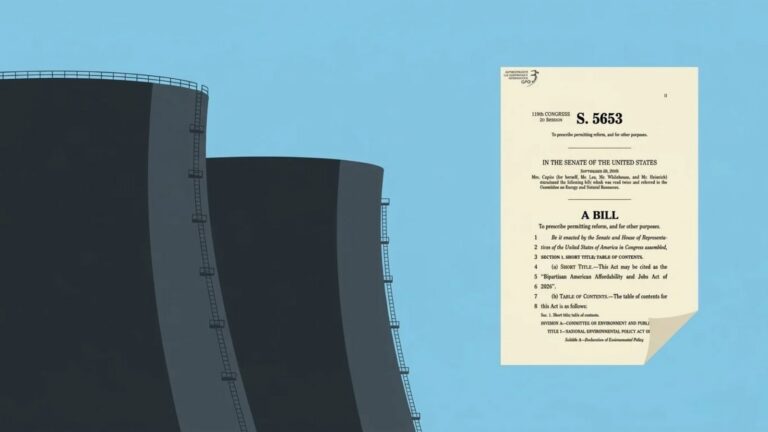
The BAAJA bill could facilitate nuclear development by streamlining federal environmental reviews and providing greater certainty for permitted projects.
This Energy Explained post represents the research and views of the author(s). It does not necessarily represent the views of the Center on Global Energy Policy. The piece...