Why Everyone Loves BAAJA’s Transmission Section
Power line permitting was overdue for an overhaul. Hereâs what the bill would unlock.
Get the latest as our experts share their insights on global energy policy.
This Energy Explained post represents the research and views of the author(s). It does not necessarily represent the views of the Center on Global Energy Policy. The piece...

Hear in-depth conversations with the world’s top energy and climate leaders from government, business, academia, and civil society.
Every permitting bill promises the same thing: build faster. The harder question is what the trade-offs are, and who bears them. That question is at the heart of...
Find out more about our upcoming and past events.
Energy storage is quickly becoming core infrastructure for the clean energy transition.

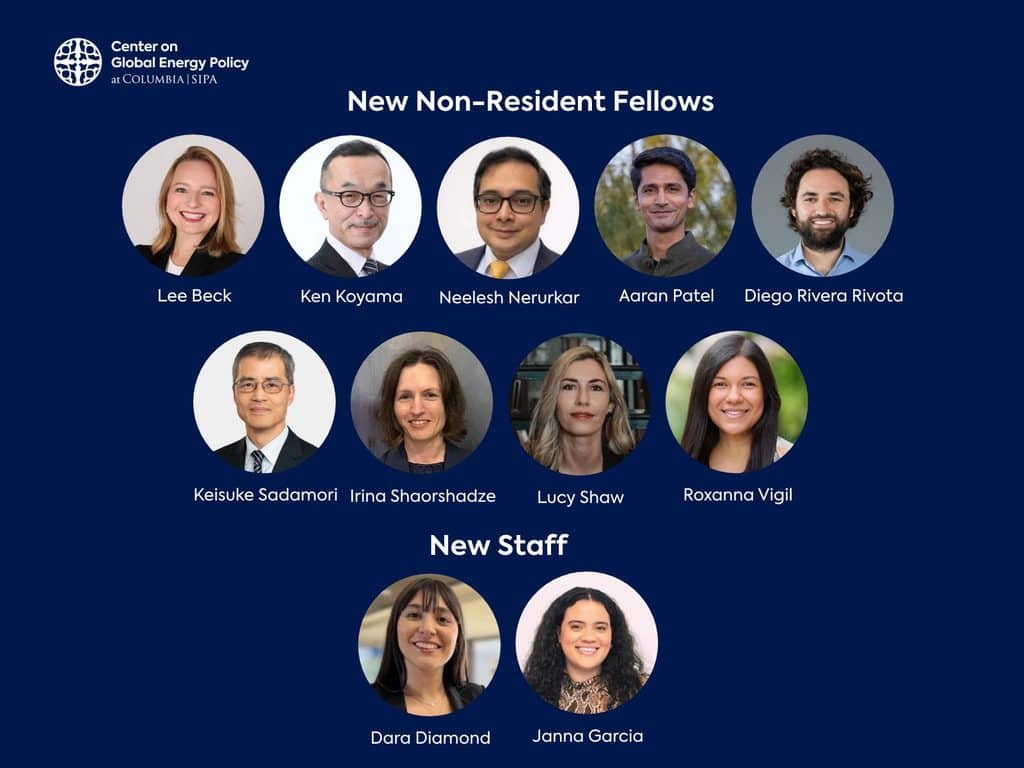
The Center on Global Energy Policy (CGEP) at Columbia University SIPA today announced a new cohort of non-resident fellows and staff who will add to its expertise on the rapidly-evolving situation in Venezuela, the expansive energy policy tools of the United States government, and strategies to mitigate the effects of climate change.
“As geopolitical fragmentation and conflict continue to reshape the world, energy has become central to questions of national security, economic resilience, and stability,” said Jason Bordoff, Founding Director of CGEP. “As alliances shift, rivalries intensify, and countries reassess their energy dependencies, policymakers face challenges that call for rigorous, independent analysis. Our new non-resident fellows bring deep and varied expertise to that work, and I am pleased to welcome them to the Center and to the Columbia community.”
CGEP Non-Resident Fellows:
Lee Beck
Lee Beck is an energy and climate policy expert working at the intersection of geopolitics, industrial policy, technology deployment, and global energy system transformation. She currently serves as chief global policy officer at HIF Global. Beck has advised policymakers, companies, and international institutions across the United States, Europe, the Middle East and emerging markets. She also serves on the boards of Catalyse Europe and Project Tempo and is affiliated with the Atlantic Council. Her current research examines how countries are responding to rising energy demand, technological diversification, geopolitical competition, and renewed concerns about energy security and affordability, and how those shifts are reshaping economic competitiveness and global power. At CGEP, Beck will explore opportunities to strengthen transatlantic energy cooperation.
Ken Koyama
Dr. Ken Koyama specializes in energy security and the geopolitics of energy, conducting extensive research on energy economics and global oil and gas markets. He is a senior adviser at the Institute of Energy Economics, Japan, where he has held various senior positions since joining the organization in 1986. His previous roles include senior research fellow in the Energy Strategy Unit and general manager of the Energy Strategy Department. He is also an honorary associate of the Centre for Energy, Petroleum and Mineral Law & Policy at the University of Dundee. Dr. Koyama holds a PhD from the University of Dundee in Scotland and bachelor’s and master’s degrees from Waseda University in Japan. Koyama’s fellowship will examine energy security from Japanese and Asian perspectives.
Neelesh Nerurkar
Neelesh Nerurkar brings two decades of expertise advising leading energy companies and policy makers. He is director for AI and energy policy at Microsoft. Previously, he served as senior policy advisor at the White House National Economic Council, director for infrastructure policy and deputy assistant secretary at the US Department of Energy, and as an energy advisor at the National Security Council, the US Department of State, and the Congressional Research Service. Nerurkar also advised institutional investors and corporate strategists on policy and markets as vice president at Clearview Energy Partners. Earlier in his career, he was an economist at BP. He holds a BA from the University of Oklahoma and an MA from the Johns Hopkins University School for Advanced International Studies. Nerurkar will focus on emerging issues in energy policy during his fellowship at CGEP.
Aaran Patel
Aaran Patel works in climate change philanthropy and policy. He is climate and conservation advisor to Godrej Enterprises Group where, among other initiatives, he has anchored programs for the Soonabai Pirojsha Godrej Foundation. He previously served as executive director, climate at the Nand & Jeet Khemka Foundation from 2022 to 2025. Patel co-founded Earth Focus Kanha, which works on landscape restoration through nature-based livelihoods and contextual education with forest-dwelling communities. He holds a master’s in public policy from the Harvard Kennedy School. Patel’s fellowship work will focus on carbon dioxide removal in India.
Diego Rivera Rivota
Diego Rivera Rivota is an energy specialist, analyst, and consultant with more than twelve years of experience in Latin American energy policy and geopolitics. His expertise spans electricity and natural gas markets and critical materials supply chains. He previously served as a senior research associate at CGEP, working mostly on power markets, natural gas and LNG, and critical materials. Prior to joining CGEP, Rivota was a visiting researcher at the Asia Pacific Energy Research Centre based in Tokyo, Japan. In previous roles, Diego worked on natural gas pipeline and electricity infrastructure development as advisor to the CEO at Mexico’s state-owned utility, Comisión Federal de Electricidad. Diego holds a bachelor’s degree in international relations from the Instituto Tecnológico Autónomo de México ITAM and a master’s in public policy with a specialization in energy and the former Soviet Union region from Sciences Po Paris. He speaks Spanish, English, French, Russian, and Portuguese. During his fellowship, Rivota will focus on energy policy and markets in Latin America.
Keisuke Sadamori
Keisuke Sadamori has been the director of J-Power, research director of the Canon Institute for Global Studies, and the chief economist of the Japan Organization for Metals and Energy Security since July 2026. Before holding these positions, he served as the director of energy markets and security at the International Energy Agency (IEA) from September 2012 to June 2026. He handled three coordinated emergency oil stock releases, including the most recent 400 mbd release in response to the Strait of Hormuz closure by the US-Iran War. Prior to joining the IEA, he held many senior positions in the Government of Japan including executive assistant to the prime minister at the time of the Great East Japan Earthquake and the Fukushima Nuclear Power Plant accident in 2011. Sadamori’s research at CGEP will explore the changing nature of energy security.
Irina Shaorshadze
Dr. Irina Shaorshadze is an economist and strategist specializing in the intersection of macroeconomics, global commodities and financial markets, and public policy. She is the founder and principal economist of Dihedral Macro, an independent research and consulting firm, and a contributing global economist for the Economist Intelligence Unit. Previously, Shaorshadze served as a director and strategist on Bank of America’s Commodity Research Team. She has also served as an economist consultant at the World Bank, leading analytical studies on energy economics, fiscal policy, and social safety net reforms across the Middle East and North Africa. Shaorshadze holds a PhD in economics from the University of Wisconsin–Madison, an MSc in economics from the London School of Economics, and a master in international affairs from Columbia University’s School of International and Public Affairs. She speaks English, Georgian, Russian, Spanish, French and Arabic. Shaorshadze’s fellowship will focus on the economics of energy demand and security as well as the effects of US critical minerals policy.
Lucy Shaw
Lucy Shaw is an investment advisor specialising in energy transition deals in the UK, US and Africa, and an elected councillor for the Royal Borough of Kensington and Chelsea in London. She writes on British energy policy for the Fabian Society and the Centre for British Progress and is a Visiting Fellow at the LSE Grantham Research Institute’s Just Transition Finance Lab. She previously worked on investment deals at Blackstone and the International Finance Corporation, and advised policy-makers as a United Nations consultant and business executives while at Boston Consulting Group. She holds an MBA from Harvard Business School, where she was a Fulbright Scholar, and an MPA/ID from the Harvard Kennedy School. Shaw’s fellowship at CGEP focuses on political trade-offs that delay fossil fuel phase-out, particularly coal.
Roxanna Vigil
Roxanna Vigil’s research focuses on US sanctions and energy policy toward Venezuela. She has served in the US government at the National Security Council, the Department of the Treasury, and the Department of State, specializing in sanctions and foreign policy toward Latin America and the Caribbean. Most recently, Vigil was an international affairs fellow in national security at the Council on Foreign Relations, where she wrote about sanctions policy, regional energy security, US control of Venezuelan oil revenues, and Colombia’s peace process. Before that, she was a senior sanctions policy advisor in the Treasury Department Office of Foreign Assets Control (2023–2025). She previously served as director for Andean affairs at the National Security Council (2022–2023), overseeing foreign policy and national security matters for Venezuela, Colombia, Peru, Ecuador, and Bolivia. She began her career at the Department of State, where she held several roles, including on the Venezuela desk in the Bureau of Western Hemisphere Affairs. Vigil holds an MA in Latin American studies from Georgetown University and a BA from the University of Michigan. She speaks fluent Spanish. At CGEP, Vigil will focus on US energy policy and sanctions toward Latin America.
CGEP Staff:
Dara Diamond
Dara Diamond is special assistant to the founding director at the Center on Global Energy Policy, Columbia University SIPA. She comes from the US Department of Energy Office of International Affairs, where she supported US engagement in the Clean Energy Ministerial, bringing expertise in stakeholder engagement, emerging energy technologies, and project development. During her tenure at US DOE, she led the launch of next-generation geothermal and clean cooking initiatives under the CEM. Previously, Diamond researched US domestic industrial decarbonization strategy and carbon dioxide removal policy at the Environmental Defense Fund. She received her master of science in climate change: environment, science, and policy, from King’s College London and her BA in theatre from Barnard College, Columbia University.
Janna Garcia
Janna Garcia is senior administrative manager at the Center on Global Energy Policy at Columbia University’s School of International and Public Affairs. Prior to joining CGEP, Garcia served as an executive assistant at Troutman Pepper Locke, supporting members of the firm’s senior leadership team. She previously held executive support and business operations roles at the National Policing Institute and Eurasia Group.
Power line permitting was overdue for an overhaul. Hereâs what the bill would unlock.
Can a key section of BAAJA be saved from unintended consequences?
Javna kampanja za varčevanje s plinom in elektriko bi Evropi pred zimo pomagala bolj kot vračanje k nekaterim ukrepom iz prejšnje energetske...
When the Strait of Hormuz closed, China's crude imports fell steeply, cushioning the price impact on global markets.