NY energy experts, advocates say Iran war shows need for Hochul to implement climate law
Gov. Hochul’s reliance on fossil fuels may end up costing more than renewables, clean energy advocates say.
Current Access Level “I” – ID Only: CUID holders, alumni, and approved guests only
Get the latest as our experts share their insights on global energy policy.
On February 28, the US and Israel launched new attacks on Iran targeting primarily the country's leadership, security forces, and missile program.

Hear in-depth conversations with the world’s top energy and climate leaders from government, business, academia, and civil society.
While US and Israeli forces have significantly degraded Iran’s military and nuclear capability, the global energy landscape remains in a precarious position. For weeks, the Strait of Hormuz...

Find out more about our upcoming and past events.
This roundtable is open only to currently enrolled Columbia University students. To register, you must sign in with your UNI. Join the Center on Global Energy Policy’s Women...

WASHINGTON – Plans to shrink the U.S. Strategic Petroleum Reserve by 40 percent over the...
WASHINGTON – Plans to shrink the U.S. Strategic Petroleum Reserve by 40 percent over the next eight years risks a spike in global energy prices, a top official at the International Energy Agency warned the Senate Thursday.
Congress has authorized the sale of almost 260 million barrels of crude over the next eight years to help fund the federal budget, in part on the argument a boom in U.S. oil production has reduced the need for a national oil reserve, which currently holds 645 million barrels.
But Keisuke Sadamori, director of energy markets and security at the Paris-based International Energy Agency, cautioned the IEA currently depends on the United States for 40 percent of its global reserve program.
“I would like to stress that oil security is not only an issue for net-importers, and security concerns such as regional extreme weather events and terrorist attacks can affect all countries,” he said. “Should the US further draw down its SPR levels, there could be a challenge to the future effectiveness of the IEA stock system.”
Congress has long looked to the oil reserve as a means to patch the federal budget – the most recent authorized sale would draw $13 billion in revenue at current oil prices.
But some senators at Thursday’s hearing before the Senate Energy and Natural Resources Committee cautioned on the risks of that approach. They cited last month’s attack on Saudi Arabia’s Abqaiq plant, which processes 5 percent of the world’s oil supply, as a sign of the risks posed to oil facilities worldwide.
“People who do not sit on this committee don’t really think about the SPR. They look at it as liquid money in the bank,” said Sen. Lisa Murkowski, R-Alaska, chairman of the committee.
Right now, the U.S. petroleum reserve, which is located across four sites in Texas and Louisiana, has enough reserves to cover oil imports for 440 days – far beyond the 90 days mandated by the IEA.
But getting down to the minimum level risks a shock to oil markets in the event of a major supply disruption, said Jason Bordoff, director of Columbia University’s Center on Global Energy Policy.
“What we are concerned about is an impact on oil prices around the world,” he testified. “The fact we are about to be an oil exporter but the IEA is here today saying we shouldn’t sell our stocks suggests 90 days isn’t adequate cover.”
Global leaders have been scrambling to contain the rising cost of oil and gasoline since the start of the Iran war.
President Donald Trump has been pressuring U.S. oil and gas executives to invest in Venezuelaâs energy sector, nearly three months after the toppling of former president Nicolás Maduro, as the country is said to have the largest crude oil reserves in the world.
The war in Iran is not just another energy shock. It is arriving at a moment when Europe is already under cumulative strain: a war on its eastern border, the lingering aftershocks of the 2022 energy crisis, industrial decline, political fragmentation, fiscal limits, and a widening debate over how much of its own security it must now provide.
Without transatlantic alignment, we risk forfeiting the very advantages our alliance was built to protect.
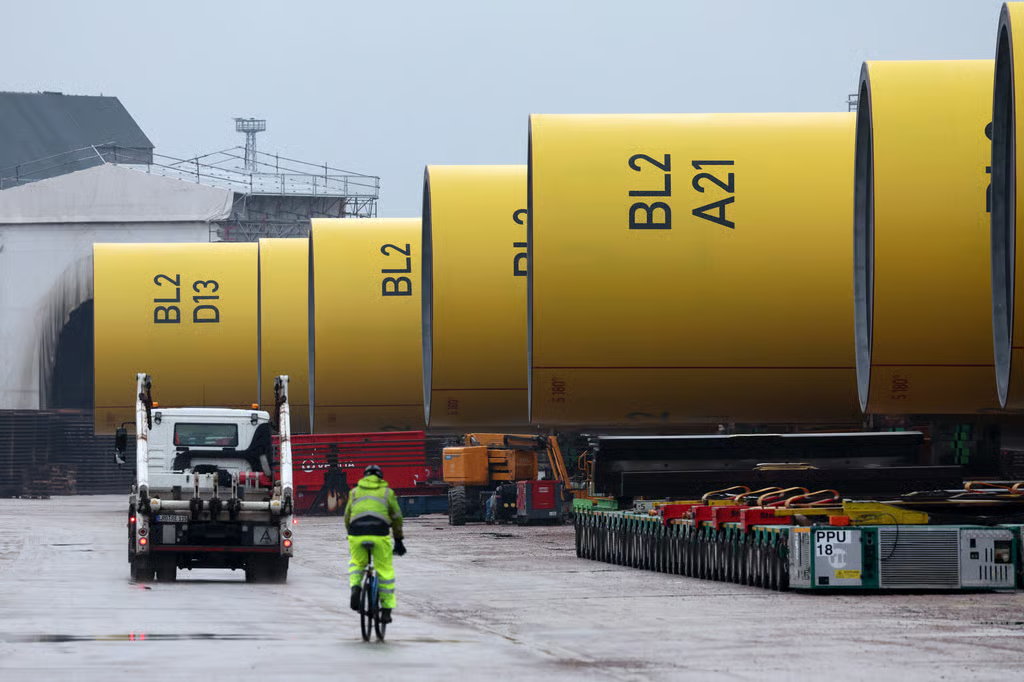
CGEP scholars reflect on some of the standout issues of the day during this year's Climate Week