This website uses cookies as well as similar tools and technologies to understand visitors’ experiences. By continuing to use this website, you consent to Columbia University’s usage of cookies and similar technologies, in accordance with the Columbia University Website Cookie Notice.
It started last year as a pressure campaign at sea, with the United States seizing tankers as part of what President Trump called a “total and complete blockade”...
PCCMs facilitate the generation, trading, and retirement of carbon credits from projects that remove, reduce, or avoid greenhouse gas emissions. By creating a revenue stream from verified climate...
Event
About Us
We are the premier hub and policy institution for global energy thought leadership. Energy impacts every element of our lives, and our trusted fact-based research informs the decisions that affect all of us.
This Energy Explained post represents the research and views of the author(s). It does not necessarily represent the views of the Center on Global Energy Policy. The piece may be subject to further revision.Contributions to SIPA for the benefit of CGEP are general use gifts, which gives the Center discretion in how it allocates these funds. More information is available here. Rare cases of sponsored projects are clearly indicated.
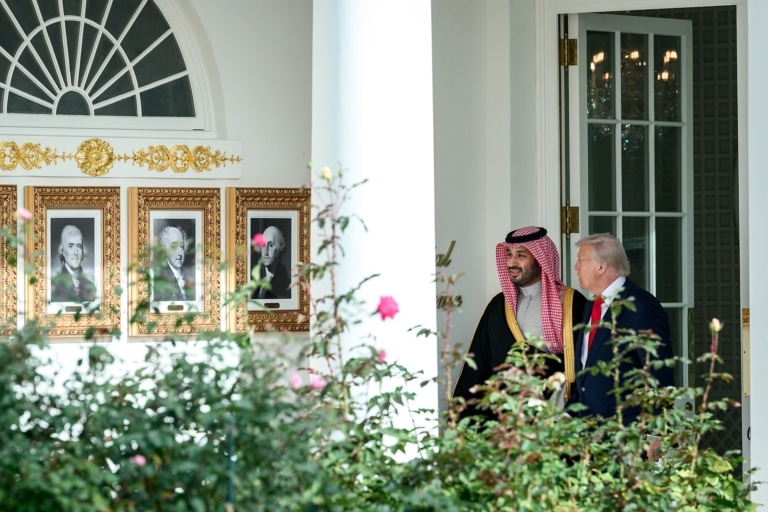
The Trump administration and Saudi Arabia’s leadership have signed a nuclear agreement that could enable United States nuclear technology transfers to Saudi Arabia. The details of the agreement are not yet available. CGEP scholars weigh in on what is known so far and the potential implications for Saudi Arabia, the broader Middle East, the United States, and global nuclear proliferation.
What nonproliferation conditions are included in the U.S.-Saudi 123 Agreement?
The specific commitments cannot be known until the full text is released. However, the U.S. Atomic Energy Act Section 123 stipulates that all peaceful nuclear cooperation agreements must contain legally binding commitments requiring the receiving state to place all nuclear facilities under International Atomic Energy Agency (IAEA) safeguards; guarantee that no transfers would be used for nuclear weapons; obtain U.S. consent for retransferring nuclear materials or technology or engaging in enrichment or reprocessing; and adequately secure all transferred nuclear materials. If the receiving state fails to comply with these commitments, the United States may demand the return of any transfers.
For its part, Saudi Arabia has accepted an obligation under the Nuclear Non-Proliferation Treaty (NPT) not to acquire nuclear weapons. As part of implementing that commitment, its Comprehensive Safeguards Agreement (CSA) with the IAEA requires it to declare all civilian nuclear facilities, materials, and activities to the IAEA, which conducts a range of verification activities to determine the “correctness and completeness” of these declarations.
Accordingly, the U.S.-Saudi 123 Agreement would be expected to legally reinforce these binding international commitments. Section 123 requires a separate agreement for the transfer of enrichment or reprocessing technology, and the U.S- Saudi 123 Agreement appears to postpone any decision on such transfers pending a two-year study of the economic viability of enrichment or reprocessing connected to nuclear fuel manufacturing. If the United States decides to proceed with a transfer, it will run counter to Nuclear Suppliers Group guidelines, which have been endorsed by the United States as a member state, that restrict the transfer of enrichment or reprocessing technology to countries, unless the Kingdom accepts additional nonproliferation measures.
Will these conditions be sufficient to prevent Saudi Arabia from developing a nuclear weapon?
Saudi Arabia has steadfastly refused to accept the path taken by the United Arab Emirates, whose 2009 123 Agreement includes a legally binding commitment to eschew enrichment and reprocessing and instead rely on the international market for nuclear fuel services. This refusal was the primary source of delay in concluding the U.S.-Saudi agreement. Saudi Arabia also dragged its feet for years on rescinding its Small Quantities Protocol to its CSA, a step that is required to adequately prepare for a full-scale nuclear energy program.
Saudi Arabia’s insistence on retaining the option to pursue enrichment, which can be used to produce both civilian fuel and nuclear weapons materials, coupled with statements from Saudi leaders that the kingdom would seek a nuclear weapon if Iran were to acquire one, has heightened concerns about the potential for a covert weapons program. This course would violate Saudi Arabia’s commitments under the NPT, its CSA with the IAEA, and aspects of the 123 Agreement.
The agreement itself reportedly does not require Saudi Arabia to accept the Additional Protocol to its CSA. This protocol allows the IAEA to review and, as needed, inspect facilities or locations not declared under a CSA. Saudi officials have previously objected to the Additional Protocol on the grounds it would enable non-Muslims access to the holy sites stewarded by Saudi Arabia on behalf of the global Islamic community. These objections could also be applied to the U.S.-Saudi inspections meant to supplement the CSA, although the details of those bilateral arrangements have not been released. U.S. visits intended to assess the security of nuclear materials subject to the 123 Agreement could also be impeded. These issues raise concerns that the agreement’s conditions may not be sufficient to prevent Saudi Arabia from developing a nuclear weapon.
Another concern is whether Saudi Arabia would abide by the 123 Agreement’s prohibition on retransfer of sensitive nuclear technology or materials to another country. Saudi Arabia has already reportedly failed to abide by legally binding commitments not to retransfer conventional military equipment to other countries without prior U.S. approval. This calls into question whether it would abide by the similar retransfer prohibitions in the 123 Agreement. The rights granted to the United States under the 123 Agreement to require the return of covered material or equipment in case the agreement is violated would be extremely difficult to implement without Saudi cooperation.
While any cooperation that increases nuclear knowledge and capacity could enhance the application of that knowledge or capacity to military purposes, how the U.S.-Saudi 123 Agreement is ultimately implemented could limit this risk. The provision of gigawatt-scale, light-water reactors fueled with approximately 5 percent enriched uranium fuel would align with time-tested IAEA safeguards procedures and reduce susceptibility to diversion of nuclear materials. By contrast, reactor technologies based on high-assay low enriched uranium of up to 19.9 percent enrichment would be especially risky for a country that has insisted on acquisition of enrichment technology and has significant potential for a covert or break-out weapons program. Spent fuel provisions would also be important to arrange in order to limit the risks associated with the extraction of plutonium from spent fuel. These steps, in addition to Saudi adoption of the Additional Protocol, would be clear indications that both sides are proceeding in ways that limit the proliferation potential of this deal.
The Trump administration, like the Biden administration before it, has identified the US nuclear industry as in need of government support to strengthen the ability of the United States to produce nuclear technology and energy domestically and provide them to customers and partner states abroad. These efforts have been framed as both a national security priority and a means to support US energy security. In this context, a potential nuclear cooperation agreement with Saudi Arabia has been a long time coming.
The deal’s emergence now is the product of several factors. There is currently less impulse from Congress to resist the sharing, sale, and transfer of nuclear technology to Saudi Arabia because one of the main opponents of this idea was Senator Lindsey Graham, who passed away on July 11. Graham had long worked to tie nuclear cooperation with Saudi Arabia to normalization with Israel. In any case, the US position on demanding normalization was already softening, though, notably, the Saudi foreign policy position towards Israel has not. Saudi Arabia remains open to relations with Israel if there is a path to Palestinian statehood. A situation may arise in which the language of the agreement and President Trump’s characterization of it differ, particularly on normalization.
Moreover, the Trump administration may view the deal as an opportunity to offer support to Saudi Arabia in the context of the Iran conflict and thereby smooth over differences and address a stark sentiment among Gulf leaders that the United States has disengaged from or reduced its commitment to the region’s security umbrella over the last thirteen months. The Gulf states have been on the receiving end of most of Iran’s retaliations against the United States. The agreement cements US technology cooperation and ostensibly some security commitments over a thirty-year period.
What’s in it for the Saudis and what’s in it for the US?
For Saudi Arabia, access to nuclear technology enhances regional prestige and strengthens its economic and strategic position. It could also support the domestic economy by fueling new sectors from AI to industrial manufacturing.
The US government, and the Trump administration in particular, had already made US nuclear technology a major priority. Through the Department of Energy, it announced an $80 billion investment in the sector, including nearly $18 billion in loans to Westinghouse to develop its AP1000 reactor lines. Saudi Arabia would be a prime customer for these products. Given that it takes nearly a decade to construct an AP1000 and the fuel and servicing will cement the relationship long after Trump is out of office, this represents a new long-term arrangement that will strengthen Saudi Arabia’s position regionally. It will also likely expand demand for nuclear energy within the region.
For now, primarily Westinghouse. However, there will likely be opportunities down the road for companies involved in nuclear fuel supply and engineering, procurement, and construction (EPC), as well as for technical advisors. Banks and infrastructure funds could also see opportunities to finance the project. The Trump administration will qualify this agreement as a foreign investment commitment of Saudi Arabia to the United States, securing support for the production and supply chain needed to feed a nuclear renaissance in US industry.
If Saudi Arabia proceeds with nuclear power, what difference could US participation make for global nuclear safety, security, and nonproliferation?
The relevant comparison for policymakers to consider may not be between US cooperation and no Saudi nuclear program, but between US participation and a program supplied by China, Russia, France, or South Korea. Even without a “gold standard” pledge or the Additional Protocol,[1] a Section 123 Agreement like the one agreed with Saudi Arabia imposes binding conditions under the Atomic Energy Act. These include full-scope International Atomic Energy Agency (IAEA) safeguards as a condition of cooperation; peaceful-use, physical-protection, and retransfer requirements; and US consent rights over enrichment or reprocessing involving US-origin material or equipment. The United States can also suspend cooperation and, in specified circumstances, seek the return of transferred items.
Nuclear exports create institutional relationships that can last for decades or even a century or more, including training, regulatory cooperation, emergency preparedness, physical security, and safeguards implementation. These ties can give Washington continuing visibility and influence that may be weaker under some alternative supplier arrangements.
The details of the 123 Agreement still matter. Without an Additional Protocol, the IAEA has more limited authority to investigate undeclared activities. Without a broader commitment to forgo enrichment and reprocessing, Saudi Arabia could still, in principle, pursue those activities through a non-US-supplied pathway, subject to its non-proliferation treaty (NPT) and IAEA safeguards obligations.
[1] The IAEA Additional Protocol supplements a country’s comprehensive safeguards agreement by requiring broader declarations about nuclear-related activities and giving the IAEA expanded access and verification tools to investigate possible undeclared nuclear material or activities. It does not prohibit enrichment or reprocessing. The “gold standard” is a US policy term for a legally binding commitment in a Section 123 agreement to forgo domestic uranium enrichment and spent-fuel reprocessing, as the United Arab Emirates agreed to do in its 2009 agreement with the United States.
What is the commercial significance of the agreement, and how might the opportunity develop for US and other companies?
A Section 123 agreement is an enabling legal framework, and doesn’t constitute a reactor award, construction plan, or financing package. Saudi Arabia would still need to select a technology, establish an owner and regulator, determine localization requirements, negotiate engineering, procurement, and construction arrangements, and secure financing. This could include the United States as a major or minor partner, and is likely to include other countries as component, technology, and/or service suppliers as well.
Current reporting indicates that the agreement’s preference for US suppliers could steer Saudi Arabia toward Westinghouse and the AP1000, although no reactor award has been publicly announced. The agreement could improve the position of US vendors by permitting nuclear trade and embedding it in a broader government-to-government relationship. A project could involve reactor vendors, engineering and construction firms, component manufacturers, and fuel and service providers from multiple countries, as well as banks, export-credit agencies, infrastructure investors, and Saudi partners.
The opportunity could be substantial, but its value in the United States will depend on Saudi selection decisions and execution. Experience in China, the United States, and the United Arab Emirates highlights the many factors that predict successful project delivery. Westinghouse AP1000 units are operating in China and at the Vogtle plant in Georgia, but the first US projects faced major cost and schedule challenges. Construction of two additional AP1000s at V.C. Summer in South Carolina was halted in 2017 after more than $9 billion had been spent; Brookfield is now evaluating their completion, with a final investment decision targeted for 2028. These experiences underscore the importance of capable project ownership, realistic schedules and cost estimates, clear risk allocation, supply-chain readiness, quality assurance, and strong project management. A program that builds several units of the same reactor design in close succession could strengthen the supply chain, develop a skilled workforce, and allow lessons from each project to improve the next, with potential benefits for cost reduction and deployment elsewhere.
What does the deal involve and how will it affect nuclear proliferation in the Middle East?
The text of the agreement is not yet available, so it’s difficult to say what it contains. Press reports suggest that the first step involves the United States and Saudi Arabia examining the economics of Saudi nuclear fuel production. Depending on the results of that study, the United States may drop its opposition to Saudi uranium enrichment and spent fuel reprocessing while placing conditions on how those activities take place. Those conditions would include US inspectors monitoring the facility and “blackboxxing” sensitive technology, essentially making it harder for Saudi Arabia to build knowledge of this technology that it could use to produce nuclear weapons elsewhere. But it is not at all clear that these impediments would be insurmountable roadblocks to a future Saudi state that was determined to get nuclear weapons.
The old US approach of insisting on a permanent foreswearing of sensitive nuclear activities in exchange for US nuclear cooperation was not working well. Countries have not wanted to sign away what they see as their right to nuclear technology under the Nuclear Nonproliferation Treaty (NPT). They see it as both a sovereignty and an economic issue, especially if they have to rely on another country to produce nuclear fuel for them.
But one also cannot escape the logic that if one country starts building these capabilities, others will seek to follow suit. Since revelations that the late Pakistani nuclear scientist A. Q. Khan sold sensitive nuclear technology to Iran, Libya, and possibly others, the US has led efforts to restrict its spread. The US has been worried about the Iranian nuclear program for years not only because it could allow Iran to produce nuclear weapons but also because it could encourage other countries in the Middle East to seek them. It is risky to change that position, even if under a set of controls.
Moreover, even if one accepts that Saudi Arabia has never done anything wrong and should not be held to a higher standard than other countries (like Iran), others could use this precedent to make bad faith arguments that help their friends acquire nuclear weapons. How would the US have responded if, say, Russia tried to build an enrichment plant in Syria under Bashar al-Assad and provided assurances that Russian inspectors would ensure the Syrians didn’t build weapons? When North Korea was facilitating the construction of a reactor there in the late 1990s and early 2000s, Israel attacked it out of concern about how Syria would use it. One hopes that the Trump administration, when making its case to the public for this agreement, will explain how it will deal with this issue.
On June 22, the United States announced that it had signed a nuclear cooperation agreement with Saudi Arabia. This type of agreement broadly authorizes
On February 24, 2026, CGEP hosted a private virtual roundtable under the Chatham House rule to discuss the importance of an independent nuclear safety regulator.