View / Hormuz limbo is now global oil’s top risk
Lost supply and a projected demand rebound have placed the oil market in a fragile equilibrium.
Get the latest as our experts share their insights on global energy policy.
President Trump issued a proclamation on August 6 imposing tariffs on polysilicon and solar products.

Hear in-depth conversations with the world’s top energy and climate leaders from government, business, academia, and civil society.
Abundance and affordability have become buzzwords among policymakers, who often have sharply different interpretations of how to attain them. To some, an energy abundance agenda means fewer regulatory...

Find out more about our upcoming and past events.
Join industry leaders, innovators, employers, and emerging talent for an evening exploring the technologies, trends, and career opportunities shaping the future of climate tech.

Insights from the Center on Global Energy Policy
This Energy Explained post represents the research and views of the author(s). It does not necessarily represent the views of the Center on Global Energy Policy. The piece may be subject to further revision. Contributions to SIPA for the benefit of CGEP are general use gifts, which gives the Center discretion in how it allocates these funds. More information is available here. Rare cases of sponsored projects are clearly indicated.
The Center on Global Energy Policy at Columbia University SIPA is closely following the escalating conflict in Iran and its implications for US national security, Middle East geopolitics, and global energy markets. See all of our coverage here.
Media reports suggest the Trump Administration is considering restrictions on US oil exports. Officials have said such measures are not under discussion, according to media reports, but the question is likely to persist if energy prices continue to climb. While legally feasible, export restrictions would likely backfire—offering limited relief to US consumers while imposing economic and geopolitical costs.
The idea is not new. The Biden Administration reportedly considered oil export restrictions after Russia’s invasion of Ukraine in 2022 raised fuel prices. Congress preserved this option in the 2015 legislation that lifted the crude export ban, allowing the President to reimpose restrictions for up to a year in the event of a national emergency or for national security purposes. The law also reaffirmed executive authority under other statutes, including the International Emergency Economic Powers Act (IEEPA), which could be applied to refined products.
In 2025, the United States exported (gross) roughly 11 million barrels per day (bpd) of petroleum, including about 4 million bpd of crude oil and 7 million bpd of refined products and hydrocarbon gas liquids such as propane and butane. Most exports originate from the Gulf Coast. Key crude buyers include Europe, South Korea, and Canada, while refined products largely flow to countries in the Americas.
At the same time, the United States imports roughly 8 million bpd of petroleum, mostly crude oil, much of it into the Gulf Coast. This two-way trade reflects both the structure of a globally integrated oil market and the configuration of US refining. Many US refineries are optimized to process heavier, sour crude from countries such as Canada and Mexico. By contrast, the United States now produces large volumes of lighter, sweeter shale crude, which is often better suited to refineries abroad.
Restricting crude oil exports would not lower gasoline prices—and could even raise them slightly over time by reducing domestic production. Forcing more US crude into the domestic market would widen the discount of US benchmark prices (WTI) relative to global prices (Brent), weakening incentives to invest and produce. But lower domestic crude prices would not translate into comparable reductions in gasoline or diesel prices, which are set in global markets. Instead, such restrictions would introduce inefficiencies that could ultimately raise costs. The economic case remains as valid today as when one of the authors argued a decade ago in papers, testimony, and op-eds that lifting the ban on crude oil exports would bring economic and geopolitical benefits without increasing consumer prices.
A key issue is refinery configuration. If US crude exports were curtailed, domestic refiners would be forced to process more light, sweet crude than they are designed to handle. At the same time, foreign refiners would bid up the price of medium and sour crudes that US refiners typically import. US refiners would then face a choice: run suboptimal crude slates—reducing yields and efficiency—or pay more for imported heavier crudes. In either case, refining costs would rise.
Moreover, many US refineries lack sufficient downstream capacity to process the lighter components associated with shale crude, limiting their ability to operate at full utilization. Even if logistical constraints—such as Jones Act restrictions on coastal shipping—were eased to move more crude within the United States, these structural mismatches would remain. The result could be lower refinery throughput, tighter product supply, and upward pressure on gasoline and diesel prices.
Some have proposed extending export restrictions to refined products such as gasoline and diesel to insulate US prices from global markets. But doing so would likely exacerbate the problem. In the short term, companies might store excess fuel in anticipation of policy reversal. Over time, refiners would be forced to cut crude runs sharply if they could not access export markets for surplus production. Given the scale of US refining capacity relative to domestic demand, such constraints would undermine refinery economics, reduce supply, and ultimately push prices higher.
Export restrictions would also have broader consequences. As the world’s largest exporter of petroleum products and a major crude exporter, the United States plays a central role in balancing global markets. Limiting exports would exacerbate fuel supply shortages abroad—particularly in Europe and Latin America—and could drive global prices higher, feeding back into US fuel costs.
Finally, such measures would carry geopolitical costs. US energy exports have helped add to a well-supplied global market (prior to the current crisis) and to diversify supplies. LNG exports in particular have helped allies diversify away from adversarial suppliers. As one of the authors wrote in Foreign Affairs in 2014, LNG exports have contributed to the creation of a more interconnected and integrated global gas market in which market focus could allocate supplies more easily and efficiently in the event of disruption, such as after Russia ceased most gas exports to Europe.
Restricting exports in a moment of crisis would undermine international coordination, weaken confidence in the United States as a reliable supplier, and risk encouraging other countries to adopt similar measures. For decades, the United States has championed open and integrated energy markets as a foundation of energy security, while criticizing efforts by others to restrict supply for domestic or coercive purposes. In today’s fragmenting global order, that norm is already under strain. If the United States were to adopt oil export restrictions, it would erode its credibility and invite retaliation, ultimately harming its own economic and strategic interests.
In short, while restricting oil and fuel exports may appear to offer a quick fix for high gasoline prices, the reality is more complicated. In a globally integrated market, such measures are unlikely to deliver sustained relief to US consumers and could instead reduce efficiency, tighten supply, and increase both domestic and global price pressures.
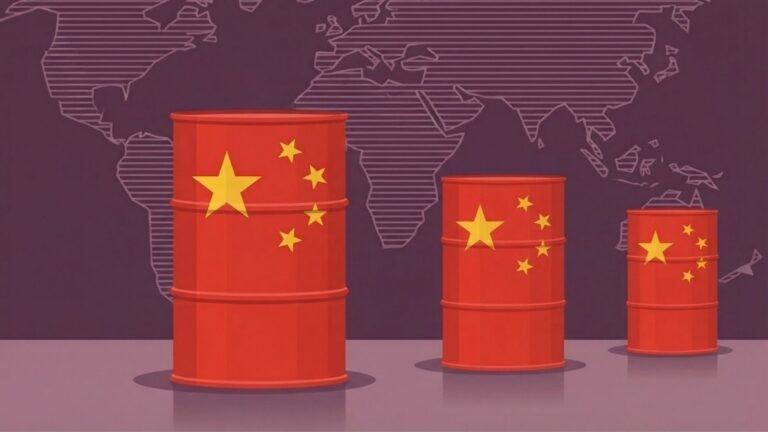
The ongoing disruption of oil exports through the Strait of Hormuz has caused a substantial decline in China's crude oil imports.
The economic and humanitarian consequences of the June 24 twin earthquakes in Venezuela continue to emerge.

The Trump administration and Saudi leadership have reportedly agreed to a nuclear agreement that could enable US nuclear technology transfers to Saudi Arabia.

The Center on Global Energy Policy is providing live updates on key developments related to the Iran crisis. Check back here for the latest.