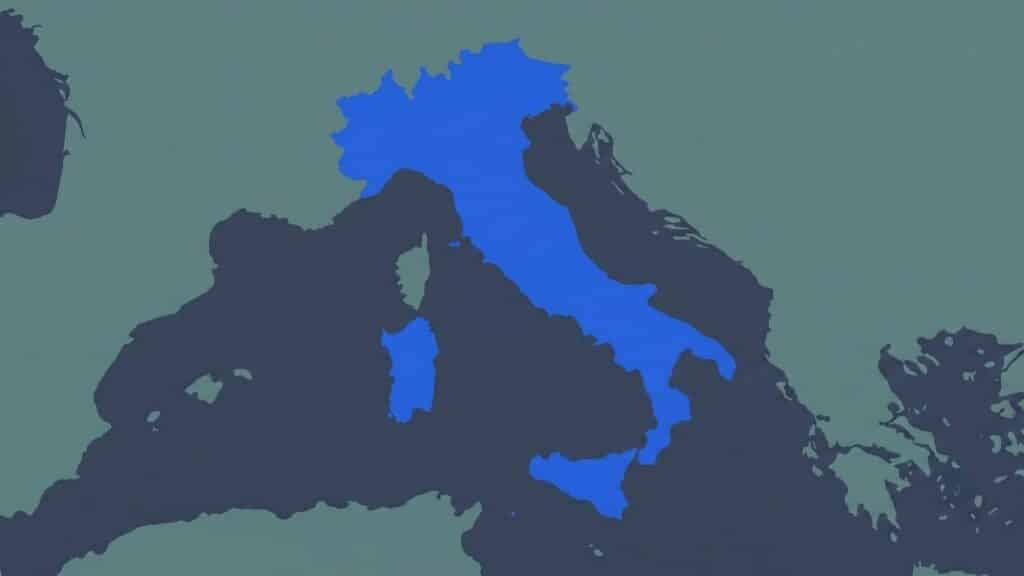
This Country Framework is part of the Regulatory Frameworks for Project-Based Carbon Credit Markets. To learn more click here.
Overview
Italy’s project-based carbon credit market represents a nascent but rapidly evolving regulatory landscape centered on the National Public Registry of Voluntary Carbon Credits (Registro nazionale dei crediti di carbonio volontari) established through an interministerial decree signed by the Minister of Agriculture, Food Sovereignty, and Forestry (MASAF) and the Minister of Environment and Energy Security (MASE).1 This landmark initiative2 establishes Italy as the first European Union country to operationalize a national forestry carbon registry under the framework of the EU’s Carbon Removal and Carbon Farming (CRCF) Regulation 2024/3012, which entered into force on December 6, 2024.3
As of December 2025, Italy’s project-based carbon credit market (PCCM) is characterized by a voluntary, forestry-focused, government-backed crediting standard with no compliance linkage to the EU Emissions Trading System (EU ETS). The registry, assigned to the Council for Agricultural Research and Analysis of Agricultural Economics (Consiglio per la Ricerca in Agricoltura e l’Analisi dell’Economia Agraria [CREA])4 as the managing authority, is expected to become fully operational by 20265 once MASAF finalizes the implementation procedures through a subsequent decree.6 Credits generated from January 1, 2021, onward may be registered retroactively, provided they comply with the guidelines and are consistent with EU Regulation 2018/841 (LULUCF) and the Paris Agreement.7
The Italian framework is explicitly aligned with the European Green Deal, the Paris Agreement, and the EU CRCF Regulation,8 positioning Italy’s voluntary carbon market as a transparent, credible, and nationally regulated system to channel private investment into nature-based climate solutions. The guidelines currently cover only the forestry section, with the agricultural section still under development, reflecting Italy’s phased approach to building a comprehensive market infrastructure. As of late 2025, approximately 90 percent of carbon credits purchased in Italy are sourced from abroad,9 underscoring the significant domestic supply gap the new registry aims to address.
On the demand side, Italy has moved decisively to combat greenwashing through a legislative decree adopted in November 202510 that transposes EU Directive 2024/825,11 making it illegal to use vague environmental claims such as “carbon neutral” or “zero impact” without clear, verifiable evidence. This regulation, enforced by the Italian Competition Authority (Autorità Garante della Concorrenza e del Mercato [AGCM]),12 grants direct power to impose sanctions for unsubstantiated green claims, including those based on low-quality carbon offsets.
I. Supply-Side Regulations
Italy operates a government-backed, voluntary forestry carbon crediting program through the National Registry, with supply-side rules governed by the Guidelines for the Implementation of the National Public Registry of Voluntary Carbon Credits—Forestry Section, approved via the 2025 Interministerial Decree.13 These guidelines define eligibility, additionality, quantification, verification, and issuance procedures for forest-based carbon projects in Italy, establishing a foundation for a transparent, high-integrity voluntary carbon market that complements but does not integrate with Italy’s participation in the EU ETS.14
A. Regulatory Framework
- Market Classification:
- Italy’s PCCM supply is classified as a voluntary market for carbon credits generated by non-obligated forest and agricultural landowners, operators, and managers. The national registry is designed exclusively for voluntary carbon credits and is not linked to compliance markets such as the EU ETS or the International Civil Aviation Organization’s Carbon Offsetting and Reduction Scheme for International Aviation (CORSIA).15
- Projects registered under the guidelines generate verified forest carbon credits representing one ton of carbon dioxide (CO₂) equivalent sequestered or avoided through eligible forestry activities. These credits may be sold on the national voluntary market to companies, public administrations, and citizens seeking to offset their emissions or support climate action, but they cannot be used for EU ETS compliance or CORSIA offsetting.16
- The guidelines currently address only the forestry section, with eligible activities limited to forest management, afforestation, reforestation, agroforestry, timber forestry, and harvested wood products (HWP). The agricultural section is pending technical reviews and will be issued through future regulatory instruments.17
- Regulatory Status:
The Italian PCCM operates under a multi-tiered statutory and administrative framework:
- Primary Legislation/Statutory Authority: Decree-Law No. 13 of February 24, 2023, converted by Law No. 41 of April 21, 2023, Article 45,18 provides the statutory basis for the establishment of the National Public Registry of Voluntary Carbon Credits for the agricultural and forestry sectors. This law authorizes the Ministers of Agriculture and Environment to adopt guidelines defining criteria, rules, and procedures for the generation, accounting, certification, and transaction of voluntary carbon credits.
- Implementing Regulation Binding Guidelines: The Interministerial Decree of October 15, 2025, signed by MASAF and MASE,19 adopts the Guidelines for the Implementation of the National Public Registry of Voluntary Carbon Credits—Forestry Section.20 These guidelines are formally binding on project operators, certification bodies, and registry participants, establishing detailed requirements for project eligibility, additionality, quantification, monitoring, verification, and credit issuance.
- Operational Procedures/Forthcoming Decree: The registry will become fully operational only after the publication of procedures and modalities for registration, updating, and control of credits, which are currently being drafted and will be issued through a subsequent decree by MASAF. This decree will specify technical implementation, data management, integration with national forestry information systems, and credit transaction protocols.21
- EU Regulatory Alignment: The Italian framework is explicitly designed to align with EU CRCF Regulation 2024/3012,22 which establishes the first EU-wide voluntary framework for certifying carbon removals, carbon farming, and carbon storage in products. The CRCF entered into force on December 6, 2024, and requires member states to implement certification methodologies and recognition procedures by 2026–2028.23 Italy’s guidelines are also consistent with LULUCF and the Paris Agreement.
The regulatory framework is therefore best characterized as a hybrid of statutory law, binding administrative guidelines, and EU-aligned voluntary standards, with legally enforceable obligations once a project is registered.
- Key Authorities: Italy’s PCCM is centrally operated by CREA, which manages the public register (referred to as “the register” hereafter) of voluntary agroforestry carbon credits. CREA is responsible for operating the digital platform and online registry system; reviewing and approving project documentation and certification reports; assessing consistency with guidelines; assigning unique serial numbers to credits; coordinating with Istituto Superiore per la Protezione e la Ricerca Ambientale (ISPRA), regional authorities, Sistema Informativo Agricolo Nazionale (SIAN), and Sistema Informativo Nazionale delle Foreste (SINFor); and enforcing sanctions for fraud, misrepresentation, or non-compliance. CREA operates within a coordinated network of national authorities, research institutions, and accreditation bodies:
- MASAF: Co-lead authority for the national registry, responsible for policy design, guidelines approval, and coordination with regional authorities on forest management and carbon projects.
- MASE: Co-lead authority for the registry, responsible for climate policy, environmental safeguards, alignment with EU CRCF and Paris Agreement frameworks, and potential designation as the national designated authority (NDA) for Article 6 of the Paris Agreement.
- Accredia (Italian National Accreditation Body): Accredits independent certification and inspection bodies that validate and verify forest carbon projects under ISO 17029 (validation and verification bodies) and ISO 14065 (requirements for greenhouse gas [GHG] validation and verification bodies). It also defines and publishes the accreditation procedure and related requirements for the certification bodies.24
- The Italian Institute for Environmental Protection and Research (ISPRA): Provides environmental data, GHG inventory coordination, and technical support for registry integration and national reporting under the United Nations Framework Convention on Climate Change and EU obligations.25
- Italian Competition Authority (AGCM)26: Enforces consumer protection law, including provisions against misleading environmental claims and greenwashing under the Italian Consumer Code, as amended by the November 2025 legislative decree, transposing EU Directive 2024/825.
- Sanctions: Italy’s Public Registry of Voluntary Carbon Credits, operated by CREA, enforces integrity primarily through registry-based controls and mandatory compensation mechanisms rather than punitive administrative fines. Credits are single-use, non-resalable to third parties, and must be canceled (retired) upon sale; if carbon storage is not maintained at the end of the project or monitoring period, the corresponding credits are canceled from the registry unless new certification demonstrates continued storage.27 Projects are subject to a mandatory buffer reserve determined by risk analysis (15–40 percent for land-based forestry activities; 5–10 percent for long-lived wood products).28 When reversals due to natural incidents, such as wildfires, floods, etc., exceed the buffer, the guidelines require a temporary cessation of credit sales until sequestration levels that existed prior to the disorder are restored. In cases of voluntary non-compliance, such as land sale or project discontinuation, the proponent is sanctioned through a mandatory compensation requirement to purchase an equivalent quantity of credits to replace those lost. CREA manages non-conformities and double-counting controls through eligibility checks, verification of certification audits, and registry oversight. Projects automatically lapse if planning instruments are not approved by competent authorities within two years.29
B. Credit Generation Standards
- Eligible Activities: Eligible project types are defined by the government-backed National Public Registry of Voluntary Carbon Credits. This registry covers activities that generate removals through biomass growth and soil carbon pools, including improved forest management (Gestione Forestale Sostenibile, generating removals through additional silvicultural commitments―that is, practices related to the cultivation and management of forest trees), afforestation and reforestation (restoring cover on temporarily unstocked land or planting on non-forest land), arboriculture for wood (arboricoltura da legno), and agroforestry (silvo-arable or silvo-pastoral systems).30 Uniquely, the scheme also includes HWP derived from national timber with a lifespan exceeding 35 years. While the registry is legally structured to include an agricultural section for soil carbon sequestration, specific guidelines for agricultural practices are pending a subsequent decree. No other project categories (e.g., renewable energy or industrial fugitives) are currently eligible.31
- Methodology Framework: The Italian regulations mandate a formal methodology framework rooted in the Intergovernmental Panel on Climate Change (IPCC) 2006 Guidelines (Tier 2 minimum).32 Projects must demonstrate additionality through a triple test (legal, environmental, and financial) to prove activities go beyond mandatory requirements and economic viability without credit revenue. Baseline determination relies on regional forestry regulations33 or Forest Europe criteria, setting a business-as-usual (BAU) scenario against which removal is measured. Permanence is secured through minimum project durations (20 years for forestry, 35 years for wood products) and a mandatory risk buffer (15–40 percent for forestry, 5–10 percent for wood products) determined by a specific risk analysis (fire, climate, financial). Leakage is explicitly accounted for in the carbon calculation formula within GHG deduction, which captures all project-related GHG emissions (including CO₂, methane [CH₄], and nitrous oxide [N₂O]), both inside and outside the project boundary from project start to completion.34
- Measurement, Reporting, and Verification Requirements: Validation and verification are conducted by an independent external certification body (OCE),35 which must be independent of the project developer. The Italian code requires OCEs to be accredited by Accredia.36 For HWP, the carbon footprint must comply with Norma UNI 14067.37 Verification audits are mandatory within the first two years and subsequently at intervals not exceeding five years.
- Registry System: The National Public Registry of Voluntary Carbon Credits is operated publicly by CREA.38 It functions within SIAN39 to ensure alignment with national land data. The registry handles the serialization of credits (assigning a unique digital identification code), prevents double counting by cross-referencing local and private registries, and manages the cancellation of credits upon sale (as credits are single-use and non-resalable).
C. Integrity Principles
- Additionality Tests: The National Public Registry requires projects to demonstrate additionality by passing a formal triple test to ensure activities go beyond standard management and legal obligations.40 The legal or normative test ensures projects do not involve activities that are mandatory under current regulations, requiring a management approach that is “closer to nature” than legally required. The environmental additionality test mandates that the effective carbon absorption must exceed the baseline scenario, calculated net of any negative externalities. The investment test (financial additionality) requires proof that the project would not be economically sustainable without the financial contribution derived from the sale of carbon credits. For projects receiving public funding, financial additionality is strictly conditional: Public support must not exceed 85 percent of the total cost, or the project must maintain commitments beyond the period required by the public subsidy. These tests are designed to align with the QU.A.L.ITY criteria (quantification, additionality, long-term storage, and sustainability)41 and IPCC guidelines.
- Permanence Safeguards: The registry mandates strict permanence safeguards to manage reversal risks through minimum duration commitments and a mandatory risk buffer. Land-based forestry and agroforestry projects require a minimum commitment period of 20 years, while HWP requires a minimum life cycle of 35 years. To address non-permanence, projects must set aside a buffer of credits determined by a specific risk analysis (covering fire, pests, climate, and financial risks): 15–40 percent of total credits for forestry activities and 5–10 percent for wood products.42 In the event of unintentional reversals (natural disturbances) exceeding the buffer, credit sales are suspended until carbon stocks are restored; for voluntary reversals (e.g., land sale or project termination), the proponent must compensate by purchasing an equivalent quantity of credits or realizing a new project.43
- Quantification Standards: Project-level removals must be quantified using methodologies consistent with the Guidelines for National Greenhouse Gas Inventories, utilizing at least a Tier 2 approach (specific local data) rather than generic estimates. The registry mandates a specific calculation formula (Crediti di Carbonio Generati [CCG])44 that nets the total carbon absorption against the baseline scenario (based on regional forestry regulations or BAU) and deducts leakage (GHG emissions) and the mandatory buffer. For wood products, quantification relies on carbon footprint analysis in accordance with ISO 14067 standards. Integrity is ensured through mandatory validation and verification by OCE, which is Accredia-accredited,45 ensuring compliance with European accreditation standards rather than solely ISO 14065.
- Double-Counting Prevention: The regulations explicitly mandate checks to avoid “double selling, double certification, or double declarations,” ensuring that the same carbon absorption is not counted multiple times within the market. To achieve this, CREA, supported by OCE,46 conducts cross-checks to verify that credits are not already registered in other public local registries or private registries managed by intermediaries. Furthermore, the registry interacts with SIAN47 and ISPRA to ensure the consistency of territorial data.
D. Sustainable Development
- Co-Benefits: Italian regulations mandate that projects demonstrate a neutral or positive impact on environmental and economic sustainability to be eligible. The project document48 requires a specific assessment of impacts on biodiversity (projects must not compromise conservation and should ideally generate a net gain by restoring habitats), water resources (preserving quantity and quality of aquifers), and pollution control. Regarding social and economic outcomes, the regulations include a unique mechanism supporting rural economies: At least 20 percent49 of the revenue generated from credit sales must be reinvested into the project or used for the general management, protection, and valorization of the local forestry patrimony. Additionally, projects must implement a communication program to engage the local community.
- Net-Zero Compatibility: Italy’s PCCM is embedded within EU climate legislation and national climate strategies. Italy is legally committed to: (1) contributing to the EU’s 55 percent emissions reduction below 1990 levels by 2030,50 (2) achieving 43.7 percent emissions reduction in Effort Sharing Regulation sectors by 2030 (relative to 2005 levels),51 and (3) achieving climate neutrality by 2050 under the European Climate Law (Regulation 2021/1119).52 Post-2050, the EU must achieve net negative emissions, requiring carbon removals to exceed residual emissions. The regulations explicitly state that while Verified Carbon Credits (VCCs) are for the voluntary market and cannot be used for EU ETS or CORSIA compliance, the carbon removals generated contribute to the achievement of national objectives for GHG absorption. To ensure this alignment, the registry interacts directly with the National Inventory of Forests and Carbon Sinks53 managed by ISPRA.54 This ensures that voluntary activities are accounted for within Italy’s international climate obligations (the Paris Agreement) and align with the European Climate Law and the National Forestry Strategy to promote carbon farming and negative emissions.
II. Demand-Side Regulations
A. Use Authorization Framework
- Applications Allowed:
- Voluntary Claims: Italian companies, public administrations, financial institutions, and individuals may voluntarily purchase and retire forest carbon credits issued under the registry for purposes such as environmental, social, and governance (ESG) reporting and disclosure, corporate social responsibility programs, climate finance contributions to support Italian forestry and rural development, and national reduction target efforts. Credits must be retired in the registry to support any voluntary claim. Retirement is the only mechanism by which a buyer can demonstrate that a credit has been used and is no longer available for sale or reclamation.55
- Compliance Integration: Italian forest carbon credits cannot be used for EU ETS compliance or CORSIA offsetting.56
- NDC Alignment: Emission reductions and removals from Italian forestry projects are accounted for within Italy’s national GHG inventory and contribute to Italy’s nationally determined contribution (NDC) under the Paris Agreement. Italy does not apply corresponding adjustments to voluntary credit purchases or retirements from domestic projects, meaning that the underlying mitigation continues to count toward Italy’s NDC rather than being transferred to the private buyer’s climate accounting. If Italy operationalizes Article 6 of the Paris Agreement for international transfers, Italian credits could be authorized for export to other countries, with corresponding adjustments applied to prevent double counting across countries’ NDCs.57
- Regulatory Status:
- No Compliance Use: There is no legal requirement for Italian companies to purchase or retire carbon credits. Participation in the voluntary carbon market is entirely discretionary, though companies may choose to use credits as part of their climate strategies, ESG commitments, or science-based targets.
- Voluntary Use: Corporate use of voluntary carbon credits is not legally mandated but is governed by the following:
- Registry Terms and Conditions: Credits may only be retired by account holders who have accepted CREA’s registry terms and conditions.58
- Consumer Protection Law: The Italian Consumer Code (Codice del Consumo),59 as amended by the Legislative Decree of November 2025, transposing EU Directive 2024/825, prohibits misleading environmental claims and requires that claims such as “carbon neutral” or “zero impact” be supported by clear, verifiable evidence.
- AGCM Enforcement: The Italian Competition Authority has direct power to investigate and sanction companies for greenwashing and misleading environmental marketing.60
- Oversight Bodies:
- MASAF: Co-lead authority for the national registry, responsible for policy design, guidelines approval, and coordination with regional authorities on forest management and carbon projects.
- MASE: Co-lead authority for the registry, responsible for climate policy, environmental safeguards, alignment with EU CRCF and Paris Agreement frameworks, and potential designation as the NDA for Article 6 of the Paris Agreement.
- CREA:61 Designated as the registry operator and managing authority, CREA is responsible for operating the digital platform and online registry system; reviewing and approving project documentation and certification reports; assessing consistency with guidelines; assigning unique serial numbers to credits; coordinating with ISPRA, regional authorities, SIAN, and SINFor; and enforcing sanctions for fraud, misrepresentation, or non-compliance
- AGCM:62 Enforces consumer protection law, including provisions against misleading environmental claims and greenwashing under the Italian Consumer Code, as amended by the November 2025 Legislative Decree, transposing EU Directive 2024/825.
- Standards Integration: Italy has not formally mandated the adoption of international voluntary carbon market standards such as the Science Based Targets initiative (SBTi), the Voluntary Carbon Markets Integrity Initiative, or the Integrity Council for the Voluntary Carbon Market.
- Enforcement Mechanisms: Credits used for voluntary claims must be permanently retired in the CREA registry and cannot be resold or reclaimed.63 The Legislative Decree of November 2025, transposing EU Directive 2024/825,64 makes it illegal to use vague environmental claims such as “carbon neutral” or “zero impact” without clear, verifiable evidence. AGCM enforces these provisions with the power to investigate companies, issue cease-and-desist orders, impose administrative fines (up to several million euros),65 and require corrective disclosures. Under the Italian Consumer Code, misleading environmental claims are classified as unfair commercial practices, exposing companies to AGCM sanctions, reputational damage, and civil litigation.
B. Corporate Use Requirements
- Mitigation Hierarchy: The guidelines impose a strict mitigation hierarchy—the MERC approach (Misurare, Evitare, Ridurre, Compensare, which translates to Measure, Avoid, Reduce, Compensate)66― for buyers wishing to purchase and register credits. CREA is required to verify that the buyer possesses a “coherent system of management and reduction of emissions” certified by an independent body. This verification must confirm adherence to the MERC approach, which dictates the following chronological order of actions:
- Measure (Misurare): Quantify the carbon footprint based on IPCC 2006 Guidelines for National Greenhouse Gas Inventories.
- Avoid (Evitare): Implement strategies to prevent GHG emissions.
- Reduce (Ridurre): Actively reduce existing emissions.
- Compensate (Compensare): Use carbon credits only for the residual emissions that could not be reduced or avoided.
- Scope Coverage: While the Italian regulations do not explicitly define eligibility by specific emission scopes (Scope 1, 2, or 3), they strictly regulate coverage through a mandatory mitigation hierarchy and specific market exclusions. The use of voluntary credits is legally restricted to offsetting only residual emissions (emissioni rimanenti) that remain after a buyer has rigorously applied the MERC approach. Furthermore, the regulations explicitly prohibit the use of these credits for compliance in mandatory regulatory markets, specifically the EU ETS and CORSIA, ensuring they serve strictly voluntary climate objectives rather than replacing mandatory abatement obligations.
- Quality Standards: Credits must be issued under the national registry operated by CREA and validated and verified by Accredia-accredited bodies under ISO 14065 standards. Credits must represent real, additional, permanent, and verifiable carbon sequestration or emissions reductions as defined in the guidelines. Companies must demonstrate that credits are: (1) registered in the national registry with unique serial numbers, (2) verified by an independent certification body, (3) retired permanently in the registry to support claims, and (4) not double counted or used for multiple purposes. The AGCM has sanctioned companies for using unreliable or low-quality carbon offsets, and companies using credits from unverified sources or unregistered projects, or with non-transparent methodologies, face a high risk of enforcement action.
- Accounting Treatment: The CREA-operated national registry serves as the sole official ledger for Italian forest carbon credits, recording all issuances, transfers, retirements, and cancellations. Italian companies must separately disclose gross emissions and credit use in sustainability reporting; no netting is permitted that obscures actual emissions profiles. Under the EU Corporate Sustainability Reporting Directive (CSRD),67 Italian-listed companies must disclose climate targets, progress, and the role of carbon credits in achieving targets. Italy has not issued specific accounting guidance for voluntary carbon credits; companies apply Italian generally accepted accounting principles or International Financial Reporting Standards, treating credits as intangible assets, inventory, or expense, depending on use.
C. Transparency and Assurance
- Public Reporting: The CREA Registry is publicly accessible online, providing visibility into project-level data (location, methodology, certification body), credit issuance (vintage, quantity, serial numbers), transfers, retirements (date, purpose, claimant optional), and cancellations (reason, date, affected parties). Italian companies are not legally required to disclose carbon credit use unless they make environmental claims or are subject to EU CSRD. Under EU CSRD,68 Italian-listed companies and large companies meeting thresholds must disclose Scope 1, 2, and 3 emissions, climate targets and progress, and the role of carbon credits in achieving targets (if material). Companies making carbon neutrality or net-zero claims must substantiate them with verifiable evidence: registry retirement records, certification reports from Accredia-accredited bodies, and transparent accounting of gross emissions and credits used.
- Third-Party Verification: Italy does not impose a separate mandatory assurance requirement for corporate buyers of voluntary carbon credits. However, companies subject to EU CSRD must obtain limited assurance (progressing to reasonable assurance in later years) on their sustainability reports, including disclosures of carbon credit use. Companies making public environmental claims are subject to AGCM investigation, which may include requests for documentation, expert review, and forensic analysis of offset claims.
- Science-Based Targets: Italy has no legal requirement for companies to receive SBTi validation.
- Policy Advocacy: There are no mandatory buy-side requirements for Italian companies to purchase a minimum volume or type of carbon credits. Demand for voluntary carbon credits is entirely discretionary.
D. Market Integrity Protection
- Anti-Greenwashing: Italy has enacted strict anti-greenwashing regulations through the Legislative Decree of November 2025, transposing EU Directive 2024/825, making it illegal to use vague environmental claims like “carbon neutral,” “zero impact,” “eco-friendly,” “CO₂ impact zero,” or claims confusing offsetting with reduction without clear, verifiable evidence. Companies must provide transparent evidence with clear, comparable, verifiable data; transparent disclosure of the carbon credits’ role; registry retirement records; and certification by accredited bodies. AGCM enforces the regulations with direct power to investigate, issue cease-and-desist orders, impose administrative fines (up to several million euros), require corrective disclosures, and refer fraud to criminal authorities.69
- Co-Benefits Delivery: Italy has no legal requirement for buyers or users of carbon credits to demonstrate co-benefit delivery. However,
- Project proponents must document and verify co-benefits (biodiversity, water quality, rural development) during project validation.
- Buyers may voluntarily disclose co-benefits associated with credits they purchase to enhance the credibility of their climate claims.
- The EU CRCF Regulation encourages recognition of co-benefits and sustainable development outcomes, which may become a market differentiator for high-quality Italian credits.
III. Market-Side Regulations
Italy’s voluntary carbon market operates as a decentralized, over-the-counter (OTC) market with no central exchange for forestry carbon credits. Market infrastructure is centered on the CREA-operated national registry, which serves as the authoritative ledger for all credit transactions.
A. Infrastructure Framework
Decentralized OTC market:
- Italian forest carbon credits are traded bilaterally between sellers (project proponents) and buyers (companies, public administrations, individuals) through private negotiations.
- There is no centralized exchange or trading platform for voluntary carbon credits in Italy.
- Price discovery occurs through bilateral agreements; however, the seller must inform CREA when its credits are available for sale and at what price.
No derivatives market: As of April 2026, there is no derivatives market (futures, options, swaps) for Italian forest carbon credits. The market is entirely spot-based, with credits delivered immediately upon payment.
Separation from EU ETS: Italy participates in the EU ETS, which operates as a separate compliance market for allowances (EUAs) covering power generation, industrial sectors, and aviation. Italian forest carbon credits cannot be used for EU ETS compliance, and the two markets do not interact.
- Registry Operations: The national registry will function as the mandatory infrastructure for all market transactions and claims validation once operational in 2026. Registry account holders will be legally required to retire (withdraw) credits in the registry only after their sale to support any voluntary climate claims, with retirement serving as the sole mechanism for demonstrating legitimate credit use. The registry’s publicly accessible online platform will enable third-party verification of corporate climate claims, allowing regulators (particularly AGCM),70 consumers, and civil society to verify that retired credits correspond to public environmental claims, thereby preventing greenwashing.
- Data Standards: Italy has not yet established dedicated cross-market data standards or governance frameworks from a market-side regulatory perspective.
B. Trading and Participation
- Eligibility Rules: From a market-side regulatory perspective, Italy’s voluntary carbon market currently has minimal formal eligibility or participation restrictions codified in binding regulations. The national registry guidelines require only that account holders accept registry terms and conditions and comply with Know Your Customer and Anti-Money Laundering requirements. Eligible participants include project proponents (forest and agricultural landowners, public and private managers, municipalities, aggregators), corporate buyers (Italian and international companies), public administrations, financial institutions, and individuals.
- Trading Mechanisms: As of April 2026, Italian forest carbon credits issued under the national registry could not be actively traded because the registry was not yet fully operational. Implementation procedures are still being finalized and will be completed through a forthcoming decree by MASAF in 2026. However, the regulatory framework anticipates that once operational, trading will occur through bilateral OTC transactions between sellers (project proponents, credit owners) and buyers, with no standardized contract, central trading platform, or organized exchange.71
- Settlement Systems: Once the registry becomes fully operational in 2026,72 settlement of Italian forest carbon credit transactions will be completed through electronic transfer of units within the registry, which will function as a serialized ledger rather than a trading venue or central counterparty. The registry will record issuance, transfers, buffer allocations, cancellations, and retirements, with each credit carrying a unique serial number and project vintage linkage. Both parties must maintain active registry accounts to complete electronic settlement.
- Price Discovery: Italy has no mandatory transaction-level price reporting for forest carbon credits and has not established indicative national price benchmarks. Price discovery will rely entirely on bilateral OTC negotiations between project proponents, buyers, and aggregators once the market becomes operational in 2026. As of December 2025, no official reference prices for Italian forest carbon credits had been published. While the market currently relies on bilateral OTC negotiations for price discovery, CREA produces an annual market monitoring report detailing average sales prices to provide market transparency.73
- Oversight Authority:
- CREA:74 Designated as the registry operator and managing authority.
- AGCM:75 Enforces consumer protection law, including provisions against misleading environmental claims and greenwashing under the Italian Consumer Code, as amended by the November 2025 Legislative Decree, transposing EU Directive 2024/825.
- Legal Classification: Carbon credits issued under the Italian national registry are electronic, registry-based instruments with no physical form. Their legal status is grounded in registry terms, program rules, and international guidance rather than a dedicated statutory definition under Italian law.
Italy has not issued specific accounting or VAT guidance for voluntary carbon credits.
C. Market Integrity Safeguards
- Anti-Manipulation and Fraud Prevention: The national registry guidelines76 codify controls to prevent double issuance and double counting: unique serial numbers for each credit, project exclusivity rules (one program only), and public disclosure of all transactions. Accredia accreditation standards (ISO 17029, ISO 14065)77 are binding requirements for all certification bodies; CREA has statutory authority to suspend or delist bodies for inadequate verification.78 Fraudulent documentation, false verification reports, and deliberate misrepresentation are prohibited under the guidelines and trigger mandatory sanctions: credit cancellation, account suspension, de-registration, criminal liability under the Italian Criminal Code, and civil restitution.
- Transparency and Reporting Requirements: The national public registry is a mandatory, open-access digital platform designed to ensure full market visibility by displaying project georeferencing, credit issuance, and retirement records to prevent double counting. Unlike markets with optional disclosure, the Italian regulations strictly enforce price transparency: Proponents are legally required to declare listing prices to the registry operator and must submit full financial transaction details, including the specific monetary quantification, upon the conclusion of any sale. Corporate claims must be substantiated through these registry records, the validity of which is conditional upon CREA’s verification that the buyer has satisfied the mandatory MERC79 approach.80
D. Financial and Cross-border Integration
- Financial Regulation Integration:
- Italian forest carbon credits (VCCs)81 are not classified as financial products by default under Italian law. They are best understood as intangible assets or registry-based instruments.
- If the VCCs are structured as investment products or collective investment schemes, the activity may fall under Italian Companies and Exchange Commission (Commissione Nazionale per le Società e la Borsa) oversight and require authorization.
- Financial intermediaries offering carbon credit–linked investment products must comply with Italian and EU financial services regulations.
- Recent legislation, notably Legislative Decree No. 192/2024 (Agricultural Tax Reform), integrates carbon credits into the framework of agricultural activities, offering tax advantages for companies generating credits through carbon farming. As of 2025, revenue from the sale of certified carbon credits derived from cultivation, livestock, or forestry activities may be included in agricultural income (assessed on a cadastral basis) up to the limit of the consideration received.82
- Cross-Border Trading Framework:
- As of April 2026, VCCs are exclusively for use in the national voluntary market. These VCCs cannot be exported to other countries or used for either international compliance obligations or for EU ETS compliance or CORSIA offsetting.
- Italy has not yet operationalized Article 6 of the Paris Agreement for international transfers of voluntary carbon credits.
- In June 2025, Italy joined France and other EU countries in urging the European Union to recognize international carbon credits under Article 6 of the Paris Agreement.83
E. Regulatory Advancement Development Road Map
- Infrastructure Plans: CREA is finalizing implementation procedures for the national registry, with full operational launch expected in 2026 once MASAF issues a decree specifying registration, updating, and control modalities.84 CREA’s online digital platform will integrate with SIAN, SINFor, ISPRA, and regional forestry databases to enable project registration, credit issuance, transaction management, georeferencing, and double-registration prevention.85 Italy has not announced plans to establish a centralized exchange or trading platform; the market is expected to remain decentralized and OTC-based.
- International Cooperation: Italy is exploring Article 6 operationalization to enable international transfers of carbon credits with corresponding adjustments, with MASE expected to serve as the NDA for Article 6. The European Commission must assess CRCF-Article 6 alignment by July 31, 2026.86 If alignment is achieved, Italian credits could become eligible for international transfer under Article 6. Italy is participating in a Mediterranean Carbon Capture and Storage Strategic Plan with France and Greece,87 including ratification of amendments to Article 6 of the London Protocol to enable transboundary transport of CO₂.
- Regulatory Evolution: The agricultural section of the national registry is under development, with methodologies for soil carbon sequestration, improved agricultural practices, and carbon farming pending technical reviews by CREA.88 The EU Commission is expected to adopt carbon farming methodologies by April 2026, following public consultation in January and February 2026; Italy will update its guidelines to incorporate these methodologies once adopted. The EU CRCF Regulation requires the European Commission to establish EU certification methodologies through delegated acts; permanent removal methodologies (e.g., biochar, enhanced weathering, direct air carbon capture) are under development with formal adoption expected in early 2026. Italy’s guidelines are designed to be forward-compatible with these EU methodologies. The AGCM is expected to continue and intensify enforcement against unsubstantiated environmental claims involving carbon offsets.89 Such enforcement will be further strengthened by Italy’s Legislative Decree of November 2025, which fully transposes EU Directive 2024/825 into national law―a directive that will become applicable across all EU member states by September 27, 2026.90
- Enforcement Enhancement: CREA is developing enhanced surveillance and compliance auditing procedures, including real-time transaction monitoring, automated cross-checks with national databases to prevent double registration, and public dashboards for market transparency.91 The AGCM is expected to issue additional guidance on carbon-neutral and net-zero claims, with increased civil penalties and public sanctions anticipated as investigations into greenwashing intensify.92 Italy is coordinating with the European Commission and other member states to harmonize enforcement approaches and share best practices on greenwashing, CRCF implementation, and Article 6 integration.93
References
- The Republic of Italy, Ministry of Agriculture, Food Sovereignty and Forestry (MASAF) and Ministry of Environment and Energy Security (MASE), “Interministerial Decree of October 15, 2025: Guidelines for the Implementation of the National Public Registry of Voluntary Carbon Credits – Forestry Section (Decreto Interministeriale 15 ottobre 2025: Adozione delle linee guida volte a individuare I criteri per l’attuazione del registro pubblico dei crediti di carbonio generati su base volontaria dal settore agricolo e forestale – Sezione forestale),” Official Gazette No. 269, November 18, 2025, https://www.gazzettaufficiale.it/eli/id/2025/11/18/25A06145/SG. ↩
- The Republic of Italy, “Decree-Law No. 13 of February 24, 2023, Converted with Modifications by Law No. 41 of April 21, 2023 (Decreto-Legge 24 febbraio 2023, n. 13, convertito con modificazioni dalla Legge 21 aprile 2023, n. 41),” Article 45, https://www.csqa.it/getattachment/f2384020-0e11-45eb-b891-b456f3496c4b/DMlineeguidacreditidicarbonio.pdf?lang=it-IT. ↩
- European Union, “Regulation (EU) 2024/3012 of the European Parliament and of the Council of December 4, 2024 Establishing a Union Certification Framework for Permanent Carbon Removals, Carbon Farming and Carbon Storage in Products,” EUR-Lex, December 6, 2024, https://eur-lex.europa.eu/legal-content/EN/TXT/?uri=OJ:L_202403012. ↩
- Consiglio per la Ricerca in Agricoltura e l’Analisi dell’Economia Agraria (CREA), “Forestry Carbon Credits: National Registry Entrusted to CREA Launched” (“Crediti di Carbonio forestali: al via il Registro Nazionale affidato al CREA”), October 17, 2025, https://www.crea.gov.it/en/-/crediti-di-carbonio-forestali-al-via-il-registro-nazionale-affidato-al-crea. ↩
- Alessandro Petrone, “Forestry Carbon Credits: National Registry is Born” (Crediti di carbonio forestali: nasce il registro nazionale), Rinnovabili, October 20, 2025, https://www.rinnovabili.it/mercato/politiche-e-normativa/crediti-di-carbonio-forestali-nasce-il-registro-nazionale/. ↩
- The Republic of Italy, Ministero dell’Agricoltura, della Sovranità Alimentare e delle Foreste (MASAF), “Lollobrigida: Forestry Carbon Credit Registry Established, a Significant Step Forward” (“Lollobrigida: nasce il registro dei crediti di carbonio forestali, un bel passo in avanti”), October 17, 2025, https://www.masaf.gov.it/Crediti_Carbonio_Forestali. ↩
- Etifor, “Launch of the National Guidelines for Regulating Italy’s Voluntary Market of Forest Carbon Credits,” November 6, 2025, https://www.etifor.com/en/updates/registro-italiano-dei-crediti-di-carbonio-forestali/. ↩
- European Union, “Regulation (EU) 2024/3012 of the European Parliament and of the Council of December 4, 2024 Establishing a Union Certification Framework for Permanent Carbon Removals, Carbon Farming and Carbon Storage in Products,” EUR-Lex, December 6, 2024, https://eur-lex.europa.eu/legal-content/EN/TXT/?uri=OJ:L_202403012. ↩
- Etifor, “Launch of the National Guidelines for Regulating Italy’s Voluntary Market of Forest Carbon Credits,” November 6, 2025, https://www.etifor.com/en/updates/registro-italiano-dei-crediti-di-carbonio-forestali/. ↩
- Maria Luigia Franceschelli, “Greenwashing: Italy Aligns with the EU Legal Framework,” Hogan Lovells, December 15, 2025, https://www.hoganlovells.com/en/publications/greenwashing-italy-aligns-with-the-eu-legal-framework. ↩
- European Union, “Directive (EU) 2024/825 of the European Parliament and of the Council of 28 February 2024 Amending Directives 2005/29/EC and 2011/83/EU as Regards Empowering Consumers for the Green Transition Through Better Protection Against Unfair Practices and Better Information,” EUR-Lex, February 28, 2024, https://eur-lex.europa.eu/legal-content/EN/TXT/?uri=OJ:L_202400825. ↩
- Orsingher Ortu, “Consumer Law – AGCM Fines GLS for Misleading Environmental Claims and Unfair Practices,” February 2025, https://orsingher.com/it/consumer-law-agcm-fines-gls-for-misleading-environmental-claims-and-unfair-practices/. ↩
- The Republic of Italy, Ministry of Agriculture, Food Sovereignty and Forestry (MASAF) and Ministry of Environment and Energy Security (MASE), “Interministerial Decree of October 15, 2025: Guidelines for the Implementation of the National Public Registry of Voluntary Carbon Credits – Forestry Section (Decreto Interministeriale 15 ottobre 2025: Adozione delle linee guida volte a individuare I criteri per l’attuazione del registro pubblico dei crediti di carbonio generati su base volontaria dal settore agricolo e forestale – Sezione forestale),” Official Gazette No. 269, November 18, 2025, https://www.gazzettaufficiale.it/eli/id/2025/11/18/25A06145/SG. ↩
- Etifor, “The EU Carbon Market: The Proposed Regulation for the Certification of Carbon Removals,” September 30, 2024, https://www.etifor.com/en/updates/carbon-removal-certification-eu/. ↩
- Alessandro Petrone, “Forestry Carbon Credits: National Registry is Born” (Crediti di carbonio forestali: nasce il registro nazionale), Rinnovabili, October 20, 2025, https://www.rinnovabili.it/mercato/politiche-e-normativa/crediti-di-carbonio-forestali-nasce-il-registro-nazionale/. ↩
- Marco Ranocchiari, “Forestry Carbon Credit Registry, a Step Forward for Climate and Forests” (Registro dei crediti di carbonio forestali, un passo avanti per il clima e i boschi), Renewable Matter, October 29, 2025, https://www.renewablematter.eu/registro-nazionale-crediti-carbonio-forestali-passo-avanti-clima-boschi. ↩
- Etifor, “Launch of the National Guidelines for Regulating Italy’s Voluntary Market of Forest Carbon Credits,” November 6, 2025, https://www.etifor.com/en/updates/registro-italiano-dei-crediti-di-carbonio-forestali/. ↩
- The Republic of Italy, “Decree-Law No. 13 of February 24, 2023, Converted with Modifications by Law No. 41 of April 21, 2023 (Decreto-Legge 24 febbraio 2023, n. 13, convertito con modificazioni dalla Legge 21 aprile 2023, n. 41),” Article 45, https://www.csqa.it/getattachment/f2384020-0e11-45eb-b891-b456f3496c4b/DMlineeguidacreditidicarbonio.pdf?lang=it-IT. ↩
- The Republic of Italy, MASAF and MASE, “Interministerial Decree of October 15, 2025: Guidelines for the Implementation of the National Public Registry of Voluntary Carbon Credits – Forestry Section (Decreto Interministeriale 15 ottobre 2025: Adozione delle linee guida volte a individuare I criteri per l’attuazione del registro pubblico dei crediti di carbonio generati su base volontaria dal settore agricolo e forestale – Sezione forestale),” Official Gazette No. 269, November 18, 2025, https://www.gazzettaufficiale.it/eli/id/2025/11/18/25A06145/SG. ↩
- The Republic of Italy, “Decree-Law No. 13 of February 24, 2023, Converted with Modifications by Law No. 41 of April 21, 2023 (Decreto-Legge 24 febbraio 2023, n. 13, convertito con modificazioni dalla Legge 21 aprile 2023, n. 41),” https://www.csqa.it/getattachment/f2384020-0e11-45eb-b891-b456f3496c4b/DMlineeguidacreditidicarbonio.pdf?lang=it-IT. ↩
- Marco Ranocchiari, “Forestry Carbon Credit Registry, a Step Forward for Climate and Forests” (Registro dei crediti di carbonio forestali, un passo avanti per il clima e i boschi), Renewable Matter, October 29, 2025, https://www.renewablematter.eu/registro-nazionale-crediti-carbonio-forestali-passo-avanti-clima-boschi. ↩
- European Union, “Regulation (EU) 2024/3012 of the European Parliament and of the Council of December 4, 2024 Establishing a Union Certification Framework for Permanent Carbon Removals, Carbon Farming and Carbon Storage in Products,” EUR-Lex, December 6, 2024, https://eur-lex.europa.eu/legal-content/EN/TXT/?uri=OJ:L_202403012. ↩
- European Commission, Directorate-General for Climate Action, “Carbon Removals and Carbon Farming,” accessed on November 9, 2025, https://climate.ec.europa.eu/eu-action/carbon-removals-and-carbon-farming_en. ↩
- Accredia, Informative Circular DC No. 08-2025: Accreditation of Verification/Validation Bodies for Environmental Information According to ISO 14065:2020, March 27, 2025, https://accredia.it/wp-content/uploads/2025/03/Circolare_informativa_DC_08-2025_ENG-Accreditation-VV-of-environmental-information.pdf. ↩
- Etifor, “Launch of the National Guidelines for Regulating Italy’s Voluntary Market of Forest Carbon Credits,” November 6, 2025, https://www.etifor.com/en/updates/registro-italiano-dei-crediti-di-carbonio-forestali/. ↩
- Roberto Randazzo, Fabio Gallo Perozzi, Federico Longo, and Francesco Bernardi, “ESG 2025 – Italy,” Chambers and Partners, last updated November 11, 2025, https://practiceguides.chambers.com/practice-guides/esg-2025/italy/trends-and-developments/O23034. ↩
- The Republic of Italy, “Decree-Law No. 13 of February 24, 2023, converted with modifications by Law No. 41 of April 21, 2023,” Article 45(2-quater)-(2-septies); decree approving the annexed guidelines, article 1(1); Chapter 1 General Part, Chapter 2 Forestry section §5, §7 (Capitolo II, Sezione Forestale), https://www.csqa.it/getattachment/f2384020-0e11-45eb-b891-b456f3496c4b/DMlineeguidacreditidicarbonio.pdf. ↩
- Ibid., sections §7 and §8. ↩
- Ibid., section §4. ↩
- Ibid., section §10. ↩
- The Republic of Italy, “Decree-Law No. 13 of February 24, 2023, converted with modifications by Law No. 41 of April 21, 2023,” Article 45(2-quater)-(2-septies); decree approving the annexed guidelines, article 1(1); Chapter 2 Articolo unico, Comma 2, https://www.csqa.it/getattachment/f2384020-0e11-45eb-b891-b456f3496c4b/DMlineeguidacreditidicarbonio.pdf ↩
- The Republic of Italy, “Decree-Law No. 13 of February 24, 2023, converted with modifications by Law No. 41 of April 21, 2023,” Article 45(2-quater)-(2-septies); decree approving the annexed guidelines, article 1(1); Chapter 2 Forestry section §6 (Capitolo II, Sezione Forestale), https://www.csqa.it/getattachment/f2384020-0e11-45eb-b891-b456f3496c4b/DMlineeguidacreditidicarbonio.pdf. ↩
- Ibid., section §9. ↩
- Ibid., section §8. ↩
- Ibid., section §7. ↩
- The Republic of Italy, “Decree-Law No. 13 of February 24, 2023, converted with modifications by Law No. 41 of April 21, 2023,” Article 45(2-quater)-(2-septies); decree approving the annexed guidelines, article 1(1); Chapter 1 General Part, https://www.csqa.it/getattachment/f2384020-0e11-45eb-b891-b456f3496c4b/DMlineeguidacreditidicarbonio.pdf. ↩
- The Republic of Italy, “Decree-Law No. 13 of February 24, 2023, converted with modifications by Law No. 41 of April 21, 2023,” Article 45(2-quater)-(2-septies); decree approving the annexed guidelines, article 1(1); Chapter 2 Forestry section §3 (Capitolo II, Sezione Forestale), https://www.csqa.it/getattachment/f2384020-0e11-45eb-b891-b456f3496c4b/DMlineeguidacreditidicarbonio.pdf. ↩
- I The Republic of Italy, “Decree-Law No. 13 of February 24, 2023, converted with modifications by Law No. 41 of April 21, 2023,” Article 45(2-quater)-(2-septies); decree approving the annexed guidelines, article 1(1); Chapter 1 General Part, https://www.csqa.it/getattachment/f2384020-0e11-45eb-b891-b456f3496c4b/DMlineeguidacreditidicarbonio.pdf. ↩
- The Republic of Italy, “Decree-Law No. 13 of February 24, 2023, converted with modifications by Law No. 41 of April 21, 2023,” Article 45(2-quater)-(2-septies); decree approving the annexed guidelines, article 1(1); Chapter 2 Forestry section §2.3.1 (Capitolo II, Sezione Forestale), https://www.csqa.it/getattachment/f2384020-0e11-45eb-b891-b456f3496c4b/DMlineeguidacreditidicarbonio.pdf. ↩
- Ibid., section §6. ↩
- The Republic of Italy, “Decree-Law No. 13 of February 24, 2023, converted with modifications by Law No. 41 of April 21, 2023,” Article 45(2-quater)-(2-septies); decree approving the annexed guidelines, article 1(1); Chapter 1 General Part, https://www.csqa.it/getattachment/f2384020-0e11-45eb-b891-b456f3496c4b/DMlineeguidacreditidicarbonio.pdf. ↩
- Ibid., section §7. ↩
- Ibid., section §8. ↩
- Ibid. ↩
- The Republic of Italy, “Decree-Law No. 13 of February 24, 2023, converted with modifications by Law No. 41 of April 21, 2023,” Article 45(2-quater)-(2-septies); decree approving the annexed guidelines, article 1(1); Linee guida, Premessa, https://www.csqa.it/getattachment/f2384020-0e11-45eb-b891-b456f3496c4b/DMlineeguidacreditidicarbonio.pdf. ↩
- The Republic of Italy, “Decree-Law No. 13 of February 24, 2023, converted with modifications by Law No. 41 of April 21, 2023,” Article 45(2-quater)-(2-septies); decree approving the annexed guidelines, article 1(1); Chapter 1 General Part, https://www.csqa.it/getattachment/f2384020-0e11-45eb-b891-b456f3496c4b/DMlineeguidacreditidicarbonio.pdf. ↩
- The Republic of Italy, “Decree-Law No. 13 of February 24, 2023, converted with modifications by Law No. 41 of April 21, 2023,” Article 45(2-quater)-(2-septies); decree approving the annexed guidelines, article 1(1); Chapter 2 Forestry section §4 (Capitolo II, Sezione Forestale), https://www.csqa.it/getattachment/f2384020-0e11-45eb-b891-b456f3496c4b/DMlineeguidacreditidicarbonio.pdf. ↩
- Ibid., section §12. ↩
- Ibid., section §12.1. ↩
- European Commission, Directorate-General for Climate Action, “2030 Climate Targets,” accessed April 6, 2026, https://climate.ec.europa.eu/eu-action/climate-strategies-targets/2030-climate-targets_en. ↩
- Climate Transparency, Italy – Climate Transparency Report: Comparing G20 Climate Action Towards Net Zero, October 2021, https://www.climate-transparency.org/wp-content/uploads/2021/10/CT2021Italy.pdf. ↩
- European Union, “Regulation (EU) 2021/1119 of the European Parliament and of the Council of June 30, 2021 Establishing the Framework for Achieving Climate Neutrality and Amending Regulations (EC) No 401/2009 and (EU) 2018/1999 (‘European Climate Law’),” EUR-Lex, June 30, 2021, https://eur-lex.europa.eu/legal-content/EN/TXT/?uri=celex%3A32021R1119. ↩
- The Republic of Italy, “Decree-Law No. 13 of February 24, 2023, Converted with Modifications by Law No. 41 of April 21, 2023” (Decreto-Legge 24 febbraio 2023, n. 13, convertito con modificazioni dalla Legge 21 aprile 2023, n. 41), Article 45, https://www.csqa.it/getattachment/f2384020-0e11-45eb-b891-b456f3496c4b/DMlineeguidacreditidicarbonio.pdf?lang=it-IT. ↩
- Ibid., Annex Linee guida, Premessa. ↩
- Etifor, “Launch of the National Guidelines for Regulating Italy’s Voluntary Market of Forest Carbon Credits,” November 6, 2025, https://www.etifor.com/en/updates/registro-italiano-dei-crediti-di-carbonio-forestali/. ↩
- Alessandro Petrone, “Forestry Carbon Credits: National Registry is Born” (Crediti di carbonio forestali: nasce il registro nazionale), Rinnovabili, October 20, 2025, https://www.rinnovabili.it/mercato/politiche-e-normativa/crediti-di-carbonio-forestali-nasce-il-registro-nazionale/. ↩
- United Nations Framework Convention on Climate Change (UNFCCC), First Biennial Transparency Report of Italy to the United Nations Framework Convention on Climate Change, 2024, https://unfccc.int/sites/default/files/resource/BTR_ITALY_2024.pdf. ↩
- Etifor, “Launch of the National Guidelines for Regulating Italy’s Voluntary Market of Forest Carbon Credits,” November 6, 2025, https://www.etifor.com/en/updates/registro-italiano-dei-crediti-di-carbonio-forestali/. ↩
- The Republic of Italy, “Legislative Decree No. 206 of September 6, 2005—Consumer Code” (Codice del Consumo), as amended, Official Gazette, https://www.normattiva.it/uri-res/N2Ls?urn:nir:stato:decreto.legislativo:2005-09-06;206. ↩
- Orsingher Ortu, “Consumer Law – AGCM Fines GLS for Misleading Environmental Claims and Unfair Practices,” February 25, 2025, https://orsingher.com/it/consumer-law-agcm-fines-gls-for-misleading-environmental-claims-and-unfair-practices/. ↩
- Etifor, “Launch of the National Guidelines for Regulating Italy’s Voluntary Market of Forest Carbon Credits,” November 6, 2025, https://www.etifor.com/en/updates/registro-italiano-dei-crediti-di-carbonio-forestali/. ↩
- Roberto Randazzo, Fabio Gallo Perozzi, Federico Longo, and Francesco Bernardi, “ESG 2025 – Italy,” Chambers and Partners, last updated November 11, 2025, https://practiceguides.chambers.com/practice-guides/esg-2025/italy/trends-and-developments/O23034. ↩
- Etifor, “Launch of the National Guidelines for Regulating Italy’s Voluntary Market of Forest Carbon Credits,” November 6, 2025, https://www.etifor.com/en/updates/registro-italiano-dei-crediti-di-carbonio-forestali/. ↩
- European Union, “Directive (EU) 2024/825 of the European Parliament and of the Council of February 28, 2024 Amending Directives 2005/29/EC and 2011/83/EU as Regards Empowering Consumers for the Green Transition Through Better Protection Against Unfair Practices and Better Information,” EUR-Lex, February 28, 2024, https://eur-lex.europa.eu/legal-content/EN/TXT/?uri=OJ:L_202400825. ↩
- Orsingher Ortu, “Consumer Law – AGCM Fines GLS for Misleading Environmental Claims and Unfair Practices,” February 25, 2025, https://orsingher.com/it/consumer-law-agcm-fines-gls-for-misleading-environmental-claims-and-unfair-practices/. ↩
- The Republic of Italy, “Decree-Law No. 13 of February 24, 2023, Converted with Modifications by Law No. 41 of April 21, 2023” (Decreto-Legge 24 febbraio 2023, n. 13, convertito con modificazioni dalla Legge 21 aprile 2023, n. 41), Annex Linee guida, Capitolo II §5, https://www.csqa.it/getattachment/f2384020-0e11-45eb-b891-b456f3496c4b/DMlineeguidacreditidicarbonio.pdf?lang=it-IT. ↩
- Roberto Randazzo, Fabio Gallo Perozzi, Federico Longo, and Francesco Bernardi, “ESG 2025 – Italy,” Chambers and Partners, last updated November 11, 2025, https://practiceguides.chambers.com/practice-guides/esg-2025/italy/trends-and-developments/O23034. ↩
- European Union, “Directive (EU) 2022/2464 of the European Parliament and of the Council (Corporate Sustainability Reporting Directive),” EUR-Lex, December 16, 2022, https://eur-lex.europa.eu/eli/dir/2022/2464/oj/eng. ↩
- Orsingher Ortu, “Consumer Law – AGCM Fines GLS for Misleading Environmental Claims and Unfair Practices,” February 25, 2025, https://orsingher.com/it/consumer-law-agcm-fines-gls-for-misleading-environmental-claims-and-unfair-practices/. ↩
- Ibid. ↩
- Etifor, “Launch of the National Guidelines for Regulating Italy’s Voluntary Market of Forest Carbon Credits,” November 6, 2025, https://www.etifor.com/en/updates/registro-italiano-dei-crediti-di-carbonio-forestali/. ↩
- Alessandro Petrone, “Forestry Carbon Credits: National Registry is Born” (Crediti di carbonio forestali: nasce il registro nazionale), Rinnovabili, October 20, 2025, https://www.rinnovabili.it/mercato/politiche-e-normativa/crediti-di-carbonio-forestali-nasce-il-registro-nazionale/. ↩
- Saverio Maluccio, Teresa Grassi, and Raoul Romano, “Forest Sustainability Projects in Italy 2023-2024” (Progetti forestali di sostenibilità in Italia 2023-2024), Nucleo Monitoraggio del Carbonio, CREA, Rome, 2025, Section 5.2.1; Figure 1, hosted by Rete PAC, accessed March 15, 2026, https://www.reterurale.it/flex/cm/pages/ServeAttachment.php/L/IT/D/d%252Fa%252F0%252FD.652a3598a7c3f1d24b8c/P/BLOB%3AID%3D27136/E/pdf. ↩
- Etifor, “Launch of the National Guidelines for Regulating Italy’s Voluntary Market of Forest Carbon Credits,” November 6, 2025, https://www.etifor.com/en/updates/registro-italiano-dei-crediti-di-carbonio-forestali/. ↩
- Roberto Randazzo, Fabio Gallo Perozzi, Federico Longo, and Francesco Bernardi, “ESG 2025 – Italy,” Chambers and Partners, last updated November 11, 2025, https://practiceguides.chambers.com/practice-guides/esg-2025/italy/trends-and-developments/O23034. ↩
- The Republic of Italy, MASAF and MASE, “Interministerial Decree of October 15, 2025: Guidelines for the Implementation of the National Public Registry of Voluntary Carbon Credits – Forestry Section (Decreto Interministeriale 15 ottobre 2025: Adozione delle linee guida volte a individuare I criteri per l’attuazione del registro pubblico dei crediti di carbonio generati su base volontaria dal settore agricolo e forestale – Sezione forestale),” Official Gazette No. 269, November 18, 2025, https://www.gazzettaufficiale.it/eli/id/2025/11/18/25A06145/SG. ↩
- Accredia, Informative Circular DC No. 08-2025: Accreditation of Verification/Validation Bodies for Environmental Information According to ISO 14065:2020, March 27, 2025, https://accredia.it/wp-content/uploads/2025/03/Circolare_informativa_DC_08-2025_ENG-Accreditation-VV-of-environmental-information.pdf. ↩
- CREA, “Forestry Carbon Credits: National Registry Entrusted to CREA Launched” (Crediti di Carbonio forestali: al via il Registro Nazionale affidato al CREA), October 16, 2025, https://www.crea.gov.it/-/crediti-di-carbonio-forestali-al-via-il-registro-nazionale-affidato-al-crea. ↩
- The Republic of Italy, “Decree-Law No. 13 of February 24, 2023, Converted with Modifications by Law No. 41 of April 21, 2023” (Decreto-Legge 24 febbraio 2023, n. 13, convertito con modificazioni dalla Legge 21 aprile 2023, n. 41), Annex Linee guida, Capitolo II §5, https://www.csqa.it/getattachment/f2384020-0e11-45eb-b891-b456f3496c4b/DMlineeguidacreditidicarbonio.pdf?lang=it-IT. ↩
- Ibid., Article 45. ↩
- Ibid., Annex Linee guida, Capitolo II §3. ↩
- Alberto Busi, The Taxation of Carbon Credits and Innovative Crops (La tassazione del carbon credit e le colture innovative), Order of Chartered Accountants and Accounting Experts of Pistoia; Foundation of Chartered Accountants and Accounting Experts of Florence; Conference of the Orders of Chartered Accountants and Accounting Experts of Tuscany, May 22, 2025, https://odcec.pistoia.it/images/LA_TASSAZIONE_DEL_CARBON_CREDIT_E_LE_COLTURE_INNOVATIVE.pdf. ↩
- Emanuela Barbiroglio, “Italy Joins Group of Countries Backing Article 6 in Push for Flexible EU Climate Rules,” Carbon Pulse, June 17, 2025, https://carbon-pulse.com/408945/. ↩
- Etifor, “Launch of the National Guidelines for Regulating Italy’s Voluntary Market of Forest Carbon Credits,” November 6, 2025, https://www.etifor.com/en/updates/registro-italiano-dei-crediti-di-carbonio-forestali/. ↩
- CREA, “Forestry Carbon Credits: National Registry Entrusted to CREA Launched,” (Crediti di Carbonio forestali: al via il Registro Nazionale affidato al CREA), October 16, 2025, https://www.crea.gov.it/-/crediti-di-carbonio-forestali-al-via-il-registro-nazionale-affidato-al-crea. ↩
- Emanuela Barbiroglio, “Italy Joins Group of Countries Backing Article 6 in Push for Flexible EU Climate Rules,” Carbon Pulse, June 17, 2025, https://carbon-pulse.com/408945/. ↩
- Carbon Gap, “Carbon Removal Policy in Italy,” October 26, 2025, https://tracker.carbongap.org/regional-analysis/national/italy/. ↩
- Etifor, “Launch of the National Guidelines for Regulating Italy’s Voluntary Market of Forest Carbon Credits,” November 6, 2025, https://www.etifor.com/en/updates/registro-italiano-dei-crediti-di-carbonio-forestali/. ↩
- Orsingher Ortu, “Consumer Law – AGCM fines GLS for misleading environmental claims and unfair practices,” Newsletter No. 104, February 2025, https://orsingher.com/en/consumer-law-agcm-fines-gls-for-misleading-environmental-claims-and-unfair-practices/. ↩
- European Union, “Directive (EU) 2024/825 of the European Parliament and of the Council of February 28, 2024 Amending Directives 2005/29/EC and 2011/83/EU as Regards Empowering Consumers for the Green Transition Through Better Protection Against Unfair Practices and Better Information,” EUR-Lex, February 28, 2024, Article 4, https://eur-lex.europa.eu/legal-content/EN/TXT/?uri=OJ:L_202400825. ↩
- Alessandro Petrone, “Forestry Carbon Credits: National Registry is Born” (Crediti di carbonio forestali: nasce il registro nazionale), Rinnovabili, October 20, 2025, https://www.rinnovabili.it/mercato/politiche-e-normativa/crediti-di-carbonio-forestali-nasce-il-registro-nazionale/. ↩
- Roberto Randazzo, Fabio Gallo Perozzi, Federico Longo, and Francesco Bernardi, “ESG 2025 – Italy,” Chambers and Partners, last updated November 11, 2025, https://practiceguides.chambers.com/practice-guides/esg-2025/italy/trends-and-developments/O23034. ↩
- Emanuela Barbiroglio, “Italy Joins Group of Countries Backing Article 6 in Push for Flexible EU Climate Rules,” Carbon Pulse, June 17, 2025, https://carbon-pulse.com/408945/. ↩