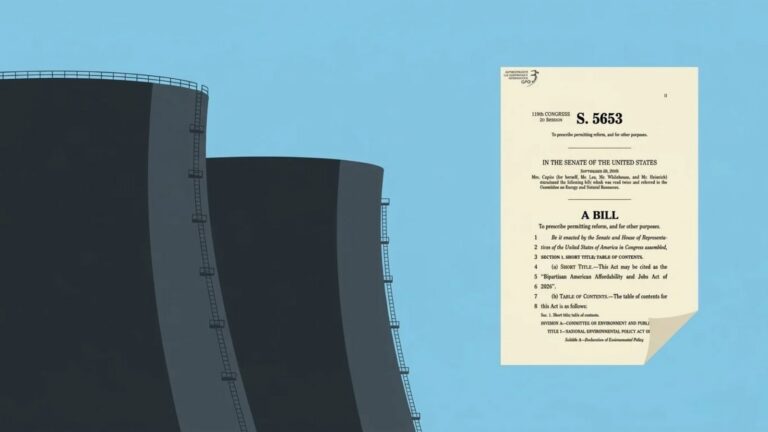
Congress Looks to Charge Data Centers Billions in Sweeping Energy Plan
The permitting bill could make it easier to build data centers for A.I. but a novel provision would also force data centers to pay much more for power.
Get the latest as our experts share their insights on global energy policy.
The shift in the balance of political power will help determine which US policies can be funded and sustained over the next two years.
Hear in-depth conversations with the world’s top energy and climate leaders from government, business, academia, and civil society.
Affordability was one of the key issues that drove US voters to the polls last week, and the resulting message for the newly elected Congress is clear: driving...

Find out more about our upcoming and past events.
Putting data centers in space once seemed fanciful. Today, a growing number of companies have started doing so.
The Center on Global Energy Policy (CGEP) at Columbia University SIPA today released a white paper analysing the United States Senate’s proposed Bipartisan American Affordability and Jobs Act of 2026 (BAAJA), which the authors call the most comprehensive effort in years to reform federal energy infrastructure permitting.
The legislation comes as concerns mount over utility bills and increased demand on the grid from data centers and manufacturing, vulnerabilities in critical minerals supply chains, and growing threats to grid resilience from extreme weather events like storms and wildfires.
The analysis finds that the bill’s broad-based reforms would make it meaningfully faster and more predictable to build energy infrastructure of all kinds, with significant potential benefits for energy costs, security, and reliability. It finds BAAJA’s technology-neutral reforms are also likely to facilitate clean energy deployment and emissions reductions relative to business as usual, though the extent of that reduction is highly uncertain. It cautions, however, that ultimate outcomes will depend on implementation of the final legislation, financing, supply chains, and market conditions. The new analysis can be found here.
“BAAJA is fundamentally a speed-and-certainty bill. It changes how quickly energy infrastructure gets approved and built, and takes an ‘all of the above’ approach to removing barriers for projects of all kinds. But it also hinges on bipartisan compromises, and as we look at the real challenges of energy affordability, security, grid resilience, and environmental protection, there are a lot of valid questions about what its impacts might be,” said Robin Millican, Director of Research Programs and Strategic Partnerships at CGEP and a lead author of the new analysis. “We hope that this new analysis from CGEP helps inform the public’s understanding of this bill as policymakers continue their negotiations in the coming weeks.”
Key findings from the analysis show that:
The analysis was written by CGEP scholars Robin Millican, Jack Andreasen Cavanaugh, Noah Kaufman, Vivek Shastry, Tom Moerenhout, Ira Joseph, and Lily Bermel. It follows CGEP’s release of an interactive platform that examines the potential impact of BAAJA, and is part of the Center’s ongoing efforts to analyze fast-moving permitting reform policies in the United States.
If you have any questions about the analysis, please email [email protected].
The permitting bill could make it easier to build data centers for A.I. but a novel provision would also force data centers to pay much more for power.
The report warns that space-based data centers are likely to become a reality within the next few years—well before the risks of large-scale deployment can be fully understood.
The shift in the balance of political power will help determine which US policies can be funded and sustained over the next two years.
The BAAJA bill could facilitate nuclear development by streamlining federal environmental reviews and providing greater certainty for permitted projects.