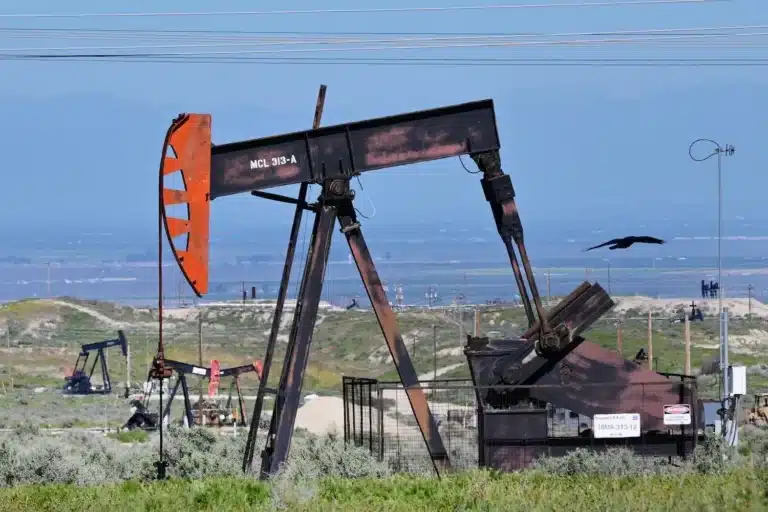
Trump promoted fossil fuels. His war is pushing the world away from them.
As oil prices spike, governments are slashing fuel use and eyeing renewables — threatening to erode global demand for fossil energy.
Get the latest as our experts share their insights on global energy policy.
On February 28, the US and Israel launched new attacks on Iran targeting primarily the country's leadership, security forces, and missile program.

Hear in-depth conversations with the world’s top energy and climate leaders from government, business, academia, and civil society.
While US and Israeli forces have significantly degraded Iran’s military and nuclear capability, the global energy landscape remains in a precarious position. For weeks, the Strait of Hormuz...
Find out more about our upcoming and past events.
This roundtable is open only to currently enrolled Columbia University students. To register, you must sign in with your UNI. Join the Center on Global Energy Policy’s Women...

As the US presidential election looms, Trump has vowed to stop the ‘madness’ of electric cars and Republicans long to reverse Biden’s IRA green energy law
Secretary Scott Bessent’s recent moves help explain something broader about the way this administration operates.
For decades we’ve seen nations exercise geopolitical dominance tied to their production and control of fossil fuels – especially oil. But that leverage may be changing. Last year, China installed nearly twenty times the amount of wind and solar as the United States. In this essay in The National Interest, the authors lay out a global political and economic realignment already underway. Petrostates, like those in OPEC, are increasingly at odds with electrostates like China and many in the EU. This isn’t to say that electrostates are not without resource challenges – they’re seriously dependent on mineral supply chains – but the challenges are different, as are the opportunities. When 70% of the world’s population lives in fossil-fuel-importing countries, how are these diverging resource paths shaping the global balances of power? Guests: Tatiana Mitrova, Global Fellow, Center on Global Energy Policy, Columbia University Vijay Vaitheeswaran, Global Energy & Climate Innovation Editor, The Economist Li Shuo, Director, China Climate Hub at the Asia Society Policy Institute For show notes, related links, and episode transcript, visit https://climateone.org/podcasts Highlights: 00:00 – Intro 04:30 – Tatiana Mitrova on petrostates and the idea of electrostates 10:00 – Electrostates are already taking market share from petrostates 13:30 – How Mitrova sees balance of power shifting as world electrifies 17:15 – Vijay Vaitheeswaran on the concept of an electrostate 26:00 – How cheap electricity could allow developing nations to skip over fossil fuels 34:00 – Vaitheeswaran on how U.S. should take on industrial policy in this moment 38:00 – Li Shuo: China’s latest 5-year plan suggests it will double down on clean tech sector 41:00 – China installed nearly twenty times wind and solar as U.S. last year 49:30 – China is on track to become firs ********** Support Climate One by going ad-free! By subscribing to Climate One on Patreon, you’ll receive exclusive access to all future episodes free of ads, opportunities to connect with fellow Climate One listeners, and access to the Climate One Discord. Sign up today at patreon.com/ClimateOne. Ad sales by Multitude. Contact them for ad inquiries at multitude.productions/ads Learn more about your ad choices. Visit megaphone.fm/adchoices
As geopolitics heat up and trading partners become less reliable, energy security takes precedence—no matter the cost.
The Iran war will accelerate the region’s economic transformation.
On March 20, Governor Kathy Hochul proposed significant changes to New York’s Climate Leadership and Community Protection Act (CLCPA), the landmark climate law passed in 2019.

The oil shock triggered by the crisis in the Persian Gulf has pushed crude above $100 per barrel, reviving familiar fears of economic turmoil in the United States driven by surging gasoline and diesel prices.