This website uses cookies as well as similar tools and technologies to understand visitors’ experiences. By continuing to use this website, you consent to Columbia University’s usage of cookies and similar technologies, in accordance with the Columbia University Website Cookie Notice.
This Energy Explained post represents the research and views of the author(s). It does not necessarily represent the views of the Center on Global Energy Policy. The piece...
Every permitting bill promises the same thing: build faster. The harder question is what the trade-offs are, and who bears them. That question is at the heart of...
The Center on Global Energy Policy (CGEP) at Columbia University’s School of International and Public Affairs and ReNew invite you to Columbia India Energy Dialogue 2026, taking place...
Event
• The Oberoi, New Delhi
Dr Zakir Hussain Marg, Delhi Golf Club, Golf Links
New Delhi, Delhi 110003, India
About Us
We are the premier hub and policy institution for global energy thought leadership. Energy impacts every element of our lives, and our trusted fact-based research informs the decisions that affect all of us.
This commentary represents the research and views of the authors. It does not necessarily represent the views of the Center on Global Energy Policy. The piece may be subject to further revision. This publication is part of the Energy Opportunity Lab, which is made possible in part by the generous support of the bedari collective. More information is available here.
India’s emerging industrial policy for critical minerals value chains entails more than a dozen regulatory, financial, and trade instruments worth nearly $40 billion, as part of a broader industrialization agenda.
The combination of three features distinguishes India’s critical minerals industrial strategy from other lower- and middle-income countries. First, the government is actively supporting multiple stages of the value chain, not only mining. Second, complementary policies, such as manufacturing incentives and consumer subsidies, stimulate domestic demand for critical minerals. Third, India is pursuing measures to secure mineral supplies from abroad, given its heavy import dependence.
But the success of India’s industrial policy will also depend on addressing transnational coordination challenges, both with mineral-rich developing economies seeking to build their own productive capabilities and with advanced economies furthering mineral security and manufacturing goals.
India could address these transnational challenges by positioning itself as a “third way” within the global critical minerals industrial ecosystem, distinct from both China’s state-capital-intensive model and Western security-led strategies. Drawing on its market scale, manufacturing capabilities, and engineering expertise, India could act as an industrial bridge that supports value addition in developing economies and diversification of critical mineral supply for advanced economies.
1. Introduction
India is rapidly developing a more coordinated industrial policy for critical minerals. In 2023, the Ministry of Mines identified 30 minerals as critical to the Indian economy based on their economic importance and supply risk.[i] The following year, the Union Budget proposed a Critical Minerals Mission among its manufacturing and services priorities for “Viksit Bharat”, India’s broader ambition to become a developed economy by 2047.[ii] The National Critical Mineral Mission (NCMM), followed in January 2025, establishing the government’s principal framework for securing critical mineral supplies and developing domestic capabilities across the value chain,[iii] with the stated objective of establishing a “globally competitive and resilient critical mineral ecosystem.”[iv]
Three features of India’s critical minerals strategy distinguish it from other low- and middle-income countries’ efforts. First, the government is intervening across multiple stages of the value chain rather than concentrating principally on mineral extraction. Second, these interventions are reinforced by policies outside the mining sector that stimulate domestic demand for mineral-intensive technologies, including manufacturing incentives for batteries, rare-earth magnets, solar photovoltaics, and semiconductors, as well as consumer subsidies for electric vehicles and rooftop solar. Third, India is simultaneously pursuing measures to secure mineral inputs from abroad.
Successfully implementing such an ambitious industrial policy is fraught with various fiscal, institutional, and technological challenges. But the need to secure imported inputs to feed a robust critical minerals industry—India depends on mineral resources, technologies, and finance from abroad—places a significant constraint on what domestic policy alone can accomplish.
The effectiveness of India’s critical minerals industrial policy, therefore, is contingent in large part on how it manages two transnational coordination complexities. The first concerns resource-rich producer countries that increasingly seek to expand their own processing, refining, and manufacturing capabilities rather than remain suppliers of raw materials. The second concerns India’s relationships with high-income partners whose interests in diversifying critical mineral supply chains align with India’s, but whose mineral security strategies increasingly favor stricter trade and investment regimes that retain manufacturing within their own economies.
This commentary first examines Indian policies for building out its critical minerals industry before assessing transnational constraints that would need to be addressed to reach its goals. The authors propose that India could articulate a clearer vision of itself as a “third way” within the global critical minerals industrial ecosystem that neither replicates China’s state-capital-intensive model nor simply integrates into Western security-led supply chains. In this role, India could function as an industrial bridge—using joint ventures, long-term offtake arrangements, technology and skills partnerships, and selective co-investment—to build mutually reinforcing value chains across low- and middle-income producer countries and advanced-economy partners.
2. Distinct Features of India’s Critical Minerals Industrial Policy
The NCMM is the organizing framework for India’s critical minerals industrial policy, but the strategy extends beyond the mission itself. In terms of budget, NCMM provides $1.7 billion (₹16,300 crore) in direct support and anticipates a further $1.88 billion (₹18,000 crore) in investments by public-sector undertakings (PSUs) through FY2030–31.[v] When combined with complementary policies by other ministries and departments, the announced financial outlays reach nearly $40 billion (see the appendix for a breakdown of policies). A review of government documents and announcements around these policies reveals three distinctive features of India’s strategy.
A Holistic Approach to Building Mineral Value Chains
First, India is intervening across multiple stages of the critical minerals value chain rather than focusing principally on extraction. The NCMM’s objectives encompass mineral exploration, mining, beneficiation, and recycling alongside technology development, skills, and financing.[vi] There are regulatory reforms to facilitate domestic exploration by opening up a formerly restricted group of commodities to private and foreign investment, the auctioning of exploration licenses, and the approval of 100 percent foreign direct investment (FDI) in exploration and mining activity. These are accompanied by fiscal measures for building various midstream capabilities, including support for domestic and international collaborative R&D, establishment of critical mineral processing parks, and funding a National Critical Minerals Stockpile for at least five commodities by 2031. The Science and Technology Programme for Promoting Research and Innovation in Startups and MSMEs (micro, small, and medium enterprises) (S&T PRISM) initiative pre-dates the NCMM, and funds start-ups working on commercializing technologies in mineral processing, metallurgy, and recycling. Finally, a set of regulations target the recovery of critical minerals from solar PV modules, batteries, and other electronics. Together, these interventions aim to create productive capabilities across upstream, midstream, and downstream segments of the mining value chain.
Complementary Policies to Spur Domestic Demand
India’s critical minerals strategy extends to industrial policy tools that generate domestic demand in industries that use minerals as inputs.
Manufacturing incentives through the Production Linked Incentive Scheme deliver payments tied to quantitative metrics for sales, outputs, and domestic value addition (DVA) requirements for firms. Three of the schemes outlined in the appendix are specific to critical minerals (advanced chemistry cells [ACC], sintered rare earth permanent magnets, and critical mineral recycling), whereas the other schemes target the downstream users of these commodities (solar PV and semiconductors). The ACC scheme, for example, provides $1.9 billion (₹18,100 crore) in incentives to establish large-scale domestic battery cell manufacturing and requires beneficiaries to achieve at least 25 percent domestic value addition, rising to 60 percent within five years.[vii]
Consumer demand incentives subsidize the purchase of mineral-intensive end products. Programs such as PM E-DRIVE, PM KUSUM, and PM Surya Ghar stimulate demand for electric vehicles and solar PV systems, pulling demand for lithium, cobalt, nickel, indium, tellurium, and other minerals. The aggregate financial outlay for the manufacturing and consumer demand initiatives (close to $40 billion) far outweighs the NCMM budget (nearly $4 billion). Policies administered across electronics, renewable energy, and other sectors can therefore provide a significant boost to the domestic markets for India’s mineral processing and manufacturing output.
Securing Critical Minerals Supplies from Abroad
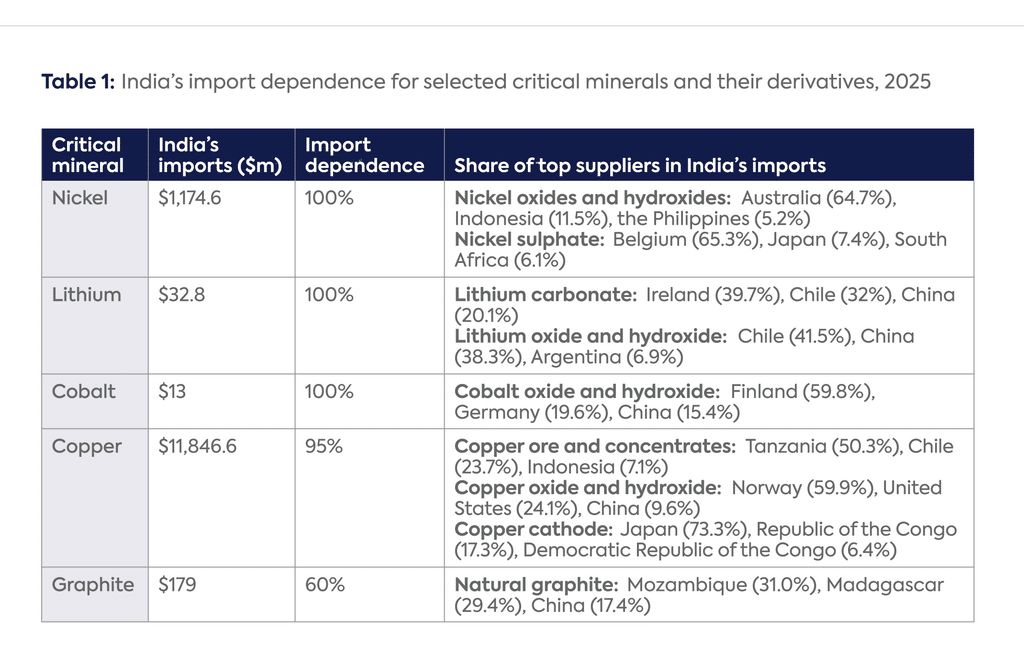
A third feature ofIndia’s policies to build productive capabilities in critical minerals value chains are measures to reduce the cost and vulnerability of mineral imports. Despite having a diverse set of suppliers, these vulnerabilities appear substantial (see Table 1). For example, India has 100 percent net import reliance for 10 minerals, including lithium, cobalt, nickel, vanadium, and niobium.[viii] India has built substantial copper smelting and refining capacity, but in 2025 imported over 90 percent of the inputs needed for these industries.
Therefore, India has paired its domestic industrial and demand policies with instruments associated with trade and overseas investments. On the trade side, the government has progressively removed the Basic Customs Duty (BCD) on critical mineral inputs. Phased exemptions announced in the fiscal year 2025 and 2026 budgets, and during the NCMM launch in January 2025, cumulatively cover most of the list of 30 critical minerals. The most recent budget provided further BCD exemptions on the capital goods required for critical minerals processing.
The government is also pursuing overseas critical mineral asset acquisition. The Khanij Bidesh India Limited (KABIL), a PSU joint venture, is mandated to identify, explore, acquire, and develop strategic mineral assets abroad. The NCMM envisions that PSUs will invest around $1.9 billion by 2031 toward acquiring 50 overseas mining assets to meet about 5 percent of India’s annual critical mineral demand.
Unlike domestic instruments, however, external measures cannot be implemented by the Indian government alone. Their effectiveness depends on negotiations with producer governments, foreign firms, and international partners whose strategic objectives may differ from India’s. This reality creates transnational coordination questions for India’s critical minerals strategy.
3. Navigating Two Transnational Challenges as a Third-Way in the Critical Minerals Industrial Ecosystem
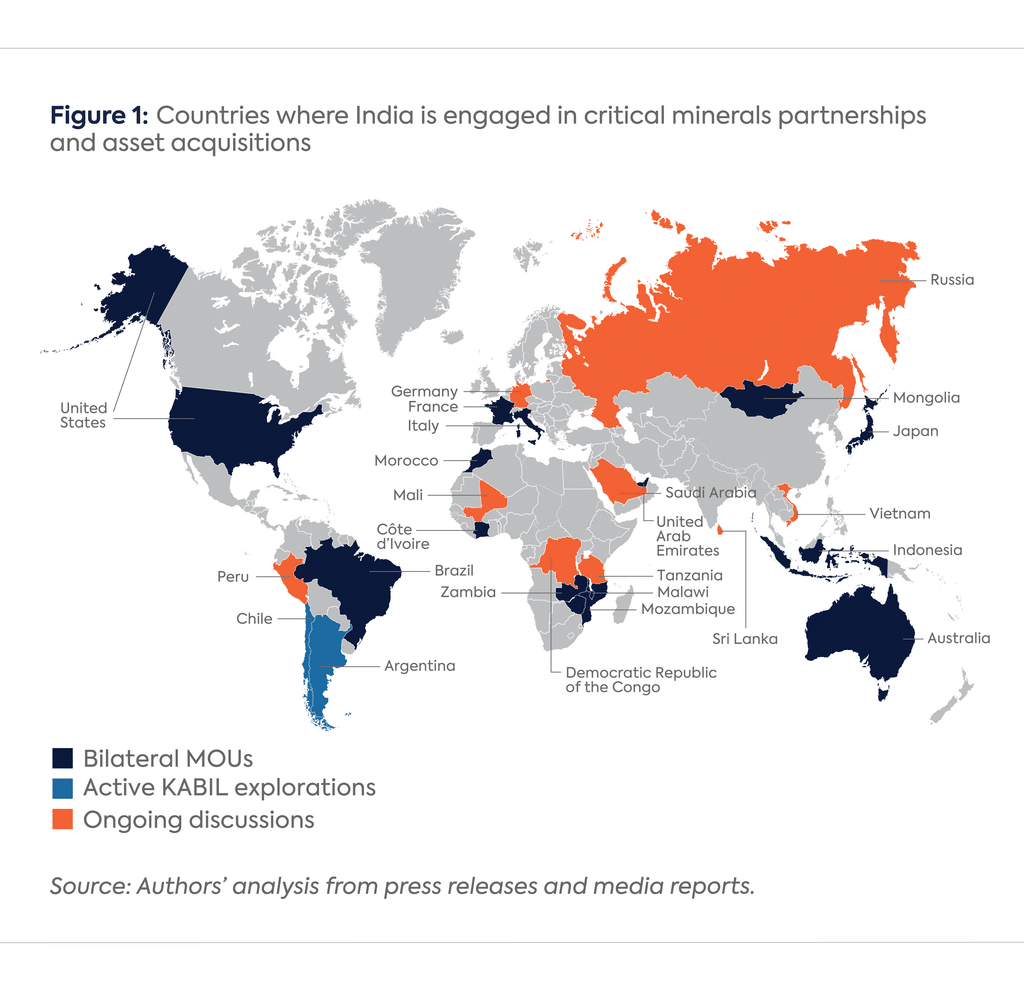
India’s dependence on imported critical minerals creates two transnational coordination challenges. The producer countries from which India seeks minerals increasingly have industrial objectives of their own, while the advanced economies with which India cooperates on securing supplies are simultaneously protecting domestic manufacturing. As Figure 1 illustrates, India’s global critical minerals engagements already span over a dozen bilateral partnerships as well as overseas asset acquisitions, plurilateral initiatives, and ongoing negotiations.
A “third way” positioning for India would rest on a dual identity: its market scale and industrial base place it closer to China than to other low- and middle-income countries (LMICs), while its continued distance from the technological frontier (the extent to which an economy possesses capabilities to innovate rather than simply copy technologies) distinguishes it from advanced-economy partners. This approach is consistent with the Indian government’s “multi-alignment” foreign policy,[ix] and with recent research from Indian think tanks.[x]
As the world’s most populous country, with a large and growing domestic market, consistently high economic growth, and substantial industrial capacity—including metals refining and smelting—India has the potential to approach China’s scale and is therefore distinct from other LMICs. Yet India remains a lower-middle-income country with significant development, infrastructure, and technology needs, setting it apart from advanced-economy partners in East Asia, North America, and Western Europe. By articulating India’s position in the global critical minerals ecosystem, the country could more effectively secure the minerals, technology, and finance needed to advance its domestic industrial ambitions while credibly supporting the value-addition goals of LMICs and the security and manufacturing priorities of advanced economies.
Coordinating with Resource-Rich LMICs on Value Addition
The first transnational coordination challenge is an overlap with many mineral producing countries’ own industrial policies. Governments across parts of Africa, Latin America, and Southeast Asia want to capture a larger share of mineral-based processing, refining, and eventually manufacturing within their own economies. Some have introduced export restrictions on raw ores and oxides and other measures to encourage greater domestic value addition. Indonesia, for example, has restricted nickel ore exports and incentivized investment to promote domestic smelting and the development of battery-related industries.[xi] Chile’s National Lithium Strategy similarly seeks to support its economic development by combining lithium extraction with “capital, technology, sustainability, and value addition…” These policies reflect a wider trend among resource-endowed countries that sometimes competes with India’s and others’ own interest in domestic processing.
As a “third way” critical minerals industrial ecosystem, India could offer resource-rich partners a value proposition aligned with their own industrialization ambitions: value chain development, knowledge and skills transfer, and access to export markets in India and advanced economies. Unlike China, whose comparative advantage includes deploying surplus capital across emerging markets or financing large infrastructure projects, one of India’s strengths is its experience developing and operating refineries, smelters, petrochemical plants, and other industrial facilities in a lower-income setting. Despite being capital-constrained, India is home to some of the world’s largest petroleum refineries, is the second-largest refiner of aluminum and lead, and is the third-largest refiner of zinc. India could therefore consider locating some mineral refineries and metals smelters in LMIC partner countries through joint ventures with local firms. These facilities could supply downstream manufacturers of solar cells and modules, batteries, and semiconductors in India.
Lohum, India’s largest critical minerals producer and processor, is taking this type of approach. Lohum has secured rights to 10 lithium mining blocks in Zimbabwe and plans to process the ore locally into lithium sulfate before shipping it to India to be refined into higher-value products. The company has similar plans for procuring nickel mines in Indonesia and the Philippines.[xii]
The multinational Dangote Group’s refinery in Nigeria provides another useful model. State-owned Engineers India Limited (EIL) provided project management and engineering services to Africa’s largest refinery and petrochemicals complex, and signed a $350 million contract in January 2026 to support its expansion.[xiii] Such partnerships could also be paired with knowledge- and skills-sharing programs linking Indian companies with counterparts in host countries. For example, the Dangote Group sent hundreds of Nigerian graduates between 2016 and 2018 to Bharat Petroleum Corporation Limited in Mumbai for training in refinery operations ahead of commissioning.[xiv]
These models could be adapted to critical minerals industries in other resource-rich countries. This may require India to articulate an explicit strategy for KABIL, it’s state-owned joint venture vehicle, to manage competition with producer-country industrial ambitions beyond its project-by-project approach to asset acquisition.[xv] A useful reference point is Japan’s longstanding resource diplomacy model, administered through the Japan Organization for Metals and Energy Security (JOGMEC), which pairs equity stakes and offtake agreements with technology transfer, joint processing investment, and infrastructure co-financing in producer countries.[xvi] South Korea’s POSCO, one of the world’s largest steel manufacturers, has taken a comparable approach in its lithium investments in Argentina, bundling capital with midstream processing technology.[xvii]
Given India’s financing constraints, such partnerships would likely need to draw on private capital rather than rely predominantly on Indian public-sector funding.
Coordinating with Advanced Economies on Supply-Chain Security
A second complexity arises from India’s engagements with high-income countries. India participates in the Minerals Security Partnership and the Quad Critical Minerals Initiative with advanced economies seeking to diversify concentrated supply chains.[xviii] In May 2026, India, Australia, Japan, and the United States formalized the Quad framework on critical minerals, which seeks to mobilize up to $20 billion in public and private support for mining, processing, and recycling while explicitly recognizing each partner’s domestic policies and priorities.[xix] Separately, India and the United States signed a Strategic Critical Minerals Cooperation Framework to develop resilient and diversified mineral supply chains. These partnerships create opportunities for India to access investment, technology, and project development expertise.
However, shared interests in supply chain security do not necessarily imply complementary industrial objectives. India seeks to build domestic manufacturing capacity while advanced economies are likewise using industrial policy to protect strategic productive capacity within their own borders. Australia, for example, will provide a refundable 10 percent tax offset on eligible company expenditure for critical minerals processed and refined domestically starting in July 2027.[xx] And US bilateral critical minerals trade deals combine economic partnerships with preferential sourcing, investment screening, market access conditions, and restrictions on third-party actors.[xxi]
As a “third way” in the global critical minerals industrial ecosystem, India could offer its advanced economy partners a different value proposition centered on mineral security: diversifying supply, rebuilding productive capacity over the medium term, and ultimately developing supply chains beyond China. In the short term, India could position itself as an alternative supplier to China of selected refined metals and mineral derivatives, drawing on facilities in India and, potentially, on smelters and refineries in LMIC partner countries. Over the medium term, it could become both a destination and a source of FDI in clean energy, storage, and digital technology manufacturing.
This two-way flow is already visible. Apple, for example, is shifting parts of its iPhone assembly from China to India via Tata Electronics and Foxconn, aiming to produce most United States bound iPhones in India by the end of 2026.[xxii] And India’s Tata Steel completed a $12.4 billion (in 2007 dollars, or £6.2 billion) acquisition of the Anglo-Dutch steelmaker Corus in 2007,[xxiii] while the acquisition by India’s Hindalco of US Novelis the same year gave the Indian group a global footprint in downstream aluminum and recycling.
Strategic partnerships do not, however, guarantee unrestricted access to advanced economy markets. Although US measures for stockpiling, price floors, and trade restrictions remain under debate and refinement, India may ultimately be excluded from certain products or segments of the mining value chain. For example, Indian exports face an 18 percent reciprocal tariff in the US.
India’s most viable approach with advanced economies, therefore, may be to present its “third way” as a non-adversarial ecosystem that complements but remains distinct from US and others’ supply-chain strategies—maintaining strategic linkages without pursuing full integration.
4. Conclusion
India’s critical minerals industrial policy is underpinned by its significant manufacturing capabilities, large domestic market, and substantial imports of mineral inputs. These characteristics create considerable scope for forward linkages from mining and processing into batteries, electronics, renewable energy technologies, defense, and other manufacturing industries. Yet some of the most consequential elements of this strategy lie beyond the reach of nationally bounded industrial policy. The effectiveness of India’s critical minerals strategy will therefore depend on how it negotiates the distribution of value across borders. India will need to forge arrangements that accommodate both the industrial ambitions of resource-rich developing economies and the security priorities and manufacturing goals of advanced economies.
[xxi] Zainab Usman, “The international trade dimensions of the United States critical minerals security strategy,” UNU WIDER Working Paper 35/2026, 2026, https://doi.org/10.35188/UNU-WIDER/2026/710-7.