This website uses cookies as well as similar tools and technologies to understand visitors’ experiences. By continuing to use this website, you consent to Columbia University’s usage of cookies and similar technologies, in accordance with the Columbia University Website Cookie Notice.
The work of scientists and researchers deserves celebration, but solid climate, energy, and technology breakthroughs need costly infrastructure and sustained funding to scale. Relying on private philanthropy like the Bezos Fund for climate research says a lot about this country’s expressed values while laying a fragile foundation for our industry’s future.
Permitting reform—to allow for faster approvals on new projects—is one thing that both climate advocates and energy developers have wanted for a long time. With demand for power...
The Center on Global Energy Policy at Columbia University SIPA invites students to join us for an engaging roundtable discussion on sustainable finance with Jacqueline Ricciani, Managing Director,...
Event
• Columbia SIPA
About Us
We are the premier hub and policy institution for global energy thought leadership. Energy impacts every element of our lives, and our trusted fact-based research informs the decisions that affect all of us.
This commentary represents the research and views of the authors. It does not necessarily represent the views of the Center on Global Energy Policy. The piece may be subject to further revision. Contributions to SIPA for the benefit of CGEP are general use gifts, which gives the Center discretion in how it allocates these funds. More information is available at Our Partners. Rare cases of sponsored projects are clearly indicated.
The 2024 Codelco–SQM agreement, the first major public-private partnership under Chile’s National Lithium Strategy, establishes an elaborate and innovative Indigenous benefit-sharing structure, channeling a portion of lithium revenues to Atacameño communities and regional development.
The agreement combines the sector’s two competing benefit-sharing models through project-based funds that preserve institutional oversight and a novel intergenerational fund to make direct payments to elderly Atacameño beneficiaries after 2060.
The agreement’s benefit-sharing design is likely to serve as a model for future partnerships, but it also underscores the need for a general legal framework to promote greater consistency and transparency in benefit-sharing arrangements across projects and communities.
Introduction
In May 2024, Chile’s state-owned copper company, Corporación Nacional del Cobre de Chile (Codelco), and the country’s leading private lithium producer, Sociedad Química y Minera de Chile (SQM), signed the Codelco–SQM agreement[i] to jointly develop lithium operations in the Salar de Atacama, an area of Indigenous Atacameño territory, through 2060, with Novandino Litio serving as the joint-venture entity responsible for operating the partnership. The agreement, the first major public-private lithium partnership under Chile’s 2023 National Lithium Strategy, enables Codelco to enter lithium operations before SQM’s existing contract expires in 2030 and leverage SQM’s operational know-how in the sector.
Although the partnership advances Chile’s objective of expanding state participation in lithium production and provides the sector with a mechanism for sustaining production at the Salar de Atacama after 2030, it has drawn scrutiny over its Indigenous consultation process, which is required under International Labour Organization (ILO) Convention No. 169 (C169),[ii] the representativeness of participating organizations, and its implications for the broader political economy of lithium and mining governance in Chile. The stakes extend beyond the agreement itself, as it could serve as a precedent for future mining projects in Chile and, given the country’s position as the world’s second-largest lithium producer, influence how similar partnerships are structured in other major mining jurisdictions.
Against this backdrop, this commentary explores what is most innovative about the deal’s benefit-sharing design: its balance between two models of financial benefit sharing— the direct cash approach and the project-based approach, which has historically characterized much of the mining sector’s engagement with local communities through investments in schools, roads, clinics, and other community development projects. The agreement establishes a multi-fund financial arrangement that channels a portion of lithium revenues to comunidades indígenas (Indigenous communities) and regional development through five mechanisms: a community investment and development fund, a broader community development fund, a fund for asociaciones indígenas (Indigenous associations), a large-scale projects fund for the municipality of San Pedro de Atacama, and an intergenerational savings fund that will make distributions to elderly members of the Atacameño community.[iii] Taken together, these mechanisms represent an attempt to combine institutional oversight of project-based benefit sharing with direct financial benefits while introducing a new mechanism for long-term individual benefits.
Chile’s Lithium Sector and the Codelco–SQM Deal
Under the Chilean Constitution, the state owns all mineral resources. Although Chile allows private parties to extract mineral resources through a concession system, lithium was excluded from this regime in 1979 because it was considered a strategic mineral due to its potential use in nuclear weapons. For this reason, lithium may be exploited only by the state, either through state-owned companies such as Codelco and the Production Development Corporation (CORFO) or through special operating contracts with private or public entities, even though its use in nuclear weapons has been of limited significance.[iv]
By the early 2020s, Chile’s lithium sector remained concentrated in two long-standing producers—Chile-based SQM and US-based Albemarle—both of which extract lithium from brine deposits in the Salar de Atacama and process the material into lithium chemicals at their respective refineries in Antofagasta.[v] In 2023, President Gabriel Boric announced a new National Lithium Strategy,[vi] which, among other objectives, aims to expand lithium production, strengthen community engagement—particularly with Indigenous peoples—and increase the state’s share of the revenues generated by lithium extraction.[vii] As part of this strategy, and with SQM’s special operating contract for its lithium operations in the Salar de Atacama set to expire on January 31, 2030, the Chilean government directed Codelco to negotiate a joint venture with SQM. The resulting agreement will allow the two companies to continue operations there through 2060. In May 2025, Rio Tinto and Codelco also signed binding agreements to form a joint venture to develop and operate a high-grade lithium project in the Salar de Maricunga, with Codelco retaining majority control.
Benefit Sharing with Indigenous Peoples in Chilean Lithium Mining
Historically, direct benefits to local communities from lithium mining did not include a share of revenues. In the 2010s, a series of agreements changed the relationship between mining companies and Indigenous peoples.[viii] Among the most significant of these was a 2016 agreement between Albemarle and the Council of Atacameño Peoples (CPA). For the first time in Chile, a private mining company committed to making direct, ongoing payments to an Indigenous organization based on a percentage of its annual gross sales: 3.5 percent directly to a fund managed by the Council, disbursed based on “development plans” drawn up by each community; 3 percent distributed in equal shares among all communities; and 0.5 percent allocated to the Council for laboratories, monitoring instruments, and administrative expenses, subject to annual independent audit.[ix] Between 2021 and 2023, annual payments under the agreement totaled an estimated USD 9,711,230 in 2021, USD 12,056,740 in 2022, and USD 42,031,263 in 2023.[x] These funds financed a range of community development initiatives, including rural water networks, photovoltaic energy projects, public lighting, and study scholarships. The relative success of the Albemarle agreement in maintaining stable community relations set a precedent that influenced subsequent negotiations in the Salar de Atacama.
Two years later, SQM renegotiated its lease with CORFO and, as part of the new agreement, committed to allocate 1.7 percent of its annual sales revenues to Indigenous communities and local governments, along with annual payments of USD 10 to 15 million, scaled to the price of lithium carbonate.[xi] Of that 1.7 percent, the Regional Government of Antofagasta (GORE Antofagasta) received 1 percent, a regional productive development program received 0.3 percent, and the three nearest municipalities shared the remaining 0.4 percent.[xii] Unlike the Albemarle arrangement, these funds were channeled through government-administered institutions rather than paid directly to the CPA.
Building on this precedent, the recent negotiations between SQM and Codelco included consultation with the Atacameño (Lickanantay) people pursuant to ILO C169 to establish financial benefit-sharing mechanisms, while also responding to environmental concerns the communities had previously raised about the local impacts of lithium brine extraction.[xiii] This process was not, however, without controversy. Communities in the southern part of the Salar, located closest to the extraction sites, blocked access roads in early 2024 to demand direct participation in talks that had previously been conducted through the regional Indigenous governance body known as the CPA. Those communities also alleged that some newly created community organizations had been formed primarily to secure financial benefits rather than to genuinely represent territorial interests.[xiv] Nevertheless, 51 representative Indigenous organizations,[xv] including members of the CPA, eventually participated in the consultation process, which lasted approximately 10 months.[xvi]
The consultation covered draft amendments to the project agreement for the Salar de Atacama and the lease agreement for the mining properties, originally executed between CORFO and SQM on January 17, 2018,[xvii] which would govern the transition period between 2025 and 2030, as well as draft lease agreements for mining properties in the Salar de Atacama and a new project agreement for the Salar de Atacama, which would govern lithium operations between 2031 and 2060.[xviii] The draft contractual arrangements included a range of provisions with potential implications for Indigenous communities, including project implementation and technology (new production technologies, long-term hydrological balance, clean energy commitments); environmental matters (compliance and monitoring); protective arrangements for mining claims (restrictions on concession transfers within designated protection zones); and financial contributions to Indigenous organizations.[xix]
The agreement reached through the consultation introduced a structured, multi-fund architecture combining fixed contractual commitments with variable contributions tied to lithium prices. As part of this architecture, the agreement also created a new mechanism for direct payments to individuals through the intergenerational fund, a perpetual savings vehicle funded by a fixed annual contribution of USD 1 million from Novandino. Once the 2031–2060 contracts expire, the fund’s investment returns will finance retirement benefits for elderly members of the Atacameño people residing in San Pedro de Atacama. The fund has no precedent in Chilean mining.
Financial Benefit-Sharing Mechanisms in the Codelco–SQM Agreement
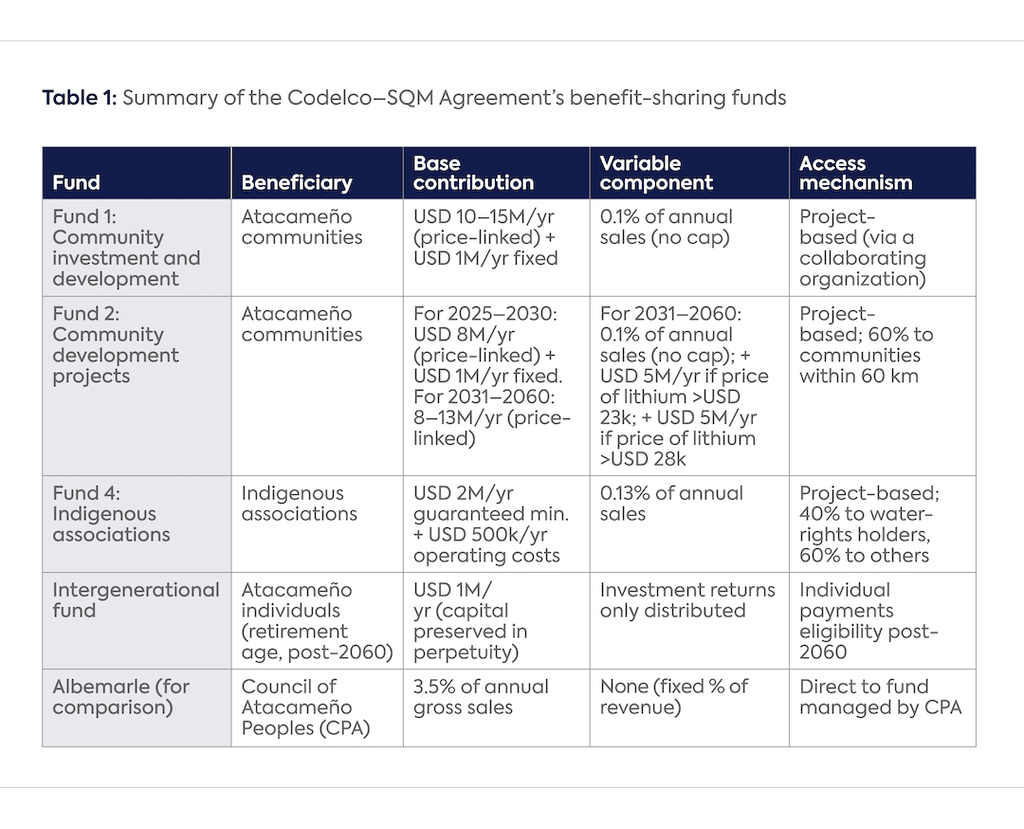
The Codelco–SQM agreement created four distinct financial benefit-sharing mechanisms. Table 1 details each mechanism, including their name, beneficiaries, base contribution, variable component, and access mechanism.[xx] It also presents Albemarle’s existing benefit-sharing arrangement for comparison.
The four mechanisms combine fixed transfers with variable contributions tied to lithium prices and other performance-based criteria.[xxi] Disbursements from Funds 1, 2, and 4[xxii] remain project-based, meaning that resources are channeled through community-approved proposals rather than provided as unconditional transfers, which preserves institutional oversight over their use. By contrast, the intergenerational fund makes direct individual payments to elderly members of Atacameño communities after 2060. This mechanism represents a significant shift in benefit-sharing arrangements toward direct compensation to individuals.
The full contractual details for each fund, including contribution formulas, distribution rules, and access mechanisms, are provided in the following text box.
Fund 1: Community Investment and Development Projects
This fund finances investment and development projects that promote the sustainable development of Atacameño Indigenous communities.[xxiii] Contributions include:
USD 10–15 million per year, indexed to the price of lithium carbonate. The contribution is set at USD 10 million when the price is below USD 4,000 per metric ton, increases proportionally as the price rises above that threshold, and reaches a ceiling of USD 15 million when the price equals or exceeds USD 10,000 per metric ton.
0.1 percent of annual sales of all products derived from the Salar’s brines, with no cap, added during consultation.[xxiv]
USD 1 million annually, added during the consultation.
Resources from this fund are distributed through community-approved projects rather than directly to individual community members. Community members seeking direct support must submit an eligible project proposal, which is then reviewed by CORFO and approved through a structured evaluation process. The distribution of funds across communities follows a formula established in an earlier consultation process[xxv]: 50 percent is distributed equally among eligible communities, 40 percent is allocated proportionally to each community’s registered member count, and 10 percent is allocated based on the communities’ proximity to extraction operations.[xxvi]
A collaborating organization will maintain a permanent presence in San Pedro de Atacama to support communities in designing and submitting eligible project proposals. Novandino will select its members from a shortlist proposed by CORFO, with one nominee designated by the communities themselves.
Fund 2: Community Development Projects
This fund is directed to the same communities as Fund 1 and finances initiatives, projects, and programs for the development of the Indigenous communities in accordance with the “life plans” they designed and approved. Contributions are structured as follows:
For 2025–2030, USD 8 million per year, plus 1 million per year added during the consultation.
For 2031–2060, USD 8–13 million per year, depending on the lithium carbonate price; an additional USD 5 million per year when the price exceeds USD 18,000 per ton; and 0.1 percent of annual sales.
USD 1 million per year fixed, added during the consultation.
An additional USD 5 million per year when the price exceeds USD 23,000 per ton, and another USD 5 million per year when the price exceeds USD 28,000 per ton, both added during the consultation.
Communities may access these funds through eligible project proposals, with payments made in accordance with the life plan approved by the community assembly. A geographic allocation rule applies: 60 percent of the fund is reserved for communities located within 60 kilometers of Novandino’s main operations, while the remaining 40 percent is reserved for communities located farther away. Within each allocation, 15 percent is divided equally among eligible communities, and 85 percent is allocated based on the number of community members.[xxvii]
Fund 4: Indigenous Associations
This fund is directed exclusively to Indigenous associations and finances projects aligned with their founding statutes.
Key features include:
Contribution: 0.13 percent of annual sales of all products from the Salar’s brines, with a guaranteed minimum of USD 2 million per year, plus USD 500,000 annually for operational costs, including a technical support organization.
Distribution: 40 percent is allocated to water rights holding associations, while the remaining 60 percent is allocated to other associations.
Intergenerational Fund: Long-Term Savings for Elderly Members of Atacameño Communities
This fund was introduced during the consultation process and did not appear in the original draft contracts. It includes the following key features:
Contributions: USD 1 million per year from Novandino over both contract periods (i.e., through 2030 and 2031–2060).
Purpose: Capital is preserved in perpetuity, while investment returns are distributed as individual payments to eligible beneficiaries, functioning in effect as a pension mechanism.
Beneficiaries: Atacameño individuals who reside in the commune of San Pedro de Atacama and reach legal retirement age after the contracts expire in 2060.
Administration: The fund is administered by an institution selected through a public tender process designed to prioritize guaranteed minimum returns and low fees.
Design: Within three years of the contract entering into force, Novandino must commission a specialized entity to develop the fund’s governance structure, investment conditions, and beneficiary rules.
Conclusion
The Codelco–SQM agreement represents a distinctive approach to benefit sharing between large-scale resource extraction projects and Indigenous communities. Its multi-fund architecture combines institutional oversight with meaningful community discretion over the use of resources, while the intergenerational fund comes closest to direct payments to eligible community members. This approach is likely to serve as an important reference point for future benefit-sharing mechanisms. Given Chile’s position as the world’s second-largest lithium producer, the model’s performance will also be watched closely by mining companies and Indigenous communities well beyond Chile’s borders.
At the same time, the process of concluding the agreement surfaced tensions between the company and the community over environmental and social issues that the financial framework alone cannot resolve. The presence of large mining operations in Indigenous territory, and the prospect of substantial new economic flows, can reshape relationships within and among communities and between communities, companies, and the state, regardless of how carefully agreements are designed.
The agreement’s benefit-sharing mechanisms are the product of a specific negotiation, under specific conditions, with a specific company. While this will always be the case, a better regulatory and institutional structure could promote greater consistency and transparency in benefit sharing across projects and communities. As Chile moves forward with additional public-private partnerships, including those currently under negotiation for the Salar de Maricunga and Laguna Verde—both of which will be exploited through a joint venture between Codelco and Rio Tinto[xxviii]—the experience of the Codelco–SQM agreement underscores the need for such a framework.
About the Authors
Juan PabloEscudero is a Chilean environmental lawyer and holds an LL.M. in Environmental Law from UCLA. He is Senior Researcher at SEDE, Universidad Adolfo Ibáñez (UAI). He is also Latin America Project Lead at the Emmett Institute on Climate Change and the Environment, UCLA School of Law, and a law professor at UAI, where he directs the Double Degree Program in Law and Business. He previously advised the President of Chile on environmental and legislative matters as part of the Ministry of the General Secretariat of the Presidency.
Dr. Tom Moerenhout is a Professor at Columbia University’s School of International and Public Affairs and leads the Critical Materials Initiative at Columbia’s Center on Global Energy Policy. His work extends to roles as Senior Advisor at the World Bank Energy and Extractives Group, Executive Director at the Geneva Platform for Resilient Value Chains, and Senior Associate at the International Institute for Sustainable Development and Intergovernmental Forum on Mining, Minerals and Metals. He has served as Visiting Professor at NYU, Sciences Po Paris, and the Geneva Graduate Institute.
Tom specializes in the intersection of geopolitics and industrial policy, particularly as they relate to energy, critical minerals, and battery supply chains. His work focuses on integrating the interests and influence of multiple actors across complex political economies to improve supply chain security and resilience. Tom has published extensively on sustainable development and energy policy reforms, specifically on energy subsidies, critical materials, and the economic development of resource-rich countries.
He has advised and consulted for various stakeholders, including the White House, Departments of Energy and State, USTR, and policymakers in several other countries, including the EU, Canada, India, Indonesia, Nigeria, DRC, Egypt, Iraq, Chile, and Brazil. His collaborative efforts span organizations such as the OECD, IEA, World Bank, UNCTAD, UNEP, OPEC, IRENA, and several philanthropic foundations.
Tom holds two master’s degrees and obtained his PhD at the Graduate Institute of International and Development Studies in Geneva. This academic background includes fellowships at LSE and the Oxford Institute for Energy Studies. He was also a Fulbright and Albert Gallatin Fellow, and a Swiss National Science Foundation Scholar.
In his downtime, Tom enjoys reading & writing, culinary experiences, football, skiing, and chess.
[i] CORFO, Informe Final: Etapa de Sistematización, Comunicación de Resultados y Término del Proceso. Consulta Indígena al Pueblo Lickanantay o Atacameño de la Cuenca del Salar de Atacama, 2025.
[ii] ILO C169, Concerning Indigenous and Tribal Peoples in Independent Countries, June 27, 1989, art. 6(1)(a).
[iv] Constitución Política de la República de Chile, art. 19, no. 24; Decreto Supremo no. 152, Ministerio de Relaciones Exteriores, Chile, 1979 (declaring lithium a mineral of “atomic interest”); Ley no. 18,097, Ley Orgánica Constitucional sobre Concesiones Mineras, Chile, 1982, art. 3 (excluding lithium from the ordinary mining concession regime, except for concessions established before 1979).
[v] Ministerio de Minería de Chile, Estrategia Nacional del Litio, 2023, 10–12.
[vii] Ministerio de Minería de Chile, Estrategia Nacional del Litio, 2023, 20.
[viii] Hans Gundermann and Barbara Göbel, “Comunidades Indígenas, Empresas del Litio y Sus Relaciones en el Salar de Atacama,” Chungará 50, no. 3 (2018): 471–86.
[ix] Rafael Poveda Bonilla, Ingresos Fiscales por Litio en Chile (Natural Resource Governance Institute, 2024).
[x] Matías Piña, Martín Latorre, Trinidad Aparici, and Rodrigo Guerrero, Recomendaciones para el Desarrollo de la Industria del Litio en Chile y Latinoamérica (Santiago: Espacio Público, 2025).
[xiii] Mauricio Lorca, Manuel Olivera Andrade, and Ingrid Garcés, “‘Se Instaló el Diablo en el Salar’: Organizaciones Atacameñas, Agua y Minería del Litio en el Salar de Atacama,” Estudios Atacameños 69 (2023): 6.
[xxi] In addition, a previously existing fund for large-scale projects in San Pedro de Atacama remains in force. This fund is managed by CORFO in coordination with the GORE Antofagasta. The underlying contribution amount comes from a percentage of revenues allocated to GORE Antofagasta; the consultation added a formal community voice in establishing priorities but did not change the funding amount.
[xxii] Fund 3, which was originally intended to finance environmental protection activities in the Salar de Atacama, including environmental, geological, hydrological, and hydrogeological studies, was eliminated during the consultation process.
[xxiii] Under Chilean Law No. 19, 253, comunidades indígenas (art. 9) and asociaciones indígenas (art. 36) are distinct legal entities. Communities are groups sharing common ancestry, traditional authority, Indigenous lands, or origin from the same ancestral settlement. They constitute the primary unit of Indigenous territorial representation. Associations are voluntary groupings of at least 25 Indigenous individuals organized around a shared interest or objective. The law expressly provides that they may not claim to represent Indigenous communities.
[xxv] In 2023, CORFO conducted an Indigenous consultation process with the Atacameño (Lickanantay) people on the distribution of SQM Salar’s contributions to community development projects, as required under the lease agreement for the concessions executed between SQM and CORFO. These contributions are derived from SQM Salar’s annual lithium carbonate sales between 2021 and 2030.