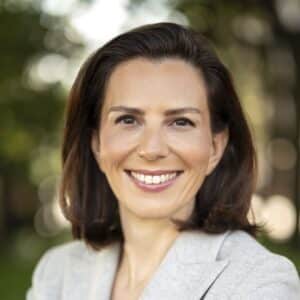
Keren Yarhi-Milo is the dean of Columbia University’s School of International and Public Affairs and the Adlai E. Stevenson Professor of International Relations. An expert in international security, crisis decision-making, and political psychology, Dean Yarhi-Milo is also an award-winning scholar with an extensive record of leadership and service at SIPA and Columbia, where she holds a professorship of political science and public and international affairs.
Before becoming dean in July 2022, Yarhi-Milo served for two years as director of SIPA’s Arnold A. Saltzman Institute of War and Peace Studies and as Arnold A. Saltzman Professor of War and Peace Studies. In that role, she launched several ambitious initiatives to elevate the School’s academic offerings and engagement with the world’s most pressing challenges. Among them is Emerging Voices in National Security and Intelligence, a program to attract and support students from underrepresented backgrounds interested in pursuing careers in those fields.
As a scholar and teacher, Yarhi-Milo bridges the academic and policy worlds, focusing predominantly on how leaders make foreign-policy decisions regarding the use of force. Her work draws on cutting-edge insights from psychology, organizational theory, and behavioral economics to explore the complicated contexts that surround decision-making, signaling, and perception in international relations. Yarhi-Milo’s research also delves into the complexities of intelligence, the role of secrecy and deception in foreign policy, and the use of face-to-face diplomacy. All of her scholarship is grounded in an ongoing dialogue with policymakers, in which ideas and approaches are challenged and refined.
In 2022, Yarhi-Milo won the International Studies Association’s Emerging Scholar Award, which recognizes “scholars who have made through their body of publications the most significant contribution to the field of security studies.” Her most recent book, Who Fights for Reputation: The Psychology of Leaders in International Conflict (Princeton, 2018) was recognized by the American Political Science Association as best book in foreign policy and by the ISA as outstanding book in foreign policy. Her previous book, Knowing the Adversary: Leaders, Intelligence, and Assessment of Intentions in International Relations (Princeton, 2014), received the Mershon Center for International Security’s Furnnis Award, given annually to an author whose first book makes an exceptional contribution to the study of national and international security, and was also co-winner of the ISA’s biennial book award in diplomatic studies.
Yarhi-Milo is a series editor of Princeton Studies in International History and Politics from Princeton University Press. She has also published extensively in academic journals, receiving honors from the American Political Science Association, the International Studies Association, and the Journal of Conflict Resolution. In 2010, her doctoral dissertation earned APSA’s Kenneth Waltz Award as best in the field of international security and arms control.
Yarhi-Milo joined the Columbia faculty in 2019 after a decade at Princeton University. She earned her PhD at the University of Pennsylvania and a BA, summa cum laude, from Columbia’s School of General Studies.
Education
- Ph.D., University of Pennsylvania
- B.A., summa cum laude, in Political Science from Columbia University
Honors and Awards
- 2022 International Studies Association’s Emerging Scholar Award
- 2016 Furnnis Award
- Co-Winner of the 2016 DPLST Book Prize