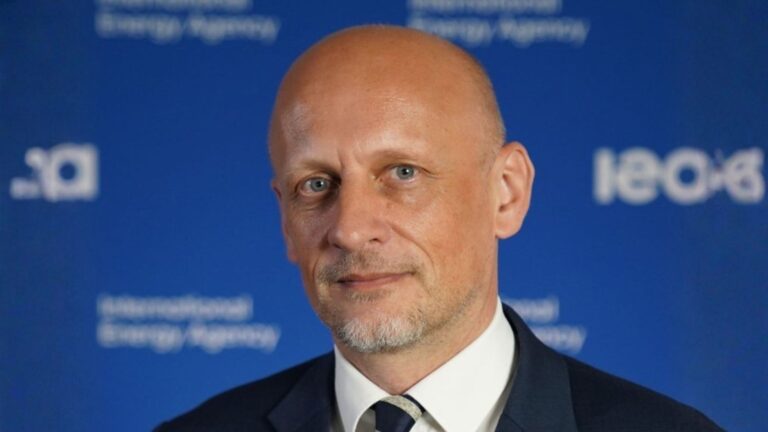
Tim Gould:
If anyone comes to you saying that there’s a single answer to affordability or security or decarbonization, be skeptical because I think one of the lessons of recent years is that you have to think about the interrelationship of lots of different moving parts.
Jason Bordoff:
The global energy system is being reshaped by powerful forces all at once. The Iran war and the disruption of shipping through the strait of Hormuz has caused the largest oil supply shock in history. War and geopolitical tensions more broadly are changing how countries think about energy security. The rise of artificial intelligence and data centers is raising new questions about how much electricity the world’s going to need and how we’re going to supply it. Affordability is at the center of political debates, even as countries face growing pressures to address climate change. Together, these forces are making the energy outlook much more uncertain with enormous implications for investment, for policy decisions, for climate change.
That’s the backdrop for this year’s World Energy Outlook from the International Energy Agency. Published annually, the outlook draws on data across fuels and technologies to explore possible futures for the global energy system and the choices that will shape them.
So how will this year’s energy crisis change the way countries balance security, affordability, and climate goals? Will it accelerate the shift toward electrification and homegrown clean energy or extend reliance on coal and other fossil fuels? How will AI and rising demand for cooling reshape electricity systems? And what will it all mean for the future of oil and gas, the expansion of renewables and nuclear, and the world’s ability to reduce emissions?
This is Columbia Energy Exchange, a weekly podcast from the Center on Global Energy Policy at Columbia University. I’m Jason Bordoff.
Today on the show, Tim Gould. Tim’s the chief economist of the International Energy Agency and along with his colleague, Laura Cozzi, co-leads the World Energy Outlook. Tim joined me to talk about the key findings of this year’s outlook during this very consequential year, how countries are responding to the crisis, the coming wave of LNG, the staying power of coal, and why cooling, not just AI, is driving electricity demand globally. I hope you enjoy our conversation.
Tim Gould, welcome to Columbia Energy Exchange once again to talk about the World Energy Outlook, must read material for those of us in the energy wonk business that just came out yesterday. Really good to see you again.
Tim Gould (02:44):
Well, thanks ever so much, Jason. It’s always a pleasure.
Jason Bordoff (02:46):
This is an audio, not a video podcast, but over my shoulder behind me, people see all of the books and hard copies of the WEO, usually signed by you and Laura Cozzi because I need them to be autographed. So I just mostly wanted to have you on the podcast to make sure I get my gift in the mail and that I can add to the collection.
Tim Gould (03:04):
Consider it then, Jason. Consider it done.
Jason Bordoff (03:07):
So let’s talk about what… There’s nothing interesting happening in the energy world. Things have been pretty boring this year, I take it.
Tim Gould (03:13):
That’s right, yes.
Jason Bordoff (03:14):
Probably found it hard to find things to talk about. We’re going to go into each of the main themes, but set the scene for everyone listening who have not read the 500 plus pages so far with what the top line messages and findings were from the world energy outlook, particularly how it might have differed from last year’s 2025 and what themes you and the team there thought were most important for the world to understand at this moment of lots of uncertainty in the energy outlook.
Tim Gould (03:43):
Well, thanks a lot, Jason. And as you can well imagine, the big theme this year was to try and determine what is the meaning for the long-term development of the energy sector of this incredibly turbulent 2026 that we’ve all seen, that we’re all still going through. An unprecedented supply shock that you’ve discussed on this program, but I mean it’s very well understood by, I’m sure your listeners. And by and large, a lot of the focus has been –
Jason Bordoff (04:15):
Just to be clear, when you say unprecedented, I mean you have charts in here several times larger than anything we have seen before.
Tim Gould (04:22):
Yeah. So if you add up the missing barrels, the lost barrels, it’s about 2.8 billion barrels worth of oil has gone missing from the system and well over 60 billion cubic meters worth of gas. And so already if we think back to where we were end of April, beginning of May, already then on the oil side, it was bigger than any disruption that we’ve seen in oil history. And you can argue about what the right metric is on the gas side, but certainly, and the drop in gas exports from the Middle East was significantly larger than anything that we’ve seen in 2022 with Russia’s cut to pipeline deliveries to Europe. So this is huge and it’s not even just about oil and gas. As you know, it’s also it’s fertilizer, it’s helium, it’s sulfur, it’s aluminum and a variety of other commodities. So the shock has been enormous.
(05:20):
The system has been quite resilient. We went into this with well-stocked inventories. We had 400 million barrels of emergency stock release from the IA member countries agreed very early on in the crisis. Some producers, particularly in the Atlantic Basin, I mean the US played a very important role there in bringing additional oil and indeed gas to market. China’s oil imports, crude oil imports were down remarkably mid-year from where they normally are, but there has been a big effect on consumers, particularly in poorer developing countries. But the focus for governments and from a lot of the analysis has been very much on how do we get out of this? What are the short-term impacts? And the purpose of the world energy outlook is to take a step back and think through what some of the longer term implications might be. Of course, all of those conclusions are tentative because we are still not out of this crisis and there’s a whole host of questions about what any kind of resolution looks like and when it will arrive.
(06:27):
But when we think about what those possible implications might be, we essentially put them in three categories, in three baskets. The first of those is a renewed focus on diversification as a central guiding principle for energy security, and that can appear in multiple dimensions. I’m sure we’ll get to some of them. A second element was particularly among the fuel importing countries, a preference at the margin for energy that you can deliver at home, homegrown energy versus imports, and that could benefit a wide variety of fuels and technologies. Renewables stand to do well. It gives a bit of an additional boost to nuclear. I think we have to think of efficiency as a homegrown resource that is untapped in many cases, but there’s also potential in some countries to look again at the domestic fossil fuel resources. And when we look at the big importers that were affected by this crisis in Asia, that obviously brings in a discussion about coal.
(07:38):
And then a third category of response is around electrification. Again, a lot of this is a sort of reinforcement of preexisting trends, and we’ve already talked for a few years in the world energy outlook about getting into this age of electricity as we’ve mentioned it, but there is a sense that this could sort of turbocharge that direction, the move towards a more electrified system as part of the strategic response to this. Two final observations. One is that the longer this lasts, the deeper those market and policy responses will be. I think a second observation which is very useful to have in mind is that whereas the sort of epicenter of the 2022 crisis was in Europe, in 2026, we really need to be looking at effects in the Middle East, but of course amongst the importers, this has been much more about Asia and particularly a lot of countries that are growing fast where energy demand is growing fast, and so their fuel and technology choices or their preferences will really be pivotal for the outlook.
Jason Bordoff (08:53):
That was a great overview and fortunately for me matches pretty closely the outline that I had sketched out to talk to you about. So that’s a good table of contents for the conversation we’ll have. The purpose of the outlook is to think long-term and as you said, take a step back, but let’s just talk for a moment about where we are right now. You talked about this disruption being several times larger than anything we’ve seen before and even back in April being larger than anything we’d seen before, and it has gone on for something like eight months and oil’s around $90. So help us understand why that is, what the problem is, and what that means for where we are. Can this be sustained? Are we kind of out of the woods now, even if the crisis and the conflict in the Middle East don’t resolve themselves anytime soon?
Tim Gould (09:44):
I don’t believe we are close to being out of the woods. I would also put forward the idea that if you are looking at the crude price as the measure of how oil markets are doing, you’re looking in the wrong place because crude has come off where it was a few weeks ago. And one of the reasons for that is there’s quite a lot of crude coming out of the Gulf now. In October, if you look at the numbers and you exclude Iran, Gulf crude exports were around 90% of where they were prior to the conflict. So we are close to pre-conflict levels for crude, but you cannot say the same thing about –
Jason Bordoff (10:28):
And just to be clear, that’s both because more ships are going through despite attacks and also the bypass routes, the combination of those things.
Tim Gould (10:35):
That’s exactly right. So it’s a combination of the bypass routes, which are open to mainly the Saudis and to the UAE, but also the fact that with US protection and ship-to-ship transfers and various other risk mitigation mechanisms, there’s quite a lot of oil coming out of the Gulf through the strait, but it is crude. So whereas that crude indicator is a 90%, if you exclude Iran, for products, it’s closer to 50%. And what we care about as consumers is products, and those product prices remain incredibly high. When you think about the product prices, it’s not just the question of the Middle East exerting pressure there. There’s been a collapse in Russian refinery runs and they’re down 30% since last year. Ukrainian attacks on Russian oil infrastructure have meant that Russian diesel exports, for example, which in former times were around 800,000 barrels a day, even north of that, are now closer to 200,000.
(11:46):
And that’s also made an important difference to balances. So I think the right measure for where we are at the moment is the product prices that we use, that we care about as consumers, and that gives quite a different picture from the crude market. One final observation is because we’re talking about damage to refineries in the case of Russia, but also to a degree in the Middle East, if you look at which refineries have been hit, by and large, it’s the big ones, it’s the big export-oriented ones. And so it will inevitably take time, even with a resolution to get all of that stuff up and running again.
Jason Bordoff (12:25):
Yeah, it’s a combination of getting the ships moving again and the economics of that and the risk calculations are a bit more complicated for product than they are for crude, large two-million-barrel crude carriers. And as you said, damage too, that I presume takes a bit longer to resolve itself. I mean, is the way to think about this situation, and tell me if this is right, I think with diesel prices in particular, even if Brent is $90 a barrel, you’re seeing the equivalent of a very high hundred, 170, 80, even $200 a barrel, what you would expect the diesel price to be based on the crude price. It’s a crude equivalent price that’s very high, running up toward $200 a barrel is the point you’re making about what we should think about when we think of a crude price.
Tim Gould (13:12):
Yeah, that’s exactly right. And I think we need to also remember that diesel, it’s the most price insensitive of the oil products because it’s just essential to economic activity. It is the sort of lubricant for all sorts of bits of the good functioning of a modern economy because it’s how you get goods around, it’s how you… Many industries rely on it, particularly extractive industries, agriculture relies on it. And so it’s a good sort of barometer for where we are in all sorts of areas of economic activity, and that means that you need very high prices in order to bring consumption down, but we are seeing consumption falling in some parts of the world, and that’s not a good sign for overall economic activity.
Jason Bordoff (13:57):
And is the way to think about the effects we’re seeing today that the world is short refining capacity or we’re kind of built for a world that has sufficient refining capacity as long as nothing goes wrong? The whole argument that we need to move from just in time to just in case, that there’s very few buffers, particularly in the product world relative to the crude world in excess inventory, spare capacity, strategic stocks. And the question, I guess, moving forward is whether people are going to want to invest in that resilience, which comes at a cost. Is that how to think about what we see in the product markets now?
Tim Gould (14:33):
Yeah, I think that’s right. The US has been flat out for some time. Many other parts of the world are sort of constrained on the refinery side. I mean, the only country that has meaningful additional refinery capacity is China, but there you run into a very complex system of refined product exports with quotas and licenses and a real prioritization for the Chinese authorities of domestic security of supply, which means that those refineries don’t respond to economic incentives from high international prices the way that you would imagine.
Jason Bordoff (15:10):
Was that an example of the risk that people turn to resource nationalism looking out for themselves? We saw China, as you said, early in the crisis, restrict refined product exports. Do you see that in the response to this crisis or this renewed concern about energy security that is going to reduce energy trade and raise costs presumably?
Tim Gould (15:33):
I think in any crisis you do see governments naturally concerned about domestic security of supply. A number of governments have intervened to restrict product exports. We saw that across different parts of Asia, but a number of other governments have intervened to try and protect their consumers in other ways by having tax holidays or other ways to keep prices as manageable as possible. But in an environment where supply is short, what that does in practice is it shifts the costs of adjustment, shifts the burden of adjustment onto someone else, and often that’s a poorer country or a poorer segment of your own country.
Jason Bordoff (16:13):
There’s often discussion about whether energy crisis leads to an acceleration of a transition, particularly in import-dependent economies, and I think the WEO shows and the IA has shown increase in deployment of projections for renewables or for electric vehicles. I’m wondering, you have in this year’s WEO, an estimate of decline in demand of around 2.6, 2.7 million barrels a day, so that’s around 2.5% of global oil demand. And that seems small relative to the scale, obviously, of transition and decarbonization that’s needed. So I’m wondering how you think about, you take the largest ever supply shock by several times, and all the debates we’re having in the United States now about permitting reform and whether strategies are effective that try to prevent oil and gas supply from coming to market, you take a straight responsible for 20% of the world’s oil supply, close much of it, not all of it, for nearly the entire year, and you’d see a decline in global demand of about 2.5%.
(17:22):
Should that make people skeptical that energy crisis and high prices can really drive a faster transition?
Tim Gould (17:29):
I don’t think in general terms we should be thinking about transition as something that’s driven by crisis because that’s not a way of managing a structural systemic change, but it can incentivize some of the longer-term things that will change the way that we meet our demand for energy services. And there have been examples of strategic choices that have played out well for certain countries and are going to come back to China because China’s been at the forefront of the electric mobility, not just for cars, but also for trucks and buses and two and three wheelers, and that took, in our view, about 1.5 million barrels a day off their 2026 oil demand. So that’s not something that you can call on an emergency situation, but it’s something that’s happened over time that has eased strains on the Chinese system. And I think a number of other countries are also looking at how they could change the structure of their energy consumption in ways that give them some insulation against these kinds of shocks.
(18:36):
And that’s why when you look at the policy announcements that have been made in many parts of the world, but I think it’s worth particularly focusing on Asia, they have been in the direction of the sorts of things I was talking about before, a focus more on domestically available energy versus imports and a focus on can we speed up that process of electrification in different parts of the economy, but mobility is certainly one of them.
Jason Bordoff (19:06):
And you have several scenarios as the WEO always does. There’s kind of two main baseline ones that we can get into, the current policy and stated policy. Are you describing… There’s another one called, what does ARC stand for? Additional response case. Is that kind of what you’re talking about now? Countries have said, “Here are a bunch of things we’re going to do to deal with energy security. If they do those things, what does the world look like?” Is that what we’re describing?
Tim Gould (19:37):
Yeah, I think that’s exactly it. And let me give you an example if we stick in Southeast Asia. So in the stated policy scenario, we have things like in Thailand, there was a revision to their long-term power development plan, and that’s come through in the course of the year. It’s still revised. They’re hoping to adopt it before year end. But the way it looks at the moment, you have a bit of additional gas, but less than in the previous version. You have a bigger push for renewables, and over the longer term, you have hopes and plans for nuclear as well. And so that would be incorporated then into the stated policy scenario. And then you have other announcements. I’ll take as an example, perhaps Indonesia announced a very ambitious hundred-gigawatt plan for solar. That’s not part of their formal power planning process as yet, but it’s an indication of a desire to develop a domestic resource in response to this crisis.
(20:41):
And I think those two give an indication of the direction of travel. And so that hundred-gigawatt target is something that we would look at in this additional response case. So it’s based on things that governments are announcing or are considering putting together where we can see clear signs of that. And it gives a sense of what more could change, particularly if the disruption lasts for longer.
Jason Bordoff (21:05):
Relative to last year’s outlook in say those two baseline scenarios, what were the biggest changes this year relative to last year? What looks very different, if anything, around AI, around the outlook for renewables, around something else?
Tim Gould (21:20):
Yeah, I think this is one where there’s been some comment in the last… Well, since we published, saying, “Well, look at those two scenarios, not much has changed.” But I think you have to dig in a little bit to see where those changes have taken place. So for example, oil and gas demand in the stated policy scenario are not a million miles away from where they were last year. But if you look at countries like India or Southeast Asia, oil and gas demand are up to 15% lower in the comparable scenario this year than they were, but that’s compensated by developments elsewhere. So some other countries, including energy exporters, use a bit more, and then there is the effect of AI related demand, which has pushed up consumption in different ways across the energy system as a whole. So you have some compensating effects, and you don’t necessarily see the full picture just by looking at the global numbers.
Jason Bordoff (22:22):
That’s really interesting. And talk a little bit just again about that additional response case, the focus on energy security, geopolitical conflict. Megan and I, as you know, have written about how that could cause countries to look to reduce imports, countries want to produce more energy within their domestic borders. That might be a push for electrification. Again, as you said before, that could be zero carbon, it could be coal. We can come back to that in a minute. But what does it do to the cost of the global energy system? This all seems quite inflationary if everybody tries to do everything themselves.
Tim Gould (22:55):
So there’s two parts to that. I mean, the first, what happens to global oil and gas demand in that world of the additional response case? So that’s a world, let’s be clear, where the uncertainty doesn’t get resolved quickly and you have these sort of persistent tail of risks affecting oil and gas supply. And there, by 2035, oil imports to countries around the world are around five million barrels a day lower than in the STEPS, which effectively means around five million barrels a day lower than 2025. And you have also a 300 billion cubic meter hit to gas demand. I think in both of those cases, you can draw a direct line between the shock and the effect because that’s all related to efforts by those countries to reduce their reliance on imports where they can.
Jason Bordoff (23:58):
Can you just quickly remind people the high-level difference between STEPS and CPS since bringing back the current policy scenario got a lot of attention last year, and I’m referring to two baseline scenarios. There’s some differences between them. Just remind people how the IA thinks about the differences in terms of the assumptions. I don’t mean the outcome, but what’s different about them?
Tim Gould (24:20):
I mean, the essence of it is that in the current policy scenario, you have a slower pace of electric mobility. So the force is pushing oil up, particularly in petrochemicals, in aviation, in shipping, and they kind of dominate the long-term trend, and that pushes us up to around 106 million barrels a day in 2035. The opposite end of the scale is the ARC. It’s almost a 10 million barrel a day variation in outcomes for 2035 between CPS and ARC. So the ARC would get you down to about 97 by pushing harder on these levers, the ones we’ve discussed, efficiency, electrification, and so on.
Jason Bordoff (25:15):
But sorry, just in terms of what is different about stated policies, that assumes countries that have said they will do things, do things, but these are not just vague promises like we should be net zero by 2050. It’s specific policies on the books that have been committed to, but maybe not implemented, just so people understand the difference between the two scenarios.
Tim Gould (25:35):
Jason, you know us very well, and it’s a very accurate description of what the stated policy scenario does.
Jason Bordoff (25:41):
I ask because I was sort of struck, tell me if this is a fair reading, about this question I was asking about whether energy crisis and energy security concerns can be a force that mobilizes a faster transition. That’s something that’s much discussed now. I think the numbers I saw were that emissions in 2035 were 6% lower. They were about flat in the current policy scenario, maybe they rose a little bit, decline of 6% in the next decade in stated policy and decline of 9% in the ARC, what you said, additional response case, which kind of tells me policy matters a lot, maybe more than all of these concerns about energy security. And again, the energy security concerns cut in both ways. You get more electrification, some renewable, some nuclear, but also some coal. Is that a fair reading? Being worried about energy security can help further a transition, but we’re going to need a lot of policy and this does not do anything close to what we need to do by itself.
Tim Gould (26:38):
Yeah, I think that’s exactly right. In our view, the alignment, particularly in fuel importing countries between security and transition objectives has never been stronger. But remember that fuel importing countries, that’s around 60% of global emissions. So on their own, they don’t determine all of the global trajectory, but there are also these countervailing tendencies, as you’ve pointed out, that when you are talking about a bias towards domestically available resources, that’s not automatically a low emission source. It’s predominantly one which favors renewables and nuclear, but we do have slightly higher coal in this ARC, the additional response case compared with STEPS. And that reverses the normal order of things in a sense. ARC is gas and oil lower, but coal slightly higher.
Jason Bordoff (27:39):
And the outlook for renewables, talk about that because the IEA sometimes gets criticized by people for being too conservative and projecting kind of flat equivalent amounts, not growing amounts year on year. I think I saw in the WEO or the renewables report that total amount of renewables deployed this year is lower than last year globally.
Tim Gould (27:59):
That’s right. And that has a lot to do with what’s going on in China. China introduced a new business model for bringing renewables into the system, into the power system, exposing project developers to a lot more merchant risk, and that’s meant a very significant reduction year-on-year in renewable deployment, almost like 50% down in terms of solar for the first nine months of the year. And China has been the force that’s pushed up renewables deployment globally. And so when it has a correction of that magnitude, it has a huge implication then for the global trend. But there are countervailing tendencies there as well. And what we’re observing is that in many other emerging developing economies, you’re seeing quite powerful growth, often from a relatively low base. So again, on the global aggregates, it doesn’t make a massive difference, but on a country level, you’re seeing some very significant pickups in deployment across many parts of Asia and Africa.
(29:02):
And you can see in the data already for 2026, a very large increase in imports of solar PV and batteries for many parts of Africa and Asia, which suggests alongside those EV sales numbers, which have also picked up, that from a consumer perspective, if you can do something now to, in sense, protect yourself against these high prices, and then consumers are in a way taking matters into their own hands, installing more rooftop solar, installing more batteries, and where they have the means to do so, going electric on mobility as well.
Jason Bordoff (29:43):
So you see strong renewables growth in most of the world, but a sharp pullback in China because of a change in policy there, and China’s just so large that it swamps global numbers. Is that accurate? And then do you see that reversing or is this kind of a… Long-term trend where the outlook for renewables is significantly diminished in China.
Tim Gould (30:05):
So China picks up again in our projections, but it doesn’t get back onto that very rapid year-on-year growth trajectory that we’ve seen in recent years. But overall, you have a big increase in the role of renewables in the energy system. So right now, if you take the global number, renewables is about 33% of global electricity generation. So in the CPS and STEPS, it gets up to 45, 50%, and then even higher in ARC. So that gives you a sense of the very significant continued growth in that source of generation.
Jason Bordoff (30:44):
So that’s the story for renewables. Talk about the outlook for global gas demand. What’s the IEA view on whether this big glut in LNG is coming and how do concerns about energy security affect that? I presume the more concern there is with energy security, the more concerned there may be about dependence on a global LNG market, but what’s the gas outlook?
Tim Gould (31:08):
So right now, gas markets are tight and there’s significant uncertainty over when the supplies from the Middle East will pick up. But the big question that we’ve talked about in the WEO for a few years, but also it’s in your own question just now is what happens to that massive wave of new LNG export capacity that has already been approved for development? So in our view over the next few years, there’s around 350 billion cubic meters worth of annualized LNG export capacity growth, and that’s adding about 50% to the total LNG market. That’s huge. We’ve had very strong growth over the last 10 years as well, but a lot of that was absorbed by Europe as it switched across from Russian pipeline gas and quite a lot was absorbed by China. But that next big wave of LNG growth is going to require a lot of new LNG customers in Asia, particularly outside China, in India and Southeast Asia.
(32:11):
And that’s where we start to look very carefully at what the implications of this crisis might be. In the STEPS, we do assume that by the end of next year, there’s unimpeded transit through the Strait of Hormuz. LNG demand picks up readily and you have a relatively small surplus of LNG that we can’t find a home for, but there’s pretty strong growth, continued growth in LNG trade in that scenario. It’s only in the CPS that we use all of that new LNG coming to market. But then there’s an open question about what happens as a result of the renewed turmoil in gas markets, the second quite sizable gas crisis within five years. And the way that we framed it in the outlook is to look at some of the infrastructure decisions that will be needed. And because if that LNG is going to be absorbed in some of these new markets in Asia, you will need to build new re-gas terminals, you will need to build new pipelines, you’ll need to find new consumers that will be using all of that gas.
(33:21):
And the current uncertainty doesn’t really help to move those decisions along. And so it becomes a sort of timing issue. That new LNG has been approved, it’s going ahead, but around half of the new markets for that LNG do require infrastructure to be built to absorb it properly. And so the question we ask is if that infrastructure doesn’t get built, so if there’s a hesitation about building that out now, that would only add to the surplus that we might see in markets. And in part, that means that this new LNG wave might pass some countries by, at least in part.
Jason Bordoff (34:04):
In every WEO scenario, coal demand declines, I believe. And people have been hearing about peak coal for a long time and this year coal demand is increasing again. How should people understand the outlook for coal and what’s the potential for coal to demand to be maybe stickier and stay with us longer than some people may think or hope?
Tim Gould (34:28):
I think that’s really what we’re looking at in the ARC as well. And I think that’s the right word to describe it. It does stick around for longer. In a world that’s concerned about energy security, you don’t want to move assets out of the system that could be useful in an emergency. And so we do see that that’s a feature of our scenarios. And there are some growth markets in our exploratory scenarios for coal, India to a degree, but also parts of Southeast Asia. But I think the key to the global trajectory is what happens in China because China more so than any other product, any other market in the world, coal is really such a huge part of the Chinese energy system. And the converse is also true. Chinese demand is 55% of global demand. And the build out that we see, even with all of the caveats that we’ve talked about, the build out that we see of renewables and nuclear in China is strong enough that coal shifts its position within the Chinese system and moves more towards a flexibility play rather than the bedrock of the system, which is what it’s been up until now.
(35:43):
And that has an implication then for the global trajectory and pushes it into decline in our view.
Jason Bordoff (35:50):
And if people were looking for ways to dent coal demand, we were just talking about gas demand for example, and where all this LNG is going to go. And if I remember the WEO correctly, read it yesterday, last night, the IEA estimates around 300 BCM of natural gas demand could be unlocked through coal to gas switching that makes economic sense. And I could imagine gas producers saying great, but some people might say, why are we doing gas? Why don’t we use renewables? Why don’t we find zero carbon ways to dent coal demand? How do you think about substitution? How should the listeners here think about it? Is that the right way to think about it or is there issues with intermittency? You can only scale solar supply chains so quickly. Obviously gas and coal are used not only for electricity generation, which is what renewables are mostly used for.
(36:42):
How big a role would gas need to play versus zero carbon forms of energy to change and dent that coal demand outlook?
Tim Gould (36:50):
I think that’s exactly the question that many are asking in developing economies in Asia. What’s the right mix for a secure electricity system? And I think gas does have an important role there because if you are looking for security in your system, you have to have a combination of sources of electricity with different attributes that enable you to produce reliable power at all times. And I think that dispatchable nature of gas is a real asset in that sense. Coal is also a dispatchable resource, so it’s not as if that is a clinching argument for gas in itself. So it really comes down to strategic choices, price, confidence in the ready availability of that imported source. But if you look at our scenarios and how they’ve evolved over time, I think there is a shift in the way that countries look at the gas in their system.
(38:00):
When you’re in Southeast Asia, you are thinking about your future energy mix, you’re making long-term commitments to gas infrastructure in many cases. And I think those commitments are subject to more questions now than they perhaps were a few years ago.
Jason Bordoff (38:19):
Can you say more about how this whole conversation looks from emerging and developing economies? As you said earlier, those are the countries … We’ve balanced the shock of this year on the backs of the most vulnerable countries. I think it’s fair to say. Tell me if you disagree. And when you think about security, the cost premium that a country can pay for resilience, for buffers, for domestic capacity, this looks a lot more challenging in lower- and middle-income countries. How does the outlook feel in those countries right now?
Tim Gould (38:53):
I mean, I think you’ve characterized it very well because affordability is a massive concern, but also this sense that those energy needs are going to grow very fast for all sorts of reasons because they’re building out national infrastructure because incomes are rising and many developing economies are now just approaching that level of per capita income where appliance ownership and vehicle ownership rise quite rapidly. So you have the prospect of a very significant increase in demand for energy services. So you are always kind of running to keep up with the needs of your societies. And then on top of that, you have a crisis which calls into question some of the things that you kind of baked in to your vision of how you meet your future needs. Because in many parts of Asia in particular, oil and gas imports were looking to increase quite dramatically.
(39:53):
So it is a proper shock to the system for that way of looking at the world. And there’s an additional element too, because you could say that that inevitably pushes countries more towards an electrified system, and that’s indeed what we think will happen, but that’s a very capital-intensive option. You have to spend a lot upfront. Down the road, you get savings because you don’t have recurring fuel costs in many cases for renewables and so on. But upfront you have to pay a bit more. And if we’re in a world of higher interest rates and a higher cost of capital, that makes those choices a bit more difficult. But when we come to the bottom line I think is that relative to where we were before the crisis, many countries are just looking to what they have at home. And with the costs of renewables being where they are, that becomes the sort of default technology choice for a more electrified system.
(40:52):
It’s not the only choice that you will need, but it has a much more prominent position in national strategies now than I think it did a little while ago.
Jason Bordoff (41:01):
You and your colleagues like Fatih Birol have talked a lot about entering the age of electrification. Electricity demand is growing much faster than total energy demand. Help us understand why that is happening, what the drivers are. I presume that gets a boost also from energy security concerns.
Tim Gould (41:20):
Yeah. In our view, that’s a preexisting trend that gets reinforced by this crisis. So it’s already been the case in recent years that electricity demand is growing twice as fast as overall energy demand. And that’s a number of drivers there. If you are an industrializing economy, you’ve got electric motors, you’ve all got all sorts of electric equipment that goes into particularly light manufacturing. Of course, you’ve got the contribution of data centers. But on the consumer side, you’ve got that growth in appliances and huge growth in demand for cooling. Cooling’s one of the fastest growing end uses for electricity. And it remains the case that if you look outside China, 85% of emerging developing economies outside China face high temperatures, indeed rising temperatures, but only 20% of households have air conditioning. And so you can imagine that that’s going to be a really important part of the electricity mix going forward.
(42:24):
And indeed in our projections in about 10 years’ time, cooling is 12% of overall electricity demand, but it’s something like 30% of peak electricity demand. And so if you have heat waves, if you have very hot periods in a country, and that can lead to enormous strains on the system. So you need to be building in some additional resilience to cope with that.
Jason Bordoff (42:49):
So big discussion say here in the US about AI and data centers, but globally there are many other drivers that are bigger sources of growth and electricity demand than the AI revolution, it sounds like.
Tim Gould (43:02):
I mean, it’s very big in certain countries and the US is of course one of them. Data center electricity demand in our view, that’s slightly over half of the growth in electricity demand in the US to 2030. And within the US, as you know very well, these data centers tend to cluster, so they have very strong local effects, but 80% of the data centers that we think are going to be built between now and 2030 are either in the US or in China or in Europe. So we shouldn’t generalize too much from the discussions that are rightly being had in some of those jurisdictions to the world, putting a couple of numbers on it. Right now, data center electricity demand is about 500 terawatt hours. So that’s half of Japan and it’ll go up to 1,000 terawatt hours, which is equivalent to Japan’s current consumption.
(44:00):
That’s from something like one and a half percent of global electricity demand to something close to three. It’s big, but we need to put that discussion in context.
Jason Bordoff (44:16):
And the IEA sees most of that growth, am I right, in power demand being met by renewables? Enhanced energy security concerns might bolster the case for renewables. How should we think about whether the electricity system can handle it? There’s often language in the WEO that in order to realize this outlook, other things have to happen. I mentioned permitting reform before. How do we better manage the grid? A few years ago, the IEA said flexibility is the new watchword of energy security. I’m wondering if there are assumptions kind of baked in to that strong outlook for renewables that people maybe should keep it more front of mind and say, “You know what? I should have a little caution or skepticism for some of those strong renewable outlooks because they depend on things that are technically possible, but we’re not doing a great job of doing so far.”
Tim Gould (45:10):
I mean that cuts both ways. And if you start from the data center example, in our view, about half of the additional data center demand is going to come from renewables. A big additional chunk is going to come from natural gas. But if you need to put in place new generation quickly, what are your options right now? If you start ordering today a new gas turbine, you’re going to be quoted to delivery sometime in the early 2030s. The similar sort of thing for a transformer for grids, if you want to put in place new power relatively quickly, solar plus batteries, put some wind in there, there are other renewable options that can be turned around quite quickly. Those are the ones that deliver most rapidly. So I think that’s one of the reasons why we see robust growth also in the United States for some of those technologies.
(46:13):
You’re in a world where electricity demand is rising again, and if you want to mobilize new power quickly, then you are going to be looking at some of the technologies that have relatively quick delivery times.
Jason Bordoff (46:24):
For the last more than a decade, one of the biggest factors shaping the global energy outlook has been this shale revolution, growth from five million barrels a day to nearly 15 in the United States, just stunning year-on-year growth. Those days may be close to over, most projections show. How would a plateauing of US oil, probably not gas, but let’s say oil production in the US, what does that mean for global oil markets, for supply and investments elsewhere, for the outlook for oil markets?
Tim Gould (46:58):
So we believe that there’s a good few more years growth in US oil demand before it plateaus. And as you say –
Jason Bordoff (47:08):
Production, you mean?
Tim Gould (47:09):
Production, sorry.
Jason Bordoff (47:09):
Yeah.
Tim Gould (47:12):
And a considerable perspective beyond that for gas, again, depending on where global demand and demand in the US is. Overall, what does it mean? There is quite a buoyant outlook for oil supply from the Americas. So we’ve talked about the America’s quintet of Canada, the US, Guyana, Brazil, Argentina. I think within a few years we’ll need to add Venezuela to that. There’s a lot more oil coming out of the Americas. And for a while, that pushes back the share of other countries, including OPEC production, which has been reduced further by the departure of the UAE. And that lasts for about the next 10 years, depending on which scenario we’re in. But after that, it does start to tail off and if demand remains high, then you do start to rely more on some of the established producers elsewhere. And so the share of the Middle East and the share of OPEC starts creeping up again.
Jason Bordoff (48:18):
And your outlook in the WEO is pretty bullish on nuclear energy, is that right?
Tim Gould (48:22):
We think that there’s good reasons for that. There’s 90 gigawatts currently under construction, which is the largest amount that we’ve seen for four decades or so. There’s a lot of other countries that are either in the process of building or looking with interest at how nuclear could be part of their future electricity mix. So we think that there’s a significant potential for nuclear generation, not just to hold its share in the electricity generation mix, which is currently around 9%, but even to increase faster than overall global energy demand, which would mean that you start to see it ticking up towards 10, 11, 12 in some scenarios. So yes, we think there’s a lot of countries are taking a fresh look at this and it’s both traditional technologies and of course also the small modular reactors that are now sort of actively under development, although we’ll need to wait until the early 2030s before we really see how the costs and the performance of these projects plays out.
Jason Bordoff (49:28):
And what other next generation technologies should listeners pay particular attention to in the outlook next generation geothermal or storage or a couple years ago we probably would’ve been talking more about green hydrogen and ammonia in this conversation than we are now, which have a stronger outlook and maybe which don’t?
Tim Gould (49:45):
So broadly speaking, the technologies that are doing well are the electrified ones, the electrification related ones. Those are the ones where we have the largest suite of cost competitive technologies. I think the challenge though has shifted somewhat from where we were a few years ago. I think there was a focus on getting new sources of generation into the mix as quickly as possible. I mean, low emission sources of generation. I think what people are talking about much more now is what combination of actions, what combination of grids, storage, AI related technologies plus generation will allow us to use those resources as cost effectively as possible because I think the affordability angle is so important right now in many countries in the world. So what does that mean for technologies? I think advanced geothermal certainly has a role, all sorts of storage technologies. But I think that the area which we need to watch most closely is the technologies that help us tie everything together, the technologies that help us to optimize the work of that more electrified system.
(50:54):
Where we are seeing slower progress is on some of the clean fuels, as you mentioned. Our expectation for low emissions hydrogen for 2030 is being sort of steadily downgraded every year as projects don’t take final investment decision and other projects move ahead more slowly than they had hoped. So whereas we do a thing called the Global Hydrogen Review every year.
(51:26):
Last year we anticipated that in 2030 we might have about 10 million tons of low emissions hydrogen compared with less than one today. Now our best guess, our best estimate, our forecast is that it’s going to be more like six million tons. So we’re steadily dialing back. That’s still pretty impressive growth, but it’s not anything like what we had before.
Jason Bordoff (51:51):
And just for people listening, thinking about particularly the energy transition and how to decarbonize, it’s a big deal because we talk a lot about the growth in solar and wind, the age of electrification, but even the COP in Turkey right now, I think the goal, the ambitious stretch goal, we don’t have a great history of achieving our COP goals unfortunately, is 35% of the global energy system being electrified in a decade. That’s around 22 or 23% today. So that’s big growth, but I mean 65% would not be. And fuels matter a lot, I guess is the point I’m making. So we have a lot of work to do there if we really want to think about decarbonization goals seriously, right?
Tim Gould (52:30):
I think that’s right. I mean, you can have a legitimate debate about how much of the future energy demand can be met by electricity. That 23% is a little bit misleading just because electricity tends to be much more efficient in its delivery of energy services than fuels. So if you look at the sort of services associated with that 23%, it’s actually significantly higher. But the point remains, you can’t electrify everything. And I think there’s a very important insight there from your question, Jason, because if you look at the shares of low emissions technologies in electricity generation, right now, if I said renewables is around 33%, you add in nuclear, get to 42%. By 2035, we might be up at 60%, but look at what the numbers are, the comparable numbers for low emissions fuels. Right now, low emissions fuels in the total supply is around 8% and by 2035, based on what we can see today, it might get up to 10%.
(53:41):
So you have a real two-speed field to the way that the energy system is developing from a transition perspective where electrification is moving ahead. I mean, of course there’s open questions there about building out the infrastructure and getting it to work effectively, but that path is in a way reinforced by the crisis, by the worries about energy security. You can’t yet say the same thing about the outlook for low emissions fuels.
Jason Bordoff (54:10):
And it’s worth also remembering, of course, that electrification is a more efficient use of primary energy. So there’s that factor too, but the broader point about fuels is still important. Lastly, and I hate to keep it to last because people forget about it, but at least we’re not forgetting about it. We’re mentioning it and asking about it. Energy efficiency, as you know, is often the sort of forgotten fuel. Talk a little bit about what the WEO shows can be done. What do you project will be done to use energy more efficiently?
Tim Gould (54:40):
So we will continue to bang this drum for as long as we can, that there is a huge potential still to use energy more efficiently. Electrification, as you pointed out just now, is a part of that because electrification is inherently more efficient than fuel consumption as a way of delivering energy services. But just to give you an illustration of what we can do with a greater focus on efficiency. So over the last 10 years, the improvements in efficiency, just of the stuff that we have at home, fridges, other white goods, appliances, that saved us around 600 terawatt hours each year of electricity. That’s more than all of the data center consumption that the world has right now. So it’s a really important untapped resource, and there’s much more that we could be doing cost-effectively in the future as well. In our view, we’re going to see a somewhat artificial pickup in the improvement in the energy intensity of the global economy this year because essentially the economy has continued to expand, but overall energy demand is likely to be flat, but that’s not an indication of a strong structural trend.
(56:04):
We really need to do more both on the electrification side and improving technical efficiency in order to get that intensity indicator, not just improving by 3% in a crisis year, but improving along those lines in a regular year as well.
Jason Bordoff (56:19):
And in closing, I know the IA is cautious about being too prescriptive with policy advice, but you talk to policymakers a lot. We have 20 or 30 people about to run for president in this country. We are a policy center. So what would you tell policymakers to keep in mind as they think about good energy policy based on what you found in this year’s WEO?
Tim Gould (56:43):
It’s a complex system. And if anyone comes to you saying that there’s a single answer to affordability or security or decarbonization, be skeptical because I think one of the lessons of recent years is that you have to think about the interrelationship of lots of different moving parts. So if you’re just putting low emissions generation into a system, you’re likely to end up with some of the things that we’re already seeing. So inefficient use of that resource, curtailment, negative prices, all sorts of things that you don’t want to see necessarily in the system. And so make sure that you are having a balance across different pieces of the puzzle. And that’s why your permitting reform remark is so important because that’s a big part of our ability to build out in a balanced way that safeguards the interests of consumers. The other thing I would say is be very wary about the increasing risks to infrastructure.
(57:44):
And I mean here extreme weather events, but I also mean sort of malicious interventions. We’re seeing a big increase in cyber-attacks. If your energy system is vulnerable, then your economy is vulnerable, your security is vulnerable. So make sure you’re paying sufficient attention to the ways in which that system can be disrupted.
Jason Bordoff (58:05):
It’s a complex system. It is a complex time politically, geopolitically, technologically, AI revolution. And the work you and your colleagues do, for those of us who are trying to understand the energy system is enormously helpful. So thanks Tim to you and Laura Cozzi and Fatih and the whole team over there for the work on this WEO and all the work you do every day. And thanks for making time to explain it to us today.
Tim Gould (58:29):
It’s always an enormous pleasure, Jason. Thanks so much.
Jason Bordoff (58:36):
Thank you again, Tim Gould, and thanks to all of you for listening to this week’s episode of Columbia Energy Exchange. The show is brought to you by the Center on Global Energy Policy at Columbia University. The show is hosted by me, Jason Bordoff, and by Bill Loveless. Mary Catherine O’Connor, Dara Diamond, and Kyu Lee produced the show. Gregory Vilfranc engineered the show.
(58:56):
For more information about the podcast or the Center on Global Energy Policy, visit us online at energypolicy.columbia.edu or follow us on social media @ColumbiaUenergy. And if you have a question about something you heard on the show, you want to share an idea for a future guest or a topic, email us at [email protected]. And please, if you feel inclined, give us a rating on Apple or Spotify or wherever you get your podcasts. It really does help us out. Thanks again for listening. We’ll see you next week.