Trump promoted fossil fuels. His war is pushing the world away from them.
As oil prices spike, governments are slashing fuel use and eyeing renewables — threatening to erode global demand for fossil energy.
This website uses cookies as well as similar tools and technologies to understand visitors’ experiences. By continuing to use this website, you consent to Columbia University’s usage of cookies and similar technologies, in accordance with the Columbia University Website Cookie Notice.
Our work is committed to independent and nonpartisan research that meets the high standards of academic integrity and quality at Columbia University.
Our initiatives and programs are designed to address critical needs in key focus areas around energy and climate policy.
Explore our expert insights and analysis in leading energy and climate news stories.
As oil prices spike, governments are slashing fuel use and eyeing renewables — threatening to erode global demand for fossil energy.
Get the latest as our experts share their insights on global energy policy.
On February 28, the US and Israel launched new attacks on Iran targeting primarily the country's leadership, security forces, and missile program.
Hear in-depth conversations with the world’s top energy and climate leaders from government, business, academia, and civil society.
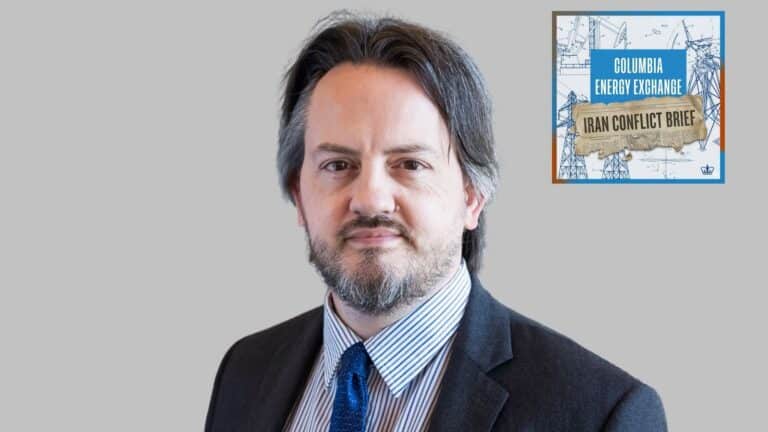
While US and Israeli forces have significantly degraded Iran’s military and nuclear capability, the global energy landscape remains in a precarious position. For weeks, the Strait of Hormuz...
Find out more about our upcoming and past events.
This roundtable is open only to currently enrolled Columbia University students. To register, you must sign in with your UNI. Join the Center on Global Energy Policy’s Women...
We are the premier hub and policy institution for global energy thought leadership. Energy impacts every element of our lives, and our trusted fact-based research informs the decisions that affect all of us.
Arthur D. Storke Professor and Chair of the Department of Earth & Environmental Sciences
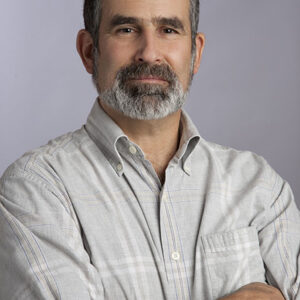
Peter Kelemen is Arthur D. Storke Professor and Chair of the Department of Earth & Environmental Sciences at Columbia University. He was recently elected to the National Academy of Sciences, and is a Fellow of the American Geophysical Union, the Mineralogical Society of America, and the Geochemical Society. He studies the chemical and physical processes of reaction between fluids and rocks. He has worked on the genesis and evolution of oceanic and continental crust, chemical cycles in subduction zones, and new mechanisms for earthquake initiation. His primary focus now is on geologic capture and storage of CO2 (CCS), and reaction-driven cracking processes in natural and engineered settings, with application to CCS, geothermal power generation, hydrocarbon extraction, and in situ mining. He teaches a popular course on “Earth Resources for Sustainable Development” at Columbia, as well as courses and seminars on petrology, geochemistry, and geodynamics. Kelemen was a founding partner of Dihedral Exploration (1980-1992), consultants specializing in exploration for mineral deposits in steep terrain, with contracts in Canada, Alaska and Greenland. Research and climbing have taken him to Peru, India, Oman, the Aleutian Islands, 7,500 meters above sea level in Pakistan, and 5,500 meters below sea level via submersibles along the Mid-Atlantic Ridge. He received his AB from Dartmouth College in 1980, and his PhD from the University of Washington in 1987. He spent 16 years at the Woods Hole Oceanographic Institution before moving to Columbia’s Lamont Doherty Earth Observatory in 2004.
Get the latest news and research on energy & climate policy.
"(required)" indicates required fields