Bipartisan Senate group urges Trump to abandon plan to buy Russian diesel amid Ukraine war
A bipartisan group of six senators is urging President Donald Trump’s administration to abandon a plan to purchase diesel from Russia.
Get the latest as our experts share their insights on global energy policy.
Mandatory application review by the Advisory Committee on Reactor Safeguards (ACRS) reflects an earlier era, when the nuclear regulator lacked today’s permanent technical staff and nuclear promotion was...

Hear in-depth conversations with the world’s top energy and climate leaders from government, business, academia, and civil society.
Carbon credit markets have become one of the most hotly debated tools in the fight against climate change. Supporters call them essential to closing the gap between corporate...
Find out more about our upcoming and past events.
The Center on Global Energy Policy at Columbia University SIPA’s Women in Energy initiative invites Columbia University students to a roundtable discussion with Pam Brown, Managing Director at...

Past Event
February 16, 2026 - February 18, 2026
1:00 pm - 2:00 pm est
This workshop will be conducted in two parts: Part one on February 16 from 1:00 PM to 2:00 PM EST, and Part two on February 18 from 1:00 PM to 2:00 PM EST. By signing up, you agree to attend both sessions.
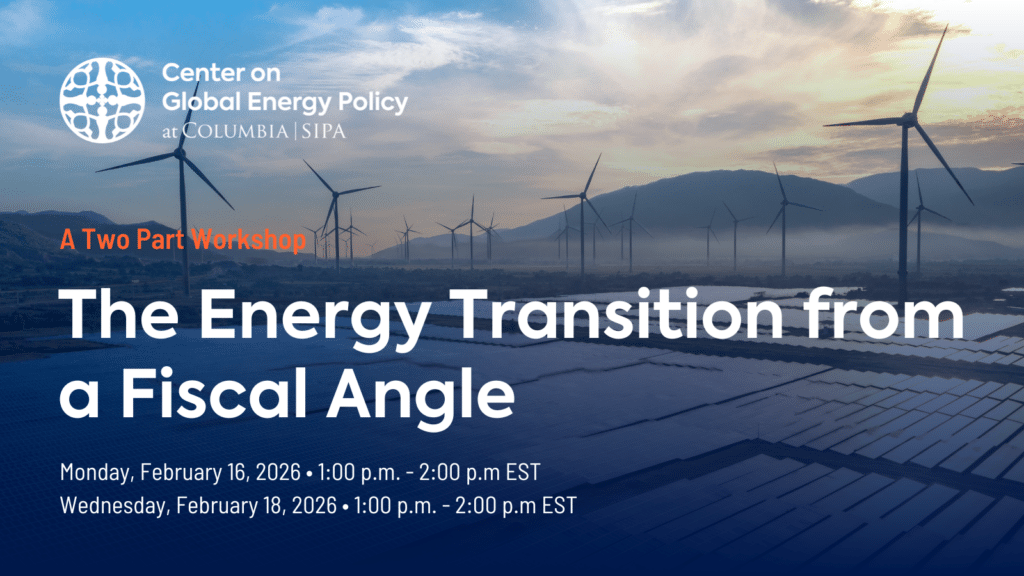
Please join the Center on Global Energy Policy at Columbia SIPA for a two-part workshop hosted by Diego Mesa Puyo. The focus will center on the current state of global greenhouse gas (GHG) emissions in relation to the collective climate goals set forth in the Paris Agreement, including recent developments from COP30. The discussion will be divided into two parts.
The first part of the workshop will take stock of the current state of greenhouse gas emissions globally against the collective climate goals set for in the Paris Agreement, including recent Nationally Determined Contribution (NDC) commitments submitted at COP30 in Belem, including transitioning away from fossil fuels in energy systems, phasing down unabated coal, phasing out inefficient fossil fuel subsidies and tripling renewables. We will look at emissions by sectors, countries, and type of GHG to have a clear picture of the mitigation challenge the world faces. We will then review existing emissions levels and projections out to 2035 under existing policies and NDC pledges, highlighting ambition gaps.
The second part of the workshop will at both the progress made in renewable and other clean technologies in recent years, as well as the financing requirements to decarbonize different sectors of the economy and achieve net-zero in 2050. We will discuss the dynamics of investment in clean energy and technologies against investment in fossil fuels, with a focus on emerging markets and developing economies and the role of private capital in the energy transition space.
Finally, the workshop will discuss fiscal policy options to address the mitigation challenge. We will discuss economy-wide policies, including carbon pricing and the removal of inefficient fossil fuel subsidies. The workshop will also look at sectoral and complementary policies and evaluate their efficiency in terms of climate and fiscal effectiveness. If there is time, we will also do a brief deep dive into the policies introduced in Colombia in 2018-2022 that allow the country to scale-up the installed capacity of large-scale solar PV and wind projects, and to develop low-emissions hydrogen and offshore wind roadmaps.
Registration is required. This workshop is open only to currently enrolled Columbia University students. To register, you must use the email address that contains your UNI.
This event will be hosted in person, and capacity is limited. We ask that you register only if you can attend this event for both sessions.
For more information about the event, please contact [email protected].
The Columbia Global Energy Summit 2026 is an annual event dedicated to thought-provoking discussions around the critical energy and climate challenges facing the global community.
On October 22, the United States Department of the Treasury announced the imposition of sanctions on Russia’s two largest oil companies, Rosneft and Lukoil, as a penalty for what it characterized as a lack of Russian commitment to ending the war in Ukraine.

*Registration is closed for this event. The Center on Global Energy Policy at Columbia University SIPA's Women in Energy initiative, in collaboration with the Columbia Policy Institute, invites...

Energy finance is transforming rapidly amid shifting political and economic dynamics in the U.S. and globally. As the landscape becomes increasingly complex, we will explore key legal insights,...
Project-based carbon credit markets (PCCMs) facilitate the generation, trading, and retirement of carbon credits from projects that remove, reduce, or avoid greenhouse gas emissions.

The World Bank is revisiting one of its most entrenched positions, publicly questioning its long-standing emphasis on market-led approaches in economic policy.