This website uses cookies as well as similar tools and technologies to understand visitors’ experiences. By continuing to use this website, you consent to Columbia University’s usage of cookies and similar technologies, in accordance with the Columbia University Website Cookie Notice.
Over the past five months, the Strait of Hormuz has been closed for extended stretches of time, disrupting roughly 10 to 15 million barrels of oil supply each...
Join industry leaders, innovators, employers, and emerging talent for an evening exploring the technologies, trends, and career opportunities shaping the future of climate tech.
Event
• 31 W 52nd St, New York, NY 10019
About Us
We are the premier hub and policy institution for global energy thought leadership. Energy impacts every element of our lives, and our trusted fact-based research informs the decisions that affect all of us.
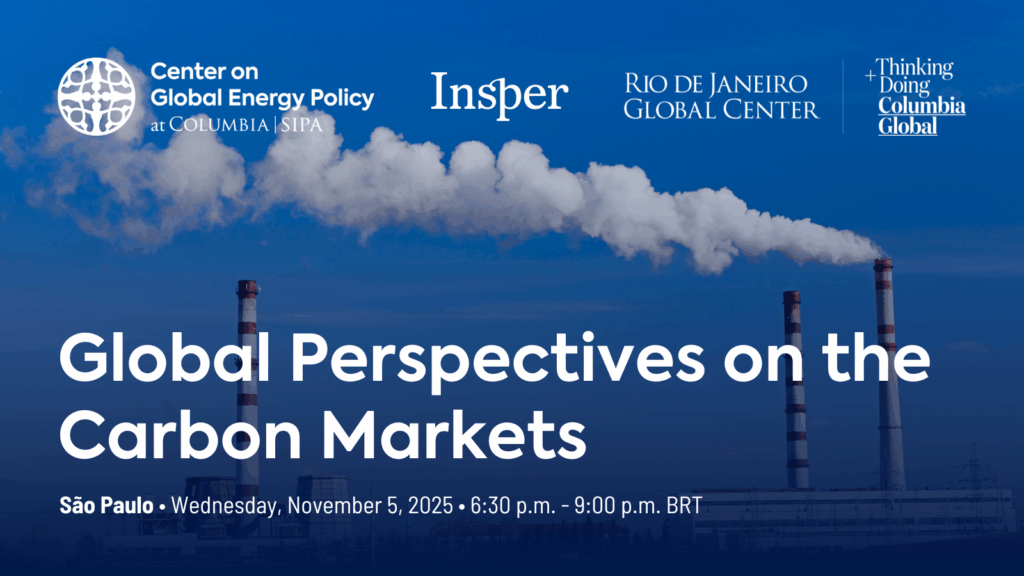
Center on Global Energy Policy (CGEP) at Columbia SIPA, the Columbia Global Center in Rio, and Insper are proud to host a high-level discussion on the future of carbon markets and their role in accelerating the global energy transition.
Bringing together leading academics, policymakers, and industry practitioners from Brazil and around the world, the event will explore how well-designed carbon markets can drive decarbonization, foster innovation, and unlock new investment opportunities. The event will host thought-provoking keynote speeches and expert panels to help participants gain strategic and critical insights into global and Brazilian perspectives on the design, governance, and integrity of carbon market, along with the pathways for integrating carbon pricing mechanisms into broader climate strategies.
The program aims to foster dialogue, collaboration, and actionable ideas that can help shape a more transparent, effective, and equitable carbon economy.
The Center on Global Energy Policy at Columbia University SIPA is pleased to host a virtual webinar with experts from Kenya, India, and Brazil to discuss and better understand the landscape...
Join us on February 25 for an in-depth, student-only conversation. Registration is required, and space is limited. The Center on Global Energy Policy at Columbia University SIPA’s Women...
Event
• Center on Global Energy Policy
1255 Amsterdam Ave Floor 1, New York, NY 10027
On January 1, 2026, the European Union's highly-anticipated Carbon Border Adjustment Mechanism (CBAM) will take effect. Introduced in 2023, CBAM will require the importers of certain carbon-intensive goods...