This website uses cookies as well as similar tools and technologies to understand visitors’ experiences. By continuing to use this website, you consent to Columbia University’s usage of cookies and similar technologies, in accordance with the Columbia University Website Cookie Notice.
Energy Explained
Get the latest as our experts share their insights on global energy policy.
The US-Venezuela Oil Deal Might De-Risk Oil Company NABEP But Not Venezuela
The White House announced last week an oil deal for more than 65 billion barrels of oil reserves in Venezuela and a 35% equity stake in North American Blue Energy Partners (NABEP).
Podcasts
Hear in-depth conversations with the world’s top energy and climate leaders from government, business, academia, and civil society.
Six Months In: Iran War Widens as Energy Markets Feel the Shock
More than six months into the war with Iran, the Strait of Hormuz crisis continues to cause turmoil in the Gulf region and global energy markets with no...
Columbia Energy Exchange Podcast
with Richard Nephew
, Daniel Sternoff
and Karen E. Young
• September 15, 2026

Events
Find out more about our upcoming and past events.
September 21, 2026
• 6:00 pm - 9:00 pm
edt
The Future of Climate Tech: Innovation, Careers, and Connections
Join industry leaders, innovators, employers, and emerging talent for an evening exploring the technologies, trends, and career opportunities shaping the future of climate tech.
Event
• 31 W 52nd St, New York, NY 10019

News
Center on Global Energy Policy Announces Fourth Cohort of David Leuschen Global Energy Fellows
February 11, 2026
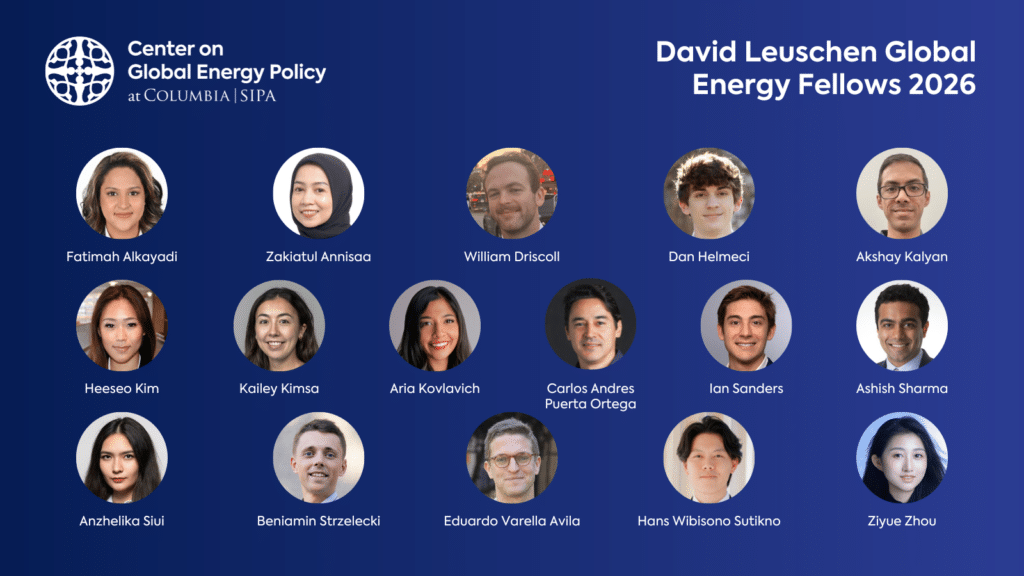
The Center on Global Energy Policy (CGEP) at Columbia University SIPA today announced the fourth cohort of the David Leuschen Global Energy Fellows. The cohort, which consists of Columbia University graduate students, will participate in monthly programming and learning sessions with energy leaders and scholars, receive networking and career support, and take part in curated events and career development opportunities. For the first time, fellows in this cohort will each be individually paired with a CGEP scholar. They will serve as research assistants to the scholars, supporting them with the writing of research products and facilitating the Center’s convenings of policymakers and stakeholders in the energy policy community.
“In an era of heightened geopolitical uncertainty and rapid change in the global energy system, the ability to understand how energy policy intersects with geopolitics and national security is essential,” said Jason Bordoff, Founding Director of CGEP.“Through the David Leuschen Global Energy Fellows Program, the Center equips Columbia graduate students with the analytical tools, policy expertise, and professional networks needed to confront today’s energy challenges and to help shape a more secure and sustainable global energy future.”
The David Leuschen Global Energy Fellows program is open to full-time graduate students (including PhD candidates) who are enrolled at Columbia University for the duration of the program. Fellows are matched with CGEP Senior Research Scholars or Global Fellows for individualized collaboration. Fellows are compensated for up to 10 hours as Student Research Workers.
“In the United States and across the globe, energy is central to a range of policy challenges that will have huge ramifications for citizens, governments, and businesses,” said David Leuschen.“The Global Energy Fellows program will provide best-in-class training and networking opportunities for promising individuals who can find the solutions to those challenges. I am pleased to join the Center on Global Energy Policy to support future energy leaders with the extraordinary talent Columbia University has to offer.”
This year’s David Leuschen Global Energy Fellows can be found below:
- Akshay Kalyan, Columbia University School of International and Public Affairs
- Anzhelika Siui, Columbia University School of International and Public Affairs
- Aria Kovlavich, Columbia University School of International and Public Affairs
- Ashish Sharma, Columbia University School of Professional Studies
- Beniamin (Benji) Strzelecki, Columbia University School of International and Public Affairs
- Carlos Andres Puerta Ortega, Columbia University School of International and Public Affairs
- Dan Helmeci, Columbia University School of International and Public Affairs
- Eduardo Varella Avila, Columbia University School of International and Public Affairs
- Fatimah Alkayadi, Columbia University School of International and Public Affairs
- Hans Wibisono Sutikno, Columbia University School of Professional Studies
- Heeseo Kim, Columbia University School of Professional Studies
- Ian Sanders, Columbia University School of International and Public Affairs
- Kailey Kimsa, Columbia Climate School
- William Driscoll, Columbia University School of International and Public Affairs
- Zakiatul Annisaa, Columbia University School of International and Public Affairs
- Ziyue Zhou, Columbia Climate School
Related
More News
Qatari LNG is trickling back through Hormuz, but the real divide now is who can afford to keep bidding for gas
The real divide isn't who lost Qatari gas — it's who could afford not to notice
Satellite image reveals major damage that shut crucial Saudi oil pipeline
Experts tell BBC Verify the pipeline's closure could cut oil supplies by as much as 3.6 million barrels per day.
The Euro Reads A Gas Bill
Europe Intelligence Brief for 15 September 2026: NATO jets destroy a drone over Lithuania in a first for that country but not for the mission, Dutch track
Relevant
Publications

The US-Venezuela Oil Deal Might De-Risk Oil Company NABEP But Not Venezuela
The White House announced last week an oil deal for more than 65 billion barrels of oil reserves in Venezuela and a 35% equity stake in North American Blue Energy Partners (NABEP).
