This website uses cookies as well as similar tools and technologies to understand visitors’ experiences. By continuing to use this website, you consent to Columbia University’s usage of cookies and similar technologies, in accordance with the Columbia University Website Cookie Notice.
Energy Explained
Get the latest as our experts share their insights on global energy policy.
How to Streamline Nuclear Approvals While Preserving Independent Safety Review
A House committee voted to allow the Advisory Committee on Reactor Safeguards (ACRS) to decline certain application reviews.
Podcasts
Hear in-depth conversations with the world’s top energy and climate leaders from government, business, academia, and civil society.
Daniel Palken on the Bipartisan Senate Bill to Reform Energy Permitting
Permitting reform—to allow for faster approvals on new projects—is one thing that both climate advocates and energy developers have wanted for a long time. With demand for power...
Columbia Energy Exchange Podcast
• October 13, 2026

Events
Find out more about our upcoming and past events.
October 16, 2026
• 11:45 am - 12:45 pm
edt
CGEP Student Roundtable on Sustainable Finance
The Center on Global Energy Policy at Columbia University SIPA invites students to join us for an engaging roundtable discussion on sustainable finance with Jacqueline Ricciani, Managing Director,...
Event
• Columbia SIPA

News
Center on Global Energy Policy Announces 2026 Energy Journalism Fellows
June 8, 2026

The Center on Global Energy Policy (CGEP) at Columbia University’s School of International and Public Affairs today announced the journalists who have been selected for the 2026 Energy Journalism Fellows (EJF) program, which will be held on the Columbia University campus in New York City from June 9 to June 12. The program, which is open to journalists who cover energy, climate, and the environment, provides fellows with in-person education and training from CGEP scholars, Columbia faculty, and other academic, industry, and government experts. Topics include the intersecting disciplines shaping the global energy sector, including finance and markets, climate change, science and technology, policy, and geopolitics.
“Energy is increasingly at the center of the most consequential stories of the day. To make sense of a complex and turbulent geopolitical landscape, journalists need a nuanced understanding of the global energy system,” said Jason Bordoff, Founding Director of the Center on Global Energy Policy. “I look forward to welcoming this year’s impressive cohort of Energy Journalism Fellows to Columbia University this week and giving them the opportunity to hear from CGEP’s world-class experts on many of the most critical energy issues facing the world today.”
“We are proud to provide early- to mid-career reporters with access to some of the energy and climate fields’ best minds as they expand their knowledge of a crucial beat in journalism,” said Bill Loveless, Director of the Energy Journalism Fellows program at CGEP. “While their backgrounds vary, they share a common challenge: helping the public understand issues that are technically complex, politically charged, economically consequential, and deeply human.”
This year’s cohort of selected journalists include:
- Maeve Allsup, Latitude Media
- Drew Anderson, The Narwhal
- Chloe Bennett-Steele, StateImpact Oklahoma
- Catherine Cartier, Reuters
- Lana Ferguson , The Dallas Morning News
- Steven Grattan, Associated Press
- Sameer Hashmi, Freelance
- Joseph Harris, Indianapolis Business Journal
- Ying (Coco) Liu, Bloomberg
- Pietro Lombardi, Reuters
- Samuel Meredith, CNBC International
- Stuti Mishra, The Independent
- Carlos Nogueras, The Texas Tribune
- Meghan Potkins, The Logic
- Clavel Rangel Jimenez, Freelance
- Nathan Risser, Bloomberg
- Noah Schwartz, S&P Global
- Hayley Smith, Los Angeles Times
- Lucas Smolcic Larson, MLive
The EJF program is open to journalists covering energy, climate, and related topics for print, online, and broadcast media. This program is free to journalists, including transportation and lodging for those who need it. Applications for the 2027 cohort will open early next year. To learn more about the Energy Journalism Fellows program, visit our website.
Related
More News
Power Plays
New US inflation figures show Trump has run out of time to bring down energy prices before the midterm election.
Houthi assaults test bin Salman as allies balk and economy weakens
Houthi assaults test bin Salman as allies balk and economy weakens Allies hesitate as Houthi strikes strain Saudi defenses and undercut Vision 2030 As
Relevant
Publications
Vivre sans gaz naturel liquéfié russe
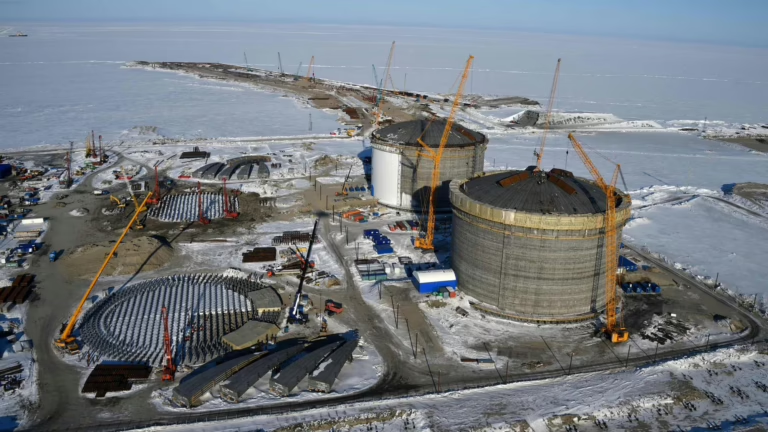
CHRONIQUE. Plus de gaz naturel liquéfié russe dès le 1er janvier, plus de gaz via gazoduc au 1er octobre 2027, mais l’UE est-elle prête? se demande la spécialiste de l’énergie Anne-Sophie Corbeau, qui rappelle que le gaz naturel liquéfié ne va pas disparaître des marchés mondiaux – il ira juste ailleurs…
Environmentalists Are Wrong to Oppose the Senate’s Permitting Deal
America needs to build more to achieve its energy goals of lower costs, greater security, and more clean energy.