NY energy experts, advocates say Iran war shows need for Hochul to implement climate law
Gov. Hochul’s reliance on fossil fuels may end up costing more than renewables, clean energy advocates say.
This website uses cookies as well as similar tools and technologies to understand visitors’ experiences. By continuing to use this website, you consent to Columbia University’s usage of cookies and similar technologies, in accordance with the Columbia University Website Cookie Notice.
Our work is committed to independent and nonpartisan research that meets the high standards of academic integrity and quality at Columbia University.
Our initiatives and programs are designed to address critical needs in key focus areas around energy and climate policy.
Explore our expert insights and analysis in leading energy and climate news stories.
Gov. Hochul’s reliance on fossil fuels may end up costing more than renewables, clean energy advocates say.
Get the latest as our experts share their insights on global energy policy.
On February 28, the US and Israel launched new attacks on Iran targeting primarily the country's leadership, security forces, and missile program.

Hear in-depth conversations with the world’s top energy and climate leaders from government, business, academia, and civil society.
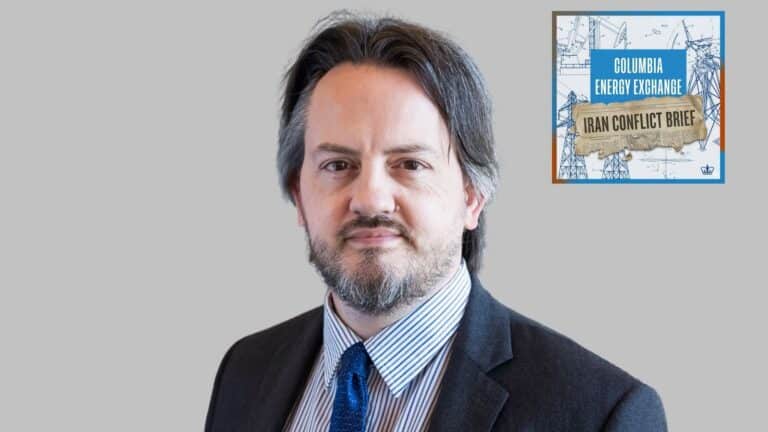
While US and Israeli forces have significantly degraded Iran’s military and nuclear capability, the global energy landscape remains in a precarious position. For weeks, the Strait of Hormuz...
Find out more about our upcoming and past events.
This roundtable is open only to currently enrolled Columbia University students. To register, you must sign in with your UNI. Join the Center on Global Energy Policy’s Women...
We are the premier hub and policy institution for global energy thought leadership. Energy impacts every element of our lives, and our trusted fact-based research informs the decisions that affect all of us.
Associate Professor of Chemical Engineering, Dept of Chemical Engineering
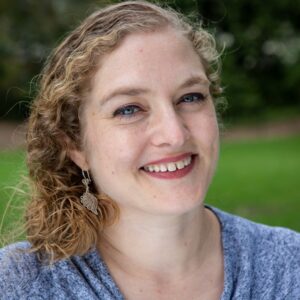
V. Faye McNeill is a Professor in the Department of Chemical Engineering at Columbia University, where she is the Chair of the Undergraduate Committee. She is also an associate member of the Earth Institute Faculty. She joined Columbia in 2007 and received tenure in 2014. She received her B.S. in Ch.E. from Caltech in 1999 and her PhD in Ch.E. from MIT in 2005, where she was a NASA Earth System Science Fellow. From 2005-2007 she was a postdoctoral scholar at the University of Washington Department of Atmospheric Sciences. She received the NSF CAREER and the ACS Petroleum Research Fund Doctoral New Investigator awards in 2009. She was the recipient of the Kenneth T. Whitby Award of AAAR in 2015 and the Mellichamp Emerging Leaders lecturer at UCSB in 2018. She is the Associate Editor in charge of Atmospheric Chemistry for ACS Earth and Space Chemistry. She was a co-editor of Atmospheric Chemistry and Physics from 2007-2017. She has served in multiple elected officer positions in AIChE, AAAR, and AGU. She is an appointed member of the IUPAC panel on kinetic data evaluation and the ACS Committee on Environmental Improvement.
McNeill’s research focuses on the fundamentals of multiphase processes in the atmosphere, including formation pathways of particulate matter from pollutant gases. In her role as principal investigator of the Clean Air Toolbox for Cities project she is conducting solutions-oriented field work on to improve air pollution in cities in India and Africa.
Get the latest news and research on energy & climate policy.
"(required)" indicates required fields