This website uses cookies as well as similar tools and technologies to understand visitors’ experiences. By continuing to use this website, you consent to Columbia University’s usage of cookies and similar technologies, in accordance with the Columbia University Website Cookie Notice.
Energy Explained
Get the latest as our experts share their insights on global energy policy.
What a US-Saudi Arabia Nuclear Agreement Could Mean
The Trump administration and Saudi leadership have reportedly agreed to a nuclear agreement that could enable US nuclear technology transfers to Saudi Arabia.
Podcasts
Hear in-depth conversations with the world’s top energy and climate leaders from government, business, academia, and civil society.
Tom Moerenhout and Tomasz Nadrowski on Fixing the Mineral Supply Chain
Critical minerals sit at the intersection of energy technology, industrial competitiveness, and economic resilience. The issue has hit a fever pitch in the United States, driving the Trump...

This is the fourth episode of a five-part series exploring the lithium-ion battery supply chain. If you haven’t listened to the first three episodes, we recommend you start there.
Season 4, Episode 4
Countries around the globe are racing to meet the growing demand for lithium-ion batteries. But can they compete with China?
China has been the world’s biggest battery manufacturer for over a decade. Chinese companies got in the game early, building an industry from scratch in the 2000s. By 2022, according to the IEA, China manufactured 76% of the world’s batteries.
But that’s changing. Battery factories in the U.S. and around the world are running 24/7 to churn out millions of cells – thanks to growing demand for storage all over the world, and government support for local manufacturing.
In this episode, we’re exploring the rapid buildout of factories to support the battery economy. We’ll tour a lithium-ion battery factory in upstate NY to see how batteries are made at scale. And we ask where a small US factory fits into a global battery market dominated by China.
More Episodes
The Battery Recycling Dilemma
So far over this season we've traced the global lithium-ion battery supply chain from mining to processing to manufacturing. And we've put it all into a geopolitical and economic context.
The Big Switch Podcast
• March 27, 2024
The High Stakes for Battery Ingredients
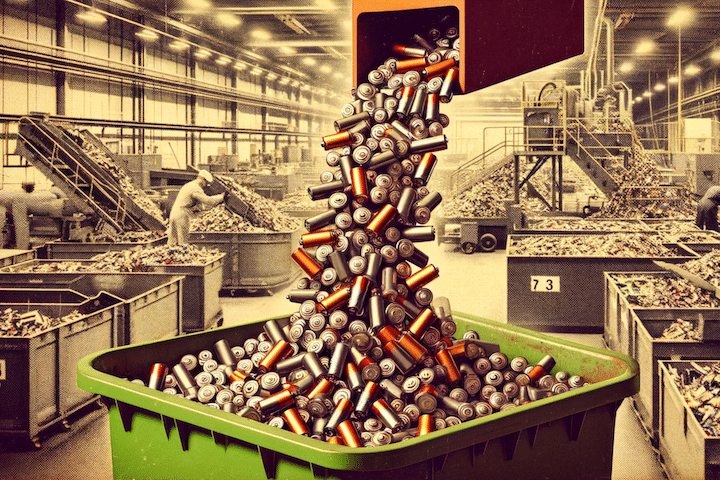
Batteries can replace gasoline in our cars, or diesel in our generators with electricity. But batteries and petroleum-based fuels share something in common: they both rely on energy-intensive processes to turn extracted materials into something useful.
The Big Switch Podcast
• March 13, 2024
The Mining Conundrum For Critical Minerals
To produce enough batteries to reach global net-zero goals, the International Energy Agency says we'll need to increase production of critical minerals by six fold by 2040. It's a monumental task.
The Big Switch Podcast
• March 6, 2024

Are Batteries the New Oil?
Season 4, Episode 1 Batteries are at the center of the clean energy economy. Will they shape geopolitics in similar ways to oil? We need to electrify much...
The Big Switch Podcast
• February 28, 2024
Relevant
Publications
Critical Minerals Governance and Community Benefit Sharing in Mexico
In early 2026, CGEP held a roundtable and several hybrid closed-door meetings in Mexico City on Mexico's mining sector.
G7 Progress on Critical Minerals Diversification Overlooks Demand Side
Raw material vulnerability was once again at the center of the G7 agenda at the summit in Evian, France.

G7 Countries Commit to Diversifying Critical Minerals Supply Without Deciding Who Bears the Cost
Critical minerals were once again near the top of the agenda for G7 leaders as they met in Évian, France, this week, a year after the G7 launched the Critical Minerals Action Plan.

Chinese Customs Data Reveal Deeper US Dependence on Chinese Rare Earths
One of the central objectives of the second Trump administration has been to pursue a maximalist trade policy toward China.