This website uses cookies as well as similar tools and technologies to understand visitors’ experiences. By continuing to use this website, you consent to Columbia University’s usage of cookies and similar technologies, in accordance with the Columbia University Website Cookie Notice.
This Energy Explained post represents the research and views of the author(s). It does not necessarily represent the views of the Center on Global Energy Policy. The piece...
Global gas markets, especially in Europe, are approaching winter under serious pressure. With storage inventories lagging behind historical averages and shipping disruptions from the Middle East threatening key...
Apply to Register The Center on Global Energy Policy at Columbia University SIPA’s Women in Energy initiative invites Columbia University students to a roundtable discussion with Pam Brown,...
Event
• Center on Global Energy Policy
Large Conference Room
About Us
We are the premier hub and policy institution for global energy thought leadership. Energy impacts every element of our lives, and our trusted fact-based research informs the decisions that affect all of us.
When a country or community lacks sufficient, predictable, timely, and accessible funding to minimize the physical impacts from climate change, it can become trapped in a vicious cycle. Without resilient infrastructure, a country would likely suffer greater economic losses following a climate disaster than would otherwise be the case, which leads to a weaker fiscal position to spend on strengthening resiliency, thus leaving it more exposed to the next disaster, and the cycle goes on. To prevent such a downward spiral, sustained international support is needed for emerging and developing countries to access financing for building resiliency. However, international public flows to emerging economies for financing adaptation amounted to a meager $28 billion in 2022.
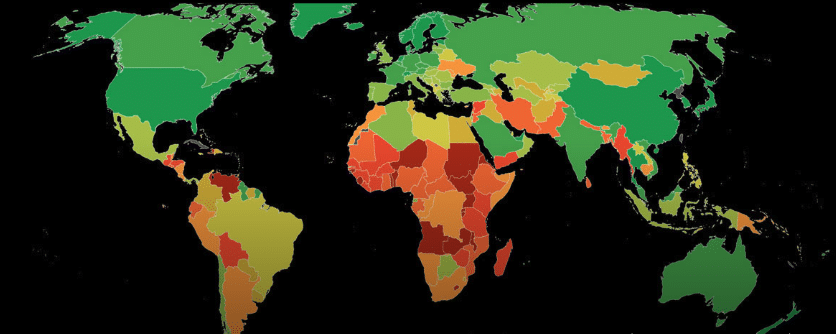
The first global stocktake undertaken during COP28 warned about the widening adaptation financing gap, which UNEP estimates to be $187-359 billion per year. Given the limited funding, it is important to direct them to places where they can have the maximum impact possible. The Climate Finance (CliF) Vulnerability Index can help in this regard. A donor can pick between two countries that face similar climate disaster risks based on where their funds can go further, as the index explicitly includes a separate dimension covering each country’s ability to access financing.
The index was created jointly by the Center on Global Energy Policy, represented by Gautam Jain and Andrew Kamau, and the Columbia Climate School, represented by Jeffrey Schlegelmilch and Andrew Kruczkiewicz, with support from Thalia Balkaran, Nitin Magima, Geneva List, Devshri Lala, Zain Alabweh, Sean Boylan, Amy Campbell, Emily Heard, and Max Mauerman. This work was funded through a grant from the Rockefeller Foundation. The methodology behind the construction of the index is described in Climate Finance (CliF) Vulnerability Index: Technical Methodology.
Project-based carbon credit markets (PCCMs) facilitate the generation, trading, and retirement of carbon credits from projects that remove, reduce, or avoid greenhouse gas emissions.
The World Bank is revisiting one of its most entrenched positions, publicly questioning its long-standing emphasis on market-led approaches in economic policy.