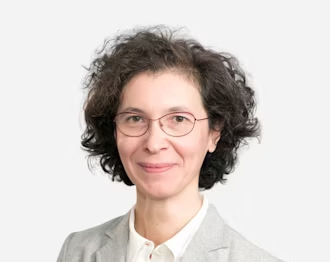
Please join the Center on Global Energy Policy for a Women in Energy lunch and roundtable discussion with Elta Kolo, Research Manager at Wood Mackenzie Power & Renewables and Fei Wang, Senior Research Analyst at Wood Mackenzie Power & Renewables. Dr. Kolo and Ms. Wang will discuss their academic and job histories, career paths, insights into exciting trends in the grid edge space, and perspectives on promoting diversity through Women Advancing Grid Edge (W.A.G.E.). Biographies Elta Kolo Elta is a Research Manager for the Grid Edge team at Wood Mackenzie Power & Renewables (formerly GTM Research) working on demand-side management in U.S. electricity markets. Prior to joining GTM, Elta pursued a joint Ph.D. funded by the European Commission on Sustainable Energy Technologies and Strategies at Delft University of Technology in the Netherlands. During her doctoral studies, she researched demand response policies for the implementation of smart grids and has presented her work at both U.S. and European conferences in addition to publishing in international scholarly journals. Elta holds a Master of Science degree in economics and management of network industries from ICAI School of Engineering (Spain) and a bachelor’s degree in economics from Union College (NY). Fei Wang Fei is a Senior Research Analyst with Wood Mackenzie Power & Renewables (formerly GTM Research) specializing in customer energy management on the grid edge team. Fei was previously a consultant in ICF’s energy practice where she worked on assessing the impact of environmental regulations for commercial, government and non-profit clients. Prior to that, Fei earned her Master of International Affairs with a concentration in energy and environment from Columbia University’s School of International and Public Affairs (SIPA). During graduate school, Fei worked with New York Power Authority (NYPA) on renewable energy procurement, the State Energy Plan and the ReCharge New York program. Fei holds a B.A. in Economics from Franklin & Marshall College. This event is open to current female grad students. Space is limited therefore please register only if you can commit to attending the roundtable. Lunch will be provided. If you have any questions, please contact: [email protected].