Did the Iran War Force Peak Oil?
Something weird is happening in China.
Get the latest as our experts share their insights on global energy policy.
In March 2026, the Office of the US Trade Representative (USTR) announced it was investigating "structural excess capacity and production in manufacturing sectors" in 16 economies.

Hear in-depth conversations with the world’s top energy and climate leaders from government, business, academia, and civil society.
For years, the energy transition was discussed as a shift that would happen in steady, predictable increments. But a massive surge in electricity demand in recent years—now colliding...
Past Event
October 16, 2014
10:30 am - 11:45 am
Please join the Center on Global Energy Policy for a discussion and update on the U.S. Quadrennial Energy Review (QER) with Melanie Kenderdine, Director of the Office of Energy Policy and Systems Analysis, and Energy Counselor to the Secretary. President Obama launched the QER in January 2014, an interagency effort aimed at understanding how the U.S. can meet the goal of affordable, clean, and secure energy and energy services.
The first QER focuses on energy infrastructure and will identify the threats, risks, and opportunities for U.S. energy and climate security against the backdrop of: – The transformation of energy supplies, markets, and patterns of end-use; – Issues of aging and capacity; – Cyber and physical threats; and, – Vulnerabilities related to the growing interdependence of energy systems with water, telecommunications, transportation, and emergency response system.
Ms. Kenderdine will provide an update on the QER and discuss how the QER can address these challenges and enable the U.S. government to translate policy goals into a set of integrated actions at the local, state, regional and federal levels. Center Director Jason Bordoff will moderate the discussion following the presentation. Registration is required. This event is open to press. It will also be livestreamed at: http://energypolicy.columbia.edu/watch. For more information contact: [email protected]
This roundtable is open only to currently enrolled Columbia University students. To register, you must sign in with your UNI. The Center on Global Energy Policy (CGEP) at...

On February 28, the United States and Israel launched an attack on Iran, resulting in the deaths of Iranian Supreme Leader Ali Hosseini Khamenei and senior Iranian leaders...


The Center on Global Energy Policy (CGEP) at Columbia SIPA and the Fashion, Energy, and Climate Network invite you to join the first session of our new talk...

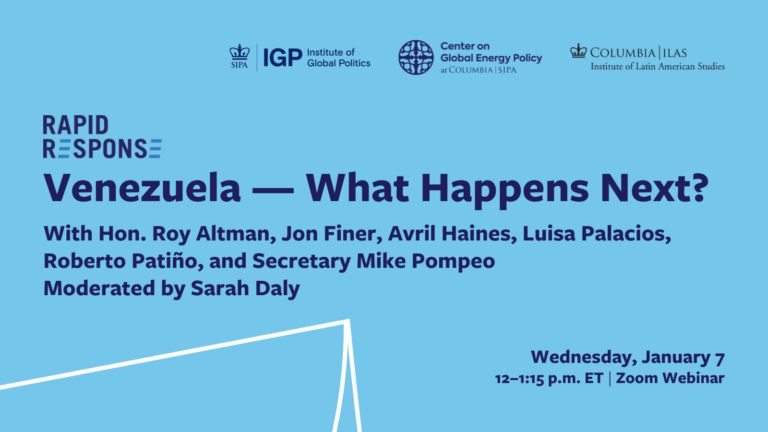
The recent military operation to remove Venezuelan President Nicolás Maduro and First Lady Cilia Flores raises several implications for the future of Venezuela and Latin America, geopolitics, and energy markets. Cosponsored by SIPA’s Institute of Global Politics (IGP) and Center for Global Energy Policy (CGEP), along with Columbia’s Institute of Latin American Studies (ILAS), this webinar will analyze the circumstances and impact of their capture and extradition to New York to face narcoterrorism and drug trafficking charges.
The UNFCCC process is marred by gridlock in the COP multilateral framework, threatening joint efforts by countries to mitigate the climate crisis.
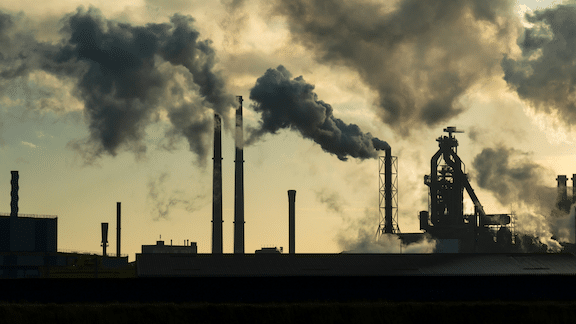
On March 20, Governor Kathy Hochul proposed significant changes to New York’s Climate Leadership and Community Protection Act (CLCPA), the landmark climate law passed in 2019.