US oil stockpiles offset Saudi Arabia supply worries
Oil prices fell on Wednesday as US crude stockpiles rose, with fears of further escalation in the Saudi Arabia and Houthis conflict
Get the latest as our experts share their insights on global energy policy.
The White House announced last week an oil deal for more than 65 billion barrels of oil reserves in Venezuela and a 35% equity stake in North American Blue Energy Partners (NABEP).
Hear in-depth conversations with the world’s top energy and climate leaders from government, business, academia, and civil society.
More than six months into the war with Iran, the Strait of Hormuz crisis continues to cause turmoil in the Gulf region and global energy markets with no...

Find out more about our upcoming and past events.
Join industry leaders, innovators, employers, and emerging talent for an evening exploring the technologies, trends, and career opportunities shaping the future of climate tech.

Past Event
February 13, 2025 - February 14, 2025
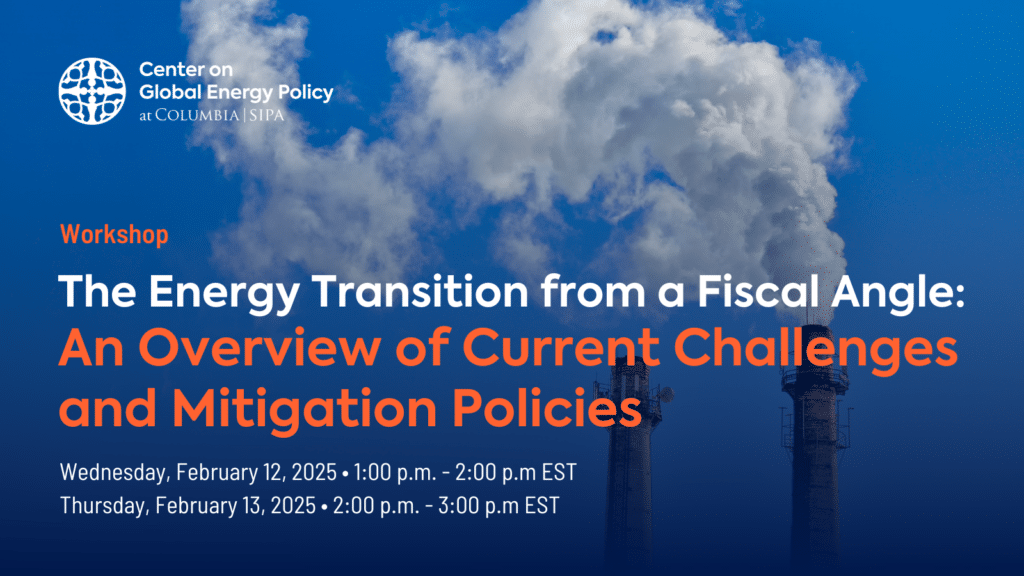
This workshop will be conducted in two parts: Part one on February 12 from 1:00 PM to 2:00 PM EST, and Part two on February 13 from 2:00 PM to 3:00 PM EST. By signing up, you agree to attend both sessions.
Please join the Center on Global Energy Policy at Columbia SIPA for a two-part workshop hosted by Diego Mesa Puyo. The focus will center on the current state of global greenhouse gas (GHG) emissions in relation to the collective climate goals set forth in the Paris Agreement, including recent developments from COP28. The discussion will be divided into two parts:
This segment will provide a comprehensive overview of global GHG emissions relative to the Paris Agreement’s collective climate goals and the recent COP28 agreements. Key topics will include transitioning away from fossil fuels in energy systems, phasing down unabated coal, phasing out inefficient fossil fuel subsidies, and tripling renewable energy capacity. Emissions will be analyzed by sector, country, and type of GHG to offer a clear understanding of the global mitigation challenge. The session will also review current emission levels and projections through 2030 under existing policies and Nationally Determined Contributions (NDCs), highlighting gaps in both ambition and implementation.
The second part will focus on the financial requirements for decarbonizing various economic sectors to achieve net-zero emissions by 2050. The discussion will cover investment trends in clean energy and technologies compared to fossil fuel investments, with particular attention to emerging markets and developing economies. The role of private capital in accelerating climate action will also be examined.
Finally, the workshop will discuss fiscal policy options to address the climate challenge. We will discuss economy-wide policies, including carbon pricing and the removal of inefficient fossil fuel subsidies. The workshop will also look at sectoral and complementary policies and evaluate their efficiency in terms of climate and fiscal effectiveness. If there is time, we will also do a deep dive into the policies introduced in Colombia between 2018 and 2022 that allow the country to rapidly expand the installed capacity of large-scale solar PV and wind projects, and to develop low-emissions hydrogen and offshore wind roadmaps.
Registration is required. This workshop is open only to currently enrolled Columbia University students. To register, you must use the email address that contains your UNI.
This event will be hosted in person, and capacity is limited. We ask that you register only if you can attend this event for both sessions.
For more information about the event, please contact [email protected].
The Columbia Fashion, Energy, and Climate Summit will bring together leaders from fashion, energy, climate, technology, business, academia, policy, and design.

The Center on Global Energy Policy at Columbia University SIPA will host a series of energy and climate focused events this September during Climate Week NYC.
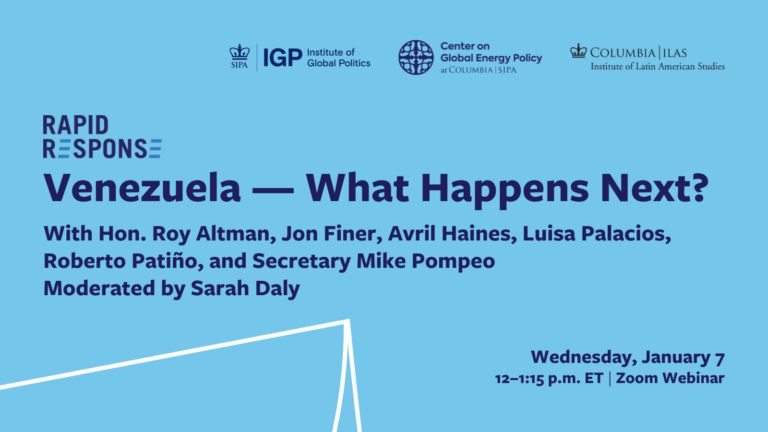
The recent military operation to remove Venezuelan President Nicolás Maduro and First Lady Cilia Flores raises several implications for the future of Venezuela and Latin America, geopolitics, and energy markets. Cosponsored by SIPA’s Institute of Global Politics (IGP) and Center for Global Energy Policy (CGEP), along with Columbia’s Institute of Latin American Studies (ILAS), this webinar will analyze the circumstances and impact of their capture and extradition to New York to face narcoterrorism and drug trafficking charges.

The Columbia Global Energy Summit 2026 is an annual event dedicated to thought-provoking discussions around the critical energy and climate challenges facing the global community.
The White House has just announced over $2 billion in new critical minerals, magnets, and battery investments.


Think tank indipendente per la transizione energetica e industriale dell'Italia