This website uses cookies as well as similar tools and technologies to understand visitors’ experiences. By continuing to use this website, you consent to Columbia University’s usage of cookies and similar technologies, in accordance with the Columbia University Website Cookie Notice.
The clean energy transition had real momentum at the end of 2024. It was buoyed by federal support, billions of dollars of investment in new technologies, and broad...
We are the premier hub and policy institution for global energy thought leadership. Energy impacts every element of our lives, and our trusted fact-based research informs the decisions that affect all of us.
Please join the Center on Global Energy Policy for the next event in our Global Leaders in Energy Lecture Series. This event will feature a lecture and discussion with Benedict Clements, Division Chief, Expenditure Policy Division, Fiscal Affairs Department, International Monetary Fund, on energy subsidies in advanced and developing economies. Mr. Clements will discuss the consequences of energy subsidies, which range from aggravating fiscal imbalances and global warming to crowding out private investment in the energy sector. In turn, he will examine what types of policies and approaches can be undertaken to reduce subsidies and win public support for reform. Manuel Pinho, Visiting Professor, School of International and Public Affairs, Columbia University, and Faculty Affiliate, Center on Global Energy Policy, will moderate a discussion following the presentation. Registration is required. This event is open to press. It will also be livestreamed at: http://energypolicy.columbia.edu/watch.
This roundtable is open only to currently enrolled Columbia University students. To register, you must sign in with your UNI. The Center on Global Energy Policy (CGEP) at...
Event
• Center on Global Energy Policy
1255 Amsterdam Ave, New York, NY 10027
On February 28, the United States and Israel launched an attack on Iran, resulting in the deaths of Iranian Supreme Leader Ali Hosseini Khamenei and senior Iranian leaders...
The Center on Global Energy Policy (CGEP) at Columbia SIPA and the Fashion, Energy, and Climate Network invite you to join the first session of our new talk...
Event
• Center on Global Energy Policy
1255 Amsterdam Ave, New York, NY 10027
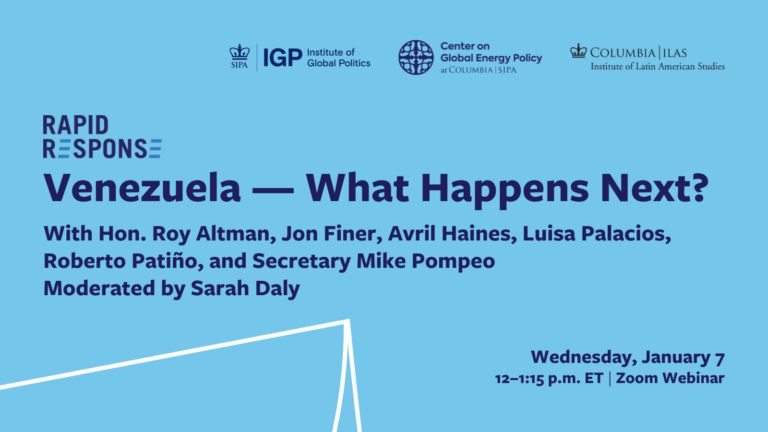
The recent military operation to remove Venezuelan President Nicolás Maduro and First Lady Cilia Flores raises several implications for the future of Venezuela and Latin America, geopolitics, and energy markets. Cosponsored by SIPA’s Institute of Global Politics (IGP) and Center for Global Energy Policy (CGEP), along with Columbia’s Institute of Latin American Studies (ILAS), this webinar will analyze the circumstances and impact of their capture and extradition to New York to face narcoterrorism and drug trafficking charges.
On March 20, Governor Kathy Hochul proposed significant changes to New York’s Climate Leadership and Community Protection Act (CLCPA), the landmark climate law passed in 2019.