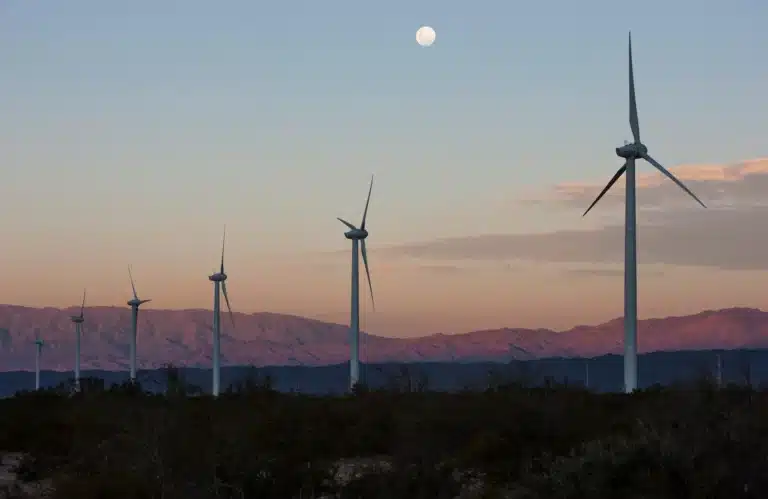
The World’s Mineral Powers Seize Their Moment
Resource-rich countries haven’t always benefited from extraction. Can this time be different?
Get the latest as our experts share their insights on global energy policy.
The US Export-Import Bank is preparing to close the first funding tranche of Project Vault, a public-private partnership establishing the US Strategic Critical Minerals Reserve.
Hear in-depth conversations with the world’s top energy and climate leaders from government, business, academia, and civil society.
For years, the energy transition was discussed as a shift that would happen in steady, predictable increments. But a massive surge in electricity demand in recent years—now colliding...

Past Event
May 11, 2021
12:00 pm - 1:00 pm utc
The Center on Global Energy Policy will host Amy Myers Jaffe, Research Professor and Managing Director at the Climate Policy Lab at Tufts University’s The Fletcher School and Co-Chair of the CGEP Women in Energy Steering Committee, for a discussion of her new book, Energy’s Digital Future: Harnessing Innovation for American Resilience and National Security.
Following her presentation, Amy will be joined by Jason Bordoff, CGEP Founding Director and Professor of Professional Practice in International and Public Affairs, Columbia University and David Sandalow, CGEP Inaugural Fellow, for a conversation moderated by Dr. Melissa Lott, CGEP Director of Research and Senior Research Scholar.
From the publisher:
Disruptive digital technologies are poised to reshape world energy markets. A new wave of industrial innovation, driven by the convergence of automation, artificial intelligence, and big data analytics, is remaking energy and transportation systems in ways that could someday end the age of oil. What are the consequences—not only for the environment and for daily life but also for geopolitics and the international order?
Amy Myers Jaffe provides an expert look at the promises and challenges of the future of energy, highlighting what the United States needs to do to maintain its global influence in a post-oil era. She surveys new advances coming to market in on-demand travel services, automation, logistics, energy storage, artificial intelligence, and 3-D printing and explores how this rapid pace of innovation is altering international security dynamics in fundamental ways. As the United States vacillates politically about its energy trajectory, China is proactively striving to become the global frontrunner in a full-scale global energy transformation. In order to maintain its leadership role, Jaffe argues, the United States must embrace the digital revolution and foster American achievement. Bringing together analyses of technological innovation, energy policy, and geopolitics, Energy’s Digital Future gives indispensable insight into the path the United States will need to pursue to ensure its lasting economic competitiveness and national security in a new energy age.
—
This webinar will be hosted via Zoom. Advance registration is required. Upon registration, you will receive a confirmation email with access details. The event will be recorded and the video recording will be added to our website following the event.
This event is open to press, and registration is required to attend.
For media inquiries or requests for interviews, please contact Artealia Gilliard ([email protected]) or Genna Morton ([email protected]).
For more information about the event, please contact Caitlin Norfleet or Nicolina DueMogensen ([email protected]).
More than a month into the Iran conflict, the United States and Iran are at a critical inflection point.


This roundtable is open only to currently enrolled Columbia University students. To register, you must sign in with your UNI. Join the Center on Global Energy Policy’s Women...

This roundtable is open only to currently enrolled Columbia University students. To register, you must sign in with your UNI. The Center on Global Energy Policy (CGEP) at...

This roundtable is open only to currently enrolled Columbia University students. To register, you must sign in with your UNI. The Center on Global Energy Policy at Columbia...

The US Export-Import Bank is preparing to close the first funding tranche of Project Vault, a public-private partnership establishing the US Strategic Critical Minerals Reserve.