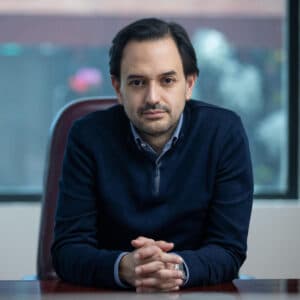
Diego Mesa Puyo is an international leader in energy policy, economic development, and resilience and sustainability, with two decades of experience spanning government, multilateral institutions, academia, and the private sector. Before his election as the next CEO and Chairman of the Global Environmental Facility (GEF), he served as Deputy Chief of the Climate Policy Division of the International Monetary Fund (IMF), where he helped lead the institution’s work on adaptation and mitigation policy, energy transition, and climate-related macroeconomic reforms across developing and emerging economies. He also represented the IMF in the Coalition of Finance Ministers for Climate Action and serves as a Non-Resident Fellow at Columbia University’s Center on Global Energy Policy.
Prior to returning to the IMF in 2022, Diego served as Minister of Energy and Mines of Colombia from 2020 to 2022, following his tenure as Deputy Minister of Energy from 2018 to 2020. As Minister, he led one of Latin America’s most ambitious energy transition agendas. Under his leadership, Colombia launched transformative market reforms that mobilized more than US$3 billion in private investment, accelerated the deployment of variable renewable energy from near-zero levels to one of the fastest-growing clean energy markets in the region, and established the country’s first clean hydrogen and offshore wind development roadmaps. He also played a central role in advancing national climate legislation and embedding sustainability objectives in economic and development policy.
Before entering public service, Diego built extensive experience in economic policy and international finance. As an economist in the IMF’s Fiscal Affairs Department, he advised governments on fiscal frameworks, natural resource wealth management, and public finance. Through direct engagement with more than sixty countries across Africa, Asia-Pacific, the Middle East, Eastern Europe, and Latin America and the Caribbean, he developed a deep understanding of the challenges and opportunities facing developing countries as they pursue sustainable growth and economic resilience. Earlier in his career, he worked with PricewaterhouseCoopers in Canada, leading projects related to infrastructure finance, public-private partnerships, energy policy, and financial modeling for governments, financial institutions, and major private sector clients. This combination of public and private sector experience has given him a distinctive ability to bridge the priorities of governments, international institutions, and investors in pursuit of large-scale sustainable investment.
Throughout his career, Diego has been recognized for his ability to build coalitions, mobilize resources, and deliver results in complex institutional environments. He has represented organizations and governments at the highest levels of international engagement, including global summits, ministerial forums, multilateral negotiations, and major media platforms.
Diego holds a Master’s degree in Economics from McGill University, a Bachelor’s degree in Economics from Concordia University, and has been a Chartered Financial Analyst (CFA®) since 2012. He has also completed executive studies in environmental economics at Harvard Kennedy School.