Everyone Wants in on Brazil’s Rare Earths
But is Brasília ready to meet the moment?
Get the latest as our experts share their insights on global energy policy.
The Center on Global Energy Policy is providing live updates on key developments related to the Iran crisis. Check back here for the latest.

Hear in-depth conversations with the world’s top energy and climate leaders from government, business, academia, and civil society.
Grid operators sit at the center of many of the biggest forces reshaping the global energy system. They’re navigating rising electricity demand, a lack of transmission infrastructure, shifting...

As the train pulls away from Davos Dorf station through the snow-capped Swiss mountains, I find myself reflecting on a rather extraordinary week at the World Economic Forum’s Annual Meeting in Davos. While many questioned Davos’ continuing relevance last year, it is difficult to argue that this year’s gathering was not among the most consequential in recent memory, shaped in large part by President Trump’s dominant presence throughout the week’s discussions.
You will no doubt have read a multitude of commentaries on the week’s headlines, so I will focus instead on how energy issues featured at this year’s meeting. While much of the media coverage centered on Trump and Greenland, I find myself thinking instead about Canada, China, and Amory Lovins. I’m weird, I know. Let me explain.
Canada, Middle Powers, and the Collapsing Rules-Based Order
Canadian Prime Minister Mark Carney’s address to the Annual Meeting was among the most important in years, drawing a rare standing ovation. Carney described the erosion of an era underpinned by United States hegemony, calling the current moment not one of transition but of “rupture”. Although he never mentioned President Trump by name, the thrust of his message was unmistakable. He called on middle powers to “stop invoking the rules-based order as though it still functions as advertised.”
“For decades,” Carney said, “countries like Canada prospered under what we called the rules-based international order. We joined its institutions, we praised its principles, we benefited from its predictability. And because of that, we could pursue values-based foreign policies under its protection.”
Carney argued “the risks of extreme global integration” are now apparent, as “great powers have begun using economic integration as weapons.” In response to this new aggression, middle powers are awakening to the reality “that they must develop greater strategic autonomy: in energy, food, critical minerals, in finance and supply chains.” As he put it, “When the rules no longer protect you, you must protect yourself. But let’s be clear-eyed about where this leads. A world of fortresses will be poorer, more fragile and less sustainable.”
Those fears were palpable in Davos this week following President Trump’s threats to take control of Greenland through economic coercion, including massive tariffs—not to mention hints of military action. This came on the heels of White House advisor Stephen Miller’s assertion earlier this month that countries can take what they are strong enough to take – that we live in a world “that is governed by strength, that is governed by force, that is governed by power.”
Trump later retreated from Greenland threats, announcing a vague framework reportedly involving increased NATO presence in the Arctic and limits on access to Greenland’s mineral resources. (I reflected on Greenland’s resources and links to climate change after my visit there in 2023 with Center on Global Energy Policy board member Tracy Wolstencroft) Yet the damage had already been done after European leaders spent days scrambling to develop a response to Trump’s perceived aggression. In every conversation I had, Europeans expressed deep concern—and regret—about the long-term erosion of trust in the United States as a reliable partner, driven by the administration’s transactional and coercive approach to foreign policy.
The Trump administration appears to believe that America was “ripped off” by the liberal order that followed World War II– that other nations free-rode on U.S. protection, security, and economic openness. This view was articulated in the recently released U.S. National Security Strategy and in the speech Vice President Vance delivered last year to the Munich Security Conference.
Yet the truth is that the international system now being dismantled brought enormous benefits to the U.S. As Robert Kagan wrote recently in The Atlantic, “the grand bargain of the American order after 1945” not only delivered an unprecedented period of peace, but also conferred on the U.S. a dominant role that others accepted, legitimized, and even embraced at the expense of their own power—”truly aberrant behavior and defied all theories of international relations as well as historical precedent,” he notes.
A multipolar world, Kagan argues, is one of greater competition and conflict, as countries rearm and carve out new spheres of influence. Writing in Foreign Affairs in November, Graham Allison and James A. Winnefeld, Jr. observed that the past eight decades represent the longest stretch without a war between great powers since the Roman Empire—and that this outcome did not occur by accident. The rules-based order that made such a peace possible, they warn, is now rapidly eroding.
Moreover, as Carney emphasized, America’s power and influence—from the dominance of the dollar to the reach of its financial and sanctions system—is not inevitable. Each time great powers wield their power in coercive ways, that power is gradually diminished as partners hedge their exposure, diversify risks, and expand optionality. “If great powers abandon even the pretense of rules and values for the unhindered pursuit of their power and interests, the gains from ‘transactionalism’ will become harder to replicate,” Carney said.
Carney has taken modest but notable steps in the energy sphere to expand Canada’s options, including approving a controversial pipeline to British Columbia ports to diversify export markets beyond the U.S., and pursuing a preliminary trade deal with China focused on energy, clean technology, and climate competitiveness. That deal would, among other provisions, open the Canadian market to Chinese electric vehicles.
Whether middle powers can rise to Carney’s challenge remains to be seen. In her Davos speech, for example, European Commission President Ursula von der Leyen highlighted the promise of a new trade deal between the EU and South America, only to see the deal stalled in the European Parliament days later for political reasons.
The implications of a collapsing rules-based order for energy and climate are profound, as Meghan L. O’Sullivan and I argued in the last issue of Foreign Affairs Magazine. A fragmenting geopolitical landscape creates fertile ground for energy to be weaponized once again. As the system that shaped the past eight decades gives way to a more divided world marked by multipolar rivalry, transactional diplomacy, and economic fragmentation, energy will increasingly be viewed as both a source of power and a strategic vulnerability.
Since the oil crises of the 1970s, energy security has been strengthened by deep, transparent, well-functioning, and interconnected global markets. When supplies are disrupted, whether by labor strikes, attacks, or hurricanes, market forces rather than political control have been able to efficiently reallocate supplies.
That logic weakens as faith in open markets erodes. Countries seeking to reduce exposure to economic coercion will increasingly pursue energy through political arrangements or shared spheres of geopolitical interest.
Energy security, however, is costly. Diversifying supplies, bolstering domestic manufacturing, and building more redundancy and resiliency can be inflationary, particularly in an era of higher capital costs.
I participated in several Davos discussions on critical mineral security, for example, all of which started from the premise that energy security required reducing dependence on China. Yet I also heard numerous European leaders – already wary of America’s ambitions for “energy dominance” – express concern that Europe has traded dependence on Russian gas for dependence on U.S. LNG, a vulnerability sharpened by Trump’s economic threats against Europe in the Greenland dispute.
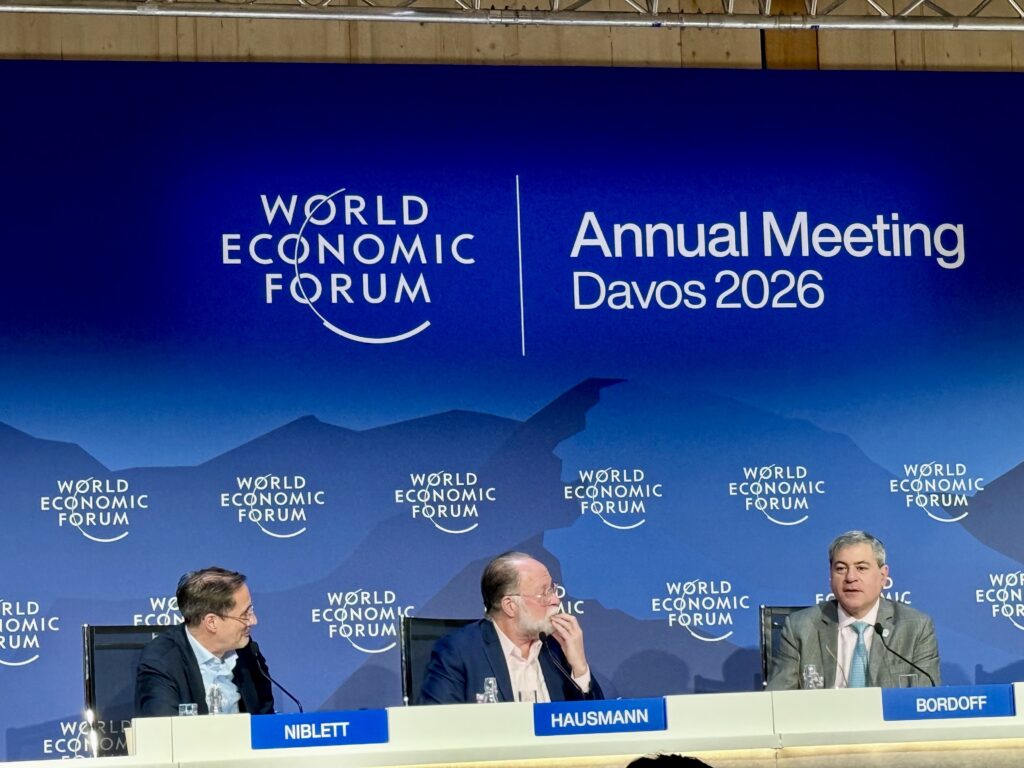
Similar anxieties surfaced during a panel I joined on Venezuela’s future (below) and its energy sector, where participants worried about U.S. control over Venezuelan oil exports. For deeper analysis, take a look at the tremendous work of my CGEP colleagues, including our latest analysis about the implications for Venezuela’s natural gas sector and the region.
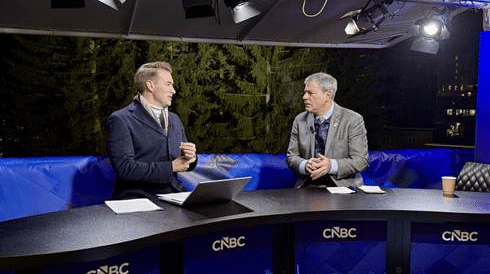
Despite the frigid mornings, I appreciated CNBC CNBC International Dan Murphy (below) having me on to talk about how countries are increasingly weaponizing energy to protect themselves amid heightened global tensions, and what this shift means for markets, policy, and international cooperation.
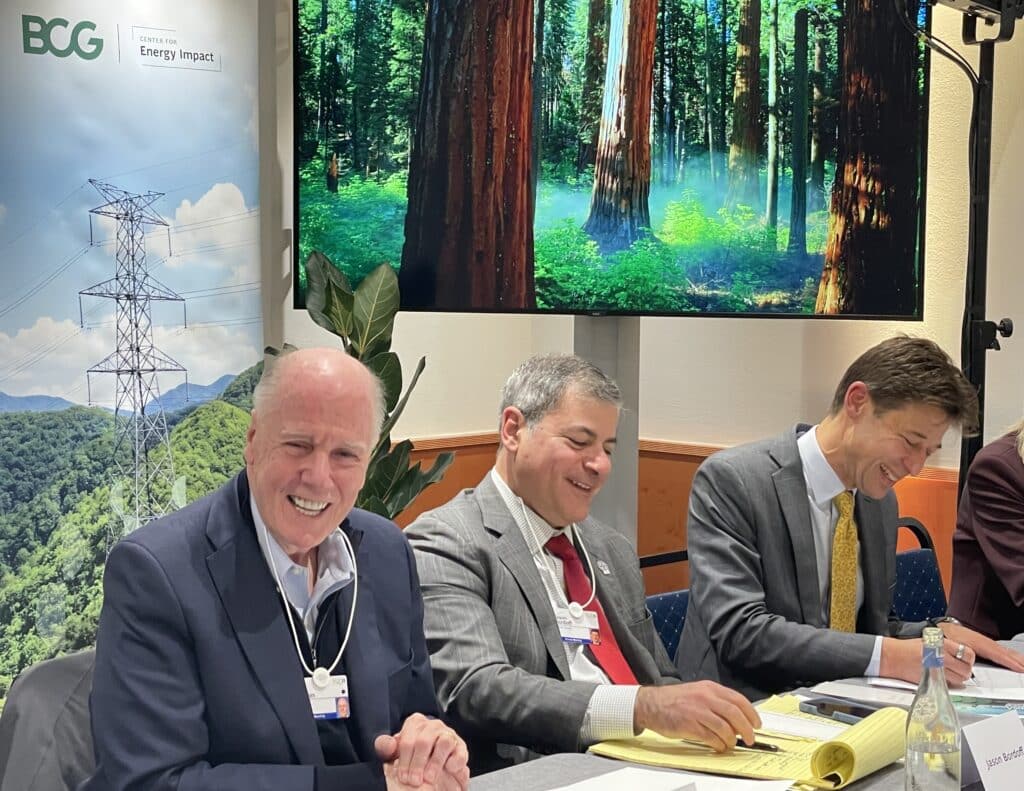
Energy geopolitics in a fragmenting world, including recent developments in Venezuela and Iran, also featured prominently in CGEP’s annual Davos roundtable with Boston Consulting Group (BCG)‘s Center for Energy Impact (below). I am grateful to Maurice Berns for his collaboration—and this excellent summary of the discussion.
AI and the Age of Electrification
Rising energy security concerns may also accelerate electrification of energy systems. As Meghan and I wrote in Foreign Affairs, for countries seeking to curb energy trade and produce more at home, particularly large oil and gas importers, a push for energy security will create more incentive to electrify energy use, and then produce that electricity from domestic sources such as solar, wind, nuclear, geothermal, or, in some cases, coal.
This dynamic compounds other drivers of electricity demand, notably the rapid growth of data centers powering the AI revolution—a central theme of Davos discussions and panels that I joined, including one (below) with fellow CGEP colleague Ann Mettler.
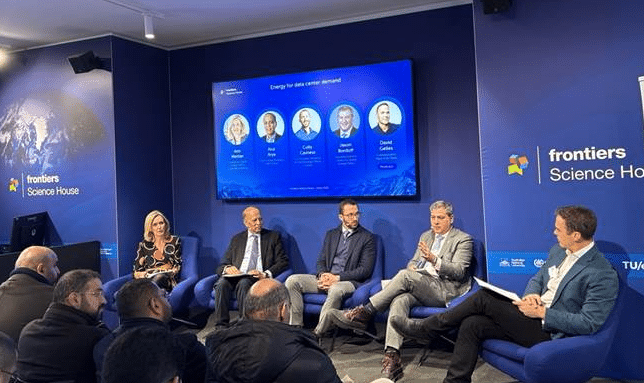
On a panel (below) with The Economist, moderated by Vijay Vaitheeswaran AES Energy Writer of the Year, I discussed how geopolitics could complicate efforts to meet rising power needs of AI, but also how AI can accelerate clean energy deployment, as I wrote about recently with CGEP’s Jack Andreasen Cavanaugh in Foreign Policy, and as CGEP’s David Sandalow has written about extensively.

While AI gets most of the attention, the story is a relatively narrow one viewed from a global perspective, as more than 80 percent of power demand growth for AI to 2030 is projected to come from the U.S. and China, according to the IEA.
As IEA Executive Director Fatih Birol emphasized repeatedly, we are entering an age of electrification, with electricity demand growing three times faster than overall energy demand. Globally, air conditioning, transport electrification, and industrial uses are projected to contribute more to power demand growth to 2030 than will data centers.
Heightened energy security concerns are likely to reinforce this trend. They may also bolster efforts to develop markets for clean fuels, a topic explored on a CEO panel I moderated. Fuels still account for more than half of the world’s energy use, and while electrification is essential for decarbonization, molecules will remain indispensable for sectors such as aviation, shipping, and heavy industry.
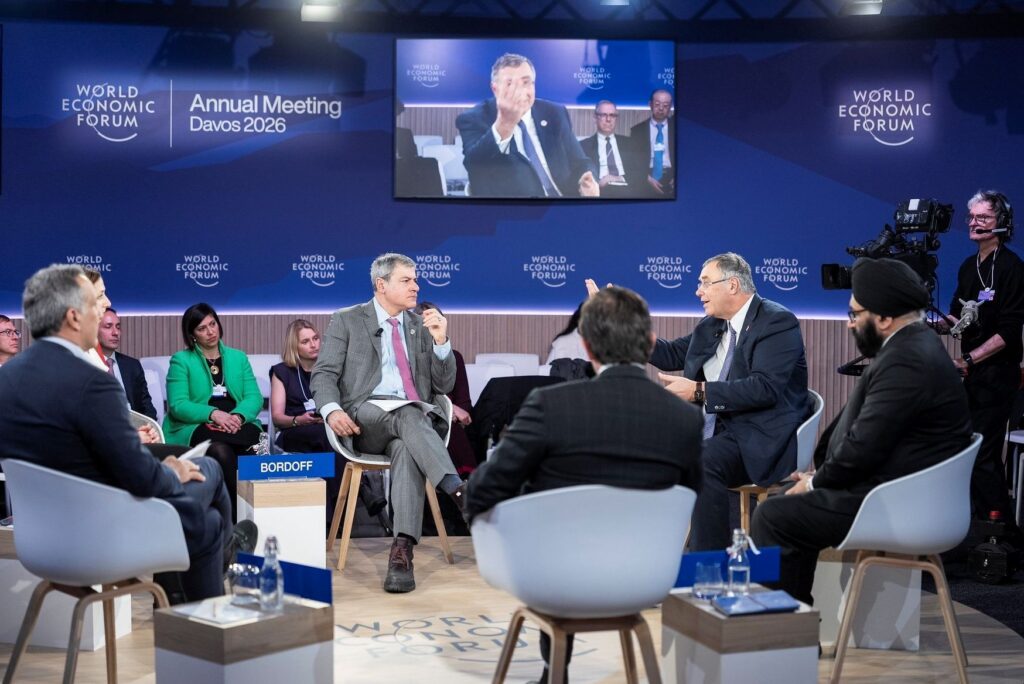
TotalEnergies CEO Patrick Pouyanné (session pictured below) noted the limited willingness to pay a green premium amid affordability concerns, constraining clean fuel adoption. Yet panelists, particularly from emerging markets such as India and Latin America, suggested that a desire to reduce oil imports in a riskier geopolitical environment may strengthen government support domestically produced clean fuels.
The Hard Path
Finally, I was left several times this week thinking about Amory Lovins’ seminal Foreign Affairs article, “Energy Strategy: The Road Not Taken?,” published exactly 50 years ago. In the wake of the 1973 oil crisis, Lovins beseeched energy leaders to take the “soft path” to meet the world’s energy needs—conservation, efficiency, and renewable energy—rather than the “hard path” of massive projects for mining, extraction, and industrial facilities. Many contemporary energy debates seem to overlook that advice.
Discussions of critical mineral security, for example, focused heavily on ways to chip away at China’s dominance: China mines roughly 70% of global rare earth ore and 79% of natural graphite, and is the leading refiner for 19 of the 20 key energy minerals, holding an average market share of around 70% according to the IEA.
Proposed solutions emphasized expanding mining in Africa and Latin America through faster permitting, public financing to de-risk investment, and guaranteed offtake agreements to provide demand certainty.
To be clear, more mining will be necessary. But it’s unmistakably a hard path. That reality was underscored during my recent visit to the Chile’s Chuquicamata copper mine—an open-pit mine so vast that Central Park could fit inside it, plunging deeper than two and a half Empire State Buildings. A few years ago, it was then converted into an underground operation with a vast grid system so that trucks with tires taller than I am can move the crushed rocks.
Yet there are soft path options, as well. As I wrote in Foreign Policy with Brian Deese, curbing demand for critical minerals—through innovations in battery chemistry, fast-charging, and recycling—can materially ease the challenge. Strategic stockpiles can help manage temporary disruptions, as my CGEP colleague Tom Moerenhout has explored. And deeper, more transparent commodity markets—often opaque and illiquid today—can allow market forces reallocate supplies in event of supply shocks, as Meghan and explained in Foreign Affairs three years ago.
These approaches are especially important given the scale of China’s lead in mineral refining, which is unlikely to be meaningfully eroded in the near term even with Herculean policy efforts. Even if China’s market share fell from 70 or 80 percent to 50 or 60 percent—an immense achievement—it would remain dominant. Policies that manage and de‑risk dependence, rather than simply seek to eliminate it, deserve greater attention.
A similar blind spot appeared in discussions of AI‑driven power demand. Panels focused overwhelmingly on building new generation—gas plants, renewables, nuclear—while largely ignoring demand‑side flexibility. On a typical day, the United States uses only about half of its installed generation capacity; the grid is built to meet the extreme peaks that occur for a handful of hours each year.
If data centers can flex demand during those peaks, or if improving storage technologies can shift supply more effectively, the scale of new infrastructure required could be significantly reduced.
Indeed, Energy Secretary Chris Wright acknowledged this opportunity in his recent request to FERC to issue a proposed rule that would expedite grid interconnections for large loads, particularly if they agree to be flexible with their consumption or generation.
To be sure, substantial new generation will still be required. But recalling Lovins’ soft path can meaningfully reduce the scale, cost, and disruption of the hard one.
Energy security is no longer merely an economic concern; it is a geopolitical one. In an era of intensifying competition, geopolitical strain, and rapid technological change, the need for impartial forums for dialogue has never been greater. I was grateful to participate in those conversations at Davos—and even more energized by the work the exceptional team at the Center on Global Energy Policy will undertake in 2026 to address the energy challenges of this new age of geopolitical fragmentation.
The Center on Global Energy Policy (CGEP) at Columbia University SIPA today released a new report examining Project-based Carbon Credit Markets (PCCMs) in G20 countries and Singapore. A...

The Center on Global Energy Policy is providing live updates on key developments related to the Iran crisis. Check back here for the latest.
El Consejo Mexicano de Asuntos Internacionales (COMEXI) y la Unidad de Estudio y Reflexión sobre Energía y Sustentabilidad, presentan el análisis: “Posición en materia de energía y sustentabilidad en la revisión del T-MEC" El documento analiza cómo México puede aprovechar este proceso para fortalecer la integración energética de América del
The UNFCCC process is marred by gridlock in the COP multilateral framework, threatening joint efforts by countries to mitigate the climate crisis.