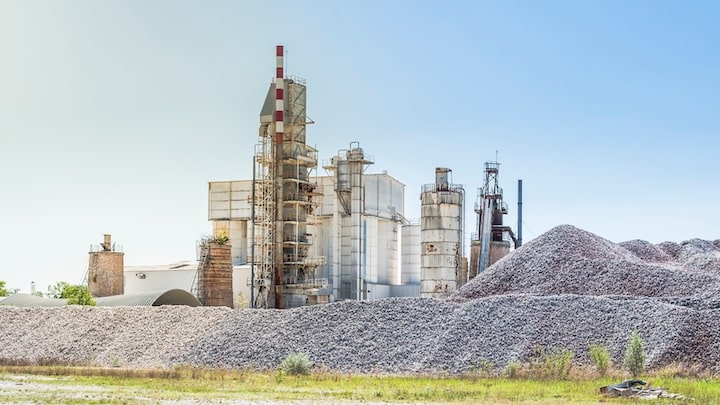
Venezuela : “Au-delà du pétrole, les minerais pourraient être un intérêt pour tout le monde”
Après la capture de Nicolas Maduro, Donald Trump lorgne sur les réserves pétrolières du pays. L'experte Luisa Palacios analyse les (vraies) perspectives ...
Current Access Level “I” – ID Only: CUID holders, alumni, and approved guests only
Get the latest as our experts share their insights on global energy policy.
Early on 3 January 2026, the United States launched a military operation to arrest President Nicolás Maduro and remove him from Venezuela.
Hear in-depth conversations with the world’s top energy and climate leaders from government, business, academia, and civil society.
Early on January 3, 2026, the United States apprehended Venezuelan President Nicolás Maduro and his wife and removed Maduro from power. Maduro was transported to New York, where he now faces federal charges of narco-terrorism and drug trafficking.

Find out more about our upcoming and past events.
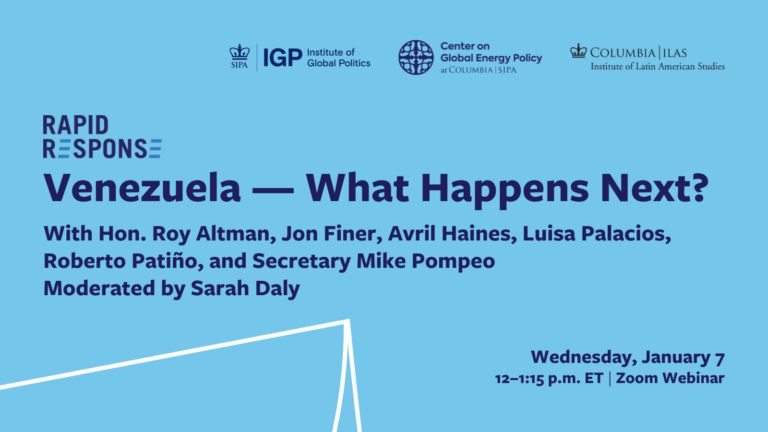
The recent military operation to remove Venezuelan President Nicolás Maduro and First Lady Cilia Flores raises several implications for the future of Venezuela and Latin America, geopolitics, and...
Past Event
October 4, 2021
12:00 pm - 1:30 pm
Building energy infrastructure can be a time-consuming and costly process. As an alternative, researchers and engineers have looked into ways to adjust and adapt existing infrastructure to help minimize costs and help accelerate the speed of the transition, which is urgently necessary to address the threat of climate change. The existing pipeline system is a potential stranded asset that risks locking us in a fossil fuel future. But is there a way to upgrade the system to offer a lower-cost means to transport low-carbon fuels that models show will be needed to achieve net-zero? This event will explore whether in the same way that the electric grid allows for increasingly low-carbon electrons to be transported, it may be possible for the natural gas grid to enable increasingly low-carbon molecules to be transported.
The Center on Global Energy Policy recently convened a panel of experts to examine energy infrastructure more broadly both within and outside the United States to identify niches around the globe where one can utilize existing energy systems to facilitate a net-zero future. Our panelists discussed ways to improve the environmental performance of energy systems around the world to make them more compatible with a decarbonizing future and where investments in these systems should be directed and how to address the real risks of fossil fuel lock-in.
Moderator:
Panelists:
—
The recent military operation to remove Venezuelan President Nicolás Maduro and First Lady Cilia Flores raises several implications for the future of Venezuela and Latin America, geopolitics, and...
On October 22, the United States Department of the Treasury announced the imposition of sanctions on Russia’s two largest oil companies, Rosneft and Lukoil, as a penalty for what it characterized as a lack of Russian commitment to ending the war in Ukraine.

*Registration is closed for this event. The Center on Global Energy Policy at Columbia University SIPA's Women in Energy initiative, in collaboration with the Columbia Policy Institute, invites...

The Center on Global Energy Policy at Columbia SIPA is pleased to host Dr. Catie Hausman, Visiting Faculty Member at CGEP and Associate professor at the Gerald R....

CGEP scholars reflect on some of the standout issues of the day during this year's Climate Week

Amid plans to nearly double its steel production capacity by 2030 to serve its growing infrastructure needs, the world’s No. 2 steel producer India has released plans to reduce greenhouse gases from the sector, which account for about 10 percent of the nation’s total emissions.

This report explores financial policy instruments that can make first-of-a-kind (FOAK) near-zero emission industrial facilities viable.