This website uses cookies as well as similar tools and technologies to understand visitors’ experiences. By continuing to use this website, you consent to Columbia University’s usage of cookies and similar technologies, in accordance with the Columbia University Website Cookie Notice.
In the 23 days since the US and Iran agreed to a ceasefire, strikes have returned, following a familiar pattern: Iran attacks vessels using an internationally backed sea...
We are the premier hub and policy institution for global energy thought leadership. Energy impacts every element of our lives, and our trusted fact-based research informs the decisions that affect all of us.
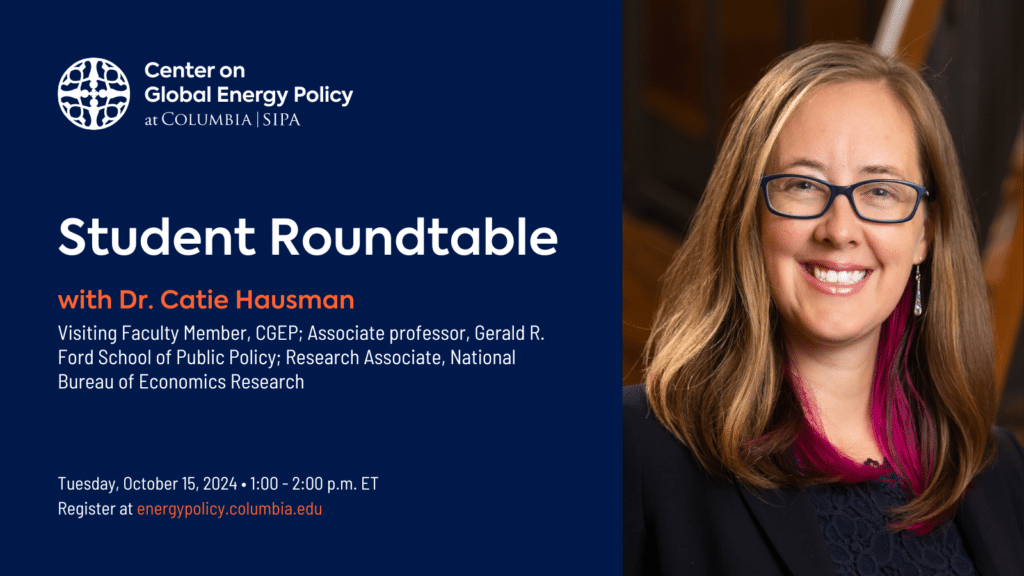
The Center on Global Energy Policy at Columbia SIPA is pleased to host Dr. Catie Hausman, Visiting Faculty Member at CGEP and Associate professor at the Gerald R. Ford School of Public Policy and a Research Associate at the National Bureau of Economics Research. Hausman will discuss how transmission network improvements can accelerate renewables deployment. She will present her research on the barriers to transmission build-out, and what this means for decarbonization.
Registration is required. This roundtable is open only to currently enrolled Columbia University students. To register, you must use the email address that contains your UNI.
This event will be hosted in person, and capacity is limited. We ask that you register only if you can attend this event in its entirety.
For more information about the event, please contact [email protected].
Share
Related
More Events
February 16, 2026 - February 18, 2026
• 1:00 pm - 2:00 pm
est
The Columbia Global Energy Summit 2026 is an annual event dedicated to thought-provoking discussions around the critical energy and climate challenges facing the global community.
On October 22, the United States Department of the Treasury announced the imposition of sanctions on Russia’s two largest oil companies, Rosneft and Lukoil, as a penalty for what it characterized as a lack of Russian commitment to ending the war in Ukraine.
*Registration is closed for this event. The Center on Global Energy Policy at Columbia University SIPA's Women in Energy initiative, in collaboration with the Columbia Policy Institute, invites...
Event
• International Affairs Building,
Columbia SIPA
Project-based carbon credit markets (PCCMs) facilitate the generation, trading, and retirement of carbon credits from projects that remove, reduce, or avoid greenhouse gas emissions.
The World Bank is revisiting one of its most entrenched positions, publicly questioning its long-standing emphasis on market-led approaches in economic policy.