Current Access Level “I” – ID Only: CUID holders, alumni, and approved guests only
Read more about the campus status level system and campus access information.
This website uses cookies as well as similar tools and technologies to understand visitors’ experiences. By continuing to use this website, you consent to Columbia University’s usage of cookies and similar technologies, in accordance with the Columbia University Website Cookie Notice.
On February 28, the United States and Israel launched a campaign against Iran targeting military infrastructure and the regime's core leadership. Supreme Leader Ayatollah Ali Khamenei and several...
Join us for an in-person event exploring careers and opportunities in the rapidly evolving electric vehicle and sustainable transportation ecosystem.
Event
• International Affairs Building, 15th Floor
Columbia University
About Us
We are the premier hub and policy institution for global energy thought leadership. Energy impacts every element of our lives, and our trusted fact-based research informs the decisions that affect all of us.
This Energy Explained post represents the research and views of the author(s). It does not necessarily represent the views of the Center on Global Energy Policy. The piece may be subject to further revision.
Contributions to SIPA for the benefit of CGEP are general use gifts, which gives the Center discretion in how it allocates these funds. More information is available here. Rare cases of sponsored projects are clearly indicated.
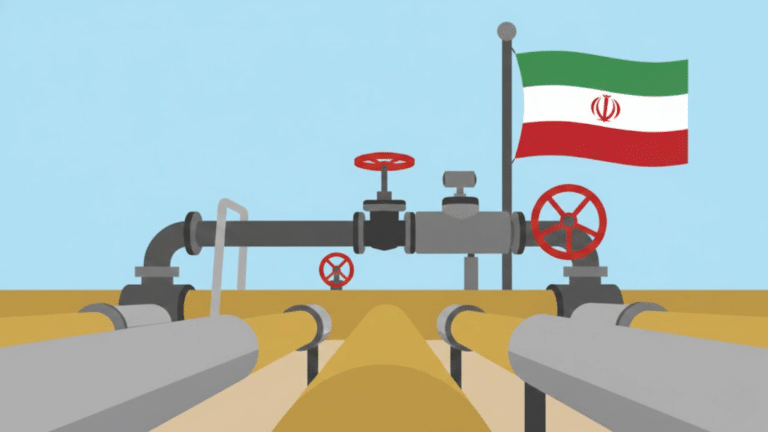
Iran appears to be a natural gas giant, due to its large proved gas reserves and significant gas production and consumption.
However, this apparent abundance masks deep structural constraints: years of sanctions have hampered Iran’s ability to increase supply to meet both growing domestic gas demand and export commitments.
As a result, Iran exports gas by pipeline to several neighboring countries but is often regarded as an unreliable supplier because exports are repeatedly curtailed during periods of domestic stress. Sanctions could also result in current importers having to stop imports.
Demonstrations began across multiple Iranian cities in late December, triggered by a deepening economic crisis and threatening the rule of the Islamic regime. Thousands of protesters have been killed. President Donald Trump threatened military intervention just days after the United States arrested Venezuelan President Nicolás Maduro and removed him from power. While both situations can hardly be compared, as far as energy concerns go, Iran is a much larger gas producer than Venezuela—nine times larger—and unlike Venezuela, it also exports gas.
In this Q&A, CGEP Global Research Scholar Anne-Sophie Corbeau and Global Fellow Dr. Tatiana Mitrova analyze the current gas situation in Iran. While Iran appears to be a natural gas giant, its ability to increase supply has been hampered by years of sanctions. The country exports to several neighboring countries but is often regarded as an unreliable supplier.
How large is Iran’s gas resource base?
At first sight, Iran appears to be a gas giant. Its proved gas reserves amount to 34 trillion cubic meters (tcm) as of 2024, ranking second globally after Russia (47 tcm). Iran’s gas production—exceeded only by the United States and Russia—reached 263 billion cubic meters (bcm) in 2024, having increased at an average rate of 4.1 percent per annum over the past decade. Iran shares the world’s largest gas field (South Pars/North Field) with Qatar; however, unlike Qatar, its gas resources are also distributed across several other fields but without a comparable export-oriented development model.
Iran is also the fourth largest gas consumer globally—behind the US, Russia, and China. In contrast to other Middle Eastern countries, Iran’s consumption includes a sizeable residential component due to Iran’s cold climate and extensive price subsidies, which limit demand responsiveness during peak winter periods.
The country is located between Asia and Europe, and supplies pipeline gas to several countries: Turkey since 2001, Armenia since 2009, and Iraq since 2017. It is also involved in several gas swap arrangements, one involving the Azeri enclave of Nakhchivan and another two swaps from Turkmenistan with deliveries for Turkey and Azerbaijan.
If Iran has such vast gas resources, what constrains its ability to expand gas supply and exports?
While Iranian gas production has been increasing, the pace of growth has slowed in recent years, falling to 2.7 percent per annum since 2021. This is largely due to the impact of sanctions, which have constrained access to compression equipment, pressure maintenance, and enhanced recovery technologies. As a consequence, Iran has awarded $17 billion of investment contracts in early 2025 to maintain gas production at the key South Pars field, which accounts for around 80 percent of Iran’s total gas production. It is uncertain whether the country has the technological capability to pursue such investments, while others estimate that the investments needed to sustain output would be at least twice as large.
As noted, the country shares the South Pars field with Qatar, but production volumes and the ability to increase production have diverged sharply between the two countries, reflecting differences in access to capital, technology, and export infrastructure rather than differences in resource endowment.
Meanwhile, Qatar is starting a new phase of liquified natural gas (LNG) expansion, a development that could further weaken Iran’s future gas production outlook if Iran is unable to sustain comparable investment in reservoir management (maintaining reservoir pressure and managing natural field decline).
Iran also concluded a deal with Russia in 2024 to import gas. Even though the initially reported volumes of about 110 bcm/y appear implausibly large and were later revised down to 55 bcm/y, the agreement nevertheless signals concerns about Iran’s potential production capacity and seasonal supply adequacy, particularly during winter demand peaks. There is no indication that any Russian gas is currently flowing, but preparations are underway: both parties have agreed on the route and are in the final stage of agreeing on contract prices.
Finally, Iran flared an estimated 20 bcm/y of gas in 2024, or around 8 percent of its gas output. In addition, a significant share of Iran’s gas production is required for reinjection to sustain oil output: Iran needs around 300 million cubic meters per day (mcm/d) of gas (or about 110 bcm/y) for reinjection to maintain reservoir pressure in aging oil fields. Actual reinjected volumes have been only 30–37 mcm/d (or about 11–14 bcm/y)—approximately 10–12 percent of estimated requirements in recent years. This further tightens the trade-off between maintaining oil output and expanding gas exports.
How reliable are Iran’s pipeline gas exports to neighboring countries?
Pipeline gas exports are weaker than their theoretical potential, and importers of Iranian gas could be impacted by the tariffs announced by President Trump in January 2026 for countries doing business with Iran.
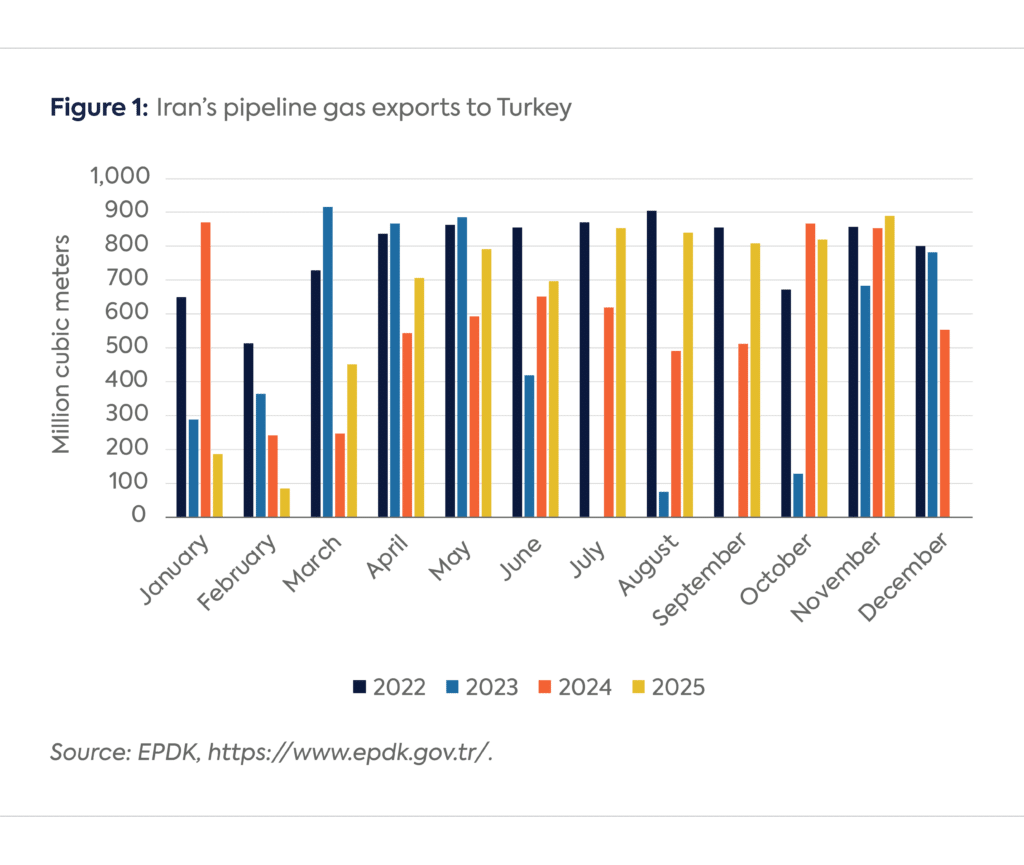
Iran has been exporting gas to Turkey under a 9.6 bcm/y contract, however, actual volumes delivered have often fallen below contracted quantities in recent years (Figure 1). Moreover, the contract is set to expire in July 2026; negotiations are ongoing, and Turkey is planning to seek a waiver from US sanctions.
Iran started exporting gas to Armenia under a gas-for-electricity exchange arrangement in 2009. Volumes were estimated at around 0.35 bcm/y, with plans to double them, although these volumes remain marginal in Iran’s overall gas balance. The agreement has been extended until 2030.
Can gas swaps and transit arrangements compensate for Iran’s domestic supply shortfall?
Another swap deal with Turkmenistan was agreed in 2021, under which 1.5 to 2 bcm/y was to be supplied to Azerbaijan starting on January 1, 2022. While volumes were broadly in line with contracted quantities in 2022 and 2023, deliveries declined in 2024 and fell to 0.23 bcm in the first 10 months of 2025.
A second swap deal with Turkmenistan began in 2025, whereby Turkey was to receive Turkmen gas annually from Iran via the existing Iran-Turkey gas pipeline. Meanwhile, Turkmen gas was delivered to northwestern Iran. Turkey started importing 1.3 bcm/y of Turkmen gas via Iran; however, the agreement appears to have only lasted from March to June 2025. Thereafter, flows were interrupted, possibly due to US and EU sanctions on Iran, highlighting the vulnerability of swap arrangements to geopolitical constraints, even though Turkey seems interested in resuming them in 2026, and at a higher level (2 bcm/y).
Finally, a plan for Iraq to import 10 bcm/y of Turkmen gas through Iran failed due to US opposition. Similarly, prospects for the long-discussed Iran-Pakistan-India pipeline have weakened amid low demand growth in Pakistan and persistent sanctions risks.
Overall, Iran’s gas sector is characterized by large resource potential but structurally constrained export capacity, making supply reliability highly sensitive to domestic demand pressures and geopolitical developments. This structural backdrop is essential for assessing how current political turmoil could affect regional and global gas markets.
Iran has among the world's largest natural gas resource bases, but its ability to supply regional and global markets is constrained by sanctions, underinvestment, and limited export infrastructure.