Current Access Level “I” – ID Only: CUID holders, alumni, and approved guests only
Read more about the campus status level system and campus access information.
This website uses cookies as well as similar tools and technologies to understand visitors’ experiences. By continuing to use this website, you consent to Columbia University’s usage of cookies and similar technologies, in accordance with the Columbia University Website Cookie Notice.
Today we greatly enjoyed hosting Dr. Tatiana Mitrova, Global Fellow at the Center on Global Energy Policy, Director of the New Energy Advancement Hub, and Senior Research Fellow at the Oxford Institute for Energy Studies.
While US and Israeli forces have significantly degraded Iran’s military and nuclear capability, the global energy landscape remains in a precarious position. For weeks, the Strait of Hormuz...
This roundtable is open only to currently enrolled Columbia University students. To register, you must sign in with your UNI. Join the Center on Global Energy Policy’s Women...
Event
• Center on Global Energy Policy
1255 Amsterdam Ave, New York, NY 10027
About Us
We are the premier hub and policy institution for global energy thought leadership. Energy impacts every element of our lives, and our trusted fact-based research informs the decisions that affect all of us.
Center on Global Energy Policy Announces New Personnel, Including Managing Director for International Programs at the Center’s Energy Opportunity Lab
January 20, 2026
Share
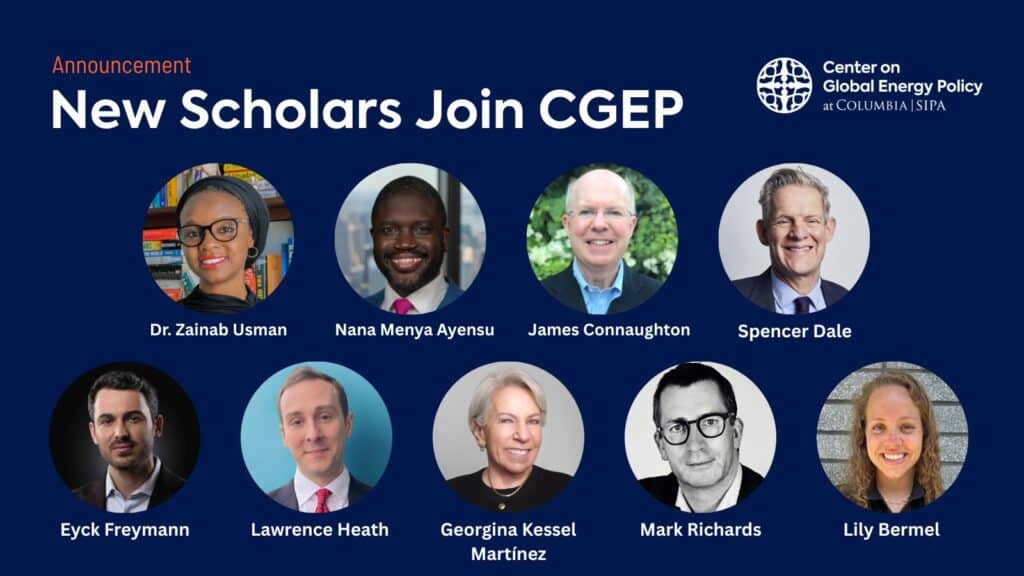
The Center on Global Energy Policy (CGEP) at Columbia University SIPA today announced that Dr. Zainab Usman has joined as senior research scholar and managing director for international programs at the Center’s Energy Opportunity Lab, where she will oversee work on energy for development in emerging markets, and contribute to the Center’s efforts in critical minerals, financial structures, and trade policy research. Usman previously served as a senior fellow and founding director of the Africa Program at the Carnegie Endowment for International Peace in Washington, DC.
CGEP also announced a new slate of non-resident fellows who will expand the Center’s expertise in regulatory policy and permitting reform, the global energy economy, critical minerals, and the complex geopolitical global landscape of today.
“Low- and middle-income countries need vast amounts of energy to improve people’s well-being and prosperity, and designing policy solutions to meet those needs is a core focus of CGEP’s Energy Opportunity Lab,” said Jason Bordoff, Founding Director of CGEP. “We are thrilled to welcome Dr. Zainab Usman to lead the international programs of EOL here at the Center. We look forward to Zainab’s leadership and scholarship working with our team to develop reliable, affordable, and sustainable energy systems, supply chains for critical minerals, and effective financial structures.”
CGEP Research Team:
Dr. Zainab Usman, Senior Research Scholar and Managing Director of International Programs at the Energy Opportunity Lab
Dr. Zainab Usman previously served as founding director of the Africa Program at the Carnegie Endowment for International Peace in Washington, DC. She has also served as a public sector specialist at the World Bank, where she worked on energy policy reforms, social sustainability, natural resource governance, and digital technologies. Dr. Usman has advised governments and development partners in Côte d’Ivoire, Morocco, Nigeria, Papua New Guinea, the Republic of Congo, Serbia, Tanzania, the United States, and Uzbekistan. She is the author of Economic Diversification in Nigeria: The Politics of Building a Post-Oil Economy, selected by the Financial Times as one of the Best Economics Books of 2022. Dr. Usman is the founding principal and chief executive officer of Elem Analytics and Advisory Group, a boutique data analytics firm. She serves on the boards of BRAC Global in Bangladesh, the Natural Resources Governance Institute in New York, and the Aig-Imoukhuede Foundation in Nigeria. She holds a DPhil (PhD) from the University of Oxford, an MSc from the University of Birmingham, and a BSc from Ahmadu Bello University.
Nana Menya Ayensu is an energy infrastructure investor and technology commercialization executive with more than fifteen years of experience delivering new energy solutions in the US and globally. He served at the White House as Special Assistant to the President on Climate Policy, Finance, and Innovation, where he led a suite of activities to accelerate the deployment of modern, clean, affordable, and resilient power systems, in the US, Africa, and Europe. Prior to that, Nana was a Partner at Sidewalk Infrastructure Partners, where he built and invested in first-of-a-kind technology-enabled infrastructure platforms, such as grid-edge flexible data centers. He also spent nine years at GE. Nana has an SB (Hons) in mechanical engineering from Harvard University and a MS in materials science and engineering from Stanford University.
James Connaughton is CEO of JLC Strategies, a sustainable technology innovation and public policy advisory firm. From 2016-2024, he was Chairman and CEO of Nautilus Data Technologies. He has also worked as Executive Vice President of C3.ai and Executive Vice President of Constellation Energy, which merged with Exelon, becoming one of the largest and cleanest US suppliers of electricity, natural gas, and energy services. In 2001, the US Senate unanimously confirmed Connaughton as Chairman of the White House Council on Environmental Quality. He served as President George W. Bush’s senior advisor on energy, environment, and natural resources, and as Director of the White House Office of Environmental Policy. He is a member of the Board of Directors of Synova, an Operating Partner of Commonweal Ventures, and Senior Advisor to Applied Materials, X (Google’s Moonshot Factory), Shine Fusion Technologies, and GSF Upcycling. He is also a Senior Advisor to the ClearPath Foundation; Senior Fellow of the Columbia Global Center on Environmental Policy; Co-Chair of the Aspen Institute Energy Policy Forum; Co-Chair of the Climate Leadership Council’s Center on Climate and Trade; member of the Board of Directors at Resources for the Future and the American Conservation Coalition; and a member of the Advisory Board at the National Renewable Energy Laboratory and at Yale’s Center on Environmental Law and Policy.
Until the end of 2025, Spencer Dale was bp’s Chief Economist and senior vice president economic and energy insights. Dale managed bp’s Economics and Energy Insights Team, which produces bp’s Energy Outlook. Prior to his time with bp, Dale was the Executive Director for Financial Stability at the Bank of England and a member of the Financial Policy Committee. Between 2008 and 2014, he served as Chief Economist of the Bank of England and a member of the Monetary Policy Committee. Dale joined the Bank of England in 1989 and served in numerous roles, including Private Secretary to Mervyn King and head of economic forecasting. He served as a Senior Advisor at the US Federal Reserve Board of Governors between 2006 and 2008. He was educated at the University of Wales, gaining a BSc in Economics in 1988 and at the University of Warwick, gaining an MSc in Economics in 1989, whereupon he immediately joined the Bank of England.
Eyck Freymann is a Hoover Fellow at Stanford University, where he directs the Allied Coordination Working Group. He is also a Non-Resident Research Fellow at the US Naval War College, China Maritime Studies Institute. He is the author of several books, including The Arsenal of Democracy: Technology, Industry, and Deterrence in an Age of Hard Choices (Hoover, 2025), with Harry Halem, and One Belt One Road: Chinese Power Meets the World (Harvard, 2021). Earlier in his career, Freymann held postdoctoral fellowships at Harvard and Columbia. He holds a doctorate from Oxford, master’s degrees from Cambridge and Harvard, and a bachelor’s from Harvard, all in history and China studies.
Lawrence Heath is an Associate Partner at McKinsey & Company within the Global Energy Practice. He focuses primarily on the electric power sector and the role of AI in energy, and leads the central geopolitics team supporting clients on strategic questions at the intersection of politics and business. Beyond McKinsey, Lawrence worked with former UK Prime Minister Tony Blair at Tony Blair Associates, where he advised political leaders and G20 presidencies on energy policy. He began his career building geopolitical wargames for oil majors. Lawrence holds degrees in Economics and International Relations, with concentrations in political economy and Chinese. He is a member of the Chicago Council on Global Affairs energy roundtable.
Georgina Kessel is an economist with extensive experience in energy and development, specializing in regulatory institutions, infrastructure policy, and market design. Her work focuses on the interaction between energy markets, economic development, and institutional frameworks in emerging economies. Kessel previously served as Mexico’s Secretary of Energy, where she was responsible for national energy policy during a period of structural challenges and rising demand. Earlier in her career, she was the first president of the Energy Regulatory Commission (CRE), establishing regulatory frameworks for the electricity market. She also held senior positions at the Ministry of Finance and the Ministry of Energy, focusing on economic analysis and the evaluation of large-scale energy investment projects. Kessel has served on the boards of major energy, mining, and financial institutions, including Iberdrola, Fresnillo, and Scotiabank Inverlat, and currently serves as Chair of Scotiabank Inverlat.
Mark Richards most recently led International Affairs and Strategy for Rio Tinto’s Battery Materials business, as well as shaping the company’s strategy and global positioning for its broader critical minerals interests and investments. He previously headed Rio Tinto’s global external affairs function, overseeing political and economic risk management across multiple regions and product groups. He is currently a member of the International Energy Agency’s Expert Advisory Group. He has also served on the Kingdom of Saudi Arabia’s Critical Minerals Framework Coordination Group and the UK Government’s Task & Finish Group on Industry Resilience for Critical Minerals. Richards also previously worked for Australia’s Minister of Resources, Energy, and the Environment and authored Australia’s first critical minerals prospectus.
Lily Bermel is a consultant with climate philanthropies, working to advance international clean industrial strategy through economic statecraft and trade. Previously, Lily worked for Brian Deese at MIT Sloan’s Center for Energy and Environmental Policy Research. There, she researched investment in clean energy technologies with the Clean Investment Monitor, contributed to the design of the Clean Energy Marshall Plan, and developed other proposals on trade policy, multilateral finance, and electricity market reform. As Deese’s speechwriter, their work and proposals have been published in Foreign Affairs, The Washington Post, The Wall Street Journal, The Atlantic, and the Financial Times. Before joining MIT, Lily served for three years as a policy advisor on the US State Department climate team, led by Special Presidential Envoy for Climate John Kerry. She negotiated on behalf of the United States in multilateral fora, strengthened institutional capacity to work on climate policy, drove private sector engagement, and advanced initiatives to mitigate non-CO2 gases. Earlier, she contributed to Massachusetts climate policy at the state and local levels. Lily received a BS in Environment and Sustainability from Cornell University.
Today we greatly enjoyed hosting Dr. Tatiana Mitrova, Global Fellow at the Center on Global Energy Policy, Director of the New Energy Advancement Hub, and Senior Research Fellow at the Oxford Institute for Energy Studies.
AUDIO Gaz et pétrole, quand la planète s’affole, épisode : Europe, l’impossible autonomie énergétique. Une série inédite proposée par France Culture. Écoutez Europe, l’impossible autonomie énergétique, et découvrez nos podcasts en ligne.
President Donald Trump has been pressuring U.S. oil and gas executives to invest in Venezuelaâs energy sector, nearly three months after the toppling of former president Nicolás Maduro, as the country is said to have the largest crude oil reserves in the world.